

If SEO feels confusing in 2026, it isn’t because ranking factors are secret.
It is because too many people confuse noise with signals.
After 18 years in the SEO industry, I have learned that most ranking drops don’t happen because Google changed “everything” overnight.
They happen because attention drifted toward the wrong things. We stop optimizing for the user and start optimizing for the panic of the week.
This article separates what actually moves rankings from what simply makes headlines.
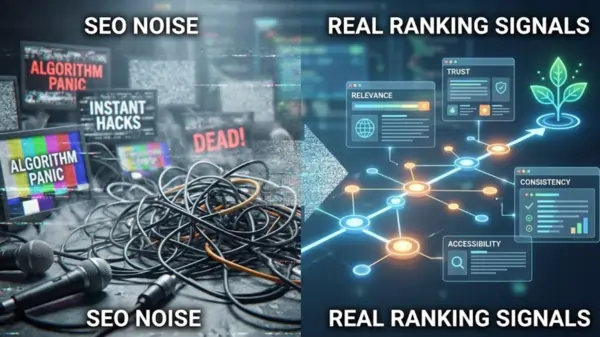
Table of Contents
What SEO Noise Looks Like
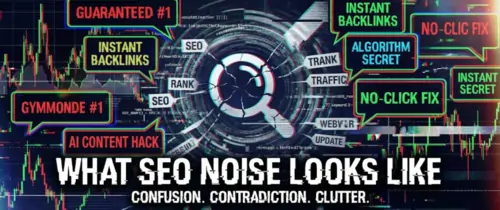
SEO noise is information that sounds urgent, triggers fear, but rarely changes long-term outcomes. It is the clickbait of the marketing world.
Common examples of noise you likely see in your feed:
- “This new update changes SEO forever.”
- “Keywords no longer matter in the age of AI.”
- “One technical mistake will destroy your entire site.”
- “You must post 10 times a day to beat the algorithm.”
The Cycle of Destruction
Noise creates reaction. Reaction breaks consistency. And broken consistency destroys trust.
When you pivot your strategy every time a headline scares you, you never build the momentum required to rank. Most of these claims come from partial data or isolated case studies—something Google explicitly warns against: 👉 Google Search Central: How Search Works
SEO Noise vs. Real Ranking Signals
Here is the simplest mental model to use in 2026:
Noise talks loudly. Signals stay consistent.
Real ranking signals do not change dramatically every few months. They evolve, but they do not disappear. Whether we are talking about the “Ten Blue Links” of 2010 or the AI Overviews of 2026, search engines still rely on signals to answer three core questions:
- Accessibility: Can I find and read this page?
- Utility: Does this content actually solve the user’s problem?
- Authority: Has this source proven itself trustworthy over time?
Everything else is secondary.
Real Ranking Signals That Still Matter in 2026
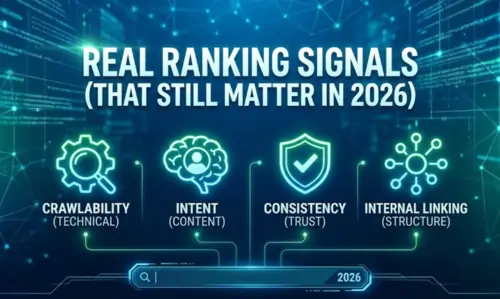
Despite the rise of AI agents and complex SERP features, these four signals remain the bedrock of performance.
1. Crawlability and Accessibility (The Technical Signal)
If search engines (and now AI bots) cannot access your content the same way users do, nothing else matters. You cannot rank what you cannot read.
The Signal:
- Clean, parseable HTML structure.
- No blocked critical resources (CSS/JS).
- A logical robots.txt file that allows access.
This hasn’t changed in over a decade. In fact, with AI crawlers needing to “read” content faster, clean code is more valuable than ever. 👉 Google SEO Starter Guide
2. Content That Satisfies Intent (The Relevance Signal)
Ranking is not about matching keywords to a page. It is about matching a solution to a problem.
The Signal:
- Task Completion: Does the user find what they need and stop searching?
- Engagement: Do they stay to read, or do they bounce immediately?
- Depth: Does the content answer the “next question” they might have?
Helpful, experience-based content continues to outperform thin or AI-generated filler.
This is consistently backed by trusted industry data: 👉 Moz: The Beginner’s Guide to SEO
3. Consistency Over Time (The Trust Signal)
Trust is not an event; it is a habit. Search engines are risk-averse—they prefer to rank sites that show stability.
The Signal:
- Publishing at a regular cadence (not bursts).
- Updating old content to keep it accurate.
- Maintaining a specific topical focus (staying in your lane).
Sites that panic and change topics frequently are flagged as unstable. Sites that stay the course recover faster from updates.
4. Internal Linking and Context (The Structure Signal)
An isolated page is a weak page. Internal links are the “neural network” of your website.
The Signal:
- Links that connect related topics (Topical Clusters).
- Anchor text that explains what the next page is about.
- A clear hierarchy from Home -> Category -> Article.
This is why building clusters around a central idea works—and why your pillar post acts as an anchor for related content: 👉 SEO Was Never the Problem. The Noise Was.
Internal structure is a signal. Random content is noise.
What Search Engines Mostly Ignore (The Distractions)
On the other side of the equation, here is what rarely moves the needle on its own, despite what the gurus sell you:
- Keyword Stuffing: Repeating the phrase “Best SEO 2026” 20 times.
- Meta Keywords Tags: Ignored by Google for over a decade.
- Exact-Match Domains: Buying
best-cheap-shoes-2026.comis no longer a shortcut. - Chasing Every Trend: Jumping on TikTok SEO or Voice Search Optimization without fixing your website’s foundation first.
Semrush’s ongoing research consistently shows that sustainable SEO comes from structure and relevance, not gimmicks: 👉 Semrush: Ranking Factors Study
Why Noise Feels More Convincing Than Signals
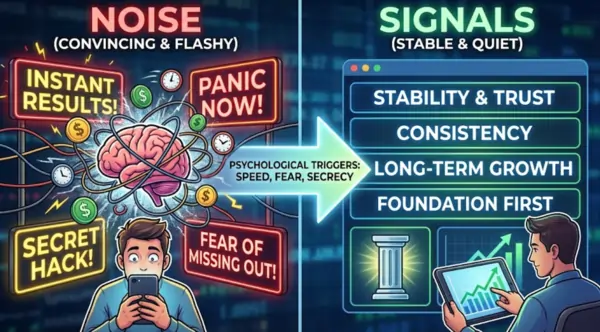
If signals work, why do we listen to noise? Because noise hits our psychological triggers:
- Speed: It promises fast results (“Rank #1 in 24 hours!”).
- Fear: It threatens loss (“Do this or die!”).
- Secrecy: It sounds exclusive (“The secret trick Google hides”).
Signals don’t sell excitement. They sell stability. And stability isn’t flashy—but it wins.
How to Filter SEO Noise in 2026

I use a simple rule to filter my feed.
If the advice:
- Requires constantly rebuilding your site…
- Contradicts basic logic or fundamentals…
- Promises instant recovery or massive growth… It is probably noise.
Real signals encourage:
- Refinement, not reinvention.
- Patience, not panic.
- Clarity, not complexity.
This mindset is critical for survival in the modern web.
I explore this further in the companion article: 👉 Why SEO Still Works in 2026 (If You Ignore the Noise)
Final Thought
SEO isn’t confusing because it is complicated. It is confusing because too many voices are speaking at once.
Once you separate the noise from the signals, SEO becomes predictable again. Search engines still reward Accessibility, Helpfulness, Consistency, and Trust.
Everything else is just background sound.
FAQ
What are real SEO ranking signals?
Real ranking signals are the foundational metrics search engines use to evaluate pages. The most enduring signals are technical crawlability, content relevance (intent), internal linking structure, and long-term domain trust.
What is SEO noise?
SEO noise refers to exaggerated, trendy, or misleading advice that creates urgency but has little impact on actual rankings. It often focuses on “hacks” rather than user experience.
Do ranking factors change every year?
The core principles (quality, trust, access) remain consistent. However, the technology used to evaluate them evolves. For example, Google is better at understanding natural language now, but the need for clear content hasn’t changed.
How can I tell if SEO advice is noise?
Ask yourself: Does this advice help the user, or is it just trying to trick the algorithm? If it feels like a trick, it is noise. If it builds a better website, it is a signal.
What matters most for SEO in 2026?
The most critical factors are clear user intent, helpful experience-based content, technical accessibility for AI crawlers, and consistency over time.







