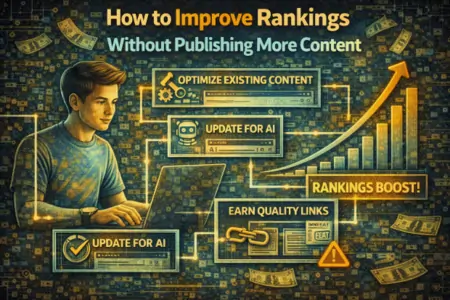
In 2026, publishing more content is not the automatic answer it used to be. For many sites, “more” becomes noise: more URLs to crawl, more overlap, more thin pages, more content decay to maintain.
That’s why I’ve learned How to Improve Rankings without defaulting to new posts every time performance dips. The truth is, most sites already have enough content to grow—they just don’t have enough structure, clarity, and maintenance.
This guide explains How to Improve Rankings without publishing more content by focusing on the highest ROI improvements you can make to pages that already exist. If you’re a beginner SEO specialist, this approach is especially useful because you can create measurable wins without needing a big content budget or a link-building campaign right away.
Why “Publishing More” Can Make Rankings Worse
Before you learn How to Improve Rankings, you need to understand what can block them.
Publishing more content often causes:
- cannibalization (multiple pages competing for the same intent)
- index bloat (low-value pages getting indexed)
- thin expansions (posts that add no new value)
- weaker internal linking (authority spread across too many pages)
- maintenance debt (outdated pages piling up)
If Google sees a site with inconsistent quality, it becomes more selective. So, the first step in How to Improve Rankings is learning when to stop creating and start optimizing.
Step 1: Find “Almost-Winners” in Google Search Console
The fastest way to learn How to Improve Rankings is to focus on pages that already have visibility.
In Google Search Console, look for:
- queries where you rank positions 4–15
- pages with high impressions but low clicks
- pages with rising impressions but flat CTR
These pages are already in the game. They don’t need new content. They need refinement. This is the core of How to Improve Rankings: harvest existing demand before you try to create new demand.
Step 2: Improve CTR First (Because Clicks Are the Signal You Control)
One of the most practical ways How to Improve Rankings works is by boosting CTR on pages already earning impressions. In 2026, ranking position and traffic aren’t perfectly linked anymore because SERP features take attention. That means your snippet needs to compete harder.
CTR upgrades include:
- rewriting titles to match intent (“checklist,” “step-by-step,” “best,” “vs”)
- adding specificity (“for beginners,” “for eCommerce,” “for PH sites”)
- removing generic wording (“ultimate,” “complete,” “everything you need”)
- strengthening meta descriptions with clear outcomes and inclusions
Even when rankings don’t move, clicks can increase—immediately improving results. And when clicks improve consistently, it can support long-term stability. This is why CTR work is part of How to Improve Rankings for nearly every site I touch.
Step 3: Refresh Existing Pages Instead of Publishing New Ones
Content decay is normal. Ignoring it is expensive.
A major reason people think they need new content is because old content quietly underperforms. One of the simplest methods in How to Improve Rankings is refreshing pages that already rank but are fading.
Choose refresh targets based on:
- pages losing clicks over the last 3–6 months
- pages with impressions but declining CTR
- pages where competitors now cover more subtopics
- pages with outdated examples or steps
Refresh actions:
- rewrite the introduction for faster answers
- improve headings for scannability
- add missing sections users expect
- update screenshots, tools, or 2026 references
- strengthen internal links into the page
Refreshing winners is one of the most reliable ways How to Improve Rankings works without adding new URLs.
Step 4: Fix Cannibalization Through Consolidation
If you want to learn How to Improve Rankings quickly, learn consolidation.
Cannibalization happens when multiple URLs target the same intent. Instead of ranking stronger, they split authority and confuse the SERP about which page should win.
Signs of cannibalization:
- multiple URLs rank for the same query cluster
- rankings swap between two pages every few weeks
- impressions are spread across similar posts
- none of the pages hold stable top positions
Fix it by:
- choosing one “primary” page
- merging the strongest parts from overlaps
- redirecting weaker pages to the primary URL
- updating internal links to point to the winner
Consolidation often creates immediate improvements because it concentrates relevance and authority. It’s a high-impact tactic in How to Improve Rankings without publishing more content.
Step 5: Strengthen Internal Linking to Push Authority Where It Matters
Internal linking is a major ranking lever in 2026. Learning How to Improve Rankings means treating internal links like an authority system—not a random afterthought.
What internal links do:
- tell Google which pages are important
- reinforce topical clusters
- improve crawl paths
- distribute authority from strong pages to priority pages
Quick internal linking wins:
- link from high-traffic posts into your priority pages
- create a pillar page that links to all supporting pages
- add contextual links where topics overlap naturally
- eliminate orphan pages (pages with no internal links)
This step is one of the most predictable ways How to Improve Rankings works because it improves site structure without needing external backlinks.
Step 6: Reduce Index Bloat So Google Focuses on Your Best Pages
Sometimes, the best way How to Improve Rankings works is by indexing less.
Low-value indexed pages can dilute perceived site quality and waste crawl budget. Common bloat sources include:
- tag and archive pages
- thin category pages
- internal search results
- parameter URLs (filters, tracking tags)
- near-duplicate posts
Actions that help:
- noindex thin archives
- canonicalize duplicates properly
- prune or merge low-value pages
- block crawl traps where necessary
A cleaner index makes it easier for Google to identify your strongest pages—and that helps How to Improve Rankings without writing anything new.
Step 7: Fix Technical Leaks That Hold Pages Back
Technical SEO doesn’t mean fixing everything. It means fixing what blocks performance. One of the more overlooked ways How to Improve Rankings works is by removing “leaks” that quietly waste authority.
High-impact fixes include:
- broken internal links
- redirect chains (A → B → C)
- canonical inconsistencies
- slow performance on key landing pages
- sitemap listing junk pages instead of priority pages
You can catch many of these using free tools and Search Console. Fixing them won’t always produce immediate jumps—but it prevents slow losses and protects your gains.
Step 8: Match the SERP Format Without Rewriting the Entire Article
Sometimes rankings slip because the SERP expects a different format.
A practical part of How to Improve Rankings is updating structure without rewriting everything:
- turn long paragraphs into steps
- add a summary box near the top
- insert a comparison table
- add a “quick answer” section
- address “people also ask” style questions with clear headings
This improves intent satisfaction, which is often the real reason pages fail to climb.
Step 9: Use the “Top 20 Upgrade” Method
If you want a beginner system for How to Improve Rankings, do this:
- In GSC, list your top 20 pages by impressions
- For each page, check:
- CTR (is it low?)
- freshness (is it outdated?)
- internal links (is it supported?)
- cannibalization (is it competing?)
- indexing (is it clean?)
- Make small improvements in batches
- Measure results after 28 days
This method is simple, repeatable, and it teaches you How to Improve Rankings through compounding optimization rather than endless publishing.
Step 10: Measure Properly (So You Don’t Panic)
When you practice How to Improve Rankings without new content, results often appear in this order:
- CTR improvements
- click gains
- ranking improvements
- impression growth
Track:
- clicks, impressions, and CTR per page
- query mix shifts
- average position trends over 28-day periods (not daily swings)
This protects you from overreacting to ranking volatility and helps you keep improving systematically.
Final Thoughts
If you want sustainable SEO growth in 2026, you need more than a publishing schedule—you need an optimization system.
The most effective way How to Improve Rankings works without publishing more content is by:
- upgrading CTR on high-impression pages
- refreshing decaying winners
- consolidating cannibalized URLs
- strengthening internal linking
- reducing index bloat
- fixing technical leaks
- aligning content structure with SERP expectations
When you apply these steps consistently, you’ll realize the truth: most sites don’t need more content to grow. They need better performance from what they already have.
That’s How to Improve Rankings the smart way—without burnout, without content overload, and without creating new maintenance debt.