

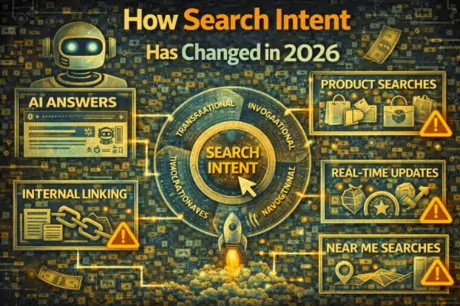
If you learned SEO a few years ago, you probably learned intent in a simple way: informational, navigational, transactional. That model still exists—but in 2026 it’s no longer enough to win consistently.
SERPs are more dynamic, AI Overviews reshape behavior, and Google is far better at interpreting what users actually want, not just what they typed. That’s why How Search Intent Has Changed in 2026 is one of the most important concepts beginners and experienced SEOs need to revisit.
This guide explains How Search Intent Has Changed in 2026 in practical terms, what the new intent patterns look like, and how to adjust your content and SEO workflows so your pages match what Google and users expect today.
Why Intent Is the Center of Modern SEO
In 2026, ranking is not just about relevance. It’s about satisfaction.
Google’s systems are designed to reward pages that:
- solve the user’s goal quickly
- reduce the need for follow-up searches
- match the format users prefer
- provide trust and clarity
Understanding How Search Intent Has Changed in 2026 means realizing that a “relevant” page can still underperform if it doesn’t satisfy the next step the user wants to take.
1) Intent Is Now More Format-Driven
One major way How Search Intent Has Changed in 2026 shows up is in content format expectations.
Users don’t just want information—they want it packaged in the right way:
- “best” queries want lists with criteria
- “vs” queries want comparisons and trade-offs
- “price” queries want ranges, inclusions, and updated context
- “how to” queries want steps, not theory
- “tools” queries want interactive solutions
In 2026, Google chooses winners based on which pages match the dominant format of the SERP. If your page is a long essay when the SERP rewards checklists, you’ll struggle.
This is why How Search Intent Has Changed in 2026 is so practical: it affects how you structure pages, not just what keywords you include.
2) AI Overviews Shift “Basic Info” Intent Into Zero-Click Behavior
Another reason How Search Intent Has Changed in 2026 is that users increasingly get “good enough” answers without clicking.
AI Overviews often satisfy:
- definitions
- simple explanations
- short how-to queries
- basic comparisons
This pushes many informational queries into a “no-click zone.” Users still search, but they don’t always visit sites.
So what happens to intent? It evolves.
Instead of clicking for the answer, users click for:
- deeper examples
- trust and proof
- templates and tools
- step-by-step implementation
- decision support
If your content only provides the basic answer, you’ll feel the effects of How Search Intent Has Changed in 2026 most strongly.
3) Micro-Intent and “Second-Level” Intent Matter More
In older SEO, you could win by matching the primary intent.
In 2026, How Search Intent Has Changed in 2026 includes micro-intents—what users want after the basic answer.
Example:
Query: “SEO audit checklist”
Primary intent: learn what to check
Micro-intent: know what to prioritize, avoid mistakes, use tools, get a template
A page that only lists checks may rank. A page that helps users execute and prioritize often wins.
Beginner takeaway: optimize for “what users do next,” not just “what users ask first.”
4) Intent Is Now Clustered, Not Single-Keyword
Another critical shift in How Search Intent Has Changed in 2026 is that Google groups queries by meaning, not exact words.
This means one page can rank for:
- multiple variations
- related questions
- long-tail phrasing
- synonyms and entity-based queries
Instead of building one page per keyword, modern SEO builds one page per intent cluster.
For beginners, this is huge because it prevents content overload and cannibalization. Understanding How Search Intent Has Changed in 2026 helps you publish fewer pages that rank for more queries.
5) Local Intent Has Become More “Instant Action”
For local queries, How Search Intent Has Changed in 2026 includes stronger action intent.
Users searching for:
- “dentist near me”
- “spa in BGC”
- “aircon cleaning service”
often want:
- hours
- location
- pricing
- booking or contact buttons
- credibility (reviews, photos)
Local SERPs push map packs and business profiles because the intent is not “read a blog.” It’s “take action.”
For PH businesses, this is important: your site must support that action intent with clear location pages and trust signals.
6) Commercial Intent Now Requires Proof and Comparison
In the past, a product page could rank with basic descriptions.
In 2026, How Search Intent Has Changed in 2026 is that commercial queries often require decision support:
- pros and cons
- comparisons
- pricing context
- “best for” scenarios
- trust indicators (reviews, guarantees, expertise)
Users don’t just want “what is this?” They want “should I choose this?”
If your pages don’t help decision-making, you’ll lose to competitors that do.
7) Informational Content Must Earn the Click
Because of AI summaries and SERP features, How Search Intent Has Changed in 2026 means informational content must deliver something extra.
To earn clicks, informational pages need:
- original examples
- templates and checklists
- clear steps
- visuals and screenshots
- expert interpretation
- localized context (especially for PH audiences)
This shift separates content that gets impressions from content that gets traffic.
8) Intent Is Influenced by Device and Context
Another overlooked angle in How Search Intent Has Changed in 2026 is device behavior.
Mobile intent is often:
- faster
- more action-oriented
- more skimmable
Users on mobile want quick answers and clear next steps. This affects:
- page structure
- intro length
- heading clarity
- CTA placement
For PH audiences, where many users browse on mid-range devices, performance and readability become part of intent satisfaction.
9) SERP Layout Shifts Change Intent Behavior
Sometimes the query intent doesn’t change—but the SERP does.
A new video block, AI Overview, or People Also Ask expansion can push organic links down and change how users interact. That’s part of How Search Intent Has Changed in 2026 too: behavior evolves as Google changes the interface.
This is why modern SEOs monitor:
- impressions vs clicks
- CTR changes
- query-level shifts
- SERP layout differences on mobile vs desktop
10) How to Adapt Your SEO to Intent Shifts
If you want to apply what you’ve learned about How Search Intent Has Changed in 2026 , use this workflow:
- Start in Search Console: find high-impression queries
- Manually check the SERP: what format dominates?
- Identify micro-intents: what decision/support is missing?
- Adjust structure: add comparison blocks, steps, FAQs
- Strengthen snippet messaging for CTR
- Update content regularly to match evolving expectations
- Consolidate overlapping pages into intent clusters
This is the practical way to respond to How Search Intent Has Changed in 2026 without chasing random tactics.
Final Thoughts
In 2026, intent is no longer a simple label. It’s a moving target shaped by SERP features, AI interfaces, device behavior, and user expectations. That’s why How Search Intent Has Changed in 2026 is the most important SEO concept to master if you want stable rankings and consistent clicks.
If you understand How Search Intent Has Changed in 2026 , you stop writing content that merely “covers a topic” and start building pages that truly satisfy what users want in that moment—fast, clearly, and with the next step built in.
That’s how modern SEO wins now.







