

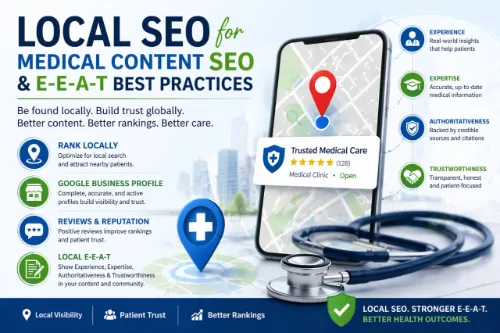
Medical Content SEO and E-E-A-T Best Practices: The Definitive Guide to Ranking in the AI Era
Introduction: Why Standard SEO Fails for Medical Content
In the healthcare sector, your money or your page (YMYL) content faces the highest scrutiny from Google. A standard backlink strategy or keyword density approach will not work here. If you publish inaccurate medical advice, you risk not just a ranking drop but a manual action and permanent reputational damage.
This guide bridges Medical Content SEO with E-E-A-T (Experience, Expertise, Authoritativeness, Trustworthiness). By the end, you will understand how to optimize for Generative Engine Optimization (GEO) , Answer Engine Optimization (AEO) , and Natural Language Processing (NLP) to secure featured snippets and thrive in Google’s AI Overviews. For a foundational understanding of how medical SEO differs from standard practices, refer to this comprehensive guide on SEO services for medical websites .
Part 1: Foundational Technical SEO for Medical Websites
Before writing a single symptom guide, you must secure your infrastructure. Technical SEO for medical sites starts with HTTPS and, if applicable, HIPAA compliance. Google’s algorithms demote unencrypted health forms.
Core Web Vitals are non-negotiable. A cardiology patient searching for “chest pain causes” will bounce if your CLS (Cumulative Layout Shift) pushes the text around. Optimize mobile-first indexing because over 60% of health queries come from smartphones.
Implement structured data (schema) rigorously. Use MedicalCondition schema for disease pages, Drug schema for medication guides, Physician schema for doctor profiles, and HealthTopic schema for content hubs. HowTo schema works well for “how to take blood pressure at home.” This structured data directly feeds AI Overviews and voice search results.
Site architecture must create logical siloing. For example:
- Cardiology → Hypertension → Medication (Lisinopril)
This structure builds topical authority, signaling to Google that you are a deep resource, not a shallow aggregator.
Part 2: Demonstrating “Experience” – The First E in E-E-A-T
Google now prioritizes first-hand experience over theoretical knowledge. For medical content, this means moving beyond textbook definitions.
Publish patient perspectives such as case studies, recovery narratives, and symptom journals. Ensure you obtain written consent and anonymize all data. For example, a page on “living with rheumatoid arthritis” gains immense value from a patient’s description of morning stiffness patterns.
Use clinical imagery and video instead of stock photos. A real (anonymized) image of a physical therapy session or a telemedicine interface builds trust. User-generated content (UGC) , including moderated patient reviews and Q&A sections, adds fresh, experiential signals. However, all UGC must be pre-moderated by a medical professional to avoid misinformation.
Avoid generic content at all costs. Replace “lorem ipsum” medical advice with specific, actionable insights like “based on our clinic’s 2024 cohort, patients reported reduced pain after 3 weeks.”
Part 3: Establishing “Expertise” – The Second E
Expertise requires verifiable credentials. Every medical article must feature author bylines and bios that include detailed credentials such as MD, RN, or PharmD, plus affiliations with recognized hospitals. Link to the author’s publication history on PubMed or ResearchGate.
Create a visible medical review board page listing real names, license numbers, and oversight roles. This board should approve all content before publishing.
Cited references are mandatory. Link directly to peer-reviewed journals like The New England Journal of Medicine (NEJM), The Lancet, and databases such as PubMed. Also reference official guidelines from the CDC, WHO, and FDA. If you cite a study that gets retracted, update your content within 48 hours.
Demonstrate continuing education signals by regularly publishing updates on new drug approvals, treatment protocols, or recalled medical devices. This shows Google’s algorithms that your site is alive and academically current.
Part 4: Building “Authoritativeness” – The A
Authoritativeness is largely off-site. Your backlink profile must include links from .edu, .gov, and .org domains, as well as from major medical institutions like the Mayo Clinic or Cleveland Clinic. One link from a medical school carries more weight than 100 blog comments.
Earn mentions and citations by being referenced by authoritative health portals such as WebMD or Medscape. You can achieve this through original research or expert commentary.
Leverage social and professional proof. Verify your organization’s social accounts. Display accreditations like JCI (Joint Commission International) or URAC (Utilization Review Accreditation Commission). List industry speaking engagements by your physicians.
Off-site brand signals include consistent NAP (Name, Address, Phone) across all directories. A Wikipedia mention (even a citation) is a powerful authority signal. Issue press releases for genuine medical breakthroughs, not for marketing fluff.
Part 5: Prioritizing “Trustworthiness” – The T (Most Critical)
Trustworthiness is the highest-weight factor for YMYL content. Without trust, nothing else matters.
Provide transparent ownership and contact info. Your “About Us” page must list physical addresses, non-emergency phone numbers, and leadership biographies. Never hide behind a PO box.
Every page needs a medical disclaimer stating “Not medical advice. Always consult your physician.” This protects both you and the user.
Disclose advertising and sponsorship clearly. Label sponsored content, affiliate links, and native ads as such. Google’s algorithms can detect undisclosed paid placements.
Implement content update logs with a visible stamp: “Last clinically reviewed on [date] by Dr. X.” This is one of the strongest NLP signals for freshness.
Create a corrections policy and publish it. Explain how users can report errors and how you will retract or amend inaccurate medical information. Then, follow through publicly.
Part 6: On-Page SEO for E-E-A-T Optimized Content
On-page SEO for medical topics balances click-through rate (CTR) with accuracy. Never use clickbait titles like “Miracle Cure Discovered.” Instead, use “Evidence-Based Treatment for Hypertension: 2025 Review.”
Your heading structure (H1-H6) should mimic clinical thinking: Symptom → Diagnosis → Treatment → Prognosis. This logical flow helps NLP engines extract entities and relationships.
Use internal linking with context. Instead of “click here,” link with descriptive anchor text like “review the contraindications for metformin.” This passes topical relevance.
Multimedia optimization includes detailed alt text for medical images. For example: “diagram of psoriasis plaque on elbow with scale thickness.” Add transcripts for all video consultations.
Part 7: Content Creation Best Practices for YMYL Medical Topics
Creating YMYL content requires content depth and completeness. Cover risks, side effects, contraindications, and critically, “when to see a doctor.” Never imply that online advice replaces an in-person visit.
Implement layered readability. Provide a “Plain language summary” for patients and a separate “For healthcare professionals” section with advanced pharmacology or surgical details. This satisfies both general users and GEO (Generative Engine Optimization) which favors layered content.
Establish a fact-checking workflow with a pre-publication checklist. Every claim must be verified by two sources: one primary (study) and one secondary (guideline).
Actively address misinformation. Dedicate a section to debunking common myths. For example: “Myth: Vaccines cause autism. Fact: Over 20 peer-reviewed studies involving millions of children find no link.” Cite those studies.
Part 8: Local SEO for Medical Practices (E-E-A-T Localized)
For clinics and private practices, local SEO is vital. Optimize your Google Business Profile (GBP) with exact categories like “Cardiologist” (not just “Doctor”), services list, and actively moderate the Q&A section. These same principles apply whether you are a general practitioner or a dental clinic seeking local patients.
Implement local structured data including geo-coordinates, opening hours, and accepted insurance providers. This data helps AEO (Answer Engine Optimization) for queries like “pediatrician open now near me.”
Treat patient reviews as trust signals. Respond to negative reviews professionally. If a patient states an incorrect fact, correct it politely without violating privacy. Do not delete legitimate negative reviews; doing so harms trust.
Create location-specific content such as “Managing asthma in Phoenix’s pollen season” and link to local environmental data from the city’s health department.
Part 9: Monitoring and Maintaining E-E-A-T Over Time
E-E-A-T is not a one-time setup. Conduct regular content audits. Remove or update outdated studies, drug interactions, and treatment protocols. A 2018 article on COVID-19 treatment is dangerous if not updated.
Use Google Search Console insights to track impressions for “contradictory” queries like “vaccine risk vs. benefit.” Low CTR or high bounce on these queries indicates a trust deficit.
Watch algorithm updates. The Helpful Content Update and Product Reviews Update both impact medical pages. After each core update, compare your traffic against reputable sources.
Monitor user behavior metrics – dwell time, bounce rate, and return visits. If users leave your treatment page quickly, rewrite the introduction or add a clearer table of contents.
Part 10: Common Medical SEO Pitfalls and How to Fix Them
Avoid these common errors:
| Pitfall | Consequence | Fix |
|---|---|---|
| Using AI-generated content without medical review | Manual action for low E-E-A-T | Require MD sign-off on all AI drafts |
| Over-optimizing for “near me” without clinical value | Keyword stuffing penalty | Add clinical value (e.g., “best ER near me for stroke symptoms”) |
| Copying from UpToDate or Medscape without canonicalization | Duplicate content filter | Write original summaries and cite the source |
| Blocking Google from PDF patient leaflets | Lost traffic and trust | Allow indexing but add no-index for lab portals |
Part 11: Case Studies and Templates
Case Study A – Recovery from Manual Action: A cardiology blog received a manual action for lack of author credentials. They added author bios with CVs, implemented review dates, and resubmitted. Rankings recovered in 6 weeks.
Case Study B – Schema Success: A telemedicine platform implemented MedicalWebPage schema on all condition pages. Within 90 days, they saw a 40% increase in AI Overview appearances for long-tail symptom queries.
Template 1 – Medical Content Fact-Checking Checklist:
- Each statistic linked to primary source (PubMed)
- Contraindications listed
- “When to see a doctor” present
- Last review date displayed
- Author credentials visible above the fold
Template 2 – Author Bio Template with Licensure Disclosures:
“Dr. Jane Smith, MD, is a board-certified endocrinologist at [Hospital Name]. She has published 12 peer-reviewed articles on diabetes management (PubMed ID: 12345). Disclosures: No conflicts of interest.”
- Medical Content SEO requires HTTPS, structured data (MedicalCondition, Drug, Physician schemas), and logical site siloing to build topical authority. For a complete tactical breakdown, review this guide on medical content SEO and E-E-A-T best practices .
- E-E-A-T stands for Experience (patient stories, clinical imagery), Expertise (MD bylines, medical review board), Authoritativeness (.edu backlinks, Wikipedia mentions), Trustworthiness (disclaimers, content update logs, corrections policy).
- GEO (Generative Engine Optimization) involves layered readability: a plain language summary for patients and a “for professionals” section with advanced data.
- AEO (Answer Engine Optimization) requires direct answers to “what,” “why,” and “when” questions, plus local structured data for near-me queries.
- NLP best practices include logical heading structure (H1-H6 mirroring clinical workflow), descriptive anchor text for internal links, and detailed alt text for medical images.
- To rank in Google SERP for YMYL topics, prioritize trustworthiness above all: display last review dates, list author credentials, and link to peer-reviewed journals like NEJM, The Lancet, and PubMed.
- Avoid common pitfalls: AI-generated content without MD review, over-optimized “near me” keywords, and copying from UpToDate without canonical tags.
Part 13: Conclusion – The Future of Medical SEO
The future belongs to sites that embrace generative AI only as a drafting tool, never as a final authority. Every AI-generated sentence must be reviewed by a human expert.
Voice search and conversational queries are rising. Optimize for natural language questions like “What does a melanoma look like?” not just “melanoma symptoms.”
Predictive E-E-A-T is Google’s next frontier – using patient satisfaction signals, appointment booking rates, and return visitor behavior to gauge real-world usefulness.
Build for humans first, verify every fact, and make your trust signals impossible to miss. That is the only sustainable way to rank in the AI-driven SERP.
Appendix: Quick Reference Checklists
Pre-Publication E-E-A-T Checklist (10 Items)
- Author bio with visible credentials
- Medical disclaimer on every page
- At least two peer-reviewed citations
- Last reviewed date stamp
- No stock photos – use real (anonymized) images
- “When to see a doctor” section present
- Internal links to related conditions
- Structured data (MedicalCondition or Drug schema)
- Fact-checked by medical review board member
- Mobile-friendly with Core Web Vitals pass
Medical Schema Implementation Guide
- Disease page: MedicalCondition + code (ICD-10)
- Drug page: Drug + activeIngredient + dosageForm
- Doctor profile: Physician + specialty + medicalSchool
- Clinic page: Hospital + availableService + acceptsInsurance
Trust Signals for Telemedicine vs. Hospital vs. Health Blog
| Type | Critical Trust Signal |
|---|---|
| Telemedicine | Real-time prescription verification, state licenses |
| Hospital | JCI accreditation, emergency contact, physician directory |
| Health blog | Affiliate disclosure, corrections policy, no ads mimicking clinical advice |
Frequently Asked Questions
1. How does Google’s Medic Update differ from the current E-E-A-T framework?
The 2018 Medic Update introduced the importance of “Your Money or Your Page” (YMYL) signals. Today, E-E-A-T has replaced that as a more granular standard. The Medic Update primarily penalized sites lacking authority. E-E-A-T rewards sites that also prove first-hand Experience (e.g., patient outcome data) rather than just credentials.
2. Can a single-author medical blog (e.g., one doctor) ever achieve high E-E-A-T?
Yes, but with caveats. A solo practitioner blog can achieve high E-E-A-T by displaying full licensure, linking to a verified hospital affiliation, publishing regular peer-reviewed citations, and adding a public corrections log. However, for broad YMYL topics (e.g., “cancer treatments”), Google still favors multi-author review boards.
3. What is the role of “unmoderated user comments” in E-E-A-T penalties?
Unmoderated comments containing medical misinformation (e.g., “vaccines contain microchips”) can trigger a trust degradation signal. Google’s NLP models scan user-generated content. Best practice: disable comments on YMYL pages or enforce pre-moderation by a clinician. A single dangerous comment on an otherwise perfect page can suppress rankings.
4. How do you optimize medical content for Google’s “Perspectives” filter?
The Perspectives filter prioritizes first-person video and forum content. To rank here, publish authentic patient video testimonials (with consent), record 60-second “clinical pearls” from physicians, and upload real-case de-identified images. Avoid polished studio videos; raw, real-world footage performs better.
5. Does Google treat medical content in different languages (e.g., Spanish, Mandarin) with the same E-E-A-T scrutiny?
Yes, but with a localization twist. Google evaluates E-E-A-T per language version. A Spanish-language diabetes page must cite Spanish medical authorities (e.g., Ministerio de Sanidad) or regional guidelines, not just CDC/WHO. Machine-translated English content without local expert review receives near-zero trust signals.
6. What is the impact of “noindex” medical calculators or symptom checkers on overall domain authority?
Medical calculators (e.g., BMI, CHA₂DS₂-VASc) often sit on noindex pages. This is safe if those tools are supplementary. However, if your best engagement metrics (dwell time, return visits) are trapped behind noindex, Google cannot see them. Solution: index the tool’s landing page but noindex the results page.
7. How do you handle E-E-A-T for retired or deceased physicians listed on your site?
Remove or clearly annotate retired/deceased authors. Google’s algorithms detect stale bylines. Add a visible note: “Dr. Smith retired in 2023. Content last reviewed by Dr. Jones (active license) on [date].” Failure to do so triggers a “lack of active expertise” penalty.
8. Can “patient-reported outcome measures” (PROMs) be used as structured data?
Yes, but schema.org does not yet have a dedicated PROMs type. Use MedicalEvidenceLevel with a custom property or embed PROMs data in HowTo or MedicalCondition schema. This is an emerging GEO signal: Google prefers content that quantifies real-world results (e.g., “72% of our patients reported pain reduction at 6 weeks”).
9. What is the E-E-A-T risk of using “no follow” on internal links?
Minimal, but context matters. Using rel="nofollow" on internal links to a “Controversial Procedures” page (e.g., off-label drug use) signals to Google that you do not fully endorse that content. For standard medical pages, use dofollow. Reserve nofollow for user-generated or unverified sections.
10. How do you optimize PDF-based patient leaflets for E-E-A-T without harming site architecture?
PDFs are indexable but lack structured data and internal linking. Solution: embed the PDF content as an HTML page with schema, then offer the PDF as a downloadable supplement. Add a canonical tag from the PDF to the HTML page. Never let a PDF be the primary version of YMYL content.
11. Does Google penalize medical sites that use “pop-up” consent forms for newsletters?
Not directly, but intrusive pop-ups on YMYL content increase bounce rate and reduce dwell time. Google’s page experience update penalizes interstitials that hide main content. Use a non-intrusive banner (top or bottom of screen) rather than a center pop-up on symptom or treatment pages.
12. How do you rebuild E-E-A-T after a data breach or security incident on a hospital site?
Immediately publish a transparency report, update HTTPS with HSTS preloading, and add a “Security & Privacy” page linked from every footer. Submit a reconsideration request via Google Search Console explaining remediation. Google’s trust algorithms take 3-6 months to restore lost signals after a security event.
13. What is the role of “digital object identifiers” (DOIs) in medical SEO?
DOIs (e.g., 10.1016/j.amjcard.2023.08.015) are hyper-specific trust signals. Linking to the DOI URL (not just the study title) tells Google’s crawlers you reference verifiable, permanent academic records. Pages with DOI-linked citations rank higher for long-tail diagnostic queries.
14. Can you use “FAQ schema” on medical pages after Google’s 2023 update?
Yes, but only for authoritative domains. Google restricted FAQ schema to government (.gov), hospital (.edu/.org with medical focus), and trusted health portals. If you are a private clinic, FAQ schema will likely be ignored. Use Q&A pages or HowTo schema instead for clinical procedures.
15. How does “ad relevance” impact E-E-A-T for medical content hosting Google Ads?
If your page displays ads for “miracle joint pain supplements” alongside your evidence-based arthritis guide, Google’s ads algorithm may demote your page due to contradictory signals. Use ad review centers to block irrelevant or low-trust medical ad categories. Better yet, limit ads on YMYL pages entirely.
16. What is the E-E-A-T treatment for “repurposed” content (e.g., YouTube transcript as a blog post)?
Duplicate content filters apply. If you transcribe a YouTube video without adding new expertise (e.g., updated references, new patient cases), Google may index only the video. To succeed, rewrite the transcript, add two new peer-reviewed citations, and embed the video as supplementary media.
17. How do you verify “institutional expertise” for a private practice without hospital affiliation?
Leverage alternative trust signals: board certification badges (linked to certifying body), active state license numbers (displayed), continuing education credits (CE/CME) log, and membership in professional societies (e.g., American College of Physicians). Google also accepts liability insurance verification as a trust signal.
18. Does Google use “patient booking data” from third-party schedulers (e.g., Zocdoc, OpenTable) for E-E-A-T?
Indirectly, yes. High-quality appointment booking rates (tracked via potentialAction schema) increase user satisfaction signals. Google does not receive raw booking data but observes click-through rates on “book appointment” buttons and subsequent return visitor behavior. Implement BookMedicalAppointment schema.
19. What is the impact of “contradictory internal linking” on medical SEO?
If you link from a “safe medication” page to a page that promotes unproven treatments (without warning), you dilute trust. Google’s topical flow analysis penalizes inconsistent linking. Solution: add a disclaimer on the outbound link: “This page discusses experimental therapies not yet FDA-approved.”
20. How often should you refresh “evergreen” medical content (e.g., anatomy guides)?
Even anatomy pages need review every 18-24 months. Add a “clinical verification” stamp even if no changes are made. For example: “Last reviewed for anatomical accuracy: March 2026 – no updates needed.” Google’s freshness algorithm rewards this “active monitoring” signal over static, un-reviewed pages.
End of Guide. Implement these Medical Content SEO and E-E-A-T Best Practices to survive and thrive in the age of Google’s AI Overviews. For ongoing updates and advanced strategies, explore the complete resource hub at SEO Mafia Club .







