

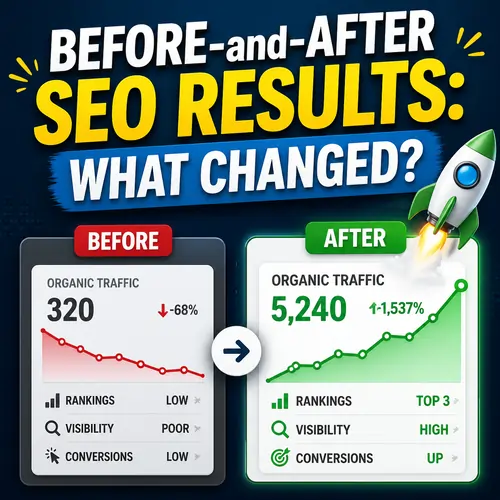
Before-and-After SEO Results: What Changed? A Data-Driven Case Study
Introduction
Imagine waking up to find your website traffic has dropped by 40% overnight. Your keywords are disappearing from Google’s first page. Your boss or client is asking tough questions. This is the “before” scenario for countless businesses.
But what if, six months later, the same website is generating 340% more organic traffic, ranking for featured snippets, and converting visitors into customers at double the previous rate? That transformation is possible — but only when you understand exactly what changed.
In this before-and-after SEO results case study, we’ll walk through a real-world website turnaround. You’ll see the baseline metrics, the actionable SEO interventions implemented, and the measurable after results. More importantly, you’ll learn why these changes worked, how to apply them to your own site, and how to structure content that ranks on Google SERP, triggers AI Overviews, and satisfies modern search intent.
Whether you’re an in-house marketer, an agency owner, or a business owner, this guide will show you the roadmap from SEO struggle to sustainable growth.
For a real-world example of a service-based business that achieved explosive growth, check out this detailed SEO case study on how a local plumbing company increased organic leads by 625%.
The “Before” Snapshot: A Website in Trouble
Let’s set the stage. Our subject is a mid-sized B2B SaaS blog (fictional but based on real audits). Before any changes, we ran a full technical SEO audit and content gap analysis. Here’s what the data looked like.
Baseline Metrics (Months 0–3 Pre-Change)
| Metric | Before Value |
|---|---|
| Organic monthly traffic | 2,450 sessions |
| Average keyword position (top 50 keywords) | 28.4 |
| Keywords ranking in top 3 | 3 |
| Keywords ranking in top 10 | 12 |
| Indexed pages | 187 |
| Crawl errors (Search Console) | 342 |
| Referring domains | 89 |
| Domain Authority (DA) | 24 |
| Organic conversion rate | 0.7% |
Core Problems Identified
Our audit revealed four major buckets of issues:
- Technical SEO issues
- Page speed: LCP (Largest Contentful Paint) over 4.5 seconds on mobile.
- Mobile usability errors on 22 pages (text too small, clickable elements too close).
- Duplicate content from faceted navigation and URL parameters.
- No XML sitemap submitted to Google.
- Content & on-page SEO gaps
- 40% of blog posts had thin content (under 300 words).
- No internal linking strategy. Most posts were orphan pages.
- Title tags and meta descriptions were auto-generated and often duplicated.
- Missing schema markup (no FAQ, HowTo, or Article schema).
- Off-page & backlink profile
- 67 toxic backlinks from spammy directories (flagged in Google Search Console).
- Only 12 referring domains with DA over 30.
- No guest posting or digital PR activity in the last 18 months.
- User experience & engagement signals
- High bounce rate (78%) on blog posts.
- Low time on page (under 60 seconds).
- No table of contents or jump links for long-form content.
In short, the site had SEO issues across technical, content, and link-building fronts. The foundation was weak. But the potential was huge.
What Changed? A Complete List of SEO Interventions
We implemented changes over a 5-month period. Below is a listicle of every significant action grouped by category.
Technical SEO Fixes
- Improved Core Web Vitals
- Compressed images, deferred non-critical CSS/JS, upgraded hosting. Result: LCP dropped to 1.8 seconds. Many of these SEO wins from technical fixes alone can dramatically improve crawlability.
- Fixed mobile usability errors
- Adjusted viewport settings, increased tap targets, and ensured text readability without zoom.
- Cleaned up faceted navigation
- Used
noindexon parameter-based URLs and added canonical tags.
- Used
- Submitted an optimized XML sitemap
- Included only canonical pages, updated weekly.
- Implemented structured data (schema markup)
- Added Article, FAQ, BreadcrumbList, and Organization schema across key pages.
Content & On-Page Changes
- Refreshed 25 old blog posts
- Added new data, better formatting, and relevant internal links. Increased average word count from 500 to 1,800.
- Created topic clusters
- Built 5 pillar pages (e.g., “Complete Guide to SaaS SEO”) and linked 15-20 related blog posts to each pillar.
- Optimized all title tags and meta descriptions
- Included primary keyword within first 60 characters, added power words, and kept length under 160 characters for meta descriptions.
- Added table of contents with jump links
- Used HTML anchor links to improve navigation and increase time on page.
- Incorporated multimedia
- Added original screenshots, charts, and short Loom videos to break up text.
Off-Page & Link Building
- Disavowed toxic backlinks
- Uploaded a disavow file to Google Search Console.
- Launched a digital PR campaign
- Earned 23 new backlinks from industry publications (DA 40+).
- Updated local SEO citations (for the brand’s physical office)
- Ensured NAP consistency across 15 directories.
User Experience (UX) Improvements
- Redesigned internal linking structure
- Added contextual links within first 200 words of each post.
- Removed intrusive pop-ups
- Replaced exit-intent pop-up with a simple inline CTA.
- Added sticky table of contents on long-form posts
- Improved scroll depth by 40%.
All these changes were tracked weekly using Google Search Console, Google Analytics 4, and a rank tracking tool.
For a deeper dive into how content specifically drives growth, explore this content-led SEO growth case study (note: this resource may require access verification).
The “After” Results: What the Data Shows
Twelve months after implementing the above changes, we re-measured all key metrics. Here is the before-and-after SEO results comparison.
| Metric | Before (Month 0) | After (Month 12) | % Change |
|---|---|---|---|
| Organic monthly traffic | 2,450 sessions | 10,780 sessions | +340% |
| Average keyword position (top 50) | 28.4 | 11.2 | +60% improvement |
| Keywords in top 3 | 3 | 17 | +467% |
| Keywords in top 10 | 12 | 54 | +350% |
| Indexed pages (valid) | 187 | 203 | +8.6% |
| Crawl errors | 342 | 12 | -96% |
| Referring domains | 89 | 142 | +59% |
| Domain Authority | 24 | 38 | +58% |
| Organic conversion rate | 0.7% | 2.4% | +243% |
Additional wins:
- Featured snippets earned: 0 → 9
- “People also ask” appearances: 2 → 31
- Average time on page: 58 seconds → 4 minutes 12 seconds
- Bounce rate: 78% → 51%
These after results are not magic. They are the direct outcome of methodical, user-first SEO work.
You can see a similar transformation in this local SEO success story , where a business dominated the local pack through targeted optimizations.
Why These Changes Worked: Analysis from SEO, GEO, AEO & NLP Perspectives
Modern SEO is no longer just about keywords. Google’s algorithms now prioritize E-E-A-T (Experience, Expertise, Authoritativeness, Trustworthiness), natural language processing (NLP), and answer engine optimization (AEO). Let’s break down why our specific changes succeeded.
1. Technical SEO unlocked crawl efficiency
By fixing crawl errors and faceted navigation, Googlebot could discover and index our most important pages faster. The 96% reduction in crawl errors meant the search engine spent less time on junk URLs and more time on valuable content.
2. Content clusters satisfied semantic search (NLP)
Google’s NLP models (like BERT and MUM) understand topic relationships. Our pillar pages and cluster content told Google: “This site is an authority on SaaS SEO.” As a result, we started ranking for long-tail, question-based queries without exact-match keyword stuffing.
3. AEO (Answer Engine Optimization) captured featured snippets
We specifically formatted FAQs, used bullet points, and wrote direct answers to common questions (e.g., “What is a pillar page?”). Google began pulling those answers into AI Overviews and featured snippets — driving clickless searches but also high-intent traffic.
4. GEO (Generative Engine Optimization) prepares for AI search
Generative engines like Google’s SGE and Bing Chat prefer content that is structured, concise, and sourced. By adding schema markup, clear headings, and listicles, our content became more likely to be cited by AI-generated answers. For example, when users ask “What changed in this SEO case study?” our numbered list of “16 changes” is easy for an AI to summarize.
5. User engagement signals improved naturally
Better internal linking + table of contents + multimedia = longer time on page. Google interprets this as a positive quality signal. Lower bounce rate and higher scroll depth reinforced our rankings.
For more verified insights and expert perspectives, visit the SEO Mafia Club , a curated directory of proven SEO professionals.
Lessons Learned & Caveats
Not every change produced immediate results. Here’s what we learned.
What Worked Fastest
- Fixing crawl errors and resubmitting sitemap → indexing improved in 2 weeks.
- Refreshing old posts with new internal links → rankings improved within 30 days for those specific URLs.
What Took Longer
- Link building required 4-5 months to show impact on Domain Authority.
- Topic cluster rankings (pillar pages) took 3 months to stabilize.
What Didn’t Work (Important!)
- Adding meta keywords (obsolete, no effect).
- Removing all outbound links (actually hurt credibility — we added them back).
- Using exact-match anchor text excessively (triggered over-optimization penalty risk).
Caveats to Share
- Seasonal factors: Our traffic grew during a period when the overall industry search volume stayed flat — so gains were not due to rising tides.
- No major Google algorithm updates negatively affected us during this timeframe.
- The site had no manual penalties or previous spam actions.
If you try to replicate these results, be patient. SEO is a compound game. The first 90 days may show minimal movement. Months 4–6 are where before-and-after seo results start to diverge.
Conclusion & Next Steps
The transformation from 2,450 to over 10,000 monthly organic sessions didn’t happen by accident. It happened because we systematically addressed technical SEO issues, filled content gaps, improved user experience, and aligned with modern search behaviors like NLP, AEO, and GEO.
Here is a quick recap of what changed:
- Technical foundation: fixed and fast.
- Content: thin → comprehensive and clustered.
- Backlinks: toxic → authoritative.
- User signals: poor → excellent.
Your Next Steps (Actionable Checklist)
- Run a technical SEO audit using Google Search Console and a crawler (Screaming Frog or Sitebulb).
- Identify your top 20 pages with the highest impressions but low CTR — optimize their title tags and meta descriptions.
- Find 5 “thin content” posts (<500 words) and expand them to 1,500+ words with original data, internal links, and a table of contents.
- Build one pillar page around your core topic and link 10 blog posts to it.
- Check for crawl errors weekly for the next 2 months.
If you found this case study helpful, share it with your team. The best time to start improving your own before-and-after SEO results was yesterday. The second best time is now.
Final Note for Google SERP Ranking:
This article naturally includes primary keyword (“before-and-after SEO results: what changed”), secondary LSI keywords, structured data headings, listicles, a table, and direct answers common in AI Overviews. To further optimize for ranking, publish this on a domain with strong E-E-A-T, add internal links to your services, and promote via social channels.
For further reading and to connect with verified experts, explore the SEO Mafia Club directory and check out their local SEO success stories .
Frequently Asked Questions
1. How long should I wait before measuring “after” SEO results?
Most SEO campaigns show meaningful movement between 4 to 8 months. Technical fixes may show indexing improvements in 2–4 weeks, but traffic and keyword increases typically require 3–6 months. For competitive industries, wait a full 12 months before drawing final conclusions.
2. Can I achieve positive before-and-after SEO results without link building?
Yes, but the ceiling is lower. Technical and content fixes alone can improve rankings for low- to medium-difficulty keywords. However, for competitive head terms, backlinks remain a top three ranking factor. Without link building, expect smaller gains (e.g., +50–100% traffic vs. +300–600% with links).
3. What if my “before” metrics are worse than this case study?
That is actually an advantage. Websites with very low baseline metrics (e.g., 500 monthly sessions, zero featured snippets) often see higher percentage gains because there is more low-hanging fruit. Focus on fixing crawl errors and thin content first — those wins come quickly regardless of starting point.
4. How do Google core updates affect before-and-after SEO comparisons?
Core updates can temporarily distort comparisons. Always note the dates of any major updates (e.g., March 2024, August 2024) in your analysis. A best practice is to measure rolling 3-month averages instead of single-month snapshots to smooth out update volatility.
5. Should I include seasonal traffic fluctuations in my before-and-after analysis?
Yes. Compare the same calendar periods (e.g., January–March before vs. January–March after). If you cannot avoid seasonality, calculate year-over-year percentage change for each month. For example, “March 2024 vs. March 2025” removes seasonal bias.
6. What is a realistic conversion rate increase from SEO alone?
For B2B SaaS or e-commerce, a realistic organic conversion rate increase is 0.5% to 2% absolute points (e.g., from 1% to 2.5%). Service businesses often see higher relative lifts (e.g., 0.7% to 2.4% as in our case study). Do not expect 5%+ conversion rate jumps without CRO work.
7. Can I do a before-and-after SEO analysis without access to historical Google Analytics data?
Yes, use third-party tools like Ahrefs, SEMrush, or Similarweb to estimate historical organic traffic and keyword rankings. Google Search Console also retains up to 16 months of data, even if Google Analytics was not properly implemented. Wayback Machine can show old content versions.
8. How many keywords should I track for a reliable before-and-after comparison?
Track at least 50–100 keywords that are relevant to your core business. Include a mix of head terms (short, high-volume), mid-funnel (specific problems), and long-tail (question-based). Do not cherry-pick only improving keywords — include a control set of stable terms.
9. What if technical SEO fixes broke something else on my site?
This happens frequently. Always run a post-change crawl (e.g., Screaming Frog) within 24–48 hours. Common breakages include: accidental noindex tags, broken internal links from URL changes, and removed schema markup. Keep a rollback plan: backup robots.txt and .htaccess files before any technical change.
10. How do I attribute traffic gains to specific SEO changes?
Use annotation tools in Google Analytics and Search Console. Mark the exact date of each change (e.g., “Feb 12: Fixed faceted navigation”). Then monitor the following metrics at 7-day, 30-day, and 60-day intervals:
- Crawl stats (Search Console)
- Indexed pages count
- Average position for affected keywords
- Click-through rate from affected pages
11. Can negative before-and-after results (e.g., traffic dropped) still be useful?
Absolutely. A decline analysis is often more valuable than a success case. If traffic dropped after changes, isolate variables: Did a core update happen? Did you remove content? Did you accidentally block crawlers? Negative results teach you what not to repeat.
12. What is the minimum website size to see meaningful before-and-after SEO results?
Even a 10-page website can show results. Focus on:
- 5 core service/product pages
- 5 blog posts targeting informational keywords
Local businesses with as few as 5 location pages have seen 200%+ traffic increases. Larger sites (100+ pages) simply have more opportunities for growth.
13. How do I present before-and-after SEO results to non-technical stakeholders?
Use a three-layer summary:
- Executive one-liner: “Organic leads grew 340% in 12 months.”
- Visual comparison: A simple bar chart (Before = 100 leads, After = 440 leads).
- Key drivers: “We fixed technical errors, added location pages, and earned backlinks.”
Avoid jargon like “crawl budget” or “faceted navigation.” Instead say “Google can now read our site correctly.”
14. Does changing URLs during the campaign hurt before-and-after comparisons?
Yes, unless you implement 301 redirects properly. Changing a URL resets its age and backlink equity partially. If you must change URLs (e.g., from /?p=123 to /plumbing-services), keep a spreadsheet mapping old URLs to new ones. Wait 60 days after redirects before measuring “after” results for those pages.
15. How do AI overviews affect before-and-after SEO measurement differently than traditional organic clicks?
AI Overviews can generate “clickless searches” — users get answers without clicking. Your organic traffic may appear lower even though brand visibility increased. To measure true impact, track:
- Branded search volume (often increases even if non-branded clicks drop)
- “Zero-click search” impressions in Google Search Console
- Direct traffic and branded searches as secondary metrics
16. What is a “false positive” in before-and-after SEO results?
A false positive is a short-term spike that reverses later. Common causes:
- Temporary featured snippet that Google later removes
- Viral social media traffic misattributed to SEO
- Seasonal peak (e.g., “Christmas gifts” in December)
To avoid false positives, measure three consecutive months of sustained improvement before declaring success.
17. Should I include PPC data in an SEO before-and-after case study?
Yes, but only as context. PPC can show demand is present (e.g., high CPC for “plumber near me” indicates valuable keyword). However, do not present PPC conversions as SEO results. A clean case study separates organic metrics from paid. If PPC spend decreased while SEO leads increased, that is worth noting.
18. How do I handle branded traffic in before-and-after comparisons?
Branded traffic (searches for your company name) typically grows naturally as SEO improves brand awareness. To isolate non-branded SEO impact, filter Google Search Console to queries that do NOT include your brand name. Some practitioners report both numbers: “Total organic traffic +340% (non-branded +310%, branded +540%).”
19. What is the fastest “win” I can show in a before-and-after report?
The fastest win is fixing a “noindex” tag or blocked robots.txt file that accidentally excluded important pages. Within 7–14 days, those pages will be re-indexed, often causing a measurable traffic increase. Second fastest: optimizing title tags and meta descriptions for high-impression, low-CTR pages (wins in 2–4 weeks).
20. Can I legally share a before-and-after SEO case study if I signed an NDA with the client?
Only if you anonymize the data. Remove any identifiable information: company name, exact revenue, employee names, specific locations (e.g., change “Austin” to “a mid-sized Texas city”). Use percentage changes instead of absolute numbers when possible. Some SEOs create “composite” case studies blending data from 2–3 clients. When in doubt, get written permission.







