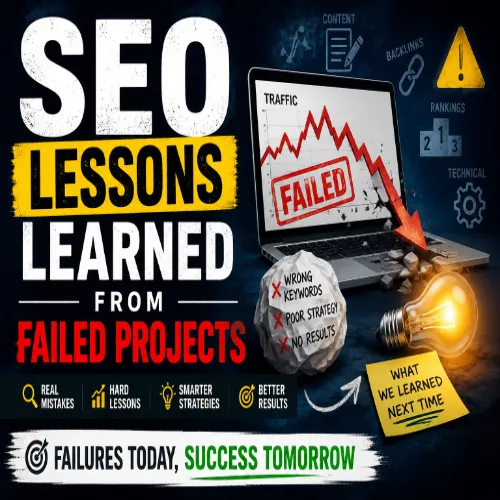
SEO Lessons Learned from Failed Projects: Real-World Mistakes That Improved My SEO Strategy
Written by John Michael Palmes
SEO success stories are everywhere. You’ll often see case studies highlighting massive traffic growth, first-page rankings, and impressive ROI. However, some of the most valuable SEO lessons I’ve learned came from projects that failed.
After working on affiliate websites, local business campaigns, content-driven websites, and lead-generation projects, I’ve realized that failed SEO campaigns often reveal more about search engines, user behavior, and business objectives than successful ones.
This article shares the biggest SEO mistakes I encountered, the consequences they created, and the lessons that helped me become a better SEO professional.
Why Failed SEO Projects Matter More Than Success Stories
Many SEO case studies focus only on what worked. The problem is that they rarely discuss:
- Incorrect assumptions
- Wasted budgets
- Ranking losses
- Technical issues
- Conversion failures
Understanding why SEO projects fail helps businesses avoid costly mistakes and build more sustainable search strategies.
Quick Answer
Failed SEO projects often reveal weaknesses in keyword targeting, technical SEO, content strategy, user intent alignment, and performance measurement. Learning from these failures can significantly improve future SEO results.
Lesson #1: Ranking for High-Volume Keywords Doesn’t Guarantee Business Results
One of my earliest affiliate SEO projects focused heavily on search volume.
The strategy seemed logical:
- Target keywords with thousands of monthly searches
- Create optimized content
- Build backlinks
- Increase traffic
Within four months, organic traffic increased by approximately 110%.
The problem?
Revenue barely moved.
What Went Wrong
After reviewing Google Analytics and conversion data, I discovered that many visitors were searching for informational content while the website was designed primarily to generate affiliate conversions.
Traffic increased, but user intent did not align with business goals.
SEO Lesson Learned
Search intent matters more than search volume.
Before targeting any keyword, ask:
Is the searcher looking to learn, compare, or buy?
A keyword with 500 monthly searches and strong commercial intent can generate more revenue than a keyword with 10,000 searches and weak purchase intent.
Actionable Takeaway
Always categorize keywords into:
- Informational
- Commercial Investigation
- Transactional
- Navigational
Then align content accordingly.
Lesson #2: Technical SEO Problems Can Destroy Great Content
A content-heavy website I worked on published over 300 articles within a year.
Content quality was strong.
Writers followed keyword research, content briefs, and internal linking recommendations.
Despite these efforts, rankings gradually declined.
Technical Audit Findings
The website had:
- Thousands of crawlable parameter URLs
- Duplicate metadata
- Slow mobile performance
- Poor Core Web Vitals
- Multiple redirect chains
- Broken internal links
Google was spending significant crawl resources on low-value pages.
What Happened Next
After fixing technical issues, impressions increased by nearly 40% within several months without publishing additional content.
SEO Lesson Learned
Content cannot compensate for a weak technical foundation.
Technical SEO Checklist
Crawlability
- Robots.txt review
- XML sitemap validation
- Crawl budget optimization
Performance
- Largest Contentful Paint (LCP)
- Interaction to Next Paint (INP)
- Cumulative Layout Shift (CLS)
Indexation
- Duplicate pages
- Canonicalization
- Orphan pages
Technical SEO should never be treated as an afterthought.
Lesson #3: Aggressive Link Building Created Short-Term Wins and Long-Term Losses
Several years ago, I managed a niche website that relied heavily on backlink acquisition.
The website gained dozens of links every month.
Rankings improved rapidly.
Organic traffic increased by nearly 200%.
Then a major Google algorithm update arrived.
The Problem
Many backlinks were:
- Weakly relevant
- Sitewide placements
- Low editorial value
- Acquired solely for SEO purposes
The website lost significant rankings within weeks.
SEO Lesson Learned
Not all backlinks provide sustainable ranking power.
Google increasingly evaluates:
- Relevance
- Context
- Editorial quality
- Natural placement
- Topic alignment
Better Approach
Focus on earning links through:
- Original research
- Industry insights
- Data studies
- Expert contributions
- Helpful resources
Quality consistently outperforms quantity.
Lesson #4: Publishing Everything Reduced Topical Authority
One project attempted to maximize traffic opportunities by covering multiple industries.
Topics included:
- Health
- Finance
- Travel
- Technology
- Business
The content volume was impressive.
The results were not.
Why It Failed
Google struggled to identify the website’s primary expertise.
Instead of becoming authoritative in one niche, the site became average in many.
SEO Lesson Learned
Topical authority is increasingly important.
When Google clearly understands what a website specializes in, rankings often improve across related topics.
AI Overview Optimization Tip
Create topic clusters rather than isolated articles.
Example:
SEO Hub
- Technical SEO
- Keyword Research
- Link Building
- Local SEO
- SEO Audits
This structure strengthens topical relevance and internal linking.
Lesson #5: Internal Linking Was Holding Back Rankings
A content website with more than 200 articles struggled to gain visibility despite publishing quality content consistently.
What We Found
Many pages had:
- Few internal links
- No topic clusters
- Weak contextual connections
Some articles were effectively isolated.
Solution
We implemented:
- Hub-and-spoke architecture
- Contextual anchor text
- Topic clusters
- Related content sections
Results
Several previously stagnant pages began ranking within months.
SEO Lesson Learned
Internal links help search engines:
- Discover content
- Understand relationships
- Transfer authority
- Build topical relevance
They are one of the highest ROI SEO activities available.
Lesson #6: Traffic Is Not the Most Important SEO Metric
One campaign appeared successful based on traditional SEO KPIs.
Positive Metrics
- Rankings increased
- Traffic increased
- Impressions increased
Negative Reality
- Lead generation remained flat
- Revenue barely changed
- Sales team reported poor lead quality
SEO Lesson Learned
Traffic is only valuable when it supports business goals.
Better Metrics to Measure
SEO Performance Metrics
- Organic traffic
- Keyword rankings
- Click-through rate
Business Metrics
- Leads generated
- Conversion rate
- Revenue attribution
- Customer acquisition cost
- Lifetime customer value
Successful SEO should improve business outcomes, not just rankings.
Lesson #7: Copying Competitors Is Not a Strategy
Many SEO professionals analyze competitors.
That’s valuable.
Blindly copying them is not.
One Campaign Mistake
We replicated:
- Content structure
- Keyword targets
- Internal links
- On-page optimization
The results were disappointing.
Why?
The competitor had:
- Strong brand recognition
- Thousands of referring domains
- Years of authority
- High direct traffic signals
We copied tactics without understanding context.
SEO Lesson Learned
Competitive research should inspire ideas, not replace strategy.
Every website requires a unique SEO roadmap.
Lesson #8: SEO Requires Patience More Than Most People Expect
One client expected dramatic results within 60 days.
The campaign included:
- Technical fixes
- New content
- Internal linking
- Link acquisition
Initial Results
Very little changed.
The client ended the campaign after three months.
Ironically, rankings improved significantly several months later.
SEO Lesson Learned
SEO is a long-term investment.
For most industries, meaningful growth often requires:
- 3 to 6 months for early traction
- 6 to 12 months for significant growth
- Ongoing optimization for sustained results
Patience is often the difference between success and failure.
Key SEO Lessons Learned From Failed Projects
If I could summarize years of SEO failures into a few lessons, they would be:
Focus on Search Intent
The right visitors matter more than more visitors.
Prioritize Technical SEO
A technically healthy website allows content to perform.
Earn Better Links
Authority grows through relevance and trust.
Build Topical Authority
Become known for a specific subject area.
Strengthen Internal Linking
Help search engines understand your content ecosystem.
Measure Business Outcomes
Rankings alone do not pay the bills.
Learn From Competitors Without Copying Them
Adapt strategies to your own situation.
Give SEO Enough Time
Organic growth compounds over time.
Frequently Asked Questions
1. How can I identify an SEO strategy that is likely to fail?
An SEO strategy may be at risk if it relies heavily on shortcuts, ignores user experience, lacks measurable goals, or focuses solely on rankings without considering conversions and business outcomes.
2. Can a website recover after losing rankings due to an algorithm update?
Yes. Recovery is possible by identifying the causes of the ranking loss, improving content quality, addressing technical issues, and aligning the website with Google’s quality guidelines.
3. What role does user experience play in SEO success?
User experience influences engagement metrics such as bounce rate, time on page, and user satisfaction. Poor user experience can negatively impact rankings and conversions over time.
4. Why do some SEO projects succeed initially but fail later?
Short-term SEO gains can result from tactics that do not provide long-term value. Algorithm updates, increased competition, or poor website maintenance can eventually reverse those gains.
5. Is it possible to over-optimize a website for SEO?
Yes. Excessive keyword usage, unnatural internal linking, and aggressive optimization tactics can make content less useful for users and potentially harm rankings.
6. How important is competitor monitoring in SEO?
Competitor monitoring helps identify trends, opportunities, and gaps in your strategy. However, insights should be adapted to your website’s goals rather than copied directly.
7. What are the warning signs of declining SEO performance?
Common warning signs include decreasing organic traffic, falling keyword rankings, reduced click-through rates, declining conversions, and lower search visibility.
8. Can poor content updates negatively affect rankings?
Yes. Updating content without preserving valuable information, search intent alignment, or topical relevance can lead to ranking declines.
9. Why is content freshness important in SEO?
Fresh content signals relevance to users and search engines. Regular updates help maintain accuracy, improve user trust, and increase competitiveness in search results.
10. Should businesses stop SEO if results are slow?
No. SEO is a long-term marketing channel. Stopping optimization efforts too early often prevents websites from benefiting from the compounding effects of organic growth.
11. How does poor website architecture affect SEO?
A confusing site structure can make it difficult for search engines to crawl pages and for users to find information, leading to lower rankings and engagement.
12. What is the biggest misconception about SEO success?
Many people believe rankings alone determine success. In reality, SEO should support broader goals such as lead generation, sales, brand visibility, and customer acquisition.
13. Can too many plugins harm SEO performance?
Yes. Excessive or poorly coded plugins can slow website performance, create security risks, and negatively impact Core Web Vitals and user experience.
14. How often should an SEO strategy be reviewed?
Most SEO strategies should be reviewed quarterly, with monthly performance monitoring to identify issues, opportunities, and changing search trends.
15. Does domain age guarantee better rankings?
No. While older domains may have established authority, content quality, technical SEO, user experience, and backlinks are more influential ranking factors.
16. How can businesses avoid repeating SEO mistakes?
Businesses should document campaign outcomes, analyze failures, conduct regular audits, and continuously test and refine their SEO processes.
17. What impact does poor mobile optimization have on SEO?
Poor mobile usability can reduce engagement, increase bounce rates, and negatively affect rankings because Google primarily uses mobile-first indexing.
18. Are SEO failures more common in competitive industries?
Yes. Highly competitive industries often require stronger content, more authority, better technical optimization, and greater investment to achieve sustainable results.
19. Can focusing on too many SEO tools become a problem?
Yes. Relying on too many tools can create data overload and distract from actionable insights. Successful SEO focuses on implementation, not just analysis.
20. What is the most valuable lesson from failed SEO projects?
The most valuable lesson is that SEO success requires continuous learning. Every failed campaign provides insights that can improve future strategies, decision-making, and long-term performance.
Final Thoughts
Looking back, my biggest SEO breakthroughs often came after my biggest mistakes.
Failed projects taught me that rankings alone do not guarantee success, traffic without conversions has limited value, and technical foundations matter just as much as content.
SEO continues to evolve, but one principle remains consistent: every setback contains valuable data.
The most successful SEO professionals are not those who avoid failure altogether. They are the ones who analyze failures, learn from them, and use those lessons to build stronger strategies moving forward.
For businesses and marketers alike, failed SEO projects should not be viewed as losses. They should be viewed as investments in experience, knowledge, and long-term growth.
About the Author
John Michael Palmes is an SEO professional specializing in organic search strategy, technical SEO, content optimization, and digital growth. He shares practical SEO insights, lessons learned from real-world projects, and actionable strategies for businesses looking to improve their online visibility.
Author Profile: https://seomafiaclub.com/expert/john-michael-palmes/
Email: palmesjohnmichael19@gmail.com
Medium: https://medium.com/@palmesjohnmichael19
LinkedIn: https://www.linkedin.com/in/john-michael-palmes/
Facebook: https://www.facebook.com/john.michael.palmes.2024
Tumblr: www.tumblr.com/johnmichaelnotes