

Search engine optimisation has never been static, but the pace of change today feels faster than ever. Algorithm updates, AI-driven search features, and shifting user behaviour have led many professionals to ask an important question: what is the future of SEO as a career?
Understanding the future of SEO as a career is essential for anyone entering the industry, transitioning roles, or planning long-term growth in digital marketing. SEO is not disappearing—it is evolving into a more strategic, value-driven discipline.
Table of Contents
Is SEO Still a Viable Career?
Yes, SEO is still a viable and rewarding career—but it now demands more than basic optimisation knowledge.
Organic search continues to be one of the strongest acquisition channels because it delivers consistent, high-intent traffic without the rising costs associated with paid advertising. Businesses rely on SEO to build long-term visibility, authority, and trust, especially in competitive markets.
When evaluating the future of SEO as a career, the key shift is expectations. Employers and clients are no longer looking for someone who can simply “add keywords.” They want professionals who understand how search supports wider goals such as revenue growth, lead quality, and brand credibility.
How SEO Careers Are Evolving
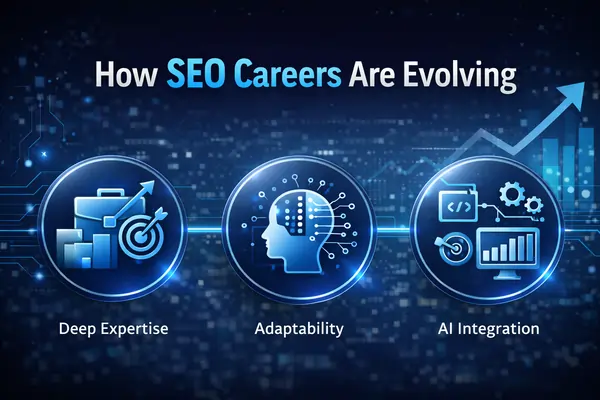
The future of SEO as a career is being shaped by two major forces: how search engines evaluate content and how organisations define success. Rankings alone are no longer the primary measure of impact. Instead, SEO is increasingly judged by its contribution to visibility, user experience, and business outcomes.
This shift has fundamentally changed what it means to work in SEO.
SEO Is Becoming More Strategic
SEO is no longer a standalone task focused on technical fixes or keyword placement. It now plays a central role within broader digital and marketing strategies.
Modern SEO professionals are expected to:
- Prioritise pages, topics, and initiatives based on business value, not just search volume
- Align SEO goals with marketing, sales, and commercial objectives
- Understand how content quality, user experience, and technical performance influence each other
This evolution means SEO roles carry greater influence across organisations. At the same time, they come with more responsibility. Career progression is increasingly driven by decision-making, prioritisation, and strategic thinking, rather than execution alone.
AI and the Future of SEO as a Career
AI has become one of the most significant factors shaping the future of SEO as a career. Automation has changed how work is done, but it has not reduced the need for skilled professionals.
AI tools can assist with research, data analysis, and content drafting, helping SEO teams work more efficiently. However, AI cannot replace:
- Human judgement and contextual understanding
- Strategic prioritisation of what actually matters
- Brand voice, tone, and audience awareness
- Ethical decision-making and quality control
As AI-generated content becomes more common, the ability to evaluate usefulness, intent, and credibility becomes even more valuable. The future of SEO as a career belongs to professionals who know how to use AI as a support tool, not those who rely on it blindly.
Technical and Content SEO Are Converging
Historically, SEO roles were often split between technical specialists and content-focused optimisers. That separation is becoming increasingly impractical.
Search engines now assess pages holistically, taking into account:
- Page speed, performance, and technical stability
- Content depth, relevance, and clarity
- Internal linking and site structure
- User engagement and overall experience
As a result, the future of SEO as a career favours professionals who understand how these elements work together. While deep specialists will always have a place, adaptable, cross-skilled SEO professionals are increasingly in demand—especially in in-house and leadership roles.
Skills Shaping the Future of SEO as a Career
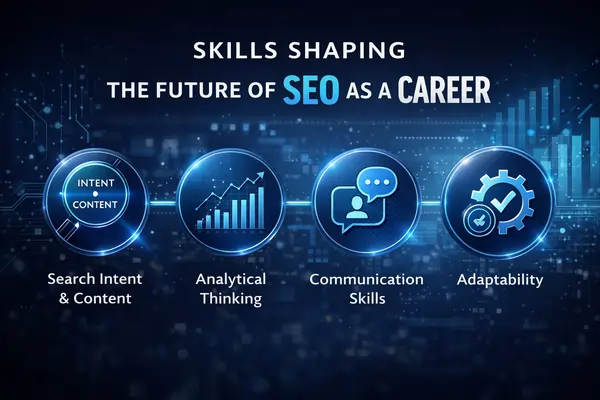
SEO success is no longer driven by tools alone. While platforms and automation can support execution, the future of SEO as a career is defined by thinking, judgement, and adaptability. As search engines become more sophisticated, the value of human decision-making continues to increase.
Professionals who understand why something works—not just how to do it—are the ones who progress.
Search Intent and Content Evaluation
Understanding search intent is foundational to the future of SEO as a career. This goes far beyond keyword targeting and focuses on why users search, what problem they are trying to solve, and what outcome they expect.
Skilled SEO professionals can recognise when content fails to meet intent, even if it ranks. They know how to improve usefulness without rewriting entire pages and can identify which formats—guides, comparisons, explanations, or tools—are most likely to perform.
This skill directly influences rankings, engagement, conversions, and long-term visibility, especially in competitive search results.
Analytical Thinking and Decision-Making
SEO produces large volumes of data, but data alone does not create value. Interpretation does.
Future-ready SEO professionals focus on understanding patterns rather than reacting to surface-level metrics. They can explain why performance changed, not just that it changed, and translate insights into clear, prioritised actions.
As SEO roles become more senior, analytical clarity becomes more important than hands-on execution. Decision-making quality often matters more than technical depth.
Communication and Collaboration
The future of SEO as a career depends heavily on communication. SEO professionals rarely work in isolation and increasingly collaborate with developers, designers, writers, product teams, and leadership.
Clear communication is essential when explaining technical issues in plain language, defending long-term strategies against short-term pressure, and aligning SEO recommendations with brand and content standards.
Those who communicate well build trust faster, influence decisions more effectively, and progress more quickly into senior or leadership roles.
Adaptability and Continuous Learning
Search engines evolve constantly, and rigid approaches fail quickly. Successful SEO professionals stay adaptable without chasing every trend or update.
This means testing changes methodically, learning from results rather than assumptions, and updating skills while maintaining strong fundamentals. Adaptability allows SEO professionals to respond calmly to change rather than react impulsively.
In the long term, adaptability is one of the strongest indicators of sustainable success in the future of SEO as a career.
Career Opportunities in Modern SEO
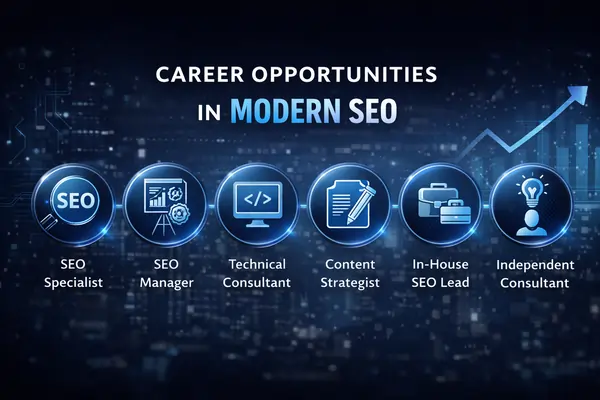
The future of SEO as a career offers more role diversity than at any point in the industry’s history. As search becomes more deeply integrated with content, technology, and business strategy, SEO professionals are no longer confined to a single, linear career path.
Many professionals begin as SEO specialists, focusing on execution, research, and optimisation fundamentals. With experience, this often progresses into SEO manager or SEO lead roles, where responsibility shifts toward strategy, prioritisation, and cross-team collaboration.
Beyond generalist roles, several specialist paths remain in strong demand, including:
- Technical SEO consultants, who focus on site architecture, performance, crawlability, and indexation
- Content and SEO strategists, who specialise in search intent, editorial planning, and building topical authority
- In-house SEO leads, who align organic growth with wider business objectives, particularly in competitive or fast-growing organisations
With broader experience, many professionals move beyond traditional SEO roles altogether. The future of SEO as a career often extends into areas such as growth marketing, digital strategy, product marketing, or leadership positions, where search expertise becomes a core strategic asset rather than a standalone function.
For many, SEO serves as a strong career foundation. The skills developed—analysis, user understanding, strategic thinking, and communication—are highly transferable, opening doors well beyond search alone.
Job Demand and the Future of SEO as a Career
Demand for experienced SEO professionals remains strong across a wide range of industries, including e-commerce, SaaS, publishing, healthcare, and local services. As competition in search continues to increase, organic visibility has become harder to earn—and more valuable to maintain.
Businesses are no longer looking for short-term optimisation or isolated tactics. Instead, they increasingly value SEO professionals who demonstrate:
- Proven experience delivering consistent, measurable results
- Sustainable optimisation practices aligned with search quality guidelines
- Strategic thinking that supports long-term growth rather than quick wins
- Cross-functional awareness, including content, UX, and technical performance
- The ability to explain impact in business terms, not just rankings
As a result, the future of SEO as a career is more stable for professionals who focus on long-term value creation. Those who combine experience with strategic insight and adaptability are better positioned for job security, senior roles, and career progression as search continues to evolve.
Challenges SEO Professionals Should Expect
SEO is a rewarding career, but it comes with real challenges that professionals must be prepared to manage. One of the most common difficulties is setting and maintaining expectations. SEO results take time, and explaining algorithm volatility or performance fluctuations to stakeholders who are unfamiliar with search mechanics can be demanding.
As the industry matures, competition—especially for senior and leadership roles—is increasing. Standing out now requires more than basic optimisation skills. SEO professionals are expected to demonstrate:
- Depth of knowledge, not just familiarity with tools
- Proven results, supported by clear reasoning and evidence
- Credibility and trust, built through consistent decision-making
- The ability to justify strategy, even when short-term results fluctuate
These challenges raise the standard of the profession. While they can be demanding, they also reward genuine expertise, strategic thinking, and long-term commitment. For those who invest in developing these qualities, the challenges of SEO ultimately become career-defining strengths rather than obstacles.
How to Future-Proof Your SEO Career
Preparing for the future of SEO as a career requires deliberate skill-building and long-term thinking. The professionals who remain relevant are those who focus on fundamentals, adapt to change, and consistently add value beyond surface-level optimisation.
To future-proof your SEO career:
- Master fundamentals before advanced tactics
A strong understanding of search basics—crawlability, indexing, intent, and content quality—creates a foundation that remains valuable even as algorithms evolve. - Build experience across technical, content, and strategy
Exposure to multiple areas of SEO helps you understand how decisions in one area affect performance in others, making you more versatile and valuable. - Learn how to use AI responsibly and effectively
AI can enhance efficiency, but long-term success depends on knowing when to apply human judgement, especially around quality, intent, and ethical optimisation. - Develop strong business and communication skills
SEO professionals who can explain impact, justify priorities, and align recommendations with business goals progress faster and gain more influence.
SEO careers are built over time, not through shortcuts. Consistency, learning, and sound judgement are what sustain long-term success in the future of SEO as a career.
Frequently Asked Questions
Is the future of SEO as a career secure long term?
Yes. The future of SEO as a career is secure for professionals who adapt to changes in search technology, user behaviour, and content evaluation. As long as businesses rely on organic visibility, skilled SEO professionals will remain in demand.
Will AI reduce the need for SEO professionals?
AI will reduce manual tasks, but it increases the need for strategic oversight, quality control, and decision-making. The future of SEO as a career depends more on judgement, intent analysis, and strategy than on repetitive execution.
What skills are most important for future SEO roles?
Analytical thinking, search intent understanding, communication, and adaptability are increasingly critical. Technical knowledge and content strategy are still important, but they are most valuable when combined with business awareness.
Is SEO still a good career choice for beginners?
Yes, but beginners should focus on learning fundamentals rather than shortcuts. The future of SEO as a career rewards those who build strong foundations, gain real experience, and continuously improve their skills.
Can SEO lead to other career opportunities?
Absolutely. Many professionals use SEO as a pathway into growth marketing, digital strategy, consulting, or leadership roles. The future of SEO as a career often extends beyond search into broader business influence.
Final Perspective
The future of SEO as a career is not about resisting change—it is about growing alongside it. As search engines become more intelligent and user-focused, SEO professionals who prioritise quality, intent, and trust are becoming increasingly valuable to organisations.
SEO is no longer just about rankings or visibility in isolation. The future of SEO as a career belongs to strategists, critical thinkers, and professionals who understand real user value and can translate search insight into meaningful business impact.
About The Author
Gevy Bonifacio is an SEO Specialist with three years of hands-on experience in search engine optimization. Gevy specializes in on-page SEO, focusing on content structure, keyword alignment, and search intent optimization. Gevy’s work emphasizes practical, ethical strategies that support consistent and long-term organic growth.







