

Home / AI and SEO / AEO vs SEO 2026: AEO vs SEO 2026 Key Differences Explained
AEO vs SEO Key Takeaways
By 2026, traditional search engine optimization (SEO) and answer engine optimization (AEO) form a hybrid landscape where AI assistants like ChatGPT, Gemini, and Perplexity AI pull content from structured, entity-rich pages.
- AEO vs SEO is not an either‑or choice; the two disciplines overlap as search engines integrate AI overviews and voice responses.
- Key differences between AEO vs SEO 2026 include ranking factors — SEO relies on backlinks and keywords, whereas AEO prioritizes entity clarity, structured data, and direct answer formatting.
- Marketers who adopt a hybrid AEO vs SEO framework see stronger visibility in both traditional SERPs and AI‑powered answer engines.
Table of Contents
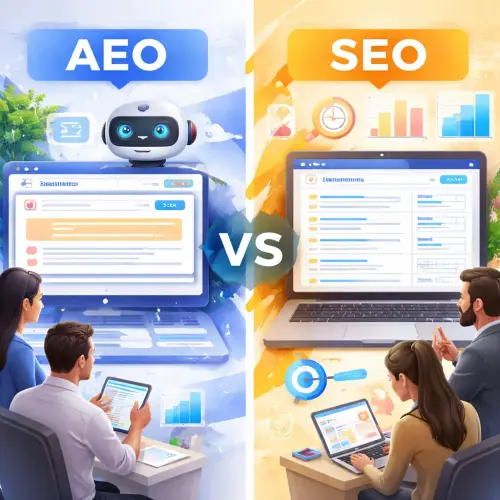
What Are the Core Differences Between AEO vs SEO 2026?
AEO vs SEO 2026 marks a fundamental shift in how content is discovered and consumed. SEO, as most professionals know it, focuses on ranking web pages in Google’s traditional blue‑link results by optimizing keywords, meta tags, and backlinks. AEO, short for answer engine optimization, tailors content so that AI systems — ChatGPT, Gemini, Claude, Perplexity AI, and Microsoft Copilot — can extract a precise, conversational answer without requiring a user to click through to a website. For a related guide, see Stop Chasing Keywords, Start Owning Answers: The AEO Shift.
In 2026, the line blurs because Google itself serves AI Overviews at the top of its results, pulling data from well‑structured pages. Understanding the key differences between AEO vs SEO 2026 helps you decide where to invest your optimization efforts.
Intent and User Experience
SEO traditionally aims to drive traffic to a landing page. Every piece of content is written to earn a click. AEO, by contrast, treats the answer as the final destination. The goal is to satisfy the user’s query inside the AI interface — whether that’s a spoken response from Siri, a paragraph from ChatGPT, or a summary box in Google Search.
This shift changes how you write. Instead of a keyword‑dense article, you produce concise, entity‑rich answers that a machine can parse and rephrase naturally.
Ranking Factors
The ranking factors in AEO vs SEO 2026 diverge significantly:
| Factor | Traditional SEO | AEO (Answer Engine Optimization) |
|---|---|---|
| Primary target | Search engine result page (SERP) | AI answer interface (chat, voice, overview) |
| Content format | Long‑form articles, landing pages | Structured snippets, Q and A, lists, tables |
| Entity signals | Keywords, backlinks | Schema markup, entity links, clear subject‑predicate‑object |
| Measurement | Organic traffic, CTR, bounce rate | Answer presence, citation frequency, voice‑read rate |
How Does AEO Change Traditional SEO Strategies?
How does AEO change traditional SEO strategies? It forces you to think beyond the page. In 2026, a piece of content must do two things simultaneously: rank in a traditional SERP and serve as a trusted source for AI assistants. That means your keyword research now includes “question phrases” and “conversational queries.” Your link building includes mentions used by AI training corpora. Your content structure prioritises clear definitions, step‑by‑step processes, and direct answers at the top of each section.
For example, a blog post about “how to brew pour‑over coffee” would, under pure SEO, target the phrase “pour‑over coffee recipe” and build backlinks. Under AEO vs SEO hybrid thinking, you also add a schema‑marked “HowTo” block, include a terse 30‑word answer in the first paragraph, and link to authoritative coffee science sources so that Gemini can cite your page with confidence.
Content Pruning and Restructuring
Many traditional seo professionals are now auditing their existing libraries to identify pages that can be repurposed for AEO. A page that ranks #3 for “best CRM for small business” might never appear in an AI answer because it lacks a direct comparison table. By adding a structured comparison section and marking it up with “table” schema, that same page becomes AEO‑eligible without losing its organic ranking.
Is AEO Replacing SEO in 2026?
Is AEO replacing SEO in 2026? No — but it is absorbing a large share of traffic that once went to clicks. When a user asks ChatGPT “What is the best CRM for a 10‑person team?” and receives a three‑paragraph answer with citations, that user may never click any link. However, the cited sources still benefit from brand exposure and authority signals that feed back into traditional rankings.
The realistic outlook is convergence. SEO without AEO principles will lose visibility in AI overviews. AEO without SEO fundamentals will lack the technical foundation (page speed, indexability, authority) that AI systems use to evaluate trustworthiness.
How Does AEO Impact Google Search Results in 2026?
Google’s AI Overviews now appear on roughly 60% of queries. These overviews compress information from multiple sources into a single paragraph, a list, or a comparison table. Pages that provide clear, structured answers are featured; pages that rely on fluff or keyword stuffing are ignored. How does AEO impact Google search results in 2026? It essentially makes the featured snippet more competitive.
Every snippet slot is now a multi‑source AI answer that can pull from dozens of pages, so your content must be both authoritative and algorithmically extractable. For a related guide, see How to Get Your Website Featured in ChatGPT Answers (Step-by-Step).
How to Optimize for Both AEO vs SEO 2026
How to optimize for both AEO vs SEO 2026 begins with understanding that the same page can serve both masters. Follow this step‑by‑step process:
Step 1: Identify High‑Value Queries
Use tools like Google Search Console, AnswerThePublic, and ChatGPT’s own analytics to find questions your audience asks. Prioritise queries that have both search volume and answer‑engine traction (e.g., “how does X work?” or “what is Y?”).
Step 2: Write a Direct, Structured Answer
Open each article or section with a 40–60 word answer that can stand alone. Use the exact question as an H3 or H4, then provide a clear, factual response. Mark it up with FAQ or HowTo schema where applicable.
Step 3: Layer in Traditional SEO Signals
Include the focus keyword in the first 100 words, meta description, and at least two H2s. Build relevant backlinks. Optimise page speed and mobile experience. These factors still influence which pages AI systems consider authoritative.
Step 4: Add Entity and Context Clues
Link to authoritative external sources (Wikipedia, official docs, research papers). Use internal links to build a topic cluster. Include a “People also ask” section that mirrors real user queries. AI engines use these signals to confirm your content’s relevance.
Step 5: Test Across AI Platforms
After publishing, ask the same question in ChatGPT, Gemini, and Perplexity. If your content does not appear in the answer, review the formatting. Did you use a table? Did you phrase the answer as a complete sentence? Adjust and republish.
Future of SEO in AI Search Era: What Comes Next?
The future of SEO in AI search era is not a single discipline but a layered skill set. By 2027, we expect that:
- AI assistants will gain access to real‑time search indexes, making freshness a stronger ranking signal.
- Voice search will account for over 50% of queries, demanding even shorter, more conversational answers.
- Brand authority will be measured not just by backlinks but by citation frequency across AI training data and live answering contexts.
- Tools like Surfer SEO and Clearscope will incorporate AEO scores that measure how extractable your content is.
The practitioners who thrive will be those who treat AEO vs SEO as complementary forces rather than competitors. A balanced strategy that combines technical SEO, rich structured data, and concise answer formatting delivers the best results for both traditional search and AI‑driven discovery.
Useful Resources
For a deeper look at answer engine optimization, consult Google’s official developer documentation on structured data: Google Structured Data Guide. To understand how AI assistants prioritise sources, read the latest research from Perplexity AI: Perplexity AI Blog.
Frequently Asked Questions About AEO vs SEO
What is AEO vs SEO 2026?
AEO vs SEO 2026 describes the comparison between answer engine optimization (optimising for AI assistants) and traditional search engine optimization (optimising for Google’s blue‑link results).
What are the key differences between AEO vs SEO 2026?
The key differences between AEO vs SEO 2026 include intent (direct answer vs. click), ranking factors (entity clarity vs. backlinks), and content format (structured snippets vs. long‑form articles).
Is AEO replacing SEO in 2026?
No, AEO is not replacing SEO. Instead, the two are merging. Traditional SEO still matters for authority, while AEO ensures your content is accessible to AI answer engines.
How does AEO change traditional SEO strategies ?
It forces you to write direct answers, use structured data, and optimise for conversational queries in addition to traditional keyword targeting and backlink building.
Which is better AEO vs SEO 2026 for rankings?
Neither is universally better. For queries that demand a quick answer, AEO performs better. For research‑based queries, traditional SEO still drives more referral traffic.
How does AEO impact Google search results in 2026?
Google’s AI Overviews pull from well‑structured pages, so AEO‑optimized content is more likely to appear in those overviews, potentially reducing click‑through rates for some pages.
How does SEO work in AI driven search era 2026?
SEO still works by building authority, optimising technical performance, and leveraging keywords, but it must now also satisfy AI extractability requirements to maintain visibility.
How to optimize for both AEO vs SEO 2026?
To optimize for both, structure each page with a direct answer, use FAQ and HowTo schema, build quality backlinks, and ensure fast load times. This hybrid approach covers both disciplines.
What are ranking factors in AEO vs SEO 2026?
SEO ranking factors include backlinks, keywords, and user signals. AEO ranking factors include entity clarity, structured data, answer completeness, and citation from authoritative sources.
How do AI assistants change SEO in 2026?
AI assistants change SEO by shifting the goal from page views to answer inclusion. Content must be concise, well‑structured, and semantically rich to be cited by AI.
What is answer engine optimization in simple terms?
Answer engine optimization is the practice of writing and structuring content so that AI assistants can extract a direct, accurate answer without sending the user to a website.
How does SEO adapt to AI overviews and voice search?
SEO adapts by prioritising short, direct answers, natural language, and structured data that voice assistants and AI overviews can parse quickly.
Can SEO and AEO work together in 2026?
Yes, they complement each other. SEO builds the authority and technical foundation, while AEO ensures that authority is used by AI to answer user questions.
What is the future of SEO in AI search era ?
The future of SEO involves hybrid strategies where content is optimised for both traditional search rankings and AI answer extraction, with an emphasis on entity signals and conversational formatting.
Do I need to change my keyword research for AEO?
Yes. For AEO, you should target question‑based queries, long‑tail conversational phrases, and “what is” or “how to” formats that AI assistants prefer.
How does structured data help with AEO?
Structured data (FAQ, HowTo, Article schema) helps AI systems identify the exact answer within your page, increasing the chance of being cited in an overview or voice response.
Will AI assistants kill blog traffic in 2026?
They will reduce click‑through rates for simple queries, but blogs that offer in‑depth analysis, unique data, or actionable guides will continue to earn traffic from users seeking more detail.
What tools can I use to measure AEO performance?
Use Google Search Console (for overview impressions), ChatGPT analytics (for answer citations), and custom queries in Gemini and Perplexity to audit your content’s answer presence.
How important are backlinks in an AEO strategy?
Backlinks remain important because they signal authority to AI systems. A page with strong links is more likely to be trusted and cited in AI answers than a page with none.
Should I focus on AEO or SEO in 2026?
Focus on both. Invest in core SEO for long‑term authority and technical health, then layer AEO formatting and structured data to ensure your content is used by AI answer engines.







