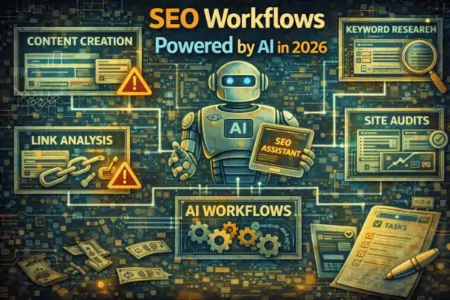
In 2026, AI didn’t replace SEO professionals.
It replaced inefficiency.
The teams winning today aren’t publishing faster just because they can. They’re building SEO Workflows that are cleaner, more repeatable, and far more data-driven than anything possible a few years ago.
The real shift isn’t “AI content.”
It’s AI-supported execution across the entire SEO lifecycle—research, planning, optimization, maintenance, and reporting. When used correctly, SEO Workflows powered by AI reduce guesswork, shorten feedback loops, and free humans to focus on judgment and strategy.
This article explains how modern SEO Workflows actually operate in 2026, where AI adds leverage, and where human control is still non-negotiable.
Why SEO Workflows Matter More Than Tools
Tools come and go. Workflows compound.
In 2026, the gap between high-performing teams and struggling ones is rarely about budgets or headcount. It’s about whether their SEO Workflows are intentional or chaotic.
Weak workflows look like:
- random keyword research
- inconsistent content briefs
- reactive optimization after traffic drops
- internal linking done “when someone remembers”
- reporting that explains nothing
Strong SEO Workflows are systematic. AI doesn’t replace thinking—it enforces structure and consistency where humans tend to drift.
1. AI-Powered Opportunity Discovery
The first place AI improves SEO Workflows is opportunity identification.
Most sites already have unrealized potential in Google Search Console:
- high impressions, low CTR pages
- queries ranking 5–15
- pages with rising impressions but flat clicks
AI accelerates discovery by:
- clustering queries by intent
- summarizing changes across time comparisons
- flagging cannibalization patterns
- identifying emerging subtopics early
Instead of manually filtering thousands of rows, AI turns raw data into a prioritized action list.
SEO Workflows become proactive instead of reactive.
2. AI for Intent-Driven Content Briefs
Content quality starts with the brief, not the draft.
Modern SEO Workflows use AI to draft:
- structured outlines
- intent-aligned headings
- common user questions
- required content blocks (comparisons, steps, FAQs)
What AI does not replace:
- originality
- real-world examples
- expert judgment
- local or industry-specific context
AI speeds up the boring parts so humans can focus on differentiation. In strong SEO Workflows, briefs are consistent, detailed, and aligned before writing even begins.
3. AI for SERP Pattern Analysis
Manually analyzing SERPs is slow and inconsistent.
AI improves SEO Workflows by extracting patterns from top-ranking pages:
- dominant formats (list, guide, tool, comparison)
- shared headings and sections
- trust signals (authors, citations, freshness)
- content gaps competitors ignore
This allows teams to compete on structure and clarity—then win on depth and insight.
SEO Workflows become pattern-aware without becoming copycat-driven.
4. AI-Assisted On-Page Optimization
On-page SEO in 2026 is not score chasing.
AI supports SEO Workflows by:
- improving intro clarity
- refining heading logic
- ensuring semantic completeness
- aligning titles and meta descriptions to intent
- formatting content for snippet and AI extraction
The highest ROI use case is upgrading pages that already rank but underperform on CTR or engagement.
AI enhances judgment—it doesn’t replace it.
5. AI for Internal Linking Systems
Internal linking is one of the most powerful and neglected SEO levers.
AI makes internal linking scalable by:
- suggesting contextually relevant links
- identifying orphan pages
- recommending natural anchor variations
- mapping topic clusters automatically
In mature SEO Workflows, internal linking is no longer random or manual. It’s reviewed, prioritized, and implemented systematically—starting with the pages that matter most.
6. AI for Content Refresh and Decay Management
Content decay is inevitable. Ignoring it is optional.
AI strengthens SEO Workflows by:
- identifying pages losing clicks
- summarizing SERP changes over time
- highlighting missing subtopics
- rewriting outdated sections for review
- improving structure and readability
Refreshing existing assets is one of the safest AI use cases because it builds on proven pages instead of flooding the site with new ones.
Strong SEO Workflows treat content as a living system, not a publishing pipeline.
7. AI for Technical SEO Prioritization
Technical SEO isn’t about fixing everything—it’s about fixing what matters.
AI helps SEO Workflows by:
- clustering crawl and index issues by template
- summarizing which problems impact key pages
- highlighting patterns in Search Console and logs
- generating QA checklists for deployments
AI doesn’t replace technical expertise. It reduces analysis time and makes prioritization clearer.
8. AI for QA and Consistency
Quality breaks first when teams scale.
AI protects SEO Workflows by acting as a QA layer:
- checking for missing sections
- flagging unclear phrasing
- spotting duplicated content
- enforcing tone and style consistency
- highlighting unsupported claims
This is especially valuable for multi-writer teams, where inconsistency quietly erodes trust.
9. AI-Driven SEO Reporting That Leads to Action
Most SEO reports describe what happened. They don’t explain what to do.
AI improves SEO Workflows by turning reporting into decision support:
- “Top pages losing clicks + why”
- “Queries rising in impressions but low CTR”
- “Pages to refresh this month for max ROI”
- “Internal linking gaps affecting priority pages”
Good reporting shortens the loop between insight and execution.
10. Governance: The Line Between AI Advantage and AI Spam
AI amplifies whatever system you already have.
In strong SEO Workflows, governance is explicit:
- no publishing without human review
- sources required for factual claims
- originality standards enforced
- limits on programmatic scaling
- clear author accountability
Without governance, AI accelerates failure. With governance, it becomes a durable advantage.
Final Thoughts
In 2026, SEO Workflows powered by AI are not about automation for its own sake.
They’re about:
- faster insight
- clearer priorities
- consistent execution
- better maintenance
- smarter decisions
AI removes friction from the process, not responsibility from the team.
The sites that win are the ones using AI to strengthen their SEO Workflows, not to flood the web with disposable content.
That’s the difference between AI as a shortcut—and AI as a system.