Build Backlinks With Resource page link building is a white hat SEO strategy where you earn editorial backlinks by getting your content listed on curated resource pages like “Resources,” “Useful Links,” “Helpful Resources,” or “Recommended Tools.”
These pages exist to help readers—so when your content genuinely improves their list, links happen naturally.
This aligns with Google’s official guidance on earning links naturally rather than manipulating rankings, as outlined in Google’s documentation on link spam policies.
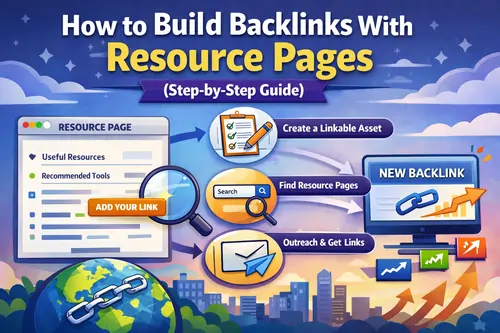
In simple terms, you’ll do three things:
- Create a linkable asset worth listing
- Find relevant resource page opportunities
- Send personalized resource page outreach to suggest your link
What Counts as a Resource Page (With Examples) Build Backlinks With Resource
A resource page is any page that collects helpful links around a topic. High-quality ones are organized, updated, and curated for a specific audience (not random link dumps).
Google itself uses curated resource-style pages in documentation hubs such as the Google Search Central documentation, which is a strong example of editorially curated references.
Common resource page names you can target
You’ll see resource pages called:
- Resources
- Useful links
- Helpful links page
- Recommended resources page
- Recommended tools
- Learning resources
- Further reading
- Best resources
- Resource library
These are prime targets for resource page backlinks, especially if your content fits their topic and audience.
Resource Pages vs Blog Posts vs Directories
Resource pages are evergreen lists built to guide readers toward quality references.
Blog posts may link out, but they’re not always curated lists.
Directories vary. Some niche directories are useful, but many accept anything and become low quality. Google’s Search Essentials guidelines emphasize avoiding manipulative link schemes.
For sustainable SEO, prioritize pages that look editorial and actively curated.
Step 1 — Create (or Choose) a Linkable Asset Worth Listing
You can’t pitch a resource page effectively if you’re sending them a thin article or a sales page.
A linkable asset is content people feel safe recommending.
This supports Google’s E-E-A-T principles (Experience, Expertise, Authoritativeness, Trustworthiness) explained in the Search Quality Evaluator Guidelines.
Best linkable asset types for resource pages
Choose one format and make it genuinely useful:
- Ultimate guide (step-by-step)
- Checklist (quick, practical)
- Templates (outreach emails, SOPs, briefs)
- Tool / calculator
- Statistics page (well-cited, updated)
- Glossary (beginner-friendly)
- Comparison guide
Well-structured content like this often earns contextual backlinks because it is easy to reference.
For example, long-form guides tend to perform well in organic rankings, as shown in multiple industry studies such as Backlinko’s analysis of Google ranking factors.
Quality Checklist (Before Outreach)
Before pitching:
- Clear promise in the intro
- Strong headings (H2/H3)
- Table of contents
- “Last updated” date
- Credible citations (government, academic, industry sources)
- Fast load time
- Mobile friendliness
- Strong internal linking
You can test mobile performance using Google’s PageSpeed Insights, especially important for Philippines and SEA audiences where mobile usage dominates (DataReportal SEA reports consistently show high mobile internet penetration: https://datareportal.com/).
Step 2 — Find Resource Page Opportunities
Method A: Google Search Operators (Footprints)
Google search operators help uncover resource pages efficiently. Google documents supported operators here.
These consistently surface pages that link out.
Method B: Competitor Backlink Analysis
If competitors rank for your keyword, analyze who links to them.
Tools commonly used in the SEO industry:
This lets you reverse engineer competitor links and identify already-proven resource page backlinks.
Method C: Prospecting at Scale
Track everything in a spreadsheet.
If scaling, you can use:
Scalable link building requires organization, not volume.
Step 3 — Qualify Targets (Protect Your Link Profile)
Relevance matters more than metrics.
Google explicitly warns against participating in manipulative linking practices in its link schemes documentation.
Quick link quality checks
- Page indexed in Google
- Curated and organized
- Outbound links relevant
- Real content across the site
- Not a link farm
For domain-level signals, you can review organic visibility using tools like Similarweb or Ahrefs.
Dofollow vs Nofollow
Google explains link attributes here; qualify outbound links
You’ll get a mix of:
- rel=”nofollow”
- rel=”sponsored”
- rel=”ugc”
- Standard dofollow links
Both can provide referral traffic and natural profile diversity.
Step 4 — Find the Right Contact
Look at:
- Contact page
- About page
- Editor bio
Personalized outreach consistently outperforms generic blasts, as supported by outreach case studies from BuzzStream: linkbuilding outreach study
Step 5 — Write Resource Page Outreach That Gets Replies
Your goal is to improve their resource page.
Personalization increases response rates. According to outreach studies (e.g., Backlinko’s outreach experiments), relevance and brevity drive better conversions:
linkbuilding
Benchmarks:
- 5–15% reply rate
- 3–10% placement rate
- Broken link emails convert higher
Broken link building works well because it improves user experience — something Google consistently emphasizes.
You can check broken links using tools like:
- Check My Links (Chrome extension)
- Screaming Frog
Step 6 — Follow Up (Politely)
Most backlinks come from follow-ups.
Research from outreach platforms like Pitchbox shows follow-ups significantly increase conversion rates:
linkbuilding outreach
Simple cadence:
- Day 3–4
- Day 7–10
- Optional Day 14
Stop after 2–3 attempts.
Step 7 — Track Wins and Scale
Treat link building like a pipeline.
Over time, this supports stronger domain authority and organic rankings, aligning with long-term organic growth strategies recommended by Google Search Central.
GEO Tips: Philippines & SEA Resource Page Link Building
Philippine educational domains (.edu.ph) and government sites (.gov.ph) are regulated under PH domain policies, which can increase trust signals when links are editorial and relevant.
You can learn more about Philippine domain structures via the PH Registry
Local links improve geographic relevance signals, which are important for local search visibility (see Google’s local SEO guidance: local seo.
Anchor Text Best Practices
Avoid over-optimized anchors. Google’s documentation on link spam makes it clear that manipulative anchor patterns can trigger penalties.
Prefer:
- Brand anchors
- Naked URLs
- Natural descriptive phrases
For example, Ahrefs provides a good breakdown of anchor text types here:
anchor text
Bonus Tactics
Link Reclamation
If someone mentions your brand but doesn’t link, request attribution.
This tactic is commonly recommended by Moz:
link-reclamation
Replace Broken Links
Broken link building remains one of the safest white-hat link building methods when done ethically.
Risks to Avoid
Avoid:
- Paying for placements
- Repeating exact-match anchors
- Pitching irrelevant niches
- Targeting link farms
- Aggressive unnatural link velocity
Google clearly defines paid link manipulation in its spam documentation.
Example Workflow (Philippines Scenario)
If you publish:
“SEO Checklist for Small Businesses in the Philippines”
You:
- Find 60 prospects using GEO footprints
- Qualify 40
- Send 30 emails
- Get 5 replies
- Earn 3 backlinks
That’s a 10% link acquisition rate — realistic for well-qualified outreach.
Repeat monthly and you can earn 15–20 contextual backlinks in 6 months without buying links.
Final Thoughts
Resource page link building works because it supports the web’s original goal: helping users discover useful information.
If you:
- Create strong linkable assets
- Follow Google’s link quality guidelines
- Use smart prospecting footprints
- Write helpful outreach emails
- Follow up politely
- Track everything
You’ll earn consistent, editorial resource page backlinks that support rankings, referral traffic, and authority — safely and sustainably.