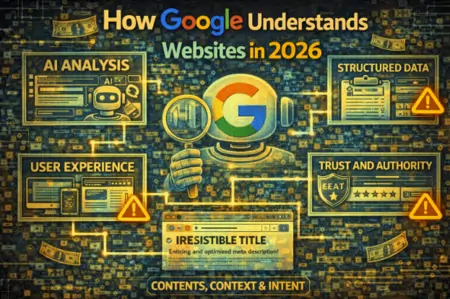
In 2026, SEO isn’t about “telling Google what your page is.” It’s about making your site easy to interpret as a system. Google doesn’t just read text anymore—it evaluates structure, intent satisfaction, entity relationships, internal linking, indexing patterns, and signals that indicate whether a site is consistent and trustworthy.
That’s why understanding How Google Understands Websites is one of the most useful skills you can develop. When you know how Google interprets your pages, you stop guessing. You build clarity: clear architecture, clear topical relationships, clean indexing, and pages that match what users actually want.
This guide explains How Google Understands Websites in 2026, in a practical way beginners and working SEOs can apply immediately.
1) Google Starts With Discovery: Crawling Is the First Gate
The first step in How Google Understands Websites is crawling. Googlebot has to discover your URLs, access them, and retrieve the content.
Google finds pages through:
- internal links (most important)
- sitemaps
- external links
- previously known URLs
If Google can’t crawl a page consistently, it can’t evaluate it reliably.
Beginner takeaway: internal linking is not optional. It’s the backbone of How Google Understands Websites, because it controls discovery.
2) Indexing Is Selective Now: Not Everything Gets In
In 2026, indexing is not guaranteed. A huge part of How Google Understands Websites is deciding what’s worthy of being stored, processed, and ranked.
Pages often don’t index because they look:
- thin
- duplicated
- low-value
- structurally messy
- disconnected from the internal link graph
If your site produces thousands of near-duplicate URLs (tags, filters, parameters), Google becomes more selective.
This is why index hygiene matters. Clean sites send stronger signals, and that affects How Google Understands Websites at the domain level.
3) Google Thinks in Entities, Not Just Keywords
A major shift in How Google Understands Websites is entity-based understanding.
Google tries to identify:
- people
- brands
- places
- products
- concepts
- relationships between them
Instead of matching exact keywords, Google maps meaning. This is why pages can rank for many query variations even if they don’t contain the exact phrasing.
How you support entity understanding:
- use clear topic coverage
- include related terms naturally
- link to relevant supporting pages
- define concepts clearly
- avoid vague, generic writing
Entity clarity is one of the most overlooked parts of How Google Understands Websites.
4) Google Uses Internal Links to Understand Priority and Relationships
Internal links tell Google two things:
- what pages matter most
- how topics connect
This is central to How Google Understands Websites because Google’s understanding is graph-based.
If your important page is buried:
- 5 clicks deep
- linked only once
- isolated from topic hubs
…it looks less important.
A strong site uses:
- topic hub pages
- consistent contextual linking
- breadcrumb structure
- clear navigation priorities
This makes How Google Understands Websites simpler: it sees a site with intentional structure, not a pile of posts.
5) Google Evaluates “Intent Match” Through Behavior Signals
In 2026, Google cares deeply about whether users are satisfied.
This is part of How Google Understands Websites because satisfaction helps Google choose which pages deserve stable rankings.
A page can be relevant but still lose if it:
- doesn’t answer quickly
- matches the wrong format (essay vs checklist)
- feels hard to use on mobile
- lacks decision support
Practical improvements:
- answer early
- structure headings clearly
- include steps, tables, or FAQs
- provide examples and proof
These aren’t just content tips—they affect How Google Understands Websites as “helpful” or “replaceable.”
6) Structured Data Helps Reduce Ambiguity
Schema isn’t a cheat code, but it’s a clarity tool.
Structured data helps How Google Understands Websites by:
- labeling page type (article, product, local business)
- clarifying entities (organization, person)
- improving interpretation of key elements (reviews, FAQs)
Schema doesn’t guarantee rich results, but it reduces confusion—especially on sites with complex templates.
7) Template Quality Matters More Than Individual Page Tweaks
Most sites don’t fail because one page is messy. They fail because templates produce repeated weakness across hundreds of URLs.
That’s why How Google Understands Websites is often template-driven:
- heading structure consistency
- internal link placement
- schema consistency
- duplicate content patterns
- thin page generation risks
If a template creates low-value pages at scale, it impacts the whole domain.
Beginners should learn to audit by page groups, not single URLs. That’s a major lesson in How Google Understands Websites.
8) Index Bloat Confuses Site Quality Signals
Google evaluates site quality partly through patterns. If your index contains too many low-value pages, it becomes harder for your best pages to stand out.
Common sources of bloat:
- tag archives
- thin categories
- internal search pages
- duplicate pagination
- parameters and filters
Cleaning bloat helps How Google Understands Websites focus on what matters. Fewer, stronger pages often perform better than thousands of weak ones.
9) Page Experience Still Matters, But It’s Strategic
Core Web Vitals and UX matter most where they impact real users:
- top landing pages
- high-conversion pages
- pages with heavy interaction
A slow site can still rank, but weak UX hurts engagement, which loops back into How Google Understands Websites through satisfaction signals.
Practical priorities:
- reduce heavy scripts
- compress images
- improve above-the-fold speed
- avoid layout shifts
10) Google Understands Websites Through Consistency Over Time
In 2026, stability is built through consistency:
- consistent topic coverage
- consistent quality across sections
- consistent internal linking patterns
- consistent updates to keep content accurate
One reason sites struggle is unevenness: a few strong pages surrounded by many weak ones.
That inconsistency affects How Google Understands Websites at the domain level: it becomes cautious.
How to Improve How Google Understands Your Website (Beginner Checklist)
If you want to improve How Google Understands Websites in practice, do this:
- Build topic hubs (pillar pages)
- Strengthen internal linking into priority pages
- Clean up index bloat (noindex thin archives if needed)
- Ensure sitemap includes only canonical, valuable pages
- Make pages answer quickly and match SERP format
- Add structured data where it truly applies
- Fix template issues that create duplication
- Improve performance on top landing pages
- Keep content updated and accurate
- Review GSC indexing and performance monthly
These steps make your site easier to crawl, easier to index, and easier to trust.
Final Thoughts
Understanding How Google Understands Websites in 2026 changes how you do SEO. You stop chasing isolated tactics and start building clarity:
- clear structure
- clean indexing
- strong internal linking
- entity-focused content
- intent satisfaction
- consistent quality
When your site becomes easier to interpret, rankings become more stable, and growth becomes more predictable.
That’s the real advantage of mastering How Google Understands Websites—you build a site Google can confidently surface again and again.