If you want SEO that lasts in 2026, you don’t start with content hacks. You start with structure.
Because great content on a messy site still struggles. Google can’t prioritize what it can’t understand, and users won’t trust what feels hard to navigate. That’s why learning How to Structure Websites for long-term SEO is one of the highest ROI skills you can build—especially as SERPs become more intent-driven, more feature-heavy, and more selective about indexing.
This guide explains How to Structure Websites so rankings don’t depend on constant publishing or luck. We’ll cover site architecture, topic clustering, internal linking systems, index hygiene, and template decisions that scale cleanly as your site grows.
Why Structure Is the Foundation of Long-Term SEO
In 2026, Google evaluates sites as systems:
- Are topics organized clearly?
- Are important pages supported by internal links?
- Is the index clean or bloated?
- Do templates create duplicate noise?
- Can users find what they need fast?
If you get structure right, every new page performs better. If you get structure wrong, every new page adds friction. That’s the central reason How to Structure Websites matters more than ever.
1) Start With Clear Site Architecture, Not Random Categories
The first step in How to Structure Websites is choosing an architecture that matches how people search.
For most sites, a simple hierarchy works best:
- Home
- Category / Service / Topic Hub
- Subcategory / Supporting Topics
- Individual pages (articles, products, locations)
- Subcategory / Supporting Topics
- Category / Service / Topic Hub
Beginners often create categories based on internal preferences rather than search behavior. Long-term SEO structure requires categories that:
- reflect search intent
- avoid overlap
- stay stable over time
If your categories compete with each other, your content competes with itself. That’s why How to Structure Websites starts with logical grouping.
2) Build Topic Hubs and Clusters (The “Topical Authority” System)
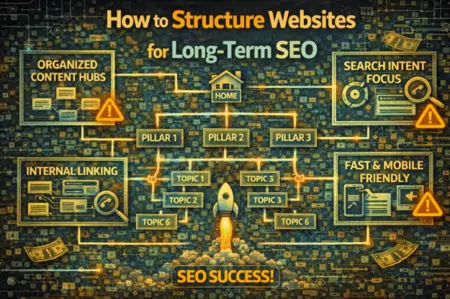
One of the clearest answers to How to Structure Websites for long-term SEO is topic clustering.
A cluster model looks like this:
- Pillar (Hub) Page: the main guide for a topic
- Support Pages: specific subtopics, comparisons, how-tos, FAQs
- Internal Links: support pages link back to the pillar, and the pillar links out
This structure helps Google understand:
- what the site is about
- which page is the “main” page for an intent
- how depth is distributed across the topic
Topic hubs also help users navigate without bouncing. If you’re serious about How to Structure Websites, clusters are not optional—they’re the long-term foundation.
3) Keep URL Structure Consistent and Predictable
Another critical part of How to Structure Websites is URL discipline.
Good URLs:
- are short and readable
- reflect hierarchy (when appropriate)
- avoid unnecessary parameters
- stay stable over time
Examples:
/seo/(hub)/seo/ctr-optimization/(support)/seo/internal-linking/(support)
Avoid:
- changing slugs frequently
- stacking dates unless necessary
- inconsistent folder naming
Long-term SEO rewards stability. URL chaos creates duplication and crawling inefficiency. That’s why How to Structure Websites includes URL governance early.
4) Use Navigation to Signal Priority (Not Just Convenience)
Your navigation isn’t just for users—it’s for SEO signals.
In How to Structure Websites, your top navigation should reflect:
- your most important commercial pages
- your most important topic hubs
- the sections you want Google to crawl frequently
Common mistakes:
- hiding key pages behind multiple clicks
- linking to low-value pages in nav (thin archives, tags)
- overloading menus with everything
Your nav should tell Google: “These are our core pillars.” That’s a practical reason How to Structure Websites matters: navigation is authority distribution.
5) Internal Linking Must Be a System, Not a Habit
If you want long-term SEO, internal linking can’t be random.
A strong internal linking system is central to How to Structure Websites because it controls:
- crawl paths
- page importance
- topical relationships
- authority flow
A simple internal linking rule set:
- every support page links to its pillar
- pillars link to all key support pages
- related support pages link to each other where relevant
- high-authority pages link into priority money pages
Also: avoid internal links pointing to non-canonical versions of URLs. Consistency matters.
6) Control Index Hygiene as You Scale
One reason sites become unstable is index bloat.
A major part of How to Structure Websites for long-term SEO is deciding what should not be indexed.
Common index bloat sources:
- tag pages
- thin category pages
- internal search results
- filter pages and parameters
- duplicate pagination and sorting URLs
Long-term structure includes:
- noindexing low-value archives (when appropriate)
- canonicalizing duplicates properly
- blocking crawl traps when needed
- keeping your sitemap clean
A clean index makes your site easier to evaluate and more stable over time. This is a core principle of How to Structure Websites.
7) Design Templates That Scale Cleanly
Most SEO issues come from templates, not individual pages.
If you want to master How to Structure Websites, you must think in templates:
- blog post template
- category template
- product template
- location page template
Template-level decisions affect:
- headings and structure
- internal link placement
- schema consistency
- duplication risks
- load performance
When templates are clean, every new page starts strong. When templates are messy, every new page multiplies problems. That’s why How to Structure Websites is really about scalable systems, not one-off fixes.
8) Avoid “Orphan Pages” and Dead-End Content
An orphan page has no internal links pointing to it.
In long-term SEO, orphan pages are wasted assets. They:
- get crawled less
- rank weaker
- fail to join topic clusters
- confuse site structure
In How to Structure Websites, you should ensure:
- every published page is linked from at least one relevant page
- every important page is linked from multiple relevant pages
- hub pages connect everything logically
This is one of the simplest ways to strengthen structure without publishing anything new.
9) Use Breadcrumbs and Context Links for Clarity
Breadcrumbs help users and search engines understand hierarchy.
For How to Structure Websites, breadcrumbs:
- reinforce category relationships
- reduce confusion in deep structures
- improve internal linking naturally
- support crawl discovery
Contextual links inside content are equally important. They signal topical relationships beyond hierarchy.
Together, these elements create clarity—a key goal in How to Structure Websites for long-term SEO.
10) Structure for Humans First, Then Search
The best structure is the one users can navigate without thinking.
In 2026, user experience is increasingly tied to SEO outcomes:
- engagement signals
- pogo-sticking behavior
- trust and brand perception
A good test:
If a user lands on a page, can they easily find:
- related guides?
- deeper subtopics?
- the next step?
- the main category hub?
If yes, your site is structured well. That’s the human side of How to Structure Websites.
A Beginner-Friendly Long-Term Structure Blueprint
If you want a simple model to follow, here’s a structure that works for most sites:
- Define 5–10 core topics (your pillars)
- Create one hub page per topic
- Write supporting pages that answer sub-intents
- Link support → hub and hub → support
- Keep URLs consistent
- Noindex low-value archives if they add no value
- Keep important pages within 2–3 clicks from the homepage
- Audit internal linking monthly
This blueprint is essentially How to Structure Websites as a repeatable system—not a one-time redesign.
Final Thoughts
Long-term SEO isn’t built on publishing speed. It’s built on clarity.
When you learn How to Structure Websites properly, everything compounds:
- Google understands your site faster
- important pages get crawled and ranked more consistently
- content clusters build topical authority
- internal linking distributes power where it matters
- index hygiene keeps the site stable as it grows
If you take only one lesson from this guide, let it be this:
Structure is what makes SEO durable.
That’s How to Structure Websites for long-term SEO in 2026—built for scalability, stability, and growth.