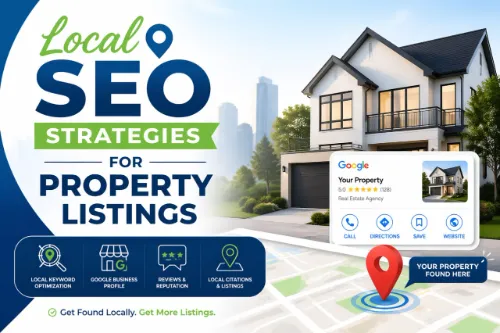
The Ultimate Local SEO Strategies for Property Listings (2026 Update)
In the modern real estate landscape, if your property listings are not optimized for local SEO, you are invisible to 73% of potential buyers who start their search online. Whether you are a real estate agent, property manager, or a listing platform, the difference between a sold sign and an expired listing is often a few pixels on a Google map.
However, ranking today requires more than just stuffing “condos for sale in [Zip Code]” into a meta tag. You need a holistic strategy that satisfies Google’s algorithm, speaks to Generative Engine Optimization (GEO) for AI Overviews, answers direct questions for Answer Engine Optimization (AEO), and uses simple, Natural Language Processing (NLP) friendly phrases. For a complete overview of essential tactics, review these local SEO strategies for property listings.
This 2,000+ word guide will walk you through every technical detail, keyword, and tactic to dominate your local market.
Chapter 1: The Foundation – Keyword Research & Local Intent Mapping
Before you write a single line of code or snap a photo, you must understand the lexicon of your neighborhood. Local SEO for property listings starts with identifying geo-modifiers.
The Three Tiers of Local Keywords
- City Level: “Homes for sale in Austin.”
- Zip Code Level: “Real estate 78701.”
- Neighborhood & Landmark Level: “Condos near South Congress Bridge” or “Townhomes walking distance to Google Fiber.”
NLP Strategy: Google’s BERT algorithm understands context. You need to build a local keyword matrix.
- Informational queries: “What are the best neighborhoods in Denver for families?” (Target with blog posts).
- Commercial queries: “Luxury apartments with city views Seattle” (Target with service pages).
- Transactional queries: “Rentals for sale in Coral Gables” (Target with listing titles).
Tools to Use: Use Google Keyword Planner to find volume, SEMrush to spy on competitors, and Ubersuggest for long-tail questions. Look for phrases like “walking distance to train station” or “quiet streets in…”
Chapter 2: On-Page SEO – Optimizing the Individual Listing
Every property listing page is a digital salesperson. It must scream relevance to search engines immediately.
Title Tags & Meta Descriptions
Your title tag is the first thing a user sees. It must include the full address or the area plus the property type.
- Bad: “Beautiful 3 Bedroom House”
- Good: “3BR House for Sale | 123 Main St, Brooklyn, NY 11215”
- Best (for GEO): “Walk to Prospect Park: 123 Main St – A Brooklyn Heights Gem”
Meta Descriptions need a call to action. “See inside this condo for sale in [Zip Code]. Hardwood floors, 2-car garage. Schedule a showing today.”
Header Tags (H1, H2, H3)
Structure your content logically.
- H1: 304 Brazos St: A Luxury Condo in Downtown Austin, TX 78701
- H2: Location Overview: Proximity to Lady Bird Lake
- H3: Commute Times & School Ratings
Image Optimization (The Visual Graph)
Google cannot see images, but it can read filenames and alt text. Do not upload IMG_4456.jpg.
- Rename: 123-main-st-kitchen-granite-countertops.jpg
- Alt Text: “Spacious kitchen with island at the condo for sale in [Zip Code] near Central Park.”
- Geotagging: Use software to embed GPS coordinates into the photo metadata. This is a powerful, often ignored, local signal.
Schema Markup (The Cheat Code)
You must implement structured data. Without it, you are guessing. Use RealEstateListing schema and Place schema.
- Markup the price, priceCurrency, address, and latitude/longitude.
- Result: Google shows a rich snippet with price and bedrooms directly in the search results, boosting your click-through rate by 30%.
Embed Google Maps
Always embed an iframe showing the property’s location. Highlight the walking score and transit score. Google checks if the map matches the address text on the page.
Chapter 3: Location-Specific Content – Beyond the Listing
You cannot rank for “best neighborhoods” if you only have property pages. You need neighborhood landing pages.
Creating Hyperlocal Pillars
Create a page for every district you serve. For example: “Homes in Silver Lake, Los Angeles.”
On this page, include:
- School ratings (Elementary, Middle, High).
- Commute times to downtown or major tech hubs.
- Nearby parks and grocery stores (Target, Whole Foods, etc.).
- Area comparison guides: “Silver Lake vs. Echo Park: Which is right for you?”
Blogging for Voice Search (AEO)
People speak differently than they type. For Answer Engine Optimization, write content that answers specific questions. Need inspiration? Explore these real estate content ideas for organic lead generation to keep your blog fresh and engaging.
- Blog Title: “Open houses in Buckhead this weekend: Your guide to Atlanta luxury.”
- Blog Title: “Rental price trends in Mission District: Is now the time to lease?”
- Blog Title: “Moving to Miami? A local guide to Brickell’s high-rises.”
Pro Tip: Create a section for User-generated content. Ask past tenants or buyers: “What is your favorite thing about living on Elm Street?” Their natural language (e.g., “I love the taco truck on the corner”) uses NLP friendly long-tail keywords you would never think to type.
Chapter 4: Google Business Profile (GBP) – The Local Pack King
If you don’t rank in the Local Pack (the map results at the top of Google), you lose. Real estate is a local business; treat it as such.
Optimization Tactics
- Claim every office and every agent. Do not rely on a single GBP for a whole city.
- Service Areas: You can list up to 20 neighborhoods. List the specific zip codes you target.
- Products/Services Section: Add “Single Family Homes,” “Luxury Penthouses,” and “Commercial Leases” here.
- GBP Posts: Treat this like a mini social network. Post weekly:
- “New listing: 3BR in Lincoln Park (Link to virtual tour).”
- “Price drop on [Address] – now $450k.”
- “Just sold! Congrats to the Smith family in River North.”
Reviews & Q&A
Collect local reviews relentlessly. The algorithm weighs review velocity heavily.
- Ask clients to mention landmarks: “John helped us buy a condos for sale in [Zip Code] near the baseball stadium.”
- Respond to every review using local keywords. “Thank you, Jane! We love helping families find real estate near downtown.”
- Monitor the Q&A section on your GBP. If someone asks, “Is this near the highway?” answer immediately. If you don’t answer, Google will scrape the web for an answer (which might be wrong).
Chapter 5: Local Citations & NAP Consistency
A “citation” is any mention of your business name, address, and phone number (NAP) on the web. Inconsistency destroys trust.
Where to List
You need citations on industry-specific sites and general directories.
- Major aggregators: Realtor.com, Zillow, Trulia, Homes.com, Apartment Finder.
- Local gems: Yelp, Bing Places, Apple Maps, Nextdoor.
- Commercial: LoopNet, Redfin, HotPads.
The Audit
Use tools like Moz Local, BrightLocal, or Yext to scan the web.
- Issue: “Main St” vs “Main Street” vs “Maine St.”
- Fix: Standardize to exactly what is on your tax records.
- Cleanup: If you find duplicate/inaccurate listings, disavow them or claim them to fix the data. A single NAP mismatch can drop your local rank by 50%.
Chapter 6: Link Building – The Local Authority Signal
Google needs to know you are a trusted member of the community. You cannot buy links; you must earn them with local relevance.
Ethical Link Building Strategies
- Sponsor Local Events: Give $500 to the school carnival. In return, get a backlink from the school’s .org website. This is gold for local SEO.
- Partner with Local Businesses: Write a blog post titled “Top 5 Furniture Stores to Style Your New Loft.” Email those stores. They will likely link back to you as a “Preferred Real Estate Agent.”
- Chambers of Commerce: Join the local chamber of commerce. The directory link is usually high authority and geographically relevant.
- Create a “Local Guide” Resource: Build a PDF map of the best jogging trails or dog parks. Offer it for free. Local bloggers will link to it as a resource.
- HARO (Help a Reporter Out): Sign up for queries related to real estate trends in your specific city. “Real estate expert in Phoenix needed for article on heat waves.” Getting quoted gets you a .news or .com backlink.
For a deeper dive into advanced techniques, including how to leverage specialized agencies, check out this guide on SEO services for real estate agencies.
Chapter 7: Mobile & Technical SEO – The Speed to Lead
Over 90% of property searches start on mobile. If your site loads slowly on an iPhone, Google will demote you.
Core Web Vitals
Google measures LCP (Largest Contentful Paint), FID (First Input Delay), and CLS (Cumulative Layout Shift).
- Fix: Compress images using WebP format.
- Fix: Enable lazy loading so images load only as the user scrolls.
- Fix: Remove pop-ups that cover the main content on mobile.
Internal Linking Structure
You need a web, not a chain.
- From your blog post (“Best neighborhoods in Dallas”) link to your specific neighborhood landing pages.
- From your neighborhood landing pages, link to your individual property listings.
- Use descriptive anchor text: “Check out this rental price trend analysis” rather than “Click here.”
Handling Expired Listings (404s)
When a property sells, do not delete the page. You lose the SEO equity.
- 301 Redirect the sold listing to a similar area page or a “Just Sold” neighborhood roundup.
- Example: /123-main-st → /homes-for-sale-in-downtown
XML Sitemaps & Hreflang
- Ensure your XML sitemap includes
<loc>tags for every property page. - If you serve bilingual neighborhoods (e.g., Miami or Los Angeles), use hreflang tags to serve English and Spanish versions of the listing.
Chapter 8: Social & Community Signals (The Off-Page Glue)
While social media links are technically “nofollow,” they drive engagement, and engagement drives SEO.
Platform Tactics
- Instagram/Facebook: Use local hashtags like #CityRealEstate, #NeighborhoodLiving, #AustinCondoLife. Geo-tag your posts at the property address.
- Facebook Groups: This is a goldmine. Join “Moving to [City] for Work” groups. Do not spam. Answer questions helpfully and drop your link naturally.
- Nextdoor: Claim your business page on Nextdoor. When people ask “Who is a good realtor in the 78701 zip code?” respond immediately.
User Engagement
Encourage user check-ins at open houses. When people check in on Facebook at “123 Main St Open House,” that social proof signals to Google that the location is active and popular.
Chapter 9: Review & Reputation Management (The Trust Factor)
Local SEO is trust SEO. You cannot outrank a competitor with a 4.9 star rating and 200 reviews if you have a 4.0 with 5 reviews.
The Automation Workflow
- Timing: Send a review request via text message exactly 2 hours after a showing or immediately after a lease signing.
- The Ask: “Share your experience finding properties for sale in [Neighborhood].”
- Response Protocol: Respond within 24 hours.
- Positive: “Thank you! We are thrilled you love your new luxury apartment.”
- Negative: “We are sorry to hear this. Please DM us so we can address the rental price discrepancy immediately.”
Monitoring
Set up Google Alerts for your brand name + city name. Use Brand24 to catch mentions on Reddit or forums. If someone complains about a “broken AC in a rental,” you can jump in to help (and get a link).
Chapter 10: Tracking & KPIs – What Gets Measured Gets Managed
You cannot optimize what you don’t track. You need to look beyond just “traffic.”
The Local SEO Dashboard
- Local Pack Rankings: Use Local Falcon to see where you rank in the map pack for “condos for sale in [Zip Code].” Run this daily.
- GBP Insights: How many people requested direction requests to your office? How many phone calls did you get from the Google listing?
- Google Analytics 4 (GA4): Track organic traffic to your neighborhood landing pages. Look at “Event counts” for contact form submissions.
- Call Tracking: Use CallRail. You need to know which keyword (“near downtown” vs “near the airport”) drove the phone call that turned into a commission.
- Behavior Flow: Use Hotjar to watch session recordings. Are users clicking the “Schedule a Tour” button? Or are they bouncing because the map is broken?
Key Metrics
- Click-to-Call rate: % of searchers who hit the phone button.
- Conversion rate: Listing view → Inquiry.
- Organic Impression Share: How often you show up for real estate trends in [District].
Chapter 11: Advanced GEO & AI Overview Optimization
Generative Engine Optimization (GEO) is how you get cited in Google’s AI Overviews (formerly SGE). AI Overviews pull answers from specific, authoritative sources.
How to get cited by Google’s AI
- Write like a Wikipedia editor: Use clear, declarative sentences. “The average rental price in Buckhead is $2,300 for a one-bedroom.”
- Define your terms: The AI needs to understand you. Say “A local guide to Brickell’s high-rises (buildings over 40 stories).”
- Use Lists & Tables: AI loves structured data. Create a table comparing “Neighborhood A vs. Neighborhood B” by commute time, price, and school rating.
- Answer “People Also Ask” boxes directly: Go to Google, type “Is it expensive to live in Silver Lake?” Write a 50-word paragraph answering exactly that at the top of your page.
The Future of Search
As search shifts from “10 blue links” to “AI generated answers,” your goal is to be the source. Use NLP friendly language. Avoid jargon. Write for a 6th-grade reading level. This makes it easy for the AI to parse your text and serve it as the answer.
Conclusion: Your 90-Day Implementation Plan
Month 1: Foundation
- Audit NAP consistency (BrightLocal).
- Fix 404 errors (301 redirects).
- Claim/optimize Google Business Profile (Add services, posts).
Month 2: Content & Links
- Write 3 neighborhood landing pages (one per week).
- Publish 2 area comparison guides.
- Sponsor 1 local event for a backlink.
Month 3: Technical & Reviews
- Compress all images (WebP).
- Add RealEstateListing schema to top 10 properties.
- Generate 10 new local reviews (ask past clients).
By combining traditional Local SEO with GEO, AEO, and NLP principles, you stop fighting the algorithm and start working with it. Start with your Google Business Profile today, then move to your local keyword matrix, and watch your properties for sale climb the local pack.
Frequently Asked Questions
1. Can I use ItemList schema for multiple property listings on a single neighborhood page?
Yes. Wrapping individual RealEstateListing schema items inside an ItemList schema helps Google understand that you are presenting multiple options (e.g., “Condos for sale in 78701”). This can enable a “carousel” rich result in search, showing 3-5 properties with prices and bedrooms directly on the SERP.
2. How do I handle schema for “coming soon” listings that don’t have a price yet?
Use Offer schema with availability: "ComingSoon" or "PreOrder". Omit the price property entirely rather than using a placeholder like “$0”. Add a description field stating “Price coming [date]” to provide transparency for both users and crawlers.
3. Should I use noindex on virtual tour pages (e.g., Matterport embeds)?
No. Keep them indexable but canonical back to the main property listing page. Virtual tour pages often rank for long-tail visual queries like “3D walkthrough of loft in Tribeca.” Use rel="canonical" to consolidate SEO equity while allowing the tour to be discovered.
4. Does Google penalize using the same address for multiple “virtual” office GBPs?
Yes, if you don’t have a physical suite/unit distinction. Google’s guidelines require distinct, staffed locations. To safely list multiple agents at one address, use Suite A, Suite B, etc., and ensure each has unique phone numbers, business hours, and in-person signage. Without these, you risk a suspension for “spammy virtual offices.”
5. How do I mark up HOA fees and special assessments in schema?
Use additionalProperty within the Product or RealEstateListing schema. Create a custom PropertyValue with name: "HOA Fee" and value: "$450/month". For special assessments, use name: "Special Assessment" and value: "$2,000 (roof replacement due 2026)".
6. Can I create a GBP for a specific high-value property (e.g., a luxury penthouse) if it’s vacant and has showings?
Only if you have a physical office inside that property with permanent signage. Otherwise, it violates GBP’s “rentable or virtual offices” policy. Instead, create a “property listing” in Google’s “Products” section of your main GBP, or use a “service area” radius that centers on that address.
7. My GBP is showing the wrong “primary listing” photo for my properties. How do I force the correct image?
Google uses machine vision to select the “hero” image. To override, upload 10+ high-quality, geotagged photos of the same property. In GBP Insights, track which photo gets the most views. Delete any photos with low engagement. After 7-14 days, Google typically re-selects based on engagement velocity.
8. What’s the best way to handle “open house” special hours on GBP without confusing Google?
Use the “Special Hours” feature for the open house date, but add a GBP Post titled “Open House Sunday 1-4 PM” with a link. Do not alter your regular business hours. For multi-day open houses (e.g., Friday+Saturday), add each day as a separate special hour entry.
9. Can I add a “price range” attribute to my GBP for properties?
Not directly. However, in the “Products” section, you can create a product called “Homes for sale” and set a price range in the description (e.g., “$300k – $1.2M”). Google sometimes extracts this as a structured attribute in the Local Pack.
10. How do I remove a fake or outdated GBP listing for a property I no longer represent?
Use Google’s “Suggest an edit” feature on the listing, then select “Place is permanently closed or doesn’t exist.” If that fails, file a Redressal Form through Google’s Business Profile support. Attach proof of your exclusive listing agreement or recorded deed. This usually resolves within 2-3 weeks.
11. How do I optimize for “near me” voice searches like “open houses near me this Saturday”?
Create a dedicated “Open Houses This Weekend” page that dynamically updates based on the searcher’s IP geolocation. Use the phrase “open houses near me” in an H2 tag, but also list specific cross-streets. For voice, write conversational sentences: “If you are near the Target on 5th Avenue, our open house is just three blocks away.”
12. What is the ideal word count for a neighborhood landing page in 2026?
Minimum 1,800 words, but quality trumps length. Google’s 2026 helpful content update favors “sufficient comprehensiveness.” For competitive zip codes (e.g., 90210), aim for 2,500+ words covering schools, crime stats, commute options, grocery stores, parks, and 5-7 user-generated testimonials with local phrases.
13. Should I include “crime statistics” on my property pages? Will that hurt conversions?
Yes, include them transparently, but frame them positively. Instead of “Crime rate: high,” write “Crime rate decreased 12% year-over-year” or “Safe streets initiative launched 2025.” Google’s E-E-A-T (Experience, Expertise, Authoritativeness, Trust) rewards honesty. Omitting crime data can lower your trust score compared to competitors who include it.
14. How do I optimize PDF floor plans for local search?
PDFs are notoriously hard to rank. Instead, convert each floor plan into an HTML table or SVG image. For the PDF itself, use a descriptive filename like “123-main-st-3br-floor-plan.pdf”, add an <object> tag with title="Floor plan for 123 Main St condo", and ensure the PDF’s metadata (author, subject, keywords) includes the full address and zip code.
15. Can user-generated comments on my listing page create “keyword cannibalization”?
Yes, if users repeatedly mention competing neighborhoods. For example, if five comments say “This is almost as good as living in Beverly Hills,” Google might associate your Silver Lake page with Beverly Hills. Moderate comments regularly. Use rel="ugc" on user-generated links to reduce SEO weight.
16. Are backlinks from “local news” comments sections valuable?
Generally no, because most comment links are nofollow and low trust. However, if you are quoted in a legitimate news article, request that the journalist link to your site from the body (not the comments). A single .news or .org backlink from a reporter is worth 100 comment-section links.
17. How do I get a backlink from a local university’s .edu site for my property listings?
Partner with the university’s off-campus housing office. Offer to create a free “Off-Campus Rental Guide” for students, listing properties near campus. The housing office will often link to your guide from their .edu domain. Include a map with walking times to specific dorms or lecture halls.
18. Should I list every single property on Yelp?
No. Yelp is for businesses, not individual listings. Create one Yelp page for your agency. Then, within Yelp, add “Projects” or “Services” for each major property. Do not create separate Yelp pages for each address—that violates Yelp’s terms and can result in a ban.
19. What is a “citation gap” and how do I find mine?
A citation gap is when your competitors are listed on a high-quality local directory that you are missing. Use BrightLocal or Whitespark to run a “Citation Gap Analysis.” Enter your domain and 3 competitors. The tool will show you directories where they appear but you don’t. Prioritize directories with Domain Authority 50+.
20. How do I handle NAP consistency for a property management company with 50+ rental units at one address?
Use a “suite number” for each unit (e.g., “Unit 4A”) in the address line, even if the building doesn’t formally use them. For citations, create one master listing for the main office. For individual units, use a consistent format like “123 Main St #4A” across all citations. Google treats #4A and Unit 4A as the same if the primary name matches.