Search intent guide (also called user intent or keyword intent) is the reason behind a person’s Google search. It’s the “why” behind the query. When you match your page to intent, you improve rankings, get better clicks, and earn more conversions. This is the foundation of intent-based SEO, intent optimization, and intent targeting—a concept Google explicitly supports in its Search Quality Rater Guidelines.
In this search intent guide, you’ll learn how to identify informational intent, commercial intent, and transactional intent, choose the best content formats, and use a practical workflow for intent research, intent analysis, SERP analysis, and intent mapping—with examples you can apply to Philippine audiences (including “near me / malapit sa akin,” Metro Manila, Cebu, Davao, and ecommerce searches on Shopee and Lazada).
What Is Search Intent Guide?
Search intent guide is what a searcher wants to do next: learn, compare, or take action. Google’s job is to show the most helpful result for that intent. Your job is to build the right page type for the right intent.
According to Ahrefs, understanding intent is one of the most important ranking factors because Google ranks pages that best satisfy the searcher’s goal (source).
You’ll also see search intent guide described as:
- user intent
- keyword intent
- intent-based SEO
- intent-driven content
- intent optimization
- intent targeting
- intent mapping
- intent analysis
- intent research
If you target the wrong intent, you can write a great article and still not rank—or rank and still not convert.
The 3 Main Types of Search Intent Guide (Quick Overview)
SEO platforms like Semrush classify search intent guide into clear categories used in keyword research tools (source):
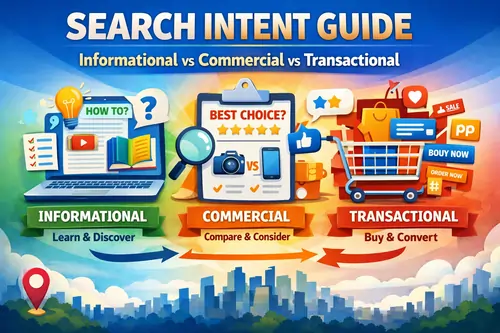
| Intent Type | What the Searcher Wants | Typical Next Step |
|---|---|---|
| Informational intent | Learn or understand something | Read a guide, tutorial, definition |
| Commercial intent | Compare options before choosing | Check reviews, comparison, best lists |
| Transactional intent | Buy or take action now | Buy, order, book now, sign up |
There’s also navigational intent (when users want a specific brand or site), but this guide focuses on the three most monetizable intents.
Informational Intent (Learn / Understand)
Informational intent means the searcher wants knowledge, instructions, or clarity. These searches often include modifiers like “what is,” “how to,” or “guide.”
How to Identify Informational Keywords
Common informational modifiers include:
- what is
- how to
- guide
- tutorial
- examples
- tips
- checklist
- definition
- explained
- difference between
- vs
If a query feels educational, it’s informational. Neil Patel explains this clearly in his breakdown of search intent Guide (source).
Informational Query Examples
Generic
- “what is search intent Guide”
- “how to do keyword research”
- “SERP analysis tutorial”
- “intent mapping guide”
PH / local
- “what is COD in Shopee”
- “how to track Lazada order”
- “how to find dental clinic near me”
- “best study habits for students in Metro Manila”
Best Content Formats for Informational Intent
- Blog post
- Guide or tutorial
- FAQ page
- Glossary / definition article
- Explainer content
This is where Answer Engine Optimization (AEO) matters. Google often pulls featured snippets from pages that answer questions directly (Google Search Central).
Commercial Intent (Compare / Consider)
Commercial intent (also called commercial investigation) happens when users are comparing options before deciding.
Common Commercial Modifiers
- best
- top
- review / reviews
- comparison
- alternatives
- pros and cons
- [product] vs [product]
- worth it
- ratings
Commercial Keyword Examples
- “best SEO tools”
- “Semrush review”
- “Ahrefs vs Semrush”
- “recommended dermatologist Cebu”
- “top online casino sites Philippines”
According to Backlinko, these keywords convert well when paired with comparison-style content.
Best Content Formats for Commercial Intent
- Comparison pages
- Listicles
- Reviews pages
- Buyer’s guides
- Best-of hub pages
Add comparison tables, trust signals, and clear CTAs like “See pricing” or “View alternatives.”
Transactional Intent (Buy / Act Now)
Transactional intent means the user is ready to take action—buy, book, sign up, or download.
Common Transactional Modifiers
- buy
- pricing / cost
- book now
- sign up
- subscribe
- deal / discount
- coupon / promo code
- free shipping
- in stock
- near me
In the Philippines, transactional searches often include price Philippines, PHP, or marketplace platforms like Shopee and Lazada.
Transactional Keyword Examples
- “SEO services pricing”
- “buy iPhone 15 price Philippines”
- “book now hotel in Cebu”
- “Shopee voucher free shipping”
Google confirms that transactional intent usually ranks product, category, and service pages, not blog posts.
Best Content Formats for Transactional Intent
- Landing pages
- Product pages
- Category pages
- Service pages
- Booking pages
How to Determine Intent From the SERP
The fastest way to identify intent is SERP analysis.
Step 1: Analyze the Search Results
- Guides/blogs ranking → informational
- Reviews/comparisons ranking → commercial
- Product/service pages ranking → transactional
Tools like Ahrefs and Semrush show intent labels directly in keyword reports:
Step 2: Match Content Format
Google already shows you what it wants. Align with it.
Step 3: Use the Intent Test
Ask: “What would I expect to see and do next?”
How to Map Keywords to Content (Intent Mapping)
This workflow is standard in professional SEO teams.
1) Keyword Research
Use:
2) Keyword Clustering & Topic Clustering
- Keyword clustering groups keywords by SERP overlap
- Topic clustering builds content hubs
Moz explains topic clustering as a way to build topical authority.
3) Intent Mapping Sheet
Keyword → Intent → Page Type → CTA → Internal Links
This is intent mapping in action.
Common Mistakes (And Fixes)
- Transactional keywords on blog posts → Use landing pages instead
- Ranking without conversions → Fix CTA to match intent
- Ignoring mixed intent → Follow dominant SERP intent
- Content cannibalization → One page per intent cluster
Quick SEO + AEO + NLP + GEO Tips
SEO
- Match content format to intent
- Use internal links
- One intent per page
AEO
- Answer questions early
- Use FAQs
- Clear definitions
NLP
- Natural synonyms (search intent, user intent, keyword intent)
- Entity-rich language
GEO (PH-focused)
- Use “near me / malapit sa akin”
- Mention Metro Manila, Cebu, Davao where relevant
- Use PHP pricing cues
- Reference Shopee and Lazada naturally
Final Verdict
When you follow this workflow, you’re doing real intent-driven SEO, not guesswork. This approach aligns with how Google evaluates relevance, how AI answer engines extract information, and how users actually convert.