Written by John Michael Palmes
Website: SEO Mafia Club
Author Profile: https://seomafiaclub.com/expert/john-michael-palmes/
Enterprise websites face unique SEO challenges that smaller websites rarely encounter. Managing hundreds of thousands or even millions of URLs requires a strategic approach to crawling, indexing, rendering, site architecture, and performance optimization.
Technical SEO for enterprise sites focuses on ensuring search engines can efficiently discover, understand, and index large-scale content while minimizing crawl waste and maximizing search visibility.
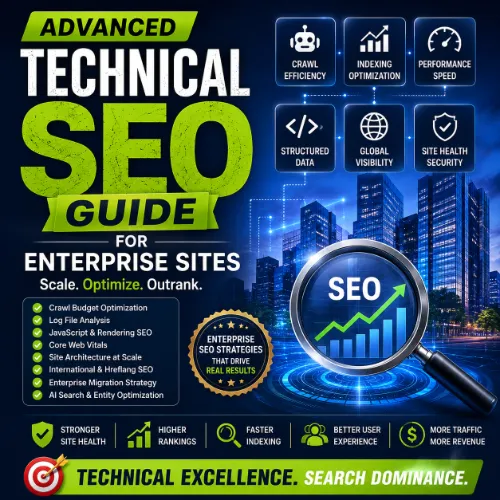
This guide covers advanced technical SEO strategies used by enterprise SEO teams, including crawl budget optimization, log file analysis, JavaScript SEO, index bloat management, Core Web Vitals, international SEO, enterprise migrations, AI search optimization, and scalable site architecture.
Quick Answer: What Is Technical SEO Guide for Enterprise Sites?
Enterprise technical SEO is the practice of optimizing large websites with thousands to millions of pages to improve search engine crawling, rendering, indexing, and ranking performance.
Key enterprise SEO priorities include:
- Crawl budget management
- Indexation control
- Log file analysis
- Site architecture optimization
- JavaScript rendering
- Core Web Vitals improvement
- Structured data implementation
- International SEO
- Large-scale migration management
- AI search visibility optimization
Organizations that successfully manage these technical areas often achieve faster indexation, stronger rankings, improved user experience, and sustainable organic growth.
Why Technical SEO Matters More for Enterprise Websites
Enterprise websites operate at a scale where even small technical issues can impact thousands of pages simultaneously.
Common Enterprise SEO Challenges
Large organizations frequently encounter:
- Millions of indexable URLs
- Duplicate content variations
- Complex faceted navigation
- Multiple subdomains
- International websites
- Legacy CMS systems
- JavaScript-heavy applications
- Product catalog expansion
- Frequent website deployments
Without strong technical governance, search engines may spend significant resources crawling low-value pages while overlooking critical revenue-generating content.
The Enterprise SEO Growth Formula
At scale, organic growth depends on four factors:
- Efficient Crawling
- Accurate Rendering
- Strategic Indexation
- Superior User Experience
Weakness in any area can reduce overall search performance.
Understanding Crawl Budget at Enterprise Scale
What Is Crawl Budget?
Crawl budget refers to the number of URLs a search engine is willing and able to crawl on a website within a specific timeframe.
For enterprise websites, crawl budget consists of two components:
Crawl Capacity
The maximum number of URLs search engines can crawl without overwhelming your server infrastructure.
Crawl Demand
The number of URLs search engines want to crawl based on:
- Content popularity
- Content freshness
- Internal links
- External links
- Historical performance
The balance between crawl capacity and crawl demand determines how effectively your content is discovered and updated.
Why Crawl Budget Becomes Critical
On a website with one million URLs, inefficient crawling can result in:
- Delayed indexing
- Missed content updates
- Reduced visibility
- Slower ranking improvements
- Wasted server resources
Googlebot may spend excessive resources crawling parameterized URLs, filtered pages, or duplicate content rather than important pages.
Enterprise Crawl Budget Optimization Framework
Step 1: Identify Crawl Waste
Common Sources of Crawl Waste
URL Parameters
Examples include:
- ?sort=
- ?filter=
- ?sessionid=
- ?tracking=
Infinite URL Spaces
Examples include:
- Calendar pages
- Pagination loops
- Dynamic search results
Faceted Navigation
Large ecommerce websites often generate millions of crawlable URL combinations.
Example:
/shoes?size=10&color=black&brand=nike
When multiplied across thousands of products, crawl inefficiency grows rapidly.
Step 2: Improve Crawl Prioritization
Strengthen Internal Linking
Search engines prioritize pages receiving stronger internal link signals.
Enterprise SEO teams commonly use:
- Topic clusters
- Hub pages
- Related product modules
- Contextual recommendations
Optimize XML Sitemaps
Rather than using a single sitemap, enterprise websites should segment XML sitemaps by:
- Product pages
- Category pages
- Blog content
- News content
- International sections
Benefits include:
- Faster discovery
- Better monitoring
- Improved crawl prioritization
Step 3: Monitor Crawl Efficiency
Track:
- Crawl requests
- Crawl frequency
- Server response codes
- Average response time
- Indexed page growth
Enterprise SEO teams should monitor crawl trends monthly.
Log File Analysis: The Most Powerful Enterprise SEO Data Source
Most SEO tools estimate crawling behavior.
Log files reveal actual search engine activity.
Why Log File Analysis Matters
Server logs show:
- Which pages Googlebot visits
- How often pages are crawled
- Crawl waste patterns
- Crawl depth distribution
- Server errors encountered by bots
This data provides insights unavailable through traditional SEO crawlers.
Enterprise SEO Case Study Example
A retail website containing approximately three million URLs experienced indexation delays despite publishing thousands of new products weekly.
Log analysis revealed:
- 47% of Googlebot activity targeted filtered URLs
- Only 12% of crawl activity reached newly published products
- More than 200,000 low-value URLs consumed crawl resources
After:
- Blocking parameter URLs
- Consolidating duplicate pages
- Improving internal linking
Indexation speed improved by 64% within three months.
Key Metrics to Monitor
Crawl Frequency
Identify which pages receive the most crawler attention.
Crawl Depth
Determine how far search engines travel into your website structure.
Status Code Distribution
Monitor:
- 200 responses
- 301 redirects
- 404 errors
- 410 pages
- 500 server errors
Crawl-to-Index Ratio
Evaluate how many crawled pages become indexed.
A low ratio often indicates content quality or indexation issues.
Index Bloat Management for Enterprise Websites
What Is Index Bloat?
Index bloat occurs when low-value pages become indexed and dilute the overall quality of a website.
Common Causes
Thin Content Pages
Pages with minimal unique value.
Duplicate Content
Generated by:
- Product variations
- Parameters
- Tracking URLs
Soft 404 Pages
Pages that appear valid but provide little useful information.
Internal Search Results
Search-generated pages often create large-scale indexation problems.
Enterprise Indexation Framework
Ask these questions:
Does the page generate traffic?
If no, evaluate further.
Does the page provide unique value?
If no, consider noindex.
Does the page support conversion goals?
If no, assess its strategic importance.
Does the page strengthen topical authority?
If no, consolidation may be appropriate.
This decision tree helps reduce index bloat while preserving valuable content.
Frequently Asked Questions
1. How does enterprise SEO differ from traditional SEO?
Enterprise SEO focuses on large-scale websites with thousands or millions of pages, requiring advanced systems for crawling, indexing, automation, and governance. Traditional SEO typically deals with smaller websites that can be managed through manual optimization efforts.
2. What is crawl depth, and why is it important?
Crawl depth refers to the number of clicks required to reach a page from the homepage. Pages buried too deeply within a website may receive less crawl attention and reduced authority distribution from internal links.
3. Can enterprise websites suffer from over-indexation?
Yes. Over-indexation occurs when too many low-value pages become indexed, making it harder for search engines to identify the most important content and potentially reducing overall site quality signals.
4. What role does automation play in enterprise SEO?
Automation helps manage repetitive SEO tasks such as internal linking, metadata generation, sitemap updates, reporting, monitoring, and technical audits across thousands of pages.
5. How do content delivery networks (CDNs) impact SEO?
CDNs improve website speed by distributing content across multiple servers worldwide. Faster loading times can improve user experience, Core Web Vitals, and crawl efficiency.
6. Should enterprise websites use subdomains or subdirectories?
The choice depends on business objectives and infrastructure. Subdirectories often consolidate authority more effectively, while subdomains may be useful for separate products, regions, or technical requirements.
7. What are orphan pages?
Orphan pages are URLs that exist on a website but receive no internal links. Because search engines may struggle to discover them, orphan pages often experience poor indexing and ranking performance.
8. How can enterprise websites improve content discoverability?
Content discoverability can be improved through stronger internal linking, XML sitemap optimization, topic clusters, breadcrumb navigation, and logical site architecture.
9. What is edge SEO?
Edge SEO refers to implementing SEO improvements through CDN infrastructure rather than directly modifying a website’s codebase. It allows organizations to deploy SEO changes more efficiently at scale.
10. Why is change management important for enterprise SEO?
Large websites often involve multiple stakeholders and development teams. Proper change management reduces the risk of technical mistakes that could negatively affect rankings or indexation.
11. How does website scalability affect SEO performance?
Scalable infrastructure ensures that website growth does not create crawl, rendering, or performance issues. Poor scalability can lead to indexing delays and reduced search visibility.
12. What is the ideal URL structure for enterprise websites?
URLs should be short, descriptive, keyword-relevant, and organized logically within the site’s hierarchy. Consistent URL structures improve crawlability and user experience.
13. How can enterprise SEO teams monitor technical issues proactively?
Organizations often use automated monitoring tools, custom dashboards, server alerts, and scheduled audits to detect issues before they affect search performance.
14. What is render budget, and how does it differ from crawl budget?
Render budget refers to the resources search engines allocate to processing JavaScript content after crawling a page. Websites with heavy JavaScript may consume more rendering resources.
15. Are XML sitemaps still important in 2026?
Yes. XML sitemaps remain a valuable signal for helping search engines discover important URLs, especially on large websites with complex architectures.
16. How do enterprise websites handle seasonal content?
Many organizations maintain evergreen category pages while updating seasonal content strategically. Proper redirects and content consolidation help preserve authority over time.
17. What are SEO governance policies?
SEO governance policies establish guidelines for content creation, website development, migrations, and technical implementation to maintain consistency across large organizations.
18. How does AI influence enterprise SEO strategies?
AI technologies are changing how search engines understand content, entities, and user intent. Enterprise SEO teams increasingly optimize for topical authority, semantic relevance, and entity relationships.
19. What are the risks of unmanaged faceted navigation?
Uncontrolled faceted navigation can create millions of duplicate URL combinations, leading to crawl waste, index bloat, and diluted ranking signals.
20. How can enterprise websites prepare for future search engine updates?
Organizations should focus on technical excellence, high-quality content, strong site architecture, entity optimization, user experience, and continuous monitoring rather than chasing algorithm-specific tactics.
About the Author
John Michael Palmes is an SEO strategist specializing in technical SEO, enterprise website optimization, search visibility growth, crawl efficiency improvements, and large-scale search performance strategies. Through SEO Mafia Club, he helps businesses implement scalable SEO frameworks that improve rankings, indexation, and long-term organic growth.
Author Page: https://seomafiaclub.com/expert/john-michael-palmes/