Let’s talk about Why Chasing SEO Trends Is Killing Your Rankings.
SEO trends move fast. Rankings don’t.
After 18 years in the SEO industry, one painful pattern shows up more often than any algorithm update: Websites don’t lose rankings because Google changed. They lose rankings because their strategy kept changing.
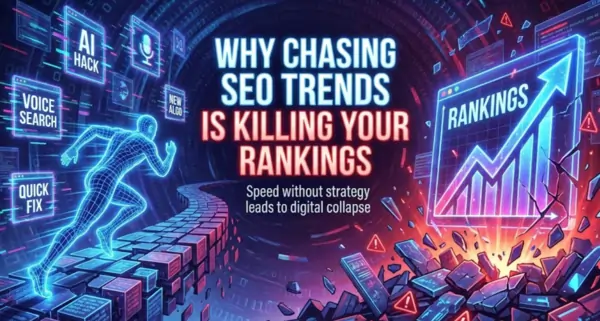
In 2026, chasing SEO trends is not just a waste of time—it is one of the fastest ways to stall growth, reset your “trust score,” and confuse search engines about what your site actually stands for.
Table of Contents
The Seductive Appeal of the “New”

SEO trends are seductive because they promise relief from the grind. They prey on the anxiety that you are missing out.
- “This new AI hack fixes traffic drops instantly.”
- “Keywords are dead—do this instead.”
- “Voice Search requires a total site rebuild.”
Trends offer urgency. Urgency feels like productivity. But urgency rarely builds authority.
Most trends are reactions to partial observations—not long-term signals. When you react to every headline, you are building a house on a foundation that shifts every three months. Google itself cautions against this, emphasizing that core systems reward consistent quality over short-term technical tricks: 👉 Google Search Central Blog
Trend-Chasing vs. Long-Term Strategy
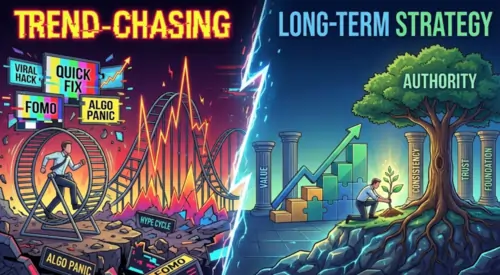
The difference isn’t just in mindset; it’s in the architectural impact on your website.
| Trend-Chasing SEO | Long-Term SEO |
| Constant Pivots: Changing topics based on what’s viral. | Topical Focus: Deepening expertise in one specific area. |
| Rewrite Loops: Overhauling content every update. | Incremental Updates: Refining content based on data. |
| Structure Chaos: Creating orphan pages for “hacks.” | Stable Structure: Building logical internal link clusters. |
| Result: Short spikes, inevitable crashes. | Result: Slow start, compounding growth. |
Search engines do not reward motion. They reward meaning.
This distinction is crucial for survival in 2026. I explain the mechanics of this in my breakdown of signals: 👉 The Difference Between SEO Noise and Real Ranking Signals
What Actually Breaks When You Chase Trends

Trend-chasing doesn’t just waste resources—it actively damages the semantic understanding search engines have of your domain. Here is the technical breakdown of the damage:
1. Topical Authority Gets Reset
Search engines (and AI models) use “vectors” to understand the relationship between your site and a topic.
- If you write about “Crypto” in January…
- Then pivot to “AI Art” in March…
- Then switch to “VR Gaming” in June…
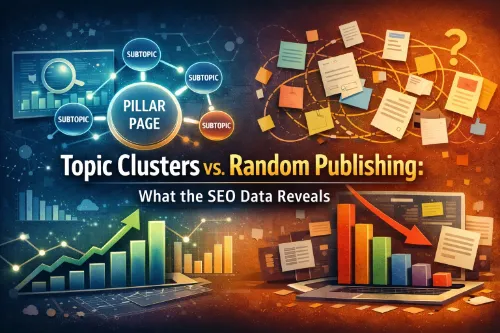
You look like an expert in nothing. Topical authority is built through the repetition of themes and consistent publishing. Every time you pivot to chase a trend, you effectively reset your authority score to zero.
2. Internal Linking Loses Meaning
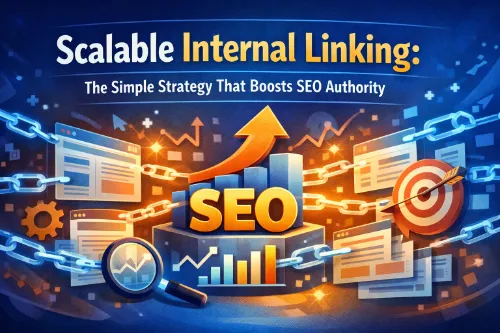
Internal links are the neural network of your website. They tell Google which pages are most important.
- When you chase trends, you often create “orphan pages” (isolated content).
- When you abandon a trend, you delete or ignore those pages, creating “link rot.”
This confuses the crawler. It can no longer find the path from your homepage to your high-value content. This is why structured clusters anchored by a permanent pillar—like my guide below—outperform scattered trend pieces: 👉 SEO Was Never the Problem. The Noise Was.
3. Trust Signals Become Unstable
Trust is a credit score. It takes years to build and one bad decision to ruin. If a site:
- Drastically changes focus…
- Publishes contradictory advice based on the “hack of the week”…
- Rewrites content to game a specific metric…
Trust becomes volatile. Search engines are risk-averse. They prefer to rank sites that are predictable. Moz’s research consistently shows that steady content improvement outperforms frequent overhauls: 👉 Moz: The Beginner’s Guide to SEO
Why Trend-Chasing Feels Necessary in 2026
The SEO landscape feels faster today.
- AI summaries surface answers instantly.
- SERP layouts change dynamically.
- Visibility feels less predictable.
But speed does not require panic. AI didn’t eliminate SEO—it simply magnified the value of clarity. If your site is a mess of half-finished trend experiments, AI cannot summarize it.
This is why the foundational principles discussed in my 2026 forecast are more relevant than ever: 👉 Why SEO Still Works in 2026 (If You Ignore the Noise)
What to Do Instead of Chasing Trends
Replace Trend-Chasing with Signal-Building.
In 2026, your strategy should be boringly consistent:
- Strengthen Existing Content: Don’t write a new post if an old one can be updated.
- Expand Clusters: If a topic works, write more about it. Don’t pivot.
- Update for Intent, Not Headlines: Change your content because the user needs new info, not because an SEO blog told you to.
Semrush’s ranking factor studies reinforce that sustainable growth comes from structure, intent, and consistency—not gimmicks: 👉 Semrush: Ranking Factors 2026
A Simple Rule for 2026
If a “new trend” requires you to:
- Rebuild your site infrastructure…
- Abandon your existing successful content…
- Change your niche or direction…
It is probably not a trend—it is noise.
Real SEO improvements stack on top of what already works. They preserve trust; they don’t threaten it.
Final Thought
SEO doesn’t reward whoever moves fastest. It rewards whoever stays clearest the longest.
In 2026, the sites that win are not the ones chasing every new AI feature—they are the ones building meaning, one consistent step at a time.
FAQ
Why is chasing SEO trends bad for rankings?
Chasing trends disrupts consistency. It breaks the “semantic understanding” search engines have of your site, dilutes your topical authority, and prevents the accumulation of long-term trust signals.
Are SEO trends ever useful?
Trends are useful for observation, not strategy. They can highlight shifts in user behavior (e.g., users wanting shorter answers), which should inform how you refine your content—but they should not force a complete strategy pivot.
How often should my SEO strategy change?
Your core strategy (who you serve and what you write about) should rarely change. Your tactics (how you format headers, how you optimize meta tags) can evolve gradually. Refinement, not reinvention.
What is the best SEO strategy for 2026?
The best strategy is “Quiet SEO”: Building deep topical authority, maintaining a clean technical structure, and updating content based on user intent rather than algorithm panic.
How do I know if SEO advice is just a trend?
Ask yourself: “Does this advice help the user, or is it just a trick for the robot?” If it’s a trick, it’s a trend. If it helps the user, it’s a signal.