If you care about ranking in Google in 2026, you can’t treat all backlinks the same. Some links send strong signals of trust and authority; others are easy to get but carry more risk, especially as Google improves at detecting manipulation in link building strategy patterns. That’s exactly where the debate around editorial links vs guest posts comes in.
Table of Contents
For years, SEO professionals have debated one critical question: does Google trust editorial links more than guest posts? In 2026, as Google’s algorithms become increasingly AI-driven, entity-focused, and trust-oriented, the answer is more nuanced than ever.
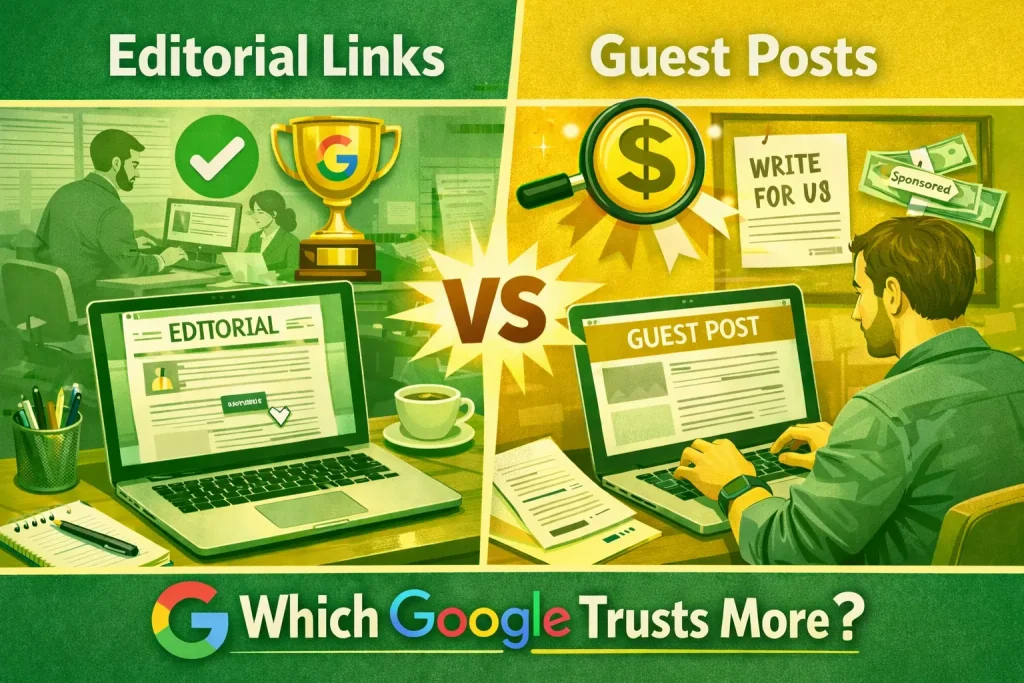
Link building is no longer about sheer volume. Instead, Google link trust is shaped by intent, relevance, authority, and context. Understanding the difference between editorial links and guest posting—and how Google evaluates each—can determine whether your site grows sustainably or quietly loses trust over time.
This guide breaks down what Google actually trusts in 2026, how editorial backlinks differ from guest posting, and how to build resilient, EEAT-aligned backlinks without triggering spam signals.
Defining the Landscape
What Are Editorial Links?
Editorial links are backlinks that are earned naturally when another website chooses to reference your content because it adds value to their audience. These links are placed at the editor’s discretion, not requested or purchased primarily for SEO.
Common examples include:
- Citations in blog posts or news articles
- References in research roundups
- Mentions in guides, tutorials, or opinion pieces
- Brand mentions or SEO citations that include a link
Editorial backlinks typically appear in-content, surrounded by relevant text, and use natural anchor text. From Google’s perspective, editorial links are powerful because they signal editorial intent—a strong indicator that the link exists to help users, not manipulate rankings.
Google’s link schemes documentation explicitly states that links should be earned editorially and not placed primarily for the purpose of manipulating search results.
If you want a deeper dive into strategies, see this editorial link building guide and these practical strategies for building editorial links.
What Are Guest Posts?
Guest posts are articles written by contributors and published on another website, often including an author bio or contextual link back to the contributor’s site. Guest posting itself is not inherently bad—Google has acknowledged that many guest articles are legitimate and helpful for users.
Guest posting becomes risky when:
- The primary intent is link placement
- Anchor text is over-optimized or keyword-stuffed
- Content quality is thin, repetitive, or spun
- The same sites or networks are used repeatedly
- Links are paid or part of a broader link scheme
In 2026, Google’s AI systems (like SpamBrain and spam-related updates) focus on patterns that differentiate editorial guest posts (written for audience value) from link-driven guest posts (written mainly to manipulate rankings). This distinction matters more than ever for both risk and long‑term value.
For tactical advice, you can study this updated guest posting guide and how a guest posts strategy fits with AI Overviews.
How Google Evaluates Links in 2026
Google no longer evaluates backlinks in isolation; it analyzes patterns, context, and intent using advanced AI systems and spam policies.
Key Google link trust signals include:
- Link Intent Signals
Google evaluates why the link exists:
- Was it editorially chosen?
- Does it support the surrounding content?
- Is it primarily for users rather than search engines?
- Contextual Relevance
Contextual backlinks placed naturally within relevant content are typically trusted far more than links in bios, footers, or author boxes, especially when they contribute to the topic at hand. For fundamentals, see Google’s SEO link best practices. - Source Authority
Links from authoritative websites with strong topical alignment carry more trust than links from generic or unrelated blogs and link-selling networks. - Anchor Text Patterns
Natural anchor text tends to be safer than exact-match anchors at scale. Over-optimized anchor text is a classic signal of link manipulation and can be devalued or trigger manual actions. - Entity & Brand Signals
Mentions of brands, authors, and entities—linked or unlinked—help Google validate topical authority and real‑world credibility.
Google explains how it understands links and context in its ranking systems documentation and quality guidance, emphasizing usefulness, relevance, and authenticity over pure link count.
The Great Debate: Trust & Quality
Editorial Links vs Guest Posts: Key Differences
| Factor | Editorial Links | Guest Posts (Typical) |
|---|---|---|
| Intent | Earned naturally, user-first | Often intentional, mixed between value and SEO |
| Trust Level | Typically very high when context is relevant | Medium to highly variable depending on execution |
| Risk Level | Low, unless part of an obvious scheme | Medium to high if scaled, paid, or over-optimized |
| EEAT Impact | Strong third‑party validation | Depends on author, site, and content quality |
| Scalability | Slower, driven by merit | Faster to scale, easier to abuse |
| AI Detection | Harder to manipulate in bulk | Easier to detect as patterns at scale |
| Long-Term Value | Excellent and compounding over time | Inconsistent; some strong, many devalued over time |
A simple chart or infographic that visualizes these differences (trust vs risk vs scalability, for example) will make this especially shareable on platforms like LinkedIn and in client decks.
Why Google Generally Trusts Editorial Links More
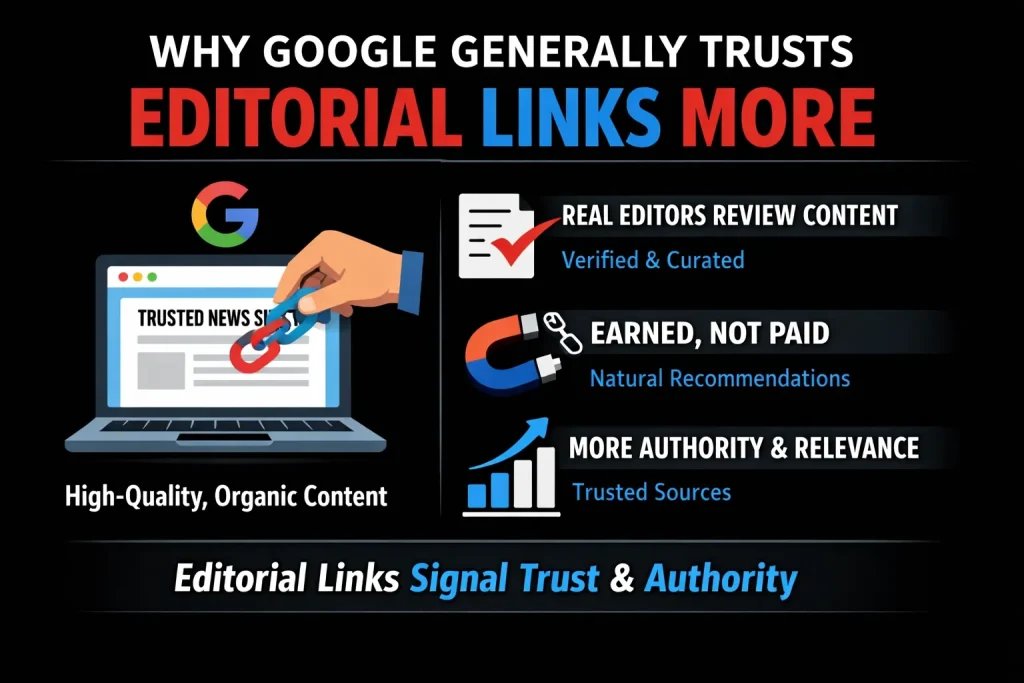
- Earned vs Placed
Editorial backlinks are earned, not placed on demand. Google’s spam and ranking systems tend to favor signals that are harder to manufacture at scale. - Editorial Discretion
Editors link because content genuinely adds value for their audience, which mirrors real‑world trust and recommendation behavior that Google is trying to model. - Natural Link Velocity
Editorial links usually appear gradually as content gets discovered and cited, rather than in predictable bursts common in guest posting campaigns or packages. - Reduced Manipulation Footprint
Editorial links are less likely to rely on exact-match anchors, private networks, or obvious reciprocal/paid patterns, giving them a cleaner risk profile. - Strong EEAT Reinforcement
Editorial citations act as third‑party endorsements of Experience, Expertise, Authority, and Trust (EEAT), especially when they come from reputable, topically aligned sources.
Google’s Search Quality Rater Guidelines and recent spam updates consistently reward content and links that demonstrate expertise and genuine value, not manipulative tactics.
When Guest Posts Still Work (And When They Don’t)
Guest posting is not dead—but it has evolved and sits under much closer scrutiny.
Guest Posts That Still Work
- Published on topically relevant, reputable sites
- Written by real, identifiable experts with relevant experience
- Provide genuine value and original insights to readers
- Use natural, non‑spammy anchor text
- Attract real traffic, engagement, and brand exposure—not just a link
Guest Posts That Lose Trust
- Paid guest post campaigns that primarily seek followed links
- Low‑quality “content farm” sites or obvious link-seller blogs
- Reused, spun, or template-based articles across many domains
- Exact-match anchor abuse and sitewide “inserted” links
- Dofollow guest posts sold as packages without editorial oversight
In practice, guest posts only work consistently when they resemble editorial content and are treated as thought leadership and audience-building, not as a shortcut to PageRank. For more nuanced tactics, see these top guest posting tips for experts and updated guest posting services.
The “Paid Link” Nuance in 2026
In 2026, the line between “Digital PR” and “Paid Links” is thinner than ever, especially when press releases, sponsored articles, or distribution platforms involve fees.
To stay on the safe side of Google’s policies:
- Any link that involves money, products, services, or other compensation should be qualified with rel=”sponsored” or rel=”nofollow”.
- Sponsored content, advertorials, paid guest posts, and affiliate placements should use rel=”sponsored” and rel=”nofollow” for paid links, which Google specifically recommends for paid links.
- Digital PR campaigns should focus on earning genuinely editorial links, but when a placement is clearly paid or sponsored, correct attributes help reduce link scheme risk.
Google treats these attributes (nofollow, sponsored, ugc) as hints, not absolute directives, but failing to qualify paid placements can still lead to devaluation or manual actions if patterns look manipulative.
For more context, see Google’s post on evolving nofollow and sponsored attributes.
Modern SEO Factors
EEAT and Link Trust: The Missing Piece
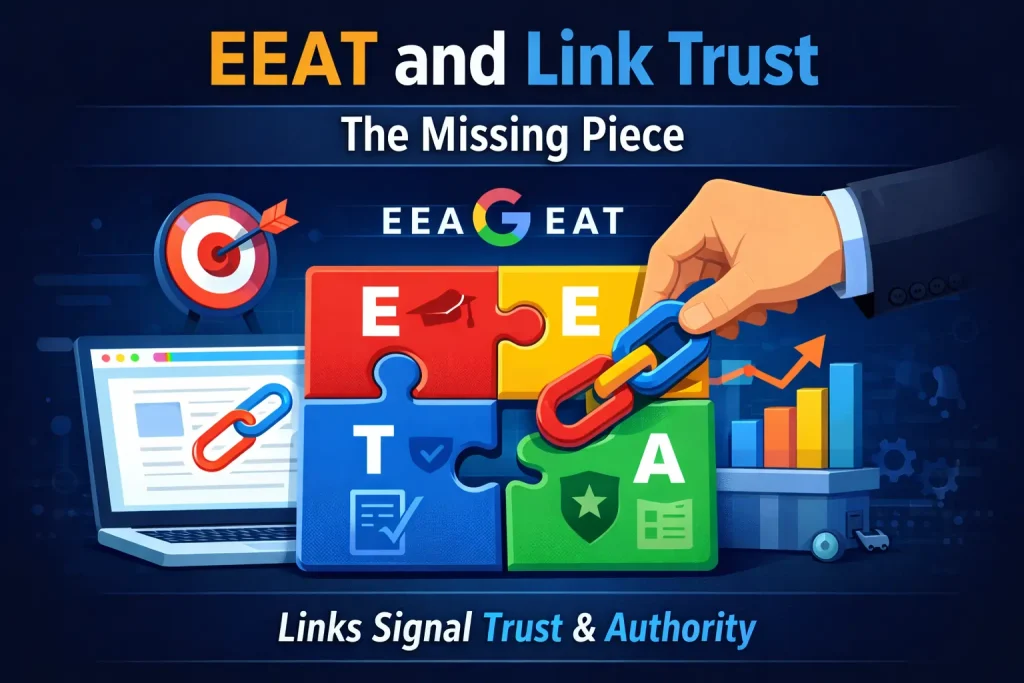
In 2026, backlinks are not just ranking signals—they are also trust signals.
How Editorial Links Support EEAT
- Cite expert content that demonstrates real‑world experience
- Reinforce topical authority through repeated mentions in relevant niches
- Validate credibility when industry sites and journalists reference your work
- Act as editorial endorsements of your brand and authors
Guest Posts and EEAT
Guest posts can support EEAT when:
- The author has real experience in the topic being covered
- The host site itself has topical authority and a good reputation
- The link exists to support the content, not to exploit the host’s authority
To understand how EEAT fits into modern SEO, review this overview of E-E-A-T (Experience, Expertise, Authority, Trust) and Google’s Helpful Content system.
Editorial Links vs Guest Posts in AI Search & SGE
AI Overviews and generative search experiences tend to surface:
- Citations from authoritative, trusted sources
- Content with strong entity signals and clear EEAT
- Pages that are referenced across the web in natural, editorial contexts
In this environment, editorial links often correlate with the kinds of sources that AI systems are more likely to highlight, while guest post links are treated more cautiously—especially when they come from low‑quality, commercial, or obviously sponsored environments.
This is why brand mentions, entity-driven authority, and editorial references frequently matter more than raw backlink counts in AI‑driven SERPs.
Common Myths About Editorial Links and Guest Posts
Myth 1: Guest Posting Is Dead
Reality: Poor, scaled, and manipulative guest posting is increasingly ineffective, but high‑quality, relevant guest content still plays a role in visibility and authority building.
Myth 2: Editorial Links Can’t Be Built
Reality: Editorial links can be earned through assets that naturally attract coverage, such as original research, data studies, thought leadership, and creative digital PR for SEO.
Myth 3: More Links = Better Rankings
Reality: Quality, context, and patterns matter more than ever; manipulative link schemes are increasingly ignored, devalued, or penalized by systems like SpamBrain and manual actions.
Strategy & Execution
Which Should You Focus on for Long-Term SEO?
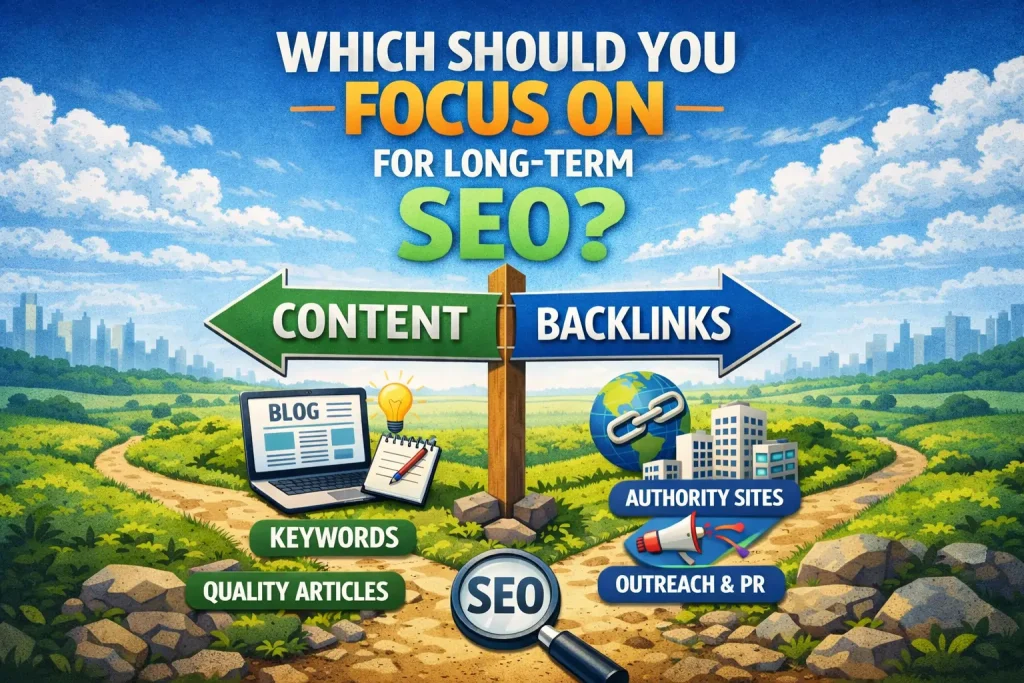
Choose Editorial Links If:
- You want sustainable, compounding growth
- You’re building a defensible brand and entity in your niche
- You care about EEAT, reputation, and long‑term trust signals
Use Guest Posts Strategically If:
- You need targeted visibility and audience expansion
- You’re entering a new niche and want to introduce your expertise
- You’re supporting broader authority building—not replacing it with guest post volume
The strongest strategies treat guest posts as a brand and relationship channel first, and a secondary link benefit second. For inspiration, see top guest posting tips for experts in 2026.
The Smart Hybrid Strategy (2026-Proof Mindset)
The best SEO strategies in 2026 combine both approaches under a user‑first, policy‑aligned framework:
- Use guest posting best practices to gain exposure on relevant, authoritative sites—not to spray links across the web.
- Publish high‑value content assets (original data, tools, deep guides) that naturally earn editorial links over time.
- Reinforce brand and entity authority with consistent, expert authorship signals across your site and off‑site profiles.
- Qualify any paid, compensated, or affiliate links with rel=”sponsored” or rel=”nofollow” to align with Google’s link guidelines.
- Audit and, where appropriate, disavow obviously manipulative or toxic backlinks if they stem from legacy schemes or previous campaigns.
Google explains how to handle unnatural links and link schemes in its backlink policy and related documentation, reminding site owners that unnatural patterns may be ignored, devalued, or addressed via manual actions.
Frequently Asked Questions
Does Google trust guest posts?
Yes—but only when they are editorial in nature, add real user value, are transparently labeled if sponsored, and are not part of scaled link schemes.
Are editorial links better for rankings?
Generally, yes. Natural editorial backlinks from topically relevant, authoritative sites tend to provide stronger and more durable trust and authority signals than most guest post links.
Are paid guest posts risky?
Yes. Paid links that pass PageRank violate Google’s link guidelines; paid placements should be marked with rel=”sponsored” or rel=”nofollow” to avoid being treated as link schemes.
What backlinks does Google trust the most?
Contextual, editorial backlinks from authoritative, topically relevant websites—with clear user value and no obvious manipulative patterns—are among the most trusted.
Conclusion: Google Trust Is Earned, Not Placed
In 2026, Google trusts intent more than tactics. Editorial links tend to win because they represent genuine recommendations, not engineered placements, while guest posts still have a role when they prioritize expertise, audience value, and transparency.
If you want long‑term rankings, focus on:
- Earning editorial links through standout content and digital PR
- Building brand and entity authority in your niche
- Prioritizing topical relevance and EEAT in every asset
- Using correct link attributes for any paid or compensated placements
Trust compounds; manipulation decays. In modern SEO, your link profile is a reflection of how the web genuinely responds to your work—not just how many links you can place.