Entity-First SEO shifts focus from ranking URLs to building brand trust. Google now evaluates brands as entities using editorial links, contextual mentions, and semantic relevance—not backlink volume. Links act as validation signals that confirm authority, credibility, and topical expertise.
Table of Contents
Introduction: Why Google Trusts Brands More Than URLs

For years, SEO revolved around URLs, keywords, and backlink counts. But in 2026, that mindset is outdated. Modern search is no longer about ranking pages—it’s about recognizing, validating, and trusting brand entities.
Google’s systems increasingly evaluate who you are, what you represent, and how the web talks about you. Links still matter, but not in the old, mechanical way. Today, links act as entity validation signals—confirming that your brand is real, reputable, and relevant within a topical ecosystem.
This shift is known as Entity-First SEO. Instead of asking, “How many backlinks does this page have?”, Google asks, “Is this brand a trusted entity in its space? ”
This guide breaks down exactly how to build links Google uses to trust your brand, not just inflate URL metrics—using entity-based SEO, semantic relevance, EEAT alignment, and authority-first link building.
What Is Entity-First SEO?

Entity-First SEO is an optimization approach that prioritizes brand entities—people, companies, organizations, and concepts—over individual pages or keywords.
An entity is something Google can uniquely identify, understand, and connect to other entities. Your brand is one of those entities.
Entity-First SEO focuses on:
- Brand entity optimization
- Entity recognition in Google’s Knowledge Graph
- Semantic SEO and entity relationships
- Trust-based ranking signals instead of raw link counts
Unlike traditional SEO, which optimizes URLs in isolation, entity-based SEO optimizes how your brand exists across the entire web.
How Google Understands Brand Entities
Google identifies a brand as a real, trustworthy entity by connecting signals like links, mentions, content, and structured data across the web—rather than evaluating pages in isolation.
Google builds entity understanding through multiple systems, including semantic search, NLP, and the Knowledge Graph. These systems evaluate:
- Brand mentions across authoritative sites
- Contextual relevance (what topics your brand is associated with)
- Entity relationships and co-occurrence
- Consistency of brand information
- Trust and reputation signals
A mention of your brand on a trusted publication carries weight—even without a link—because it reinforces entity authority in Google.
This is why brand authority SEO now outperforms keyword-stuffed, link-heavy strategies.
How Google Uses Links to Evaluate Brand Trust
Links are no longer just pathways for PageRank. In entity-first SEO, links act as validation signals.
Google evaluates:
- Who is linking to or mentioning your brand
- Contextual relevance of the content
- Proximity to trusted entities
- Editorial intent vs manipulation
- Consistency across multiple sources
An editorial link from a respected publication signals far more brand trust than dozens of low-quality backlinks.
To understand Google’s public stance on links and quality, see its official guidance on link practices from Google
Entity-Based Link Building vs Traditional Link Building
The shift from acquiring links mainly to boost page rankings to earning authoritative mentions and links that help Google recognize, validate, and trust your brand as a real entity.
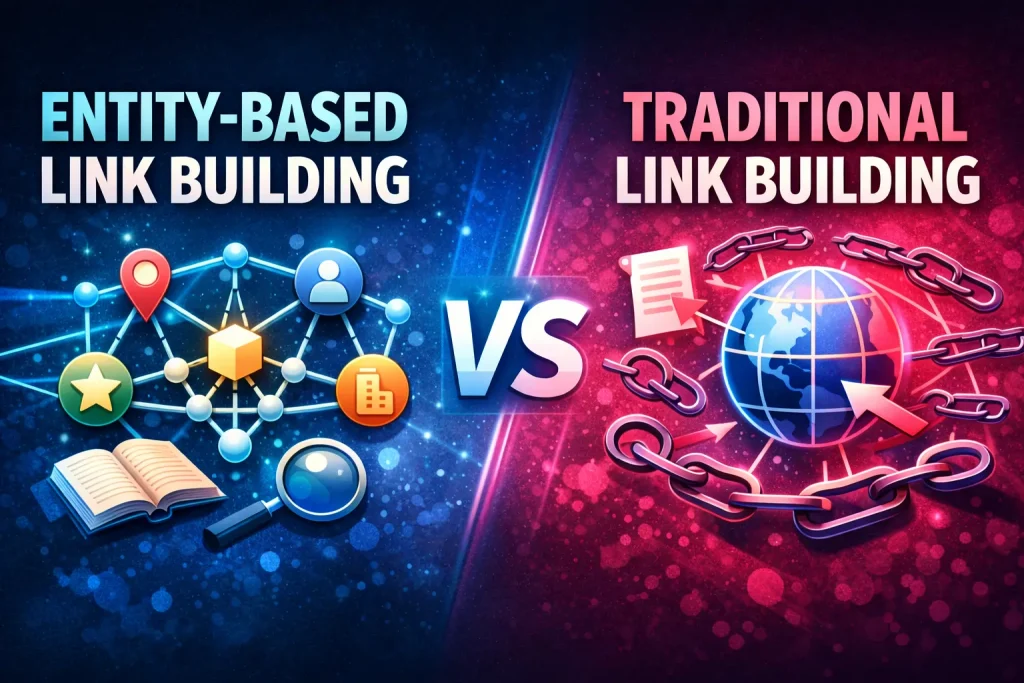
Traditional Link Building (URL-Centric)
- Focuses on link volume
- Prioritizes anchor text manipulation
- Targets pages, not brands
- Often relies on guest posts and placements
- Short-term ranking gains, long-term risk
Entity-Based Link Building (Brand-Centric)
- Focuses on brand-focused link building
- Values editorial links and citations
- Strengthens entity authority in Google
- Reinforces topical relevance
- Builds durable trust signals
Entity-based link building doesn’t ask, “How many links can we get? ”
It asks, “Which links validate our brand as a trusted authority? ”
Link Types That Strengthen Brand Entities
1. Editorial Links from Authoritative Publishers
Editorial links are earned, not placed. They appear naturally within content because your brand adds value to the discussion.
Examples:
- Industry publications
- News sites
- Research articles
- Expert roundups
These links act as entity validation signals, especially when surrounded by relevant topical content.
You can see how editorial context influences authority in studies published by Moz.
2. Brand Mentions (Linked and Unlinked)
Unlinked brand mentions SEO is no longer a myth. Google uses implied links, co-citation, and co-occurrence signals to strengthen brand entities.
If authoritative sites mention your brand consistently within relevant topics, Google associates your entity with those concepts—even without a clickable link.
This is why PR and digital visibility matter more than ever.
3. Citations and Brand Consistency
Citations aren’t just for local SEO. Consistent brand references across:
- Business profiles
- Author bios
- Industry directories
…help Google confirm brand name consistency, entity legitimacy, and trust.
Inconsistent naming weakens entity recognition. Consistency strengthens entity relevance scoring.
4. Contextual Links Within Topical Content
Context matters more than placement. A link inside deeply relevant content reinforces contextual entity alignment.
Google evaluates:
- Topic relevance
- Semantic proximity
- Entity associations
This is where semantic SEO entities and NLP-driven content shine.
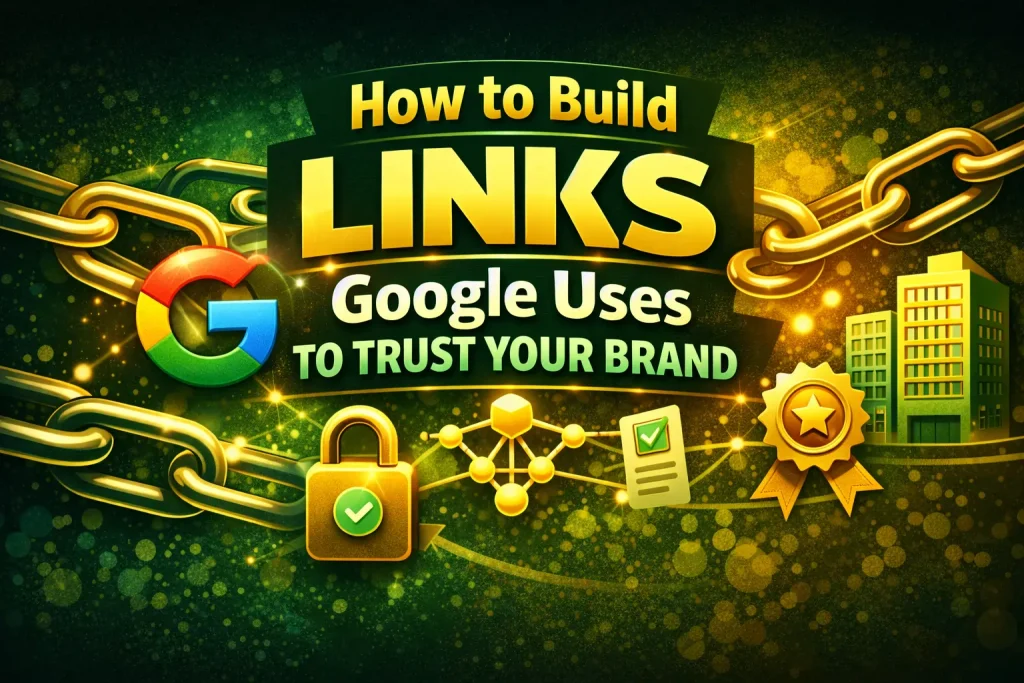
How to Build Links Google Uses to Trust Your Brand
It’s not about getting more backlinks anymore—it’s about getting the right kind of links that help Google trust who you are as a real brand, not just rank a page.
Step 1: Define Your Brand Entity Clearly
Before link building, your entity must be unambiguous.
Key actions:
- Optimize your About page with clear brand identity
- Use consistent brand naming everywhere
- Implement Organization and Author schema
- Clarify your topical focus
Schema helps Google connect signals. Learn more from Schema.org documentation
Step 2: Align Content with Entity Topics
Entity-based SEO requires topical authority SEO.
Build content clusters around:
- Core services
- Primary expertise
- Supporting subtopics
This creates topical entity clusters that reinforce brand-topic relevance.
Google then sees links to your brand as contextually justified, not artificial.
Step 3: Earn Editorial Coverage, Not Placements
Editorial coverage validates brands.
Effective strategies:
- Digital PR
- Original research and data
- Expert commentary
- Thought leadership
Editorial links send Google-approved link signals because they reflect genuine editorial intent.
Step 4: Strengthen Entity Associations
Entity strength grows through relationships.
Focus on:
- Co-citation with trusted brands
- Mentions alongside authoritative entities
- Participation in industry discussions
This reinforces entity relationship SEO and builds algorithmic trust.
The Role of EEAT in Entity-First Link Building
EEAT (Experience, Expertise, Authoritativeness, Trustworthiness) is fundamentally entity-based.
Links support EEAT by
- Confirming third-party validation
- Associating brands with expertise
- Reinforcing reputation signals
But EEAT cannot be faked with links alone. It emerges from consistent brand authority across content, mentions, and links.
Google’s EEAT documentation reinforces this brand-centric evaluation
Common Link Building Mistakes That Weaken Brand Entities
- Over-optimized anchors that look manipulative
- Irrelevant niche links with no contextual alignment
- Link velocity spikes that signal artificial growth
- Treating links as transactions instead of trust signals
- Ignoring unlinked brand mentions
These mistakes dilute entity trust signals and can stall long-term growth.
Measuring Entity Trust Beyond Backlinks
Traditional SEO metrics are no longer enough.
Entity-first SEO success indicators include:
- Growth in branded search queries
- Increased brand mentions across authoritative sites
- Knowledge Panel visibility
- Co-occurrence with trusted entities
- SERP dominance for brand-related queries
These signals indicate domain-level trust signals rather than page-level manipulation.
Entity-First SEO Strategy for 2026 and Beyond
As AI-driven search evolves, entity understanding becomes central.
Future-proof SEO focuses on:
- Brand-first ranking strategy
- Authority-building SEO
- Semantic relevance over keyword density
- Links as confirmation, not shortcuts
Entity-first SEO is algorithm-resistant because it aligns with how Google naturally understands the web.
Frequently Asked Questions
What is Entity-First SEO?
Entity-first SEO prioritizes brand entities over URLs, focusing on how Google understands, connects, and trusts brands.
Do unlinked brand mentions help SEO?
Yes. Google uses co-citation and implied links to strengthen entity authority.
Are backlinks still important in 2026?
Yes—but only when they reinforce brand trust and topical relevance.
How does Google determine brand trust?
Through entity relationships, mentions, editorial links, consistency, and reputation signals.
What types of links does Google trust most?
Editorial links from authoritative, relevant sources with clear contextual intent.
Final Thoughts: Build Brand Authority, Not Just Backlinks
SEO has evolved beyond chasing links and rankings.
In an entity-first world:
- Links validate brands
- Mentions reinforce authority
- Context defines trust
If you want sustainable rankings, stop building links for URLs—and start building trust for your brand entity. That’s how Google decides who deserves visibility.
The future of link building is no longer about volume or manipulation, but about earning trust through authoritative entities, editorial relevance, and real-world credibility.