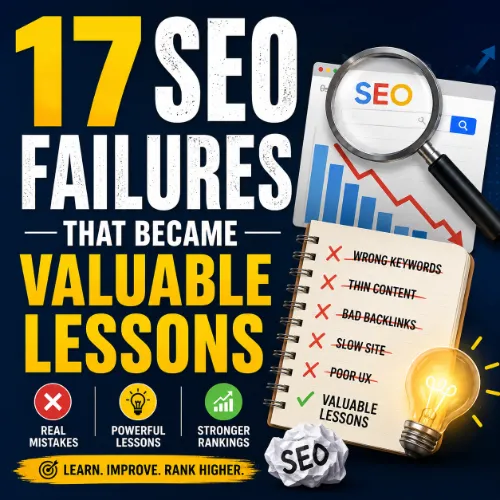
17 SEO Failures That Became Valuable Lessons: Real Mistakes That Improved Search Performance
Search engine optimization is often portrayed as a process of continuous growth, rising rankings, and increasing traffic. The reality is much different. Behind many successful SEO campaigns are failed experiments, ranking losses, technical mistakes, and strategic decisions that didn’t produce the expected results.
In fact, some of the most valuable SEO lessons come from failure rather than success.
Over the years, SEO professionals have watched websites lose traffic after migrations, disappear from Google’s index due to technical errors, and spend months creating content that never ranked. While these experiences can be frustrating, they often reveal weaknesses that lead to stronger and more sustainable SEO strategies.
This guide explores 17 common SEO failures and the lessons they taught, helping marketers, business owners, and SEO practitioners avoid costly mistakes and build more resilient search strategies.
Why SEO Failures Matter More Than SEO Wins
A successful SEO campaign shows what works.
A failed SEO campaign shows why it works.
When a website loses rankings, experiences a drop in organic traffic, or fails to achieve expected results, it often uncovers gaps in technical SEO, content quality, user experience, or search intent alignment.
Understanding these failures helps improve:
- Organic traffic growth
- Search visibility
- Conversion rates
- User engagement
- Content quality
- Technical website performance
The lessons below represent some of the most common SEO mistakes and the insights gained from them.
1. Chasing High-Volume Keywords Instead of User Intent
What Happened
An SEO team targeted keywords with thousands of monthly searches and created dozens of articles around those terms.
Traffic increased slightly, but conversions remained low.
What Went Wrong
The content focused on keywords rather than user needs.
Visitors arrived expecting solutions but found generic information.
Valuable Lesson
Google increasingly rewards content that satisfies search intent.
Key Takeaway
Focus on what users want to accomplish, not just the keywords they type into search engines.
2. Publishing Hundreds of Thin Articles
What Happened
A website attempted to dominate search results by publishing large volumes of short articles.
After several months, rankings stagnated.
What Went Wrong
Most pages provided little value and covered topics superficially.
Valuable Lesson
One comprehensive guide often outperforms multiple low-quality pages.
Key Takeaway
Depth, expertise, and usefulness matter more than content volume.
3. Ignoring Technical SEO Until Rankings Dropped
What Happened
A business invested heavily in content marketing but saw minimal ranking improvements.
What Went Wrong
A technical audit revealed crawl errors, broken links, redirect chains, and indexing issues.
Valuable Lesson
Even excellent content struggles when search engines cannot properly crawl a website.
Key Takeaway
Technical SEO forms the foundation of organic search success.
4. Losing Traffic After a Website Migration
What Happened
A company redesigned its website and launched a new URL structure.
Within weeks, organic traffic dropped by more than 40%.
What Went Wrong
Redirects were incomplete, and important pages lost accumulated authority.
Valuable Lesson
Website migrations require careful SEO planning before launch.
Key Takeaway
Always conduct a migration audit and test redirects thoroughly.
5. Buying Low-Quality Backlinks
What Happened
A website acquired hundreds of inexpensive backlinks promising quick ranking improvements.
What Went Wrong
The links came from irrelevant and low-authority websites.
Valuable Lesson
Poor-quality backlinks can harm long-term SEO performance.
Key Takeaway
Prioritize relevance and authority over backlink quantity.
6. Over-Optimizing Anchor Text
What Happened
Every backlink used the exact same target keyword.
What Went Wrong
The backlink profile appeared unnatural.
Valuable Lesson
Natural link patterns are more sustainable and trustworthy.
Key Takeaway
Use a balanced mix of branded, generic, and keyword-rich anchor text.
7. Neglecting Mobile Optimization
What Happened
A website performed well on desktop but poorly on smartphones.
What Went Wrong
Mobile users experienced slow loading times and difficult navigation.
Valuable Lesson
Mobile-first indexing means mobile usability directly affects rankings.
Key Takeaway
Optimize for mobile users before optimizing for desktop users.
8. Ignoring Core Web Vitals
What Happened
Traffic grew steadily, but engagement metrics remained weak.
What Went Wrong
Pages loaded slowly and experienced layout shifts.
Valuable Lesson
User experience influences both rankings and conversions.
Key Takeaway
Page speed and responsiveness are SEO priorities, not optional improvements.
9. Creating Content Without a Strategy
What Happened
A blog published articles on dozens of unrelated topics.
What Went Wrong
Search engines struggled to identify the site’s expertise.
Valuable Lesson
Topical authority is built through consistency and relevance.
Key Takeaway
Create content clusters around core topics.
10. Failing to Update Older Content
What Happened
Previously successful pages gradually lost rankings.
What Went Wrong
Information became outdated and competitors published fresher resources.
Valuable Lesson
SEO content requires maintenance.
Key Takeaway
Regular content updates can recover lost rankings.
11. Ignoring Search Console Warnings
What Happened
Ranking declines appeared unexpectedly.
What Went Wrong
Google Search Console had been reporting indexing and coverage issues for months.
Valuable Lesson
Search Console provides critical SEO insights directly from Google.
Key Takeaway
Monitor Search Console regularly and act on warnings promptly.
12. Creating Duplicate Content Across Multiple Pages
What Happened
Several pages targeted nearly identical keywords.
What Went Wrong
The pages competed against one another.
Valuable Lesson
Keyword cannibalization reduces ranking potential.
Key Takeaway
Consolidate overlapping content whenever possible.
13. Measuring Rankings Instead of Revenue
What Happened
A website ranked for numerous keywords but generated few leads.
What Went Wrong
Success metrics focused on rankings rather than business outcomes.
Valuable Lesson
Traffic alone does not equal profitability.
Key Takeaway
Track conversions, leads, and revenue alongside rankings.
14. Overlooking Internal Linking Opportunities
What Happened
Strong content existed across the website but remained disconnected.
What Went Wrong
Search engines had difficulty understanding content relationships.
Valuable Lesson
Internal links help distribute authority and improve discoverability.
Key Takeaway
Build strategic internal linking pathways throughout your website.
15. Copying Competitors Instead of Creating Better Content
What Happened
A website replicated top-ranking content formats.
What Went Wrong
The content offered no unique value.
Valuable Lesson
Original insights outperform imitation.
Key Takeaway
Provide experiences, examples, data, and perspectives competitors cannot replicate.
16. Relying Entirely on Organic Traffic
What Happened
An algorithm update caused a significant traffic decline.
What Went Wrong
SEO was the only acquisition channel.
Valuable Lesson
Traffic diversification reduces risk.
Key Takeaway
Combine SEO with email marketing, social media, and brand-building efforts.
17. Reacting Too Quickly to Ranking Fluctuations
What Happened
Minor ranking changes triggered constant content revisions.
What Went Wrong
Normal search volatility was mistaken for a major issue.
Valuable Lesson
SEO requires patience and long-term analysis.
Key Takeaway
Evaluate trends over weeks and months instead of reacting to daily fluctuations.
Common Patterns Behind Most SEO Failures
Looking across these examples, several themes emerge.
Failure Pattern #1: Prioritizing Search Engines Over Users
Successful SEO focuses on solving problems and delivering value.
Failure Pattern #2: Ignoring Technical Foundations
Technical issues can undermine even the best content strategy.
Failure Pattern #3: Seeking Shortcuts
Quick wins often create long-term problems.
Failure Pattern #4: Neglecting Ongoing Optimization
SEO is a continuous process rather than a one-time project.
What Modern SEO Professionals Can Learn From These Mistakes
Today’s search landscape rewards:
- Helpful content
- Real expertise
- Strong user experiences
- Technical excellence
- Clear topical authority
- Trustworthy information
The most successful SEO professionals are not those who avoid failure completely. They are the ones who learn from mistakes, adapt their strategies, and continuously improve.
Every ranking drop, failed campaign, and traffic decline contains valuable insights that can lead to better decisions and stronger long-term performance.
Frequently Asked Questions
1. How long does it take to recover from a major SEO mistake?
Recovery time varies depending on the issue. Technical errors may be fixed within days, while recovering from poor-quality backlinks or content issues can take several weeks or months after Google re-crawls and reassesses the website.
2. Can changing URLs hurt SEO performance?
Yes. Changing URLs without proper 301 redirects can lead to lost rankings, broken backlinks, and reduced organic traffic. Every URL change should be carefully planned and monitored.
3. What is an SEO experiment, and why do some fail?
An SEO experiment involves testing changes such as content updates, internal linking strategies, or page optimizations. Some fail because of incorrect assumptions, insufficient data, or external factors like algorithm updates.
4. Are Google algorithm updates responsible for most SEO failures?
Not always. While algorithm updates can affect rankings, many traffic losses are caused by underlying issues such as weak content, technical errors, poor user experience, or stronger competitors.
5. How can businesses identify SEO problems before rankings drop?
Regular monitoring through Google Search Console, analytics platforms, site audits, and rank-tracking tools can help detect issues before they significantly impact visibility.
6. Is deleting underperforming content a good SEO strategy?
Sometimes. Removing outdated or low-value pages can improve overall site quality, but valuable content should usually be updated, consolidated, or redirected rather than deleted.
7. Why do some SEO tactics stop working over time?
Search engines continuously improve their algorithms. Strategies that once produced results may become less effective as Google’s ranking systems evolve and user expectations change.
8. Can website design changes negatively impact SEO?
Yes. Design updates can affect page speed, internal linking, mobile usability, and crawlability. SEO considerations should be included in every redesign project.
9. What role does competitor analysis play in avoiding SEO mistakes?
Competitor analysis helps identify content gaps, backlink opportunities, keyword trends, and industry standards, reducing the risk of making uninformed optimization decisions.
10. Should businesses focus on traffic or engagement metrics?
Both matter. High traffic is valuable, but engagement metrics such as time on page, bounce rate, and conversion rates often reveal whether visitors find content useful.
11. How does poor website architecture affect SEO?
A confusing site structure can make it difficult for search engines and users to navigate content, leading to weaker indexing, lower rankings, and reduced engagement.
12. What is the biggest misconception about SEO success?
Many people believe SEO delivers immediate results. In reality, sustainable SEO growth often requires months of consistent effort, optimization, and content development.
13. Can AI-generated content lead to SEO failures?
AI-generated content is not inherently problematic. Issues arise when content lacks originality, accuracy, expertise, or value for users. Human review remains essential.
14. Why do some high-ranking pages suddenly lose visibility?
Search trends, competitor improvements, algorithm updates, content freshness, and technical issues can all contribute to ranking declines over time.
15. Is keyword research enough to guarantee rankings?
No. Keyword research is only one component of SEO. Content quality, backlinks, technical performance, user experience, and authority also influence rankings.
16. How important is brand recognition for SEO?
Strong brands often benefit from higher click-through rates, better user trust, and increased search demand, all of which can contribute to stronger organic performance.
17. Can local SEO mistakes affect national rankings?
Yes. Inconsistent business information, poor local optimization, and weak location signals can impact visibility in both local and broader search results.
18. What happens when search engines cannot crawl important pages?
Pages that cannot be crawled may not be indexed properly, making it difficult for them to appear in search results regardless of content quality.
19. Why is SEO documentation important?
Documenting changes, experiments, and outcomes helps teams identify what works, avoid repeating mistakes, and make more informed optimization decisions.
20. What is the most valuable lesson from SEO failures?
The biggest lesson is that SEO is a continuous learning process. Every mistake provides insights that can improve future strategies, strengthen decision-making, and support long-term growth.
Final Thoughts
SEO success is rarely built on perfect decisions. More often, it emerges from identifying mistakes, understanding their causes, and applying those lessons to future strategies.
The 17 SEO failures discussed here highlight a simple truth: setbacks are not the opposite of success—they are often part of the process.
By learning from these common mistakes, businesses can create more effective SEO strategies, improve user experiences, and build sustainable organic growth that lasts beyond the next algorithm update.