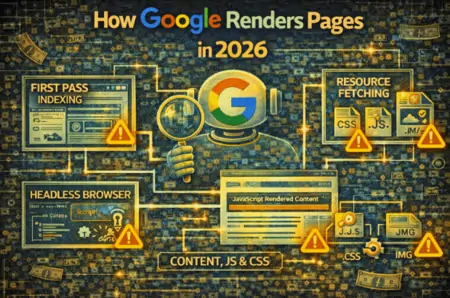
Understanding How Google Renders Pages in 2026 is one of the most important skills for SEO professionals, developers, and business owners. Many websites look perfect to users but fail to rank because they misunderstand how Google processes modern JavaScript-driven pages.
In this complete guide, we will break down How Google Renders Pages in 2026 in simple terms. You will learn the difference between crawling, rendering, and indexing, why JavaScript can still cause visibility issues, and how to optimize your site for reliable indexing.
Why Understanding How Google Renders Pages in 2026 Matters
Websites today are more dynamic than ever. Frameworks like React, Vue, and Next.js generate content using JavaScript. While Google has improved its rendering capabilities, it still processes pages in stages.
If you do not understand How Google Renders Pages in 2026, you may experience:
- Pages discovered but not indexed
- Content visible to users but missing in search
- Delayed ranking of new pages
- Structured data not detected
- Internal links ignored
Knowing How Google Renders Pages in 2026 helps you avoid these problems before they affect traffic.
The Three Core Stages: Crawl, Render, Index
To fully understand How Google Renders Pages in 2026, you must separate three processes.
1. Crawling
Googlebot visits your URL and downloads the HTML and available resources.
2. Rendering
Google executes JavaScript and builds the final version of the page — similar to what users see in a browser.
3. Indexing
Google evaluates the rendered content and decides whether to include it in search results.
When people struggle with How Google Renders Pages in 2026, it is usually because they confuse these stages.
The Rendering Pipeline in 2026
Let’s look deeper into How Google Renders Pages in 2026.
Step 1: Discovery
Google finds URLs through:
- Internal links
- Sitemaps
- External backlinks
If links only appear after user interaction, discovery becomes weaker.
Step 2: Initial Crawl
Google downloads the raw HTML. If the HTML is mostly empty and relies on JavaScript, the first wave of processing may not contain your important content.
Step 3: JavaScript Rendering
Google uses a rendering system (based on modern browser technology) to execute JavaScript. However, rendering is not unlimited. Heavy scripts, blocked files, or slow responses can prevent full content from loading.
Understanding this stage is critical when analyzing How Google Renders Pages in 2026.
Step 4: Indexing
Once rendering is complete, Google evaluates:
- Main content
- Headings
- Internal links
- Structured data
- Meta signals
If important elements fail to appear during rendering, indexing can fail.
The Two-Wave Processing Reality
A major concept behind How Google Renders Pages in 2026 is two-wave indexing.
First Wave
Google indexes what it sees in raw HTML.
Second Wave
Google processes JavaScript-rendered content later.
If your page depends entirely on client-side rendering (CSR), your important content may not appear in the first wave. That delay can affect ranking speed and reliability.
Rendering Methods That Work Best in 2026
When analyzing How Google Renders Pages in 2026, certain rendering approaches perform better for SEO.
Server-Side Rendering (SSR)
Content is generated on the server before being sent to Google. This ensures important text appears in initial HTML.
Static Site Generation (SSG)
Pages are pre-built as static HTML files. This is highly reliable for SEO.
Hydration
Combines server-rendered HTML with JavaScript interactivity.
Client-Side Rendering (CSR)
Content loads entirely via JavaScript in the browser. While Google can render it, CSR remains riskier.
Understanding these approaches helps you align with How Google Renders Pages in 2026 for stable rankings.
Common Rendering Problems That Hurt SEO
Many issues arise from misunderstanding How Google Renders Pages in 2026.
Blocked Resources
If robots.txt blocks JS or CSS files, rendering may be incomplete.
Lazy-Loaded Main Content
If your primary text appears only after scrolling or clicking, Google may miss it.
JavaScript-Injected Meta Tags
Titles, canonicals, or noindex tags changed only via JS can cause inconsistencies.
Heavy JavaScript Bundles
Large scripts slow down rendering and increase the chance of incomplete processing.
How Google Treats Key SEO Elements
To properly optimize for How Google Renders Pages in 2026, focus on these elements:
Main Content
Ensure it appears in the initial HTML whenever possible.
Internal Links
Use standard anchor tags. Avoid links generated only after user interaction.
Structured Data
Keep schema markup server-rendered for reliability.
Canonical Tags
Avoid dynamically changing canonical URLs through JavaScript.
Best Practices for Optimizing How Google Renders Pages in 2026
If you want to align with How Google Renders Pages in 2026, follow these recommendations:
- Prioritize HTML-first content delivery
- Use SSR or SSG for critical landing pages
- Ensure content parity between raw HTML and rendered output
- Avoid hiding text behind user-triggered events
- Keep JavaScript lightweight
- Test rendering in Search Console
These practices reduce rendering risk and improve index reliability.
How to Test Rendering Like Google
Understanding How Google Renders Pages in 2026 requires testing tools.
URL Inspection Tool
Shows indexing status and rendered output.
Compare View Source vs Inspect Element
- View Source shows raw HTML.
- Inspect Element shows post-JS content.
If your main content appears only in Inspect Element, your SEO depends heavily on rendering.
Rich Results Test
Useful for checking structured data visibility.
AI Overviews and Rendering in 2026
Clear structure improves extraction into AI-generated summaries. If you want to benefit from how AI systems interpret How Google Renders Pages in 2026, structure your content with:
- Clear H2 and H3 headings
- Short definitions near the top
- Bullet lists and step-by-step sections
- FAQ blocks
Clean HTML improves both rendering and extractability.
Quick Audit Checklist
When reviewing How Google Renders Pages in 2026, ask:
- Does the main content appear in raw HTML?
- Are JS and CSS files accessible to Googlebot?
- Are internal links crawlable without interaction?
- Are canonical and robots tags stable server-side?
- Does rendered output match user-visible content?
If you can answer yes to all, your rendering setup is strong.
Final Thoughts
Mastering How Google Renders Pages in 2026 is not optional for modern SEO. As websites become more JavaScript-driven, understanding the rendering pipeline ensures your content is visible, indexable, and competitive.
The key takeaway: prioritize HTML visibility, reduce dependency on heavy client-side rendering, and test how Google processes your pages. When you align technical structure with How Google Renders Pages in 2026, you build a stronger foundation for long-term search performance.