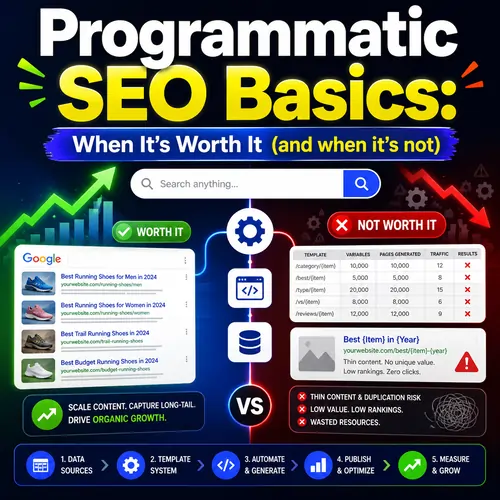
In the modern digital landscape, the dream of scaling a website from 50 pages to 50,000 pages overnight is tempting. This is the promise of Programmatic SEO. It sounds like a growth hack, but in reality, it is a double-edged sword.
Programmatic SEO uses structured data sources (like product feeds or location databases) and template systems to create thousands of scalable URL structures automatically. Think of job boards like Indeed, real estate listings on Zillow, or review aggregators like TripAdvisor. These platforms dominate search because they mastered the core mechanics of programmatic creation.
However, for every success story, there are hundreds of failures where Google applies a thin content penalty. This guide covers the Programmatic SEO basics, specifically when it is worth the investment—and critically—when it is not. For a deeper dive into sustainable execution, explore this resource on safe pSEO practices and quality control .
The Core Mechanics: How It Works
Before deciding if this is right for you, you must understand the three pillars of programmatic SEO:
- Structured Data Source: A clean database, API, or spreadsheet containing unique variables (e.g., city names, product SKUs, or event dates).
- Template System: A landing page “shell” that pulls data from the source. This includes the H1, meta description, body text, and schema markup.
- Scalable URL Structure: A logical hierarchy (e.g.,
domain.com/city/service) that allows search engines to crawl efficiently.
When these three elements align, you create high-intent, long-tail opportunities. You capture users searching for specific modifiers like plumber in Austin TX or blue suede shoes size 12. Individually, these terms have low search volume per term, but in aggregate, they drive massive traffic. However, Google has made it clear that doorway pages created solely for search engines harm the user experience. You can read Google’s official update on doorway pages to understand what to avoid .
When Programmatic SEO Is Worth It (The Green Flags)
Programmatic SEO is not a magic wand. It is a manufacturing plant. You should only turn the plant on if you have the raw materials to build something valuable. Here is when the effort pays off.
1. You Own a Massive, Structured Dataset
If you have unique data that no one else has, you have a moat. Real estate MLS data, event listings, patent filings, or product specifications for a niche catalog are goldmines.
- Why it works: Google prioritizes original information. If you aggregate data that requires subscriptions or specific access, your programmatic pages become the definitive source for that query.
2. Clear User Utility Per Page
Each page must answer a distinct user query better than a filter page could. For example, comparing "plumbers in Dallas" vs "plumbers in Houston" offers clear user utility per page. The intent differs geographically.
- The test: If a user lands on the page, does it solve their immediate problem? If yes, programmatic works. Real-world results show this approach generates tangible revenue. For instance, one firm secured a $14,000 lead using programmatic SEO landing pages within just four months .
3. Repeatable, Shallow Modifications
If the only thing changing between pages is a variable (price, date, location, or stock status), automation is efficient. You don’t need a human writer to describe every single AT&T store location. Repeatable, shallow modification needs are ideal for templates because the core value is the variable, not the prose.
4. Strong Existing Domain Authority
A brand new domain cannot launch 100k pages and rank. You need strong existing domain authority. Established sites (like Yelp or Wikipedia) can rank programmatic pages instantly because the topical trust is baked into the root domain. Without authority, Google won’t waste crawl budget on your new pages.
When Programmatic SEO Is NOT Worth It (The Red Flags)
Here is where most SEOs fail. They build the machine, but they ignore the quality gates. Do not use programmatic SEO in the following scenarios. According to search experts, “pSEO failures are usually technical and systemic” .
1. Small or Sparse Dataset
If you are generating fewer than 200 pages, the engineering overhead is not worth it. Manual creation is cheaper. Furthermore, a small or sparse dataset leads to duplicate or similar content because you run out of unique variations. Google’s algorithms are adept at detecting doorway pages—pages created solely to rank for specific searches without offering unique value. You can learn more about identifying doorway page violations to ensure compliance .
2. YMYL and Deep Expertise Topics
YMYL (Your Money or Your Life) topics are strictly off-limits for pure programmatic generation. If you are in the legal, medical, or financial space, Google requires E-E-A-T (Experience, Expertise, Authoritativeness, Trustworthiness) .
- The risk: A machine cannot provide a deep expertise or original narrative on brain surgery or tax fraud. If the pages require deep expertise, programmatic SEO will trigger a manual penalty or be ignored by the algorithm. Understanding Google’s E-E-A-T framework is critical for these niches .
3. No True Variation Between Pages
This is the cardinal sin. If swapping the city name is the only change, you have no true variation between pages.
- Warning sign: Your template could be replaced by a single “search filter” page. If that is true, do not generate separate URLs. Google’s algorithms are designed to “minimize the impact of webspam on users” by targeting large-scale doorway campaigns .
4. Thin Content That Won’t Earn Links
Google uses engagement metrics (bounce rate, time on page, pogo-sticking) as quality signals. If your page has 50 words and a generic map, users will leave instantly. This is thin content that won’t earn links or engagement.
- The reality: Programmatic pages rarely earn backlinks. If the content isn’t link-worthy, you are relying 100% on domain authority to rank. Google’s Helpful Content Update specifically targets content that “seems to have little value” for searchers .
5. Lack of Long-Term Maintenance
Programmatic SEO is not “set it and forget it.” What happens when an event ends? When a product is discontinued? A lack of long-term maintenance leads to stale data. Serving users expired content is a user harm signal for Google.
6. You Cannot Monitor at Scale
If you build 10,000 pages, you cannot review them manually. If you cannot monitor at scale using log files and Google Search Console (GSC), you will miss problems like duplicate content, broken canonicals, or pagination errors.
The Risks (And How to Mitigate Them)
Even when it is worth it, the path is dangerous. You need a risk mitigation checklist.
- Duplicate Content: Use canonical tags aggressively. If page A and page B are 90% similar, point one to the other. Implement parameter handling in GSC to tell Google which URL parameters matter. Screaming Frog is an essential tool for finding “duplication footprints, canonicals misfiring, and indexable parameter URLs” at scale .
- Google Penalty: Start small. Launch 500 pages, not 50,000. Monitor for a drop in index rate. If Google stops indexing them, pause the campaign.
- Scalability Traps: Programmatic generation spikes server load. It also creates internal link dilution (too many links on a page, spreading PageRank too thin). Use faceted navigation best practices (using
robots.txtto block useless filters).
The Mitigation Checklist for Success (Listicle):
- Unique meta descriptions for every URL (use the data variables to write them).
- Original sentences above the fold (don’t start with the template boilerplate; start with a dynamic data-driven sentence).
- User-generated content (reviews, comments, Q&A) layered on top of the template to increase uniqueness.
Advanced Strategies: GEO, AEO, and NLP Integration
To rank in 2025 and beyond, you cannot just “spray and pray” keywords. You must optimize for Generative Engine Optimization (GEO) , Answer Engine Optimization (AEO) , and Natural Language Processing (NLP) . This is how you win the AI Overview (formerly SGE).
Applying NLP (Natural Language Processing)
Google doesn’t read words; it reads entities and sentiment. When writing your template, you must use NLP-friendly syntax.
- The fix: Use listicles for attributes. Instead of writing “We have blue shoes,” write: “Features: 1. Color: Blue. 2. Material: Leather. 3. Usage: Running.”
- Why it works: Listicles break content into machine-readable entities.
Applying AEO (Answer Engine Optimization)
People ask questions. Your programmatic pages must answer them. For a page about "Atlanta plumber", you need a template section titled “Common Questions.”
- AEO friendly keywords: “How much does a plumber cost in Atlanta?” “Is a license required?” Answer these in simple, declarative sentences (e.g., “A plumber in Atlanta costs $150 on average.”). This pulls your data directly into voice search results and featured snippets.
Applying GEO (Generative Engine Optimization)
AI Overviews (like Gemini or Perplexity) cite sources. To be cited, you need structured clarity. “Trust is the most important member of the E-E-A-T family” according to Google, and AI models prioritize trustworthy sources .
- GEO tactic: Use tables. If you are comparing cities, rates, or products, put the comparison in an HTML table. AI models love tables for training data.
AI Overview Friendly Keywords
To trigger the AI Overview, you need to prompt the AI. According to recent analysis, winning in AI search requires “authoritative websites with significant backlinks” and “trustworthy brands” . Use phrases that look like data queries:
- The Keywords: “Data shows,” “Comparison of X vs Y,” “The average price is,” “Steps to find,” “Top 5 features.”
Practical Decision Framework (The Checklist)
Before writing a single line of code, run your idea through this decision framework. “Google wants content that is written by people, for people” . Ask yourself these questions:
- Distinct User Need: Does each page serve a distinct user need? (Yes/No)
- Data Reliability: Is the data source reliable and updateable? (Yes/No)
- Content Uniqueness: Can we add at least 100 words of unique content per page? (Yes/No)
- Maintenance: Are we willing to de-index failing pages automatically? (Yes/No)
The “Worth It” Score:
- 4/4 Yes: Full steam ahead.
- 3/4 Yes: Proceed with a small pilot.
- < 3/4 Yes: Do not proceed. Use manual landing pages.
Calculating ROI
ROI Calculation = (Volume of Search Traffic * Realistic Conversion Rate) – (Development Cost + Ongoing Maintenance).
If the volume is less than 1,000 clicks per month potential, programmatic kills your ROI via technical overhead.
Case Studies: Winners and Losers
Works: Weather Forecasts
- Example: Timeanddate.com
- Why: Every city has a distinct temp and humidity. Variable depth is high. User utility is immediate.
Works (With Care): E-commerce Filters
- Example: Amazon’s
"blue men's sneakers size 10" - Why: These are repeatable, shallow modifications that serve high-intent shopping queries.
Fails: Law Firm Zip Codes
- Example: “Lawyer in 90210,” “Lawyer in 90211.”
- Why: Doorway pages. No variation in text. “Visitors who click on the page on search results are then redirected to a different webpage” , creating a frustrating user experience .
Fails: Generic AI Travel Guides
- Example: “Things to do in Paris” spun 50 times for small towns using Wikipedia data.
- Why: No true variation. The AI generated low value content that offered no unique insight.
Conclusion: The Golden Rule
Programmatic SEO is a tool, not a strategy.
The technology allows you to scale, but the value must exist at the individual page level. If you follow the core mechanics and respect the warning signs (thin content, lack of variation, YMYL topics), you can dominate long-tail search. If you ignore the rules, Google will interpret your pages as doorway pages and remove them from the index.
Frequently Asked Questions
1. Can I use programmatic SEO on an e-commerce site with fewer than 500 products?
Yes, but only if you create faceted navigation pages (e.g., domain.com/color-red/size-large). With fewer than 500 products, focus on manual category optimization first. Programmatic only makes sense when you have at least 10,000 potential URL combinations.
2. How does programmatic SEO affect Core Web Vitals?
Poorly coded templates can destroy Core Web Vitals. If your template injects heavy JavaScript or loads thousands of database queries per page, you risk CLS (Cumulative Layout Shift) issues and slow LCP (Largest Contentful Paint). Always run the template through PageSpeed Insights before scaling.
3. What is the ideal page count to start programmatic SEO on a new domain?
Do not start with programmatic on a new domain. First, publish 50–100 manually written, high-quality pages to establish topical authority. Then layer in programmatic pages. Without this foundation, Google will ignore your generated pages entirely.
4. How do I handle programmatic pages for seasonal or temporary content?
Use meta robots “noindex” or return a 410 (Gone) status code when the season ends. For recurring events (e.g., “Christmas in NYC 2025”), redirect the old URL to a new one. Never let expired pages linger with a 200 status code—Google sees this as stale data.
5. Can programmatic SEO work for B2B companies with low search volume?
Rarely. B2B niches often have low search volume per term (e.g., 10–50 searches/month). The engineering cost usually exceeds the traffic value. Instead, build a few comprehensive pillar pages with filters, not thousands of individual URLs.
6. What is the difference between programmatic SEO and a dynamic internal search page?
A dynamic search page (e.g., site.com/search?q=plumber) should be noindexed because it creates infinite URLs with no user intent. Programmatic SEO uses deterministic, curated URLs (e.g., site.com/plumber-austin) that you intentionally build and index.
7. How do I prevent programmatic pages from cannibalizing my main money pages?
Use canonical tags pointing to the main page for low-value variants. Also, add internal links from programmatic pages back to the core commercial page. For example, a programmatic plumber-austin page should link to your master plumbing-services page.
8. Should I use AI-generated text for programmatic templates?
Yes, but only for boilerplate sections (e.g., introduction, safety disclaimers). Never use AI to generate the unique variable data (prices, dates, locations). AI-generated uniqueness is often shallow and repetitive, triggering Google’s spam detection.
9. How long does it take for programmatic pages to rank?
On an established domain: 2–4 weeks for long-tail terms. On a new domain: 3–6 months if you build authority first. If you see no impressions after 60 days for 80% of pages, the template likely has a quality or technical issue.
10. Can programmatic SEO work for YouTube video descriptions or titles?
Yes, but with caution. You can programmatically generate location-specific video titles (e.g., “Best Pizza in Chicago – 2025 Review”). However, YouTube’s algorithm penalizes metadata stuffing, so each description still needs unique, human-edited sentences beyond the template.
11. What is the #1 mistake that kills programmatic SEO projects?
Not having a unique H1 for every page. If your H1 is generic (e.g., “Our Services in [City]”), Google sees this as a doorway pattern. The H1 must be the exact query (e.g., “Emergency Plumber in Austin, TX – 24/7 Service”).
12. How do I recover from a programmatic SEO penalty?
Immediately noindex the lowest-value 50% of pages. Then add 3–5 unique sentences to the remaining pages using real data. Submit a reconsideration request via Google Search Console explaining the specific improvements made. Recovery takes 2–4 months.
13. Is programmatic SEO compatible with headless CMS platforms?
Yes, and it’s actually easier. Headless CMS (e.g., Contentful, Sanity, Strapi) allows you to store templates as JSON and fetch data from external APIs. The biggest challenge is managing preview environments—you cannot visually review 10,000 pages before publishing.
14. How do I handle pagination for programmatic index pages?
Use rel=”prev” and rel=”next” for category pages that list programmatic sub-pages. For example, domain.com/plumbers/texas/page/2 should link to page 1 and page 3. Without proper pagination, Google wastes crawl budget on endless parameter URLs.
15. Can programmatic SEO replace a traditional link-building campaign?
No. Programmatic pages rarely earn editorial backlinks because they lack originality. You still need manual link-building to your hub pages. The programmatic pages rely on internal links from those authoritative hubs to pass PageRank.
16. What budget do I need for a programmatic SEO project?
Minimum 5,000–5,000–10,000 for development and data cleaning. Monthly 500–500–2,000 for hosting (larger databases require dedicated servers) and monitoring tools like Screaming Frog or DeepCrawl. If your expected traffic value is lower, do not proceed.
17. How does Google’s “Site Abuse” policy affect programmatic SEO?
Google’s Site Abuse policy (updated March 2024) specifically targets scaled content abuse—generating thousands of pages solely to manipulate rankings. To comply, ensure every page offers demonstrable user utility beyond the template (e.g., unique user reviews, real-time data).
18. Should I use subdomains (e.g., city.domain.com) for programmatic pages?
No. Subdomains are treated as separate sites by Google, so they inherit zero domain authority. Always use subdirectories (e.g., domain.com/city/service). The only exception is massive international sites (e.g., uk.domain.com) with separate languages and currencies.
19. Can I mix programmatic pages with user-generated content (UGC) reviews?
Yes, and you should. Adding UGC (reviews, Q&A, ratings) to each programmatic page is the best way to achieve uniqueness. For example, a programmatic hotel page becomes unique when users add photos and comments. This signals high quality to Google’s algorithms.
20. What is the future of programmatic SEO with AI Overviews (SGE)?
AI Overviews will reward structured, factual data and punish generic templates. To survive, embed schema.org/Table, schema.org/Product, and schema.org/LocalBusiness markup. Also, add declarative statements (e.g., “The average price is $150”) that AI models can directly cite as sources.