In 2026, SEO success is rarely about a single breakthrough tactic.
It’s about consistency, discipline, and maintenance.
Most ranking drops don’t come from dramatic algorithm penalties. They come from neglect. Small issues accumulate quietly—until performance slips. That’s why an SEO Hygiene Checklist is no longer optional. It’s the system that keeps your site healthy while competitors slowly decay.
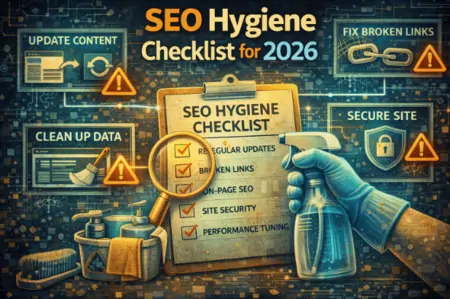
An effective SEO Hygiene Checklist helps you catch problems early, protect your strongest pages, and maintain trust with search engines as your site evolves. Think of it like routine maintenance for a high-performance engine: skip it long enough, and something will fail at the worst possible moment.
This guide walks through a practical, modern SEO Hygiene Checklist for 2026, designed for publishers, agencies, e-commerce teams, and local businesses that want stable, predictable results.
Why SEO Hygiene Matters More in 2026
SEO systems today are far more sensitive to quality signals than they were years ago. Index bloat, crawl inefficiency, outdated content, and degraded UX don’t always trigger immediate penalties—but they weaken your site’s overall trust.
Without an SEO Hygiene Checklist, common issues build up:
- pages get indexed that shouldn’t exist
- strong pages lose internal support
- redirects quietly break authority flow
- performance degrades after updates or plugins
- content becomes stale while competitors improve theirs
A consistent SEO Hygiene Checklist keeps these problems from compounding.
How to Use This SEO Hygiene Checklist
This isn’t a one-time audit. The SEO Hygiene Checklist works best when broken into:
- weekly checks for early warnings
- monthly tasks for compounding gains
- quarterly reviews for structural health
Used correctly, this SEO Hygiene Checklist becomes part of your operating rhythm—not a panic response when traffic drops.
Weekly SEO Hygiene Checks (15–30 Minutes)
1. Monitor Search Console for anomalies
Every week, scan for unusual changes:
- sudden drops in clicks on key pages
- impression spikes that signal new demand
- CTR declines on stable rankings
This step in the SEO Hygiene Checklist helps you spot problems before they turn into traffic losses.
2. Review indexing coverage and exclusions
Check for increases in:
- “Crawled – currently not indexed”
- “Discovered – currently not indexed”
- unexpected excluded URLs
Indexing changes are often early indicators of quality or structural issues. This part of the SEO Hygiene Checklist protects crawl efficiency.
3. Identify CTR leaks on high-impression pages
Pages with impressions but weak clicks are low-hanging fruit.
Quick wins include:
- clarifying titles
- aligning meta descriptions with intent
- removing misleading phrasing
CTR optimization is one of the fastest-return items in any SEO Hygiene Checklist.
4. Fix new 404s and broken internal links
Broken paths leak authority and hurt UX.
Weekly checks should catch:
- internal links pointing to removed URLs
- pages returning 404s that previously ranked
- navigation or breadcrumb errors
This keeps your site structurally sound—an underrated but critical part of the SEO Hygiene Checklist.
Monthly SEO Hygiene Tasks (Where ROI Compounds)
5. Refresh decaying content
Choose 2–6 pages each month that:
- are losing clicks
- contain outdated information
- no longer match current intent
Refresh actions include updating examples, expanding sections, improving readability, and strengthening internal links. Content refreshes are a core pillar of any serious SEO Hygiene Checklist.
6. Audit internal linking to priority pages
Internal links define crawl paths and authority flow.
Monthly checks should ensure:
- pillar pages support cluster pages
- money pages receive internal links
- orphan pages don’t exist
This step of the SEO Hygiene Checklist ensures your best content stays visible and supported.
7. Prune thin pages and reduce index bloat
Not every page deserves to be indexed.
Identify:
- thin tag or category pages
- duplicate archives
- low-value filters or parameters
- near-duplicate posts
Actions include noindexing, consolidation, redirects, or removal. A clean index is one of the biggest long-term benefits of following an SEO Hygiene Checklist.
8. Review redirects and eliminate chains
Redirect chains waste crawl budget and dilute authority.
Monthly redirect hygiene includes:
- collapsing chains into single hops
- fixing redirects to irrelevant destinations
- ensuring high-value pages resolve cleanly
Redirect maintenance is unglamorous—but essential to a strong SEO Hygiene Checklist.
9. Check Core Web Vitals on key pages
You don’t need to optimize every URL.
Focus on:
- top organic landing pages
- top conversion pages
- pages with high bounce rates
Fix common issues like heavy images, script overload, and layout shifts. Performance stability is a quiet but powerful component of the SEO Hygiene Checklist.
10. Validate schema and rich result eligibility
Ensure that:
- schema matches visible content
- no spammy or misleading markup exists
- templates use correct schema types
Schema won’t fix weak pages, but it supports clarity. That’s why it remains part of a modern SEO Hygiene Checklist.
Quarterly SEO Hygiene Reviews (Structural Health)
11. Consolidate cannibalized content
If multiple pages target the same intent:
- merge the strongest sections
- choose one authority URL
- redirect weaker pages
Consolidation reduces volatility and strengthens topical authority—key outcomes of a disciplined SEO Hygiene Checklist.
12. Rebuild or expand topic clusters
Each major topic should have:
- a clear pillar page
- supporting cluster content
- logical internal linking
Topic systems outperform scattered posts, and cluster reviews are a strategic layer of the SEO Hygiene Checklist.
13. Run a technical SEO health review
Quarterly checks should focus on:
- crawl efficiency
- canonical consistency
- sitemap accuracy
- parameter control
- template behavior
This prevents technical debt from accumulating unnoticed—a core reason the SEO Hygiene Checklist exists.
14. Review site taxonomy and templates
Audit:
- category and tag structures
- duplicate templates
- pagination behavior
- faceted navigation
Most index bloat originates here, not from writers. Template reviews keep your SEO Checklist effective at scale.
15. Reassess tracking and third-party scripts
Remove or limit:
- duplicate analytics tags
- heavy scripts hurting INP
- unused marketing tools
Script creep is the fastest way to undo performance gains. Script audits complete the quarterly cycle of the SEO Checklist.
How to Implement the SEO Hygiene Checklist as a System
The SEO Hygiene works best when it’s operationalized:
- assign weekly owners
- schedule monthly tasks
- document quarterly reviews
- track changes and outcomes
When the SEO Hygiene Checklist becomes routine, SEO stops being reactive and starts becoming predictable.
Final Thoughts
SEO in 2026 rewards sites that stay clean, clear, and consistent.
An SEO Hygiene Checklist isn’t about perfection—it’s about preventing small problems from becoming big ones. When you follow a structured SEO Hygiene Checklist, you protect your rankings, stabilize traffic, and give every piece of content the best chance to succeed.
That’s how SEO becomes sustainable—not stressful.