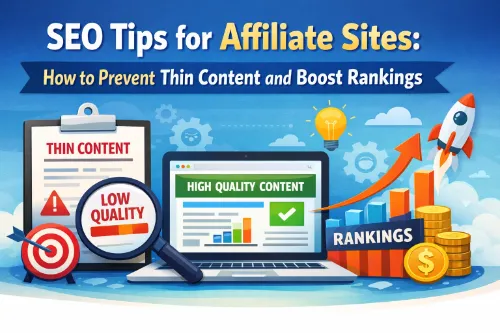
Affiliate websites live or die by how much real value they give to users, not by how many posts they publish. Use these SEO tips for affiliate sites to avoid thin content, improve user experience, and steadily boost your search rankings and conversions.
What Thin Content Looks Like on Affiliate Sites
Thin content on affiliate sites usually means shallow pages that don’t fully answer user questions or simply repeat what everyone else is saying. These pages are often short, generic, and overloaded with affiliate links but light on insight, making them easy targets for quality-related ranking drops.
Search engines see thin affiliate content as a sign that a site is chasing clicks instead of solving problems. If big portions of your affiliate site consist of auto-generated product summaries, duplicate vendor descriptions, or “top 10” lists with one‑sentence blurbs, you are likely dealing with thin content issues that hold back your SEO.
Why Thin Content Hurts Your Affiliate SEO
When many pages on your affiliate site offer little value, your topical authority weakens and your best pages can get dragged down. Thin content can hurt crawling efficiency, reduce dwell time, and trigger lower engagement metrics, which all work against you in competitive affiliate niches.
From a business standpoint, users rarely trust pages that look like quick cash grabs. They skim, bounce, and head to competitors that offer richer guides, clearer comparisons, and more transparent reviews, which means fewer clicks on your affiliate links and fewer conversions overall.
Auditing Your Affiliate Site for Thin Content
Start by listing all your key affiliate URLs and reviewing basic metrics such as traffic, bounce rate, time on page, and conversions. Pages with very low traffic, little or no engagement, and minimal content depth are prime candidates for a thin content audit and improvement plan.
Look for patterns: extremely short buying guides, near-duplicate reviews targeting slightly different long-tail keywords, or posts that never clearly match search intent. Decide whether each weak page should be expanded, merged into a stronger guide, redirected, or noindexed so that your best content can carry more SEO weight.
Building In-Depth, Helpful Affiliate Content
The fastest way to prevent thin content is to design each article around a complete solution instead of a quick recommendation. For example, instead of a short “Top 5 products” list, turn the topic into a full buyer’s guide with use cases, criteria for choosing, pros and cons, and FAQs that match real user questions.
This approach lets you naturally incorporate your main phrase, such as SEO tips for affiliate sites, together with related ideas like keyword research for affiliate sites, long-tail keywords for affiliate marketing, internal linking, and EEAT, without forcing the language. The more complete and user-focused your guide, the easier it becomes to rank for multiple intent‑driven queries.
On‑Page SEO Tips for Affiliate Websites
Treat every money page as a mini hub that deserves careful on‑page SEO. Use a descriptive title, a clear H1, and logical H2–H3 subheadings that reflect your target topics, such as affiliate SEO strategies, affiliate site content optimization, and how to avoid thin affiliate content while still driving sales.
Within the body, mix your focus and semantic keywords in a way that sounds natural to humans. For instance, when discussing on‑page SEO for affiliate websites, you can smoothly mention long-tail keywords for affiliate marketing, featured snippets for affiliate blogs, internal linking for affiliate sites, and affiliate link SEO best practices as distinct yet related ideas that support your main topic.
Keyword Strategy That Reduces Thin Content
A smart keyword strategy helps you avoid publishing dozens of nearly identical posts. Instead of chasing a long list of broad terms, group related long-tail keywords and commercial phrases into a few strong, in‑depth pages that cover the topic from several angles.
For example, instead of separate weak articles for each small variation of “best product for X,” create one comprehensive guide that targets multiple buyer-intent phrases. Inside that piece, you can cover keyword research for affiliate sites, commercial and transactional keywords for affiliates, and how to map those terms to one well‑structured page instead of many thin ones.
Adding EEAT to Your Affiliate Content
To stand out from generic affiliates, show clear experience, expertise, authoritativeness, and trust. Add author bios that highlight your background, mention personal tests or hands‑on experience, and include clear disclaimers and affiliate disclosures so users understand your relationship with the products.
Over time, keep updating your reviews and guides to reflect new versions, price changes, and user feedback. This pattern of regularly updated, experience‑driven content signals quality, which supports both better rankings and higher conversion rates, especially in competitive affiliate marketing niches.
Simple GEO and AEO Enhancements
To capture more qualified traffic, layer GEO elements into relevant posts. For instance, if your affiliate site targets readers in a specific country or region, reference local availability, shipping options, or pricing where appropriate, and add location‑specific modifiers to a few long-tail keywords to naturally reflect how people in that area search.
For AEO (Answer Engine Optimization), structure sections so they can work as concise answers for voice search and featured snippets. Include short question‑and‑answer segments, such as a brief paragraph directly answering “How do I avoid thin content on my affiliate site?” or “What are the best SEO tips for affiliate sites?” followed by a clean, scannable explanation.
Using NLP‑Friendly, Natural Language
Modern search systems rely heavily on natural language processing, so write in a way that feels conversational and clear. Use full sentences, define jargon, and explain concepts like affiliate SEO strategies, on‑page SEO for affiliate websites, and EEAT for affiliate websites in simple terms that a beginner can understand.
Avoid keyword stuffing and aim instead for semantic richness. When you cover a topic like improving affiliate site rankings, mention related ideas such as internal linking, updating old affiliate content, avoiding thin affiliate content, and using high-quality affiliate content formats (comparison tables, tutorials, FAQs) as part of a single, coherent narrative.
Updating and Expanding Existing Thin Content
Go through your existing posts and pick one thin article to transform into a high‑value asset. Add sections that address specific user objections, expand the pros and cons list, introduce alternatives, and include new subtopics like mobile‑friendly affiliate website design or simple on‑page SEO tweaks that users can apply immediately.
Each time you refresh a post, review whether you can consolidate nearby topics or redirect weaker URLs into the improved guide. Over a few months, this process gradually reduces the number of thin pages on your affiliate site and replaces them with a smaller set of strong resources that can rank for more queries and better serve users.
Practical Example for One Guide
Imagine you have a short article titled “Best Budget Headphones for Remote Work” with only basic product descriptions. To strengthen it, start with a brief overview of pain points, add a buyer’s checklist, share personal usage tips, and then build a clear comparison table that highlights differences and use cases.
Inside that same guide, you can naturally weave in topics like long-tail keywords for affiliate marketing, affiliate link SEO best practices, internal linking for affiliate sites (linking to related setup or productivity guides), and featured snippets for affiliate blogs by including a short paragraph that directly answers a key question in plain language.
Simple Checklist to Prevent Thin Content
Use a small checklist before publishing any new affiliate article:
- Does this post fully answer the main search intent?
- Does it provide unique insight, examples, or data beyond vendor descriptions?
- Does it naturally include your main and related phrases without stuffing?
- Does it show real experience and transparent affiliate disclosure?
- Does it link internally to relevant guides and receive links from them as well?
If you can confidently answer “yes” to each item, you are far less likely to publish thin content and far more likely to see sustainable gains in rankings and conversions for your affiliate site.
Frequently Asked Questions (FAQs)
How long does it take to see SEO results after fixing thin content on an affiliate site?
Most sites start seeing early ranking and traffic improvements within 4–12 weeks after cleaning up thin content, but highly competitive niches can take longer.
Should I delete or noindex thin affiliate pages that don’t get traffic?
If a page has no traffic, no links, and no real value, deleting or redirecting it is often better; if it has some value but is weak, consider noindexing until you improve it.
Can I rank an affiliate site using only product reviews, or do I need informational content too?
You can rank with only reviews, but adding informational guides, how‑tos, and comparison posts builds stronger topical authority and usually leads to better rankings and conversions.
Is AI‑generated content safe to use on affiliate websites?
You can use AI as a drafting tool, but you should always edit, fact‑check, add real experience, and ensure the final content is unique, helpful, and aligned with user intent.
How many words should an affiliate article have to avoid being thin content?
There is no fixed word count; the article should be as long as needed to satisfy search intent, cover the topic thoroughly, and offer more value than competing pages.
Do product comparison tables help reduce thin content on affiliate pages?
Yes, well‑structured comparison tables that highlight key features, pros and cons, and use cases can significantly increase perceived value and user engagement.
Can I use manufacturer descriptions on my affiliate site without creating thin content?
If you copy manufacturer descriptions without adding anything unique, it’s likely to be considered thin or duplicate; always add your own insights, tests, and comparisons.
How often should I audit my affiliate site for thin content?
Most affiliate sites benefit from a full content audit every 6–12 months, plus smaller quarterly reviews of newly published posts and underperformers.
Does page speed affect how search engines treat thin content?
Slow pages with thin content create a poor user experience and can amplify negative signals; improving speed won’t “fix” thin content but will support stronger pages.
Can internal linking alone fix thin content on affiliate pages?
Internal links can help distribute authority and improve crawlability, but they can’t replace missing depth; you still need to expand, merge, or rewrite thin pages.