Ways Organic Traffic Into Paying Customers SEO Key Takeaways
Turning organic traffic into paying customers in 2026 requires more than high rankings — it demands a strategic blend of intent alignment, UX optimization, and persuasive content.
- Ways Organic Traffic Into Paying Customers SEO prioritize aligning every page with commercial and transactional search intent.
- Improving landing page design, CTAs, and trust signals directly boosts conversion rates from organic visitors.
- Tracking ROI through structured funnels and AI-driven analytics ensures continuous optimization for revenue growth.
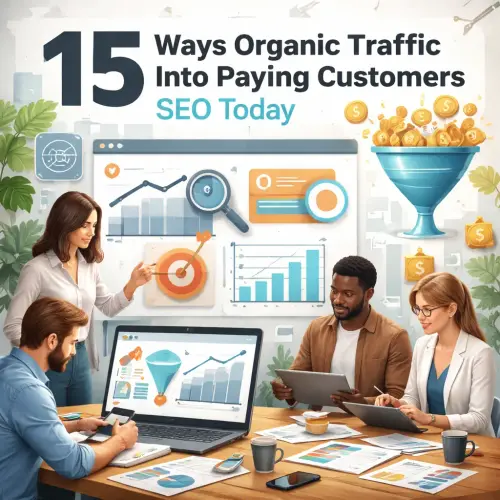
What Are the Best Ways Organic Traffic Into Paying Customers SEO in 2026?
The landscape of search has shifted dramatically. Google’s AI overviews, voice search, and zero-click results mean simply driving traffic no longer guarantees revenue. To convert organic visitors into buyers, you must address intent, experience, and persuasion at every touchpoint. Below are 15 proven ways to turn organic traffic into paying customers with actionable SEO strategies. For a related guide, see 28 Ways to Get Traffic Without Publishing in 2026 Guide.
1. Align Content with Search Intent to Boost Sales
How does search intent affect sales? It determines whether a visitor is ready to buy or still researching. If you target informational keywords with a sales page, you’ll get bounces. Instead, match each page to the intent: informational (blog posts), commercial (comparison guides), transactional (product pages). For example, a SaaS company might target “best project management tools” with a comparison article, then funnel readers to a free trial landing page. This alignment is one of the most effective Ways Organic Traffic Into Paying Customers SEO because it pre-qualifies leads before they land on your site.
Map Keywords to Funnel Stages
Use tools like Ahrefs or Semrush to classify keywords by intent. Create content clusters: top-of-funnel (TOFU) educational articles, middle-of-funnel (MOFU) comparison posts, and bottom-of-funnel (BOFU) product or pricing pages. This structured approach ensures every search query leads to a page that matches the user’s readiness to convert.
2. Optimize Landing Pages for Higher Conversion Rates
What makes landing pages convert better? Speed, clarity, and relevance. A landing page that loads in under 2 seconds and has a single, clear call-to-action (CTA) can increase conversions by up to 50%. Remove navigation links to keep focus on the offer. Use social proof — testimonials, case studies, trust badges — to build credibility. For eCommerce, include high-quality product images and size guides. For SaaS, use a demo video or a “Start Free Trial” button prominently above the fold.
Elements of a High-Converting Landing Page
- Headline that matches the search query and states the main benefit.
- Subheadline that clarifies the offer.
- Bullet points or short paragraphs highlighting key features.
- A single CTA button with action-oriented copy (e.g., “Get Started Today,” “Claim Your Discount”).
- Trust signals: money-back guarantee, secure checkout icons, customer logos.
3. Craft Persuasive CTAs That Drive Actions
How can CTAs increase conversions from SEO traffic? By creating urgency and aligning with the user’s goal. Instead of generic “Submit” or “Click Here,” use CTAs that speak to the benefit: “Download the Free Guide,” “Get 20% Off Now,” “Book a Strategy Call.” Place CTAs at the end of blog posts, in sidebars, and as mid-page banners. A/B test color, placement, and wording. For instance, an eCommerce store selling coffee makers saw a 32% lift in sales by changing its CTA from “Shop Now” to “Brew Better Coffee Today.”
4. Build Trust That Accelerates Purchasing Decisions
How does trust building impact organic sales? Visitors who trust your brand are three times more likely to buy. Display trust signals throughout the customer journey: SSL certificates, clear return policies, real customer reviews, and media mentions. Publish detailed case studies with real results. If you’re a B2B service, include client logos and video testimonials. For affiliate sites, disclose affiliate relationships transparently. Trust is often the deciding factor between a bounce and a conversion.
5. Structure Content to Guide Visitors Toward Purchase
What content structure drives more customers? A logical flow that moves the reader from problem awareness to solution evaluation. Use the PAS (Problem-Agitate-Solution) framework in blog posts and landing pages. For example, an article on “How to Reduce SaaS Churn” could start by describing the problem (high churn rates), agitate it (lost revenue, wasted acquisition costs), then present your software as the solution with a case study and CTA. This structure keeps visitors engaged and primes them to convert.
6. Optimize Your Sales Funnel for SEO Revenue
How can funnel optimization improve SEO revenue? By creating content for each stage of the funnel and linking them seamlessly. A visitor might land on a TOFU blog post, click an internal link to a MOFU comparison guide, then proceed to a BOFU product page. Use “next-step” CTAs within content to move users down the funnel. For example, after a blog post about “email marketing best practices,” include a CTA like “Try Our Email Marketing Tool Free for 14 Days.” This method turns passive readers into active leads. For a related guide, see Optimization Strategies That Increase Affiliate in 2026.
Sample Funnel Content Mapping
| Funnel Stage | Content Type | Example CTA |
|---|---|---|
| TOFU (Awareness) | Blog post, infographic | “Download the Ultimate Guide” |
| MOFU (Consideration) | Comparison guide, webinar | “Watch the Demo” |
| BOFU (Decision) | Case study, product page | “Start Free Trial” |
7. Improve UX to Keep Organic Visitors Engaged
What role does UX play in conversion from organic traffic? A frustrating experience kills conversions. Slow load times, cluttered layouts, and confusing navigation drive visitors away. Google’s Core Web Vitals are now ranking signals and user expectations. Optimize for mobile-first, use clear typography, and minimize pop-ups that block content. A simple UX tweak — like reducing form fields from 5 to 3 — can increase conversion rates by 20% or more. Tools like Google PageSpeed Insights and Hotjar help identify friction points.
8. Monetize AI Search Traffic Through Structured Data
How can AI search traffic be monetized? As Google’s AI Overviews pull answers directly from web pages, you can position your content to be featured. Use FAQ schema, how-to schema, and review schema to increase the chance of appearing in rich results. A featured snippet or AI-generated summary can drive high-intent clicks to your site. For example, a recipe blog that uses how-to markup may appear in voice search results, leading to more affiliate link clicks. Optimizing for AI search is a growing Way Organic Traffic Into Paying Customers SEO tactic.
9. Generate High-Quality Leads from SEO
What are the best lead generation strategies from SEO? Gated content — ebooks, whitepapers, templates, and webinars — remains a top tactic. Create a dedicated landing page for each lead magnet and optimize it for a specific long-tail keyword. For instance, “free SEO audit checklist” can capture leads from small business owners. Follow up with an automated email sequence that nurtures leads toward a paid offer. Pop-ups and slide-ins with exit-intent triggers also capture bounce traffic effectively.
10. Use Persuasive Content to Influence Buying Decisions
How does content persuasion affect buying decisions? The right words can turn a skeptic into a buyer. Use social proof (X customers trust us), authority (featured in Forbes), and scarcity (limited-time offer). Write benefit-driven copy that answers “What’s in it for me?” For product pages, use comparison tables and before-and-after scenarios. For example, a skincare brand might show a photo of a customer’s skin improvement after using the product for 30 days. Persuasion techniques reduce friction and build desire.
11. Optimize Product Pages for Search and Conversion
How can product pages improve SEO conversions? Start with keyword-rich titles and meta descriptions that include the product name and a buying intent keyword. Add high-quality images with alt text, detailed descriptions with bullet points, and customer reviews. Include a clear CTA and trust badges. For example, an eCommerce site selling yoga mats could target “non-slip yoga mat for hot yoga” and include a video demonstration. Schema markup (Product, Review) helps the page appear in rich snippets, driving more qualified traffic.
12. Avoid Common Mistakes That Kill Conversions
What mistakes reduce organic traffic conversions? The biggest culprits are slow load speed, unclear value proposition, too many CTAs, and lack of mobile optimization. Other mistakes: using generic stock photos, hiding pricing, and not tracking user behavior. For example, a B2B software company saw a 40% drop in demo requests after adding a video that auto-played with sound. Test every element and remove anything that distracts from the conversion goal.
13. Track ROI to Measure and Improve Performance
How do you track ROI from organic search traffic? Use Google Analytics 4 (GA4) to set up conversion goals — purchases, sign-ups, form submissions. Attribute revenue to specific organic landing pages with UTM parameters. Tools like Google Search Console show which queries drive impressions and clicks, while GA4 reveals which of those clicks convert. Calculate ROI by dividing revenue from organic traffic by the cost of SEO efforts (tools, content production, link building). Regularly review and double down on pages with the highest conversion rates.
14. Leverage User-Generated Content for Social Proof
Encourage customers to leave reviews, upload photos, and share testimonials. Embed these on product pages and landing pages. User-generated content (UGC) builds trust and provides fresh SEO content. For example, an outdoor gear brand can create a gallery of customer hiking photos with links to the products used. UGC signals to both users and search engines that your brand is active and trusted.
15. Implement a Continuous A/B Testing Program
Never assume your pages are optimized. Run A/B tests on headlines, CTAs, images, page layouts, and offers. Use tools like Google Optimize or VWO to test variations. For instance, test a “Free Shipping” vs. “10% Off” offer on a product page to see which drives more purchases. Small improvements compound over time, turning more organic visitors into paying customers. Make testing a monthly habit.
Useful Resources
To dive deeper into converting organic traffic, check out these resources:
- Neil Patel’s Guide to Conversion Rate Optimization Strategies — Practical tips for turning more visitors into customers.
- Moz: How SEO and CRO Work Together to Increase Revenue — An in-depth look at aligning search optimization with conversion tactics.
Final Takeaway: The most effective Ways Organic Traffic Into Paying Customers SEO require a strategic blend of intent-driven content, seamless UX, trust-building elements, and continuous testing. Start by auditing your current pages, align them with buyer intent, and implement one or two of these tactics each month. Over time, you’ll see a steady increase in revenue from your organic traffic. Now pick your first tactic — maybe optimize a landing page or write a new lead magnet — and take action today.
Frequently Asked Questions About Ways Organic Traffic Into Paying Customers SEO
How can organic traffic be converted into paying customers ?
By aligning content with search intent, optimizing landing pages, using persuasive CTAs, building trust signals, and guiding visitors through a structured funnel. Each touchpoint should move the user closer to a purchase decision.
What SEO strategies improve conversion rates ?
Focus on keyword intent, page speed optimization, mobile-friendliness, internal linking to conversion pages, and using schema markup for rich results. These strategies ensure visitors find what they need quickly and trust the page.
How does search intent affect sales ?
When a page matches the user’s intent (informational, commercial, transactional), the visitor is more likely to engage and convert. Mismatched intent leads to high bounce rates and lost sales.
What makes landing pages convert better ?
Fast load times, a clear headline, compelling copy, a single CTA, social proof, and an uncluttered design. Each element should support the main conversion goal.
How can CTAs increase conversions from SEO traffic ?
By using action-oriented, benefit-driven language and placing them strategically — at the end of posts, in sidebars, or as exit-intent pop-ups. A/B test wording and colors for maximum impact.
How does trust building impact organic sales ?
Trust signals like reviews, testimonials, money-back guarantees, and secure checkout badges reduce perceived risk. Trusted brands see higher conversion rates and repeat purchases.
What content structure drives more customers ?
Structures like Problem-Agitate-Solution (PAS) or Before-After-Bridge (BAB) keep readers engaged and lead them logically toward a purchase decision. Clear headings and bullet points improve scannability.
How can funnel optimization improve SEO revenue ?
By creating content for each funnel stage and linking them with CTAs, you guide users from awareness to conversion. This increases the likelihood that organic visitors eventually become customers.
What role does UX play in conversion from organic traffic ?
Good UX ensures visitors stay on the page, find information easily, and take action without frustration. Poor UX — slow load times, confusing navigation — directly hurts conversions.
How can AI search traffic be monetized ?
Optimize for AI overviews and voice search by using structured data, FAQ schema, and concise answers. This increases the chance of being featured in AI-generated responses, driving high-intent clicks.
What are the best lead generation strategies from SEO ?
Gated content like ebooks, checklists, webinars, and free tools are effective. Create dedicated landing pages with clear CTAs and optimize them for long-tail keywords.
How does content persuasion affect buying decisions ?
Persuasive content uses social proof, authority, scarcity, and benefit-driven copy to reduce hesitation. It frames the product or service as the obvious solution to the user’s problem.
How can product pages improve SEO conversions ?
By targeting buying-intent keywords, using detailed descriptions, high-quality images with alt text, customer reviews, and clear CTAs. Schema markup helps appear in rich snippets.
What mistakes reduce organic traffic conversions ?
Common mistakes include slow page speed, unclear value proposition, too many CTAs, poor mobile experience, and lack of trust signals. Each can significantly lower conversion rates.
How do you track ROI from organic search traffic ?
Set up conversion goals in GA4, attribute revenue to specific landing pages, and calculate ROI by comparing revenue against SEO costs (tools, content, link building).
What is the first step to converting organic traffic?
Audit your current content and keyword strategy. Identify which pages bring the most traffic and where visitors drop off. Then align those pages with user intent and add conversion elements.
How important is mobile optimization for conversions?
Extremely important — over 60% of organic traffic comes from mobile devices. Mobile-friendly pages with fast load times and easy navigation directly impact conversion rates.
Can social media help convert organic SEO traffic?
Yes. Share blog posts and landing pages on social platforms to extend reach. Social proof from shares and comments can also increase trust and conversions from organic visitors.
How often should I update conversion strategies?
Review your conversion data monthly and run A/B tests continuously. Algorithm updates, user behavior shifts, and new competition require regular optimization.
What tool is best for tracking organic conversions?
Google Analytics 4 (GA4) combined with Google Search Console provides a complete picture. For deeper insights, tools like Hotjar, Crazy Egg, and Semrush help identify conversion barriers.