SEO isn’t what it used to be. The old approach focused on keyword stuffing, backlinks, and ranking for search engines alone. Today, SEO is driven by user intent, content quality, AI-powered search, and real value. As Google and generative engines evolve, understanding the shift from Old SEO vs. new SEO tactics to modern SEO strategies is essential for staying visible, relevant, and competitive online. Old SEO vs. New SEO tactics now require a focus on user satisfaction and engagement.

Table of Contents
Introduction: Why SEO Looks Completely Different Today
If you learned SEO a few years ago, you may feel like the rules have suddenly changed. Techniques that once produced fast rankings—such as keyword stuffing, exact-match domains, and mass backlink building—no longer work the way they used to, and can even lead to ranking drops or penalties.
This has left many beginners and website owners asking a simple but important question: Is old SEO dead, or does it still work in today’s search environment? The answer is more nuanced than a simple yes or no. SEO hasn’t disappeared—it has evolved from “gaming algorithms” to serving people first.
Ultimately, the conversation around old SEO vs. new SEO is essential for anyone looking to thrive in the digital realm. Adapting strategies accordingly will lead to better outcomes.
Today, search engines and AI answer engines are not just matching keywords. They interpret meaning, measure user satisfaction, and prioritize trust and real experience, which is why Google emphasizes creating helpful, reliable, people‑first content.
Understanding old SEO vs. new SEO can help marketers adapt and refine their strategies. With evolving algorithms, the distinction between old SEO vs. new SEO highlights the need for high-quality content tailored to user needs.
The debate of old SEO vs. new SEO continues as strategies evolve. It’s crucial to discern the effective techniques in the context of old SEO vs. new SEO to ensure ongoing success in digital marketing.
By analyzing old SEO vs. new SEO, marketers can identify what works today and what no longer applies. The transition from old SEO vs. new SEO approaches emphasizes quality and relevance.
What Is Old SEO? (How SEO Worked Before)
Old SEO, also known as traditional SEO, refers to practices that focused on manipulating search engine algorithms rather than delivering the best possible experience to users. In the early days, algorithms were simple: repeat a keyword often enough, point enough links at a page, and it could rank—even if the content wasn’t very helpful.
Key characteristics of old SEO
- Heavy reliance on keyword repetition.
- Exact-match keyword targeting with little regard for context.
- Thin or low-quality content could still rank.
- Backlink quantity mattered more than relevance or authority.
- User experience and engagement were rarely considered.
Common old SEO tactics that (used to) work
- Keyword stuffing in content, titles, and meta tags.
- Exact-match anchor text links at scale.
- Article spinning and duplicate content.
- Mass directory submissions.
- Comment spam and low-quality forum links.
- Paid or private backlink networks.
These methods exploited early search engine limitations and often produced poor results for users, which is exactly what modern updates have tried to fix.
What Is New SEO? (How SEO Works Now)

Modern SEO focuses on solving problems for users and aligning with how search engines evaluate helpful, reliable content. Instead of chasing loopholes, you build content and experiences that deserve to rank.
Core concepts from Google’s helpful content guidance. and many expert frameworks include:
- Search intent optimization (why the user is searching, not just what they type).
- Content depth and topical authority across related subtopics.
- Natural language processing (NLP) and semantic understanding.
- E‑E‑A‑T (Experience, Expertise, Authoritativeness, Trustworthiness) as a quality framework.
- User experience and performance signals such as Core Web Vitals.
- Semantic and contextual search that goes beyond exact keywords.
Google describes this shift as people‑first content: pages created primarily to help users, not just to rank in search results.
Old SEO vs New SEO: Side-by-Side
| Old SEO | New SEO |
| Keyword repetition | Search intent and problem‑solving focus |
| Thin, generic content | Helpful, in‑depth, experience-based content |
| Backlink quantity at all costs | Backlink quality, relevance, and authority |
| Manipulative, short-term tactics | Trust, credibility, and long-term value |
| Obsessing over rankings only | Visibility, brand, and perceived expertise |
| Manual, checklist-style optimization | Human-first content with AI-assisted evaluation |
This contrast explains why many legacy tactics now stagnate or backfire while modern, user-focused strategies keep compounding over time.
SEO Evolution: How Search Engines Changed

Search engines have moved through several phases:
- Keyword Matching Era – Pages ranked heavily on keyword frequency and basic on-page signals.
- Link Authority Era – Backlinks became a core signal of importance and how Google builds brand trust.
- Semantic Search Era – Algorithms started understanding intent, entities, and context.
- AI & Experience Era – Trust, usefulness, user satisfaction, and real-world experience dominate.
You can see this reflected in Google’s helpful content update documentation and many modern interpretations of its quality guidelines.
How AI Changed SEO (and Introduced GEO & AEO)
AI systems now play a central role in how search engines and answer engines work: they interpret queries, summarize information, and assess patterns of low-quality content.
This is why AI-generated content is risky when it is generic, low-value, or unedited. On the other hand, many practitioners show that AI content can perform well when it’s reviewed, enriched with real experience, and created to benefit users, in line with people‑first guidelines.
Generative Search & GEO (Generative Engine Optimization)
With AI answers and overviews appearing directly in search and chat interfaces, ranking is no longer the only goal. You also want your content to be cited as a trusted source in those AI-generated answers, which is the focus of Generative Engine Optimization (GEO).
GEO emphasizes:
- Clear definitions of concepts and entities.
- Concise, quotable explanations near the top of sections.
- Logical, hierarchical structure with strong headings.
- Trustworthy sources, author bios, and references.
- Natural, conversational language that LLMs can parse.
For a broader introduction, see beginner‑friendly GEO overviews such as this GEO guide.
The landscape of old SEO vs. new SEO is constantly changing, making it imperative for marketers to stay informed and adapt. Understanding these dynamics can significantly impact online visibility and engagement.
AEO (Answer Engine Optimization)
AEO (Answer Engine Optimization) is about structuring content so answer engines can directly use your content as the answer, not just as a citation.
Good deep dives on AEO, like Neil Patel’s Answer Engine Optimization guide, recommend you:
- Use question-focused headings (H2/H3 that mirror user queries).
- Provide a direct 1–2 sentence answer before expanding.
- Include robust FAQ sections with variations of core questions.
- Make entities, features, and comparisons very explicit.
In conclusion, the evolution of old SEO vs. new SEO illustrates the importance of aligning with user expectations and search engine algorithms to succeed.
Together, SEO (rankings), GEO (citations), and AEO (being the answer) define how your content shows up in both traditional SERPs and AI-driven experiences.
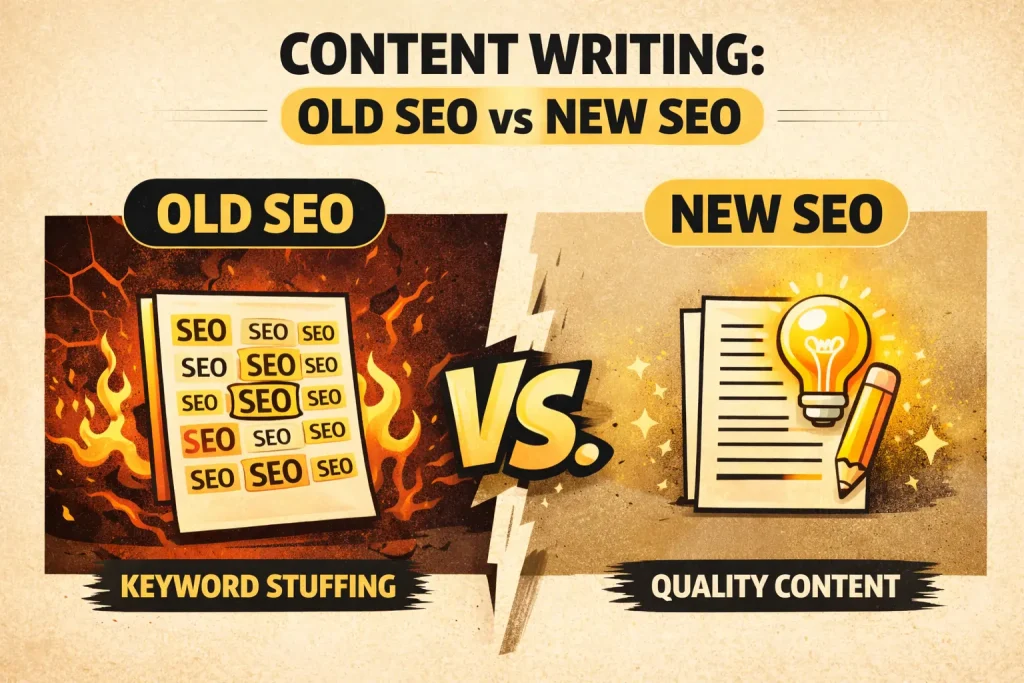
Content Writing: Old SEO vs. New SEO
Old SEO content style
- Keyword-heavy paragraphs written for bots.
- Short, generic articles with little originality.
- Minimal or no first-hand experience.
- Thin answers padded with fluff.
New SEO content style
- User-focused writing that addresses a clear problem.
- Topic clusters and semantic coverage across related questions.
- Experience-based insights, examples, and opinions.
- Clear headings, formatting, and summaries for scanners.
- Natural, NLP-friendly language instead of forced keywords.
Guides that break down people‑first writing, such as this helpful content framework, are excellent references as you write.
Keywords: Old SEO vs. New SEO
Old keyword strategy
- Exact-match keywords for every page and heading.
- High keyword density targets.
- Awkward repetition for the sake of search engines.
Modern keyword strategy
- Semantic keywords and related phrases.
- Natural placement that fits user-first writing.
- Focusing on topics and entities, not just single phrases.
- Covering related subtopics users also care about.
Google’s own documentation encourages focusing less on exact matching and more on intent, relevance, and helpfulness, which many SEO platforms echo in their helpful content guides.
Backlinks: Old SEO vs. New SEO
Old link-building methods
- Link farms and low-quality directories.
- Spam comments and forum profile links.
- Buying large volumes of backlinks.
- Over-optimized anchor text at scale.
Modern link-building practices
- Editorial backlinks from relevant articles and resources.
- Natural brand mentions and digital PR.
- Topical relevance between linking page and your page.
- Authority links from trusted, niche-relevant sites.
- “Trust signals” like consistent brand presence and reviews.
Ethical link-building playbooks such as the Ahrefs link building guide show how to earn these links by publishing genuinely useful assets and outreach.
Links still matter, but relevance, authority, and authenticity matter more than raw volume.
Technical SEO: What Changed and What Stayed
What changed
- Core Web Vitals
- as performance benchmarks.
- Mobile-first indexing as the default.
- UX and page experience signals gaining importance.
What stayed the same
- Crawlability and indexability fundamentals.
- Clean, logical site structure.
- Canonical tags and proper internal linking.
- Use of structured data to clarify content meaning.
For a deeper overview, you can reference Google’s technical SEO documentation alongside practical guides on helpful content.
User Experience & Core Web Vitals
Modern SEO heavily values user experience:
- Loading: How quickly your main content appears (LCP).
- Interactivity: How soon users can interact with the page (INP).
- Visual stability: Avoiding layout shifts as the page loads (CLS).
Resources like
Web.dev’s Core Web Vitals articles and explainers from providers such as Cloudflare or Adobe’s Core Web Vitals guide walk through how to measure and improve these metrics.
Sites that frustrate users—slow pages, intrusive pop-ups, poor mobile layouts—tend to struggle over time, even if they are well-optimized on paper.
E‑E‑A‑T: Why Trust Is a Priority
E‑E‑A‑T (Experience, Expertise, Authoritativeness, Trustworthiness) is a quality framework from Google’s Search Quality Rater Guidelines. It is not a single direct “ranking factor,” but it describes the kind of content Google wants its systems to reward.
Search engines and answer engines look at signals such as:
- Who created the content and their experience.
- Evidence of real-world usage or expertise.
- Authority signals (links, mentions, reviews, reputation).
- Transparency, accuracy, and safety—especially for sensitive topics.
For a practical breakdown, see resources like “Is E‑E‑A‑T a ranking factor?” or agency explainers on E‑E‑A‑T and people-first content E‑E‑A‑T is especially important for finance, health, legal, and reviews, where bad information can cause harm.
Real-World Example: Old SEO vs. New SEO

Old approach
A blog targets “best SEO tools” and:
- Repeats the phrase dozens of times.
- Publishes a generic, surface-level listicle.
- Buys or trades backlinks from unrelated sites.
This might generate short-term impressions but usually leads to low time-on-page, high bounce rates, and weak trust signals.
New approach
Another blog targets the same topic but:
- Describes how the tools were actually used.
- Includes screenshots, workflows, pros and cons, and pricing context.
- Compares tools for different user types (beginners, agencies, in‑house teams).
- Links out to credible sources and transparently discloses affiliations.
Result: the second approach tends to earn more natural links, higher engagement, and better long-term rankings—and is more likely to be cited by AI systems as a trustworthy source.
What Old SEO Techniques Still Work (When Updated)
Despite major changes, some fundamentals still matter when used in a modern way:
- Keyword research to understand demand and language (used naturally).
- Internal linking to guide users and distribute authority.
- Technical SEO basics to make content discoverable.
- On-page optimization (titles, headings, meta descriptions for clarity).
- Earning authority backlinks through genuinely valuable content.
For beginners, holistic guides such as Moz’s Beginner’s Guide to SEO remain a solid foundation.
SEO evolution removed shortcuts, not fundamentals.
SEO Techniques That No Longer Work
Avoid these outdated tactics:
- Keyword stuffing and unnatural repetition.
- Thin affiliate pages offering no unique value.
- Spammy backlinks and link schemes.
- Automated content farms with little to no review.
- Duplicate or scraped pages without added value.
These patterns are precisely what Google’s helpful content system and spam updates try to demote.
Beginner SEO Checklist for Today (Actionable)
Use this as a simple starting framework, referencing the guides linked above:
- Write helpful, original content that fully answers a specific question or task, following Google’s people‑first content recommendations.
- Optimize for search intent by identifying whether users want to learn, compare, or buy—and structuring your page accordingly, as outlined in many helpful content guides.
- Improve site speed and UX using tools like PageSpeed Insights and guidance from Web Vitals documentation..
- Use clear headings and schema so search engines and answer engines can understand your sections and entities, supported by Google’s structured data docs
- Build trust signals with author bios, about pages, references, and honest reviews, in line with E‑E‑A‑T best practices
- Focus on topical authority by covering related subtopics in a cluster, interlinking them, and updating content regularly, as many helpful content and topical authority guides recommend.
The Future of SEO: How to Stay Ahead
Over the next few years:
- AI answers and overviews will continue to grow.
- Zero-click and low-click searches will increase.
- Brand authority, reputation, and trust will matter more.
- GEO and AEO will become essential for AI visibility.
- Human-centered, experience-rich content will keep outperforming shortcuts.
If your content consistently:
- Solves real problems for a defined audience.
- Demonstrates lived experience and credible expertise.
- Is easy to understand and act on.
- Helps users better than competing results.
Then both search engines and AI systems have strong reasons to reward you. Pro tip for ranking and visibility faster: combine SEO (rankings), GEO (citations in AI outputs), and AEO (being the answer), and build everything around people‑first content using the official helpful content guidelines as your north star.