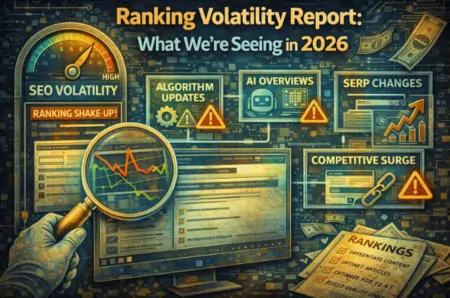
In 2026, Ranking Volatility is no longer something SEOs talk about only during “update weeks.” It has become a constant background condition of search.
SERPs move more often, in smaller increments, and with less public explanation. Rankings fluctuate even when nothing obvious changes on your site. Traffic drops without ranking drops. Pages recover quietly weeks later. This new environment makes Ranking Volatility feel more stressful — not because it’s harsher, but because it’s continuous.
This report explains what Ranking Volatility actually looks like in 2026, what’s driving it beneath the surface, and how experienced SEO teams are responding without overcorrecting.
Ranking Volatility Is Now the Default State
In earlier years, Ranking Volatility was event-based. You could usually trace movement back to:
- a confirmed core update
- a spam update
- a link-related adjustment
In 2026, that model no longer fits.
Instead, we see:
- rolling recalibrations
- query-level reshuffling
- sector-specific movement
- frequent but lower-amplitude changes
Google appears to be tuning results continuously rather than in large, isolated pushes. That means Ranking Volatility is no longer a signal that something is “wrong” — it’s simply how modern search operates.
Why Ranking Volatility Feels Worse Than Before
Even when ranking changes are smaller, Ranking Volatility feels more intense for a few reasons:
- It happens more often
- SERP features absorb clicks even when rankings hold
- CTR drops without clear positional movement
- Tool data lags behind real user behavior
- Teams react emotionally instead of diagnostically
In other words, it’s not just about positions moving — it’s about outcomes becoming harder to interpret.
The Main Patterns Behind Ranking Volatility in 2026
Across multiple sites and industries, Ranking Volatility tends to cluster around a few consistent drivers.
1. Intent Reinterpretation
Google is constantly refining what it believes a query actually wants.
When intent interpretation shifts:
- guides may lose to lists
- articles may lose to tools
- informational pages may lose to commercial or marketplace pages
Your content didn’t suddenly degrade. The SERP just decided a different format satisfies users better. This is one of the most common causes of modern Ranking Volatility.
2. Site-Wide Quality Rebalancing
Another frequent source of Ranking Volatility is uneven site quality.
Examples include:
- strong blog content paired with weak tag archives
- high-quality service pages surrounded by thin programmatic URLs
- good content buried under index bloat
Volatility often exposes these inconsistencies. Importantly, it usually affects sections of a site, not everything at once.
3. SERP Feature Expansion
AI Overviews, People Also Ask, carousels, and local packs continue to expand.
This creates situations where:
- rankings look stable
- impressions stay flat or rise
- clicks drop noticeably
This isn’t traditional Ranking Volatility — it’s volatility in attention. But from a business perspective, the impact feels the same.
Which Sites Handle Ranking Volatility Better
Sites that remain relatively stable during Ranking Volatility tend to share common traits:
- clear topical clusters instead of scattered posts
- fast intent satisfaction (answers appear immediately)
- disciplined indexing with fewer low-value pages
- strong internal linking that reinforces priority pages
- consistent mobile UX
These sites still experience movement — but less dramatic swings, and faster recoveries.
Which Sites Are Hit Hardest by Ranking Volatility
On the other hand, Ranking Volatility hits harder when sites rely on:
- generic informational content
- high volumes of near-duplicate URLs
- tag, filter, or archive bloat
- weak internal authority flow
- publish-and-forget content strategies
In many cases, volatility doesn’t cause the problem — it reveals structural weaknesses that already existed.
How to Diagnose Ranking Volatility Correctly
The biggest mistake teams make in 2026 is reacting too quickly to Ranking Volatility.
Before changing anything, ask three questions.
1. Is the movement sustained?
- Wait at least 7–14 days
- Compare multiple time ranges
- Ignore 24–48 hour dips
Short-term fluctuations are now normal.
2. Is it sitewide or segment-specific?
Break performance down by:
- blog vs commercial pages
- category vs product pages
- location pages
- programmatic templates
Most Ranking Volatility starts in one system before spreading — if it spreads at all.
3. Is it rankings, CTR, or both?
- ranking drops require different fixes than CTR drops
- CTR loss often signals SERP layout or snippet issues
- ranking loss often signals intent or quality mismatch
Misdiagnosis is what turns manageable Ranking Volatility into long-term damage.
What Actually Helps During Ranking Volatility
When volatility hits, the most effective actions are usually stabilizers, not aggressive overhauls.
1. Clean Index Bloat
- noindex thin archives
- consolidate overlapping content
- control parameter-driven URLs
Cleaner indexes tend to respond more predictably during Ranking Volatility.
2. Strengthen Internal Linking
- reinforce topic clusters
- push authority to priority pages
- eliminate orphan content
Internal links are one of the strongest buffers against ranking swings.
3. Refresh Pages Losing Clicks
Focus on:
- faster answers at the top
- clearer structure
- updated examples
- stronger intent alignment
Content refreshes often recover performance faster than net-new publishing during periods of Ranking Volatility.
4. Improve CTR Where Rankings Hold
If positions are stable but clicks dropped:
- rewrite titles for clarity and specificity
- align meta descriptions to user intent
- add differentiators (audience, use case, context)
CTR optimization is one of the quickest wins when Ranking Volatility affects outcomes rather than rankings.
What Not to Do During Ranking Volatility
Avoid these common reactions:
- rewriting large portions of the site at once
- deleting content impulsively
- restructuring URLs without a clear diagnosis
- chasing every daily SERP movement
- assuming penalties by default
Most Ranking Volatility in 2026 is evaluative, not punitive.
Ranking Volatility and PH-Based Sites
For Philippine-based sites, Ranking Volatility often magnifies existing challenges:
- weaker local trust signals
- slower mobile performance on mid-range devices
- less explicit decision support content
- competition from global publishers and marketplaces
Stability strategies that work well locally include:
- stronger location relevance
- clearer audience targeting
- mobile-first performance discipline
- tighter topical ownership
Local clarity helps offset global competition during volatile periods.
The Right Mindset for Ranking Volatility in 2026
The most important shift is psychological.
In 2026, Ranking Volatility is not a crisis indicator. It’s feedback.
Strong SEO teams:
- expect movement
- diagnose calmly
- act selectively
- improve systems, not just pages
They treat volatility like weather — not a disaster.
Final Thoughts
Ranking Volatility in 2026 reflects how search has evolved: more intent-aware, more dynamic, and more selective about what deserves visibility.
The sites that perform best aren’t the ones that react the fastest. They’re the ones with:
- clean indexing
- strong topical systems
- clear intent satisfaction
- stable internal linking
- solid UX where it matters
Ranking Volatility doesn’t reward panic.
It rewards discipline.
And in 2026, discipline is still the most underrated SEO advantage.