

So the question is Does TLD Affect SEO? In this article we will discuss the Myths, Facts and what actually matters based on my experiences and research.
Choosing a domain is one of the first big decisions you make for a website—and one of the hardest to change later. That’s why people worry so much about top‑level domains (TLDs) and SEO. In 2026 there are over a thousand domain extensions in use, from classic .com and .org to newer options like .ai, .io, .shop, and other domain extensions.
If you need a fundamentals refresher, see What Is a TLD? and TLDs Explained from SEO Mafia, which break down TLD types, structure, and role in SEO strategy.
The big question is simple:
Does your TLD actually affect SEO—or is it just a branding decision?
The short answer:
search engines like Google treat all generic TLDs equally for ranking, but your TLD can still influence user trust, click‑through rates, spam perception, and local relevance, all of which do affect your SEO performance over time.
For a practical overview, see guides like “Do Domain Name Extensions Factor Into SEO?” and “Domain extensions and SEO: What you need to know”.
Table of Contents
1. Quick Definitions: TLDs, gTLDs, and ccTLDs
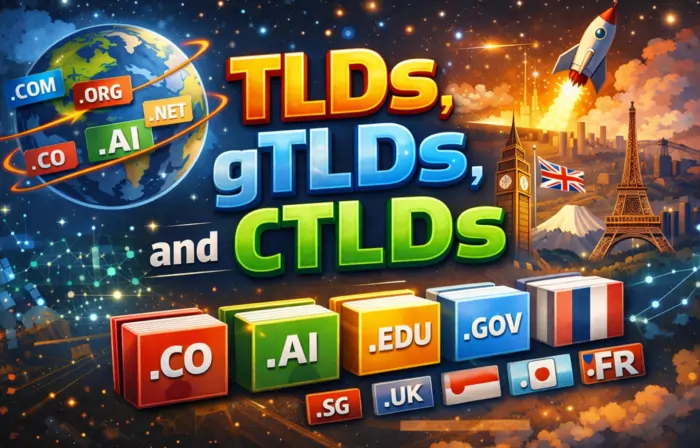
Before we dig into myths and data, it helps to define a few terms.
- TLD (Top‑Level Domain)
The last part of a domain, after the final dot—like .com, .net, .org, .ai, .shop. For a simple breakdown with examples, see What Is a TLD?. - gTLD (Generic TLD)
Non‑country TLDs: .com, .org, .biz, .info, .tech, .shop, .agency, .ai, .io, etc. SEO Mafia’s TLDs Explained and Webcentral’s 2025 guide to domain extensions cover gTLDs in detail. - ccTLD (Country‑Code TLD)
Country‑specific endings: .uk, .de, .fr, .in, .ph, .kh, etc. These often send a geographic signal in search. For a direct comparison of gTLD vs ccTLD in SEO and branding, see gTLD vs ccTLD.
For more background on domain extensions, you can combine SEO Mafia’s TLDs Explained with Name.com’s domain extensions & SEO guide.
2. Myth vs Fact: Does TLD Directly Affect Google Rankings?
Myth: “.com ranks better than everything else”
The myth: if you don’t get a .com, you’re doomed.
What Google says:
Google representatives and independent analyses agree that generic TLDs are treated equally and are not a direct ranking factor. A 2024–2025 update in “TLD keywords are not a factor in rankings” confirms this.
Resources like Name.com’s SEO and TLD article, Moz’s domain best practices, and SEO Mafia’s What Is a TLD? all reiterate that .com doesn’t get a ranking boost just for being .com.
Myth: “Keyword TLDs help you rank for that keyword”
Examples:
- bestlawfirm.law
- digitalmarketing.agency
- fitness.guru
- seomafia.expert
Google has explicitly said this is not the case, as summarized in “Google Confirms .LAWYER and .LAW TLD Addresses Don’t Help SEO” and “gTLDs and SEO: Google’s Take”.
Fact: For general queries, most TLDs are treated the same
For general, non‑geo queries, all gTLDs are treated equally by Google’s ranking systems.
What actually moves the needle is outlined in ranking‑factor summaries like:
- “Google’s 200 Ranking Factors: The Complete List (2026)”
- “200 SEO Ranking Factors to Win the SERP”
So: your TLD is not where you “win” SEO.
3. How TLD Can Indirectly Influence SEO
Even though TLD isn’t a direct ranking factor, it can affect user behavior and perception, which then influence your SEO outcomes.
User trust and “spammy” vs “safe” TLDs
Different extensions carry different reputations:
- Familiar: .com, .org, .net, many ccTLDs
- Neutral/popular: .io, .ai, .co, .app, .dev, etc.
- Overused in spam: some very cheap TLDs like .xyz, .top, .tk, etc.
DNS‑abuse research (e.g., DarkDNS / DNS abuse) shows some TLDs are disproportionately used in phishing and spam. Articles like Does TLD Affect SEO? Learn How Your Domain Impacts… and Best Domain Extensions For SEO call out this risk explicitly.
SEO Mafia’s TLDs Explained also touches on why certain TLDs attract more low‑quality usage, and how that perception can rub off on legitimate sites.
Click‑Through Rate (CTR) in SERPs
In crowded SERPs—with AI overviews, ads, and rich results—users scan quickly and make snap judgments based partly on your domain + TLD.
Guides like “Domain names and SEO: what you should know” and GoDaddy’s “SEO Domain Names” highlight that:
- Familiar, professional TLDs (.com, trusted ccTLDs, popular niche TLDs) often get better CTR.
- Unknown or spam‑looking TLDs can reduce clicks even when you rank.
SEO Mafia’s Domain Selection Strategy frames this as “choosing a domain that doesn’t make users hesitate before they click”—which is exactly what you want in SERPs.
Backlink potential and outreach
When you’re doing outreach, your domain is part of your first impression.
- Publishers are more comfortable linking to domains that look serious and familiar.
- Spam‑heavy TLDs can subtly reduce your success rate in link‑building and partnerships.
Since links remain a core ranking signal, anything that affects your ability to earn them (including TLD perception) indirectly affects SEO.
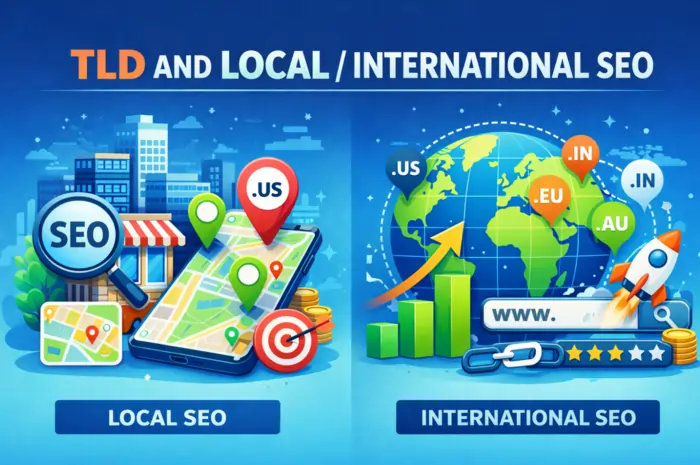
4. TLD and Local / International SEO
ccTLDs as a local signal
Country‑code TLDs (ccTLDs) like .co.uk, .de, .fr, .in, .ph, .kh act as strong signals that your site targets users in that country.
Resources such as gTLD vs ccTLD and Moz’s “Different Types of Domains and Best Practices for SEO” describe how ccTLDs can help local SEO when everything else (language, content, citations) matches that geography.
If you’re a single‑country brand and expect to stay that way, a ccTLD can:
- Reinforce local trust
- Signal relevance to search engines
- Make your domain feel “native” to that market
gTLD vs ccTLD for global brands
If you serve multiple countries, a single gTLD (.com or similar) with localized subfolders is usually easier to scale than many separate ccTLDs.
SEO Mafia’s Domain Selection Strategy article and Webcentral’s guide both recommend:
- One strong global domain
- Clear regional folders (e.g., /uk/, /de/, /kh/)
- hreflang and Search Console geo settings for each locale
This keeps your authority consolidated while still signaling local relevance.
5. Scenario‑Based Advice for 2026
Scenario 1: Startup choosing between .com and .ai / .io
Choosing between yourbrand.com and yourbrand.ai?
Look at:
- Is a clean, brandable .com available?
- Is .ai/.io widely accepted in your niche?
- How will this look on pitch decks, email signatures, and ads?
SEO Mafia’s Domain Selection Strategy gives a simple matrix: choose the option that best balances brand clarity, trust, and flexibility—not just short‑term cleverness.
Scenario 2: Local business choosing .com vs ccTLD
Example: localclinic.com vs localclinic.ph / .kh / .co.uk
Combine insights from:
- gTLD vs ccTLD for SEO and branding trade‑offs
- Moz’s domain best practices
- Name.com’s domain & SEO guide
If your business is “forever local,” a ccTLD can be a strong choice. If you might expand, a neutral gTLD (.com or similar) is usually safer.
Scenario 3: Considering ultra‑cheap or obscure TLDs
DNS‑abuse research like DarkDNS and practical guides such as Best Domain Extensions For SEOhighlight that some rock‑bottom TLDs are deeply associated with spam.
SEO Mafia’s TLDs Explained also recommends avoiding “obviously abused” extensions for any brand you want to keep long‑term.
Scenario 4: Migrating from one TLD to another
Moving from brand.io to brand.com?
Check:
- “Does Switching TLDs Hurt Your SEO Rankings?”
- Moz and Search Engine Land’s domain migration advice
The short version: a TLD change done with proper 301s, updated internal links, and Search Console updates doesn’t inherently hurt SEO—most damage comes from rushed migrations.
6. What Matters More Than TLD for SEO
Ranking‑factor overviews like Backlinko’s and cmlabs’ make it clear: the heavy lifters are content quality, links, UX, and technical health.
Helpful references:
Domain‑related elements that do matter:
- Brandability and memorability of your domain name
- Clean, non‑spammy history
- Alignment with audience expectations
- Ease of saying and spelling your domain
SEO Mafia’s Domain Selection Strategy distills this into practical rules to choose a domain that supports long‑term SEO and branding, instead of chasing short‑term tricks.
7. Practical Guidelines for Choosing a TLD in 2026
You can combine everything above into a simple, actionable framework:
- Start with trust and brand clarity
Use a TLD that makes your domain look legitimate and easy to remember. A strong .com is still the safest default for broad audiences. - Use ccTLDs when you’re truly local
If you’re locked into one country, a ccTLD plus local content and citations is a strong local‑SEO signal, as covered in gTLD vs ccTLD and Moz’s domain guide. - Use niche gTLDs when they’re normal in your vertical
In tech, .io or .ai are widely accepted; in some creative fields, .studio or .design makes sense. Just validate with your audience and industry norms, using resources like TLDs Explained and Spaceship’s TLD overview. - Avoid obviously spam‑associated extensions for serious projects
Cross‑check with DNS‑abuse research and “best TLD” guides before committing. - Plan migrations like full SEO projects
Follow checklists like NameSilo’s TLD‑switch guide and, if needed, pair that with technical guidance from SEO Mafia’s Domain Selection Strategy. - Remember: algorithms don’t care, humans do
Google treats gTLDs equally, but people and link‑partners absolutely don’t. Choose the TLD that your users will trust, click, remember, and link to.







