

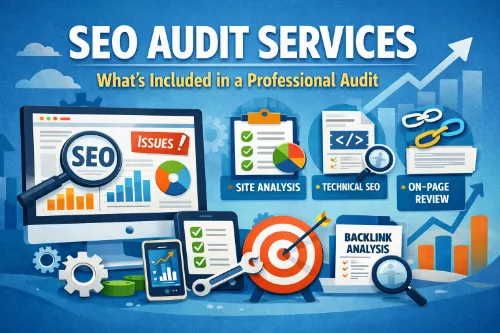
What’s Included in Professional SEO Audit Services?
Professional SEO audit services give you a complete health check of your website so you can fix issues, grow organic traffic, and get more leads or sales. A comprehensive SEO audit typically includes a technical SEO audit, on-page SEO review, content audit, off-page SEO and backlink analysis, UX and conversion review, local SEO audit (if relevant), and a prioritised action plan with clear next steps.
If you want to know exactly what is included in a professional SEO audit, how SEO audit services work, and why a complete SEO audit checklist matters for rankings in 2026, this guide breaks it down in simple language. For a broader view of how an audit connects to ongoing optimisation, you can also review this guide on SEO services.
What Are SEO Audit Services?
SEO audit services are professional services that evaluate the overall SEO performance of your website and identify what needs to be fixed or improved. A solid audit looks at technical SEO, on-page optimization, content quality, off-page signals, user experience, and analytics data to show you why your site is not ranking as well as it could.
Instead of guessing, a professional SEO audit uses data from tools like Google Search Console, Google Analytics, and third-party platforms to highlight which pages underperform, where users drop off, and which technical issues block search engines from crawling or indexing your content. This is why expert SEO audit services are more reliable than quick, free automated scans that only surface basic problems. If you want to compare a focused audit against a longer-term plan, this breakdown of a website SEO audit vs full SEO strategy is helpful.
Why You Need a Professional SEO Audit in 2026
Search and AI-driven experiences are evolving fast, and a one-time basic SEO check is no longer enough. A professional SEO audit helps you:
- Identify technical SEO problems that block crawlers and hurt indexability.
- Fix on-page SEO issues such as weak titles, poor internal linking, and thin content.
- Understand how your content performs for search intent and AI-powered overviews.
- See how your backlink profile, authority, and trust signals compare with competitors.
- Improve user experience, conversions, and revenue from existing traffic.
A modern SEO audit checklist in 2026 also considers AI visibility, entity clarity, and schema markup so your brand can appear in AI Overviews and other rich search features. To understand timing and ROI expectations, it’s useful to read about how often you should get an SEO audit and what to do after an SEO audit.
What’s Included in a Professional SEO Audit?
Below is a high-level list of what is commonly included in professional SEO audit services.
- Technical SEO audit
- On-page SEO audit
- Content quality and SEO content audit
- Off-page SEO audit and backlink profile review
- UX, engagement, and conversion review
- Local SEO audit (for local and GEO-focused businesses)
- Analytics, tracking, and reporting review
- Prioritised action plan and SEO roadmap
Each component supports the others, so a complete website audit checklist should cover all of them, not just one area. For a deeper service-level view, see this dedicated page on SEO audit services.
1. Technical SEO Audit: Foundation of Your Website Health
A technical SEO audit is the base layer of professional SEO audit services. It checks whether search engines can crawl, render, and index your pages correctly.
A thorough technical SEO audit usually includes:
- Crawlability and indexation review: robots.txt, XML sitemaps, noindex tags, canonical tags, and response codes.
- Site structure: URL structure, site architecture, faceted navigation, and internal linking patterns.
- Core Web Vitals and site speed: loading speed, interactivity, and visual stability across key templates and devices.
- Mobile-first indexing and mobile usability: how pages render on phones, tap targets, fonts, and responsive layouts.
- HTTPS and security: SSL configuration, mixed content issues, and security warnings.
- Structured data and schema markup: validation of schema types (such as Organization, FAQ, Product, Article) that help search engines understand entities and context.
For a step-by-step breakdown of this part of the audit, you can reference a detailed technical SEO audit guide and a companion article on common technical SEO issues. If you are planning to outsource, this overview of technical SEO services explains what a specialised provider usually handles.
Core Web Vitals and speed are now core ranking and UX signals, so it is smart to read how page speed impacts SEO performance and why Core Web Vitals for SEO matter before prioritising fixes.
2. On-Page SEO Audit: Titles, Content, and Internal Links
On-page SEO audit services take a closer look at individual pages and how they target keywords, match search intent, and guide users through the site.
A professional on-page SEO audit will:
- Review page titles and meta descriptions for uniqueness, keyword relevance, and click-worthiness.
- Check headings (H1, H2, H3) for structure, clarity, and natural keyword placement.
- Analyze internal linking to make sure important pages receive enough link equity and are easy to reach in a few clicks.
- Identify duplicate content, keyword cannibalization, and overlapping URLs that confuse search engines about which page should rank.
- Evaluate image optimization, alt text, and media file sizes to support both speed and accessibility.
To dig deeper into this section, you can study the fundamentals of on-page SEO basics and a service-level view of on-page SEO services. For service businesses, an on-page SEO checklist for service-based websites is especially useful.
Internal links are a big part of on-page audits, so it helps to review how internal linking improves rankings. When you start optimising content, keep this guide on content optimization vs keyword stuffing handy to avoid over-optimisation.
If you rely heavily on landing pages, this article on how to optimize landing pages for search engines will complement your on-page audit work.
3. Content Quality and SEO Content Audit
Content is still one of the strongest ranking and conversion signals. A professional content audit evaluates whether your pages are relevant, useful, and aligned with current search intent.
A detailed SEO content audit usually includes:
- Content performance review: traffic, rankings, engagement, and conversions per page.
- Topic and keyword coverage: which primary keywords and supporting terms you cover, and where gaps exist.
- Intent alignment: whether content matches informational, navigational, commercial, or transactional intent for each query.
- Content depth and freshness: thin, outdated, or low-value pages that need updating, consolidation, or removal.
- Readability and clarity: simple language, logical structure, and clear answers that help users and AI systems understand the page quickly.
For strategy and execution, look at content SEO services: strategy, writing, and optimization and how content refresh services for old website pages keep your library current. To build topical authority, use these resources on SEO content planning for topical authority and how blog clusters support SEO service pages.
Search intent is a key lens for a content audit, so it also helps to review search intent optimization for better rankings.
4. Off-Page SEO Audit and Backlink Profile Review
Off-page SEO audit services focus on your authority and trust signals, especially backlinks and mentions from other websites.
A strong off-page SEO audit includes:
- Backlink profile overview: total links, referring domains, and how these compare with competitors.
- Quality and relevance of links: editorial links vs. spammy ones, niche relevance, and brand mentions.
- Anchor text distribution: branded, generic, and exact-match terms, plus patterns that may look manipulative.
- Toxic link analysis: links from low-quality or suspicious sites that may need disavowal.
- Opportunities for authority building: competitor link gaps, industry directories, and digital PR prospects.
If you want to go beyond the audit and into active off-site work, start with off-page SEO services, dedicated link-building services, and a comparison of digital PR vs traditional link building. These guides on how backlinks affect domain authority and rankings, white-hat vs black-hat SEO link building, and how to evaluate the quality of backlinks show you what to aim for.
5. User Experience, Engagement, and Conversion Review
Modern SEO audits go beyond rankings and check how users actually behave on your site. If your pages do not convert, the traffic you gain from SEO will not translate into real business results.
A UX and conversion review within professional SEO audit services looks at:
- Site navigation and structure: how quickly users find key pages and actions.
- Page layout and design: readability, visual hierarchy, and distraction-free content sections.
- Conversion paths: forms, CTAs, lead magnets, checkout flows, and micro-conversions.
- Engagement metrics: bounce rate, time on page, scroll depth, and pages per session.
- UX issues that impact SEO: intrusive interstitials, layout shifts, or confusing mobile experiences.
For concrete examples of how UX and technical fixes translate into results, check case-based resources like SEO wins from technical fixes alone, a content-led SEO growth case study, and a service business that increased leads organically.
6. Local SEO Audit and GEO Optimization
If your business serves specific regions or cities, a local SEO audit is a crucial part of SEO audit services. It checks how well you show up in local packs, Maps, and GEO-targeted search results.
A local SEO audit typically covers:
- Google Business Profile (GBP) optimization: categories, business description, photos, posts, and Q&A.
- NAP consistency: name, address, phone number, and website consistency across local directories and citations.
- Local landing pages: city- or region-specific pages with localized content and schema.
- Local reviews and ratings: review volume, sentiment, and response strategy.
- Local link and mention opportunities: local media, industry associations, and location-based resources.
You can go deeper into this area with guides on local SEO services for small businesses, Google Business Profile optimization services, and local citation building. For multi-location brands, this overview of local SEO ranking factors for multi-location brands is useful, while local SEO helps clinics, law firms, and restaurants and a local SEO success story for a Philippine business show real scenarios.
Vertical-specific local SEO resources include local SEO for personal injury and family law firms, local SEO for dental clinics and healthcare providers, and local SEO strategies for property listings. To unpack the auditing side, check the dedicated local SEO audit guide.
7. Analytics, Tracking, and Reporting Review
Good data is essential to any professional SEO audit. If analytics or tracking are broken, you cannot correctly measure the impact of SEO audit services.
This part of the audit often includes:
- Google Analytics / GA4 review: property setup, events, and filters.
- Google Search Console review: coverage reports, queries, pages, and manual actions.
- Tag management and pixels: Google Tag Manager, advertising pixels, and event tracking.
- Conversion tracking: goals, ecommerce tracking, form submissions, calls, and lead events.
- SEO reporting framework: dashboards, KPIs, and cadence for ongoing performance reviews.
To understand what good reporting looks like, see SEO reporting metrics clients actually care about, SEO KPIs every business owner should track, and how to measure SEO ROI for your business. If your focus is more strategic, this breakdown of important sections of an SEO audit report is helpful.
8. Prioritised Action Plan and SEO Roadmap
The most important outcome of comprehensive SEO audit services is a clear, prioritised action plan. A good professional SEO audit does not just list problems; it tells you what to do next, in what order, and why.
A typical SEO roadmap from an audit includes:
- Summary of key findings grouped by category (technical, on-page, content, off-page, UX, local).
- Impact vs. effort ratings for each recommendation so you can focus on high-impact tasks first.
- 30 / 60 / 90-day plan with phases for quick wins, medium-term projects, and long-term improvements.
- Owner assignments and implementation notes for developers, content teams, and marketers.
- Optional ongoing SEO support proposal if you prefer expert help executing the roadmap.
If you want to see how agencies turn audits into action, read about what SEO clients need to know and real-world examples like before and after SEO results. For context on long-term value, see why SEO is a long-term investment, why rankings dropped even with SEO work, and why some SEO campaigns fail.
Top Benefits of SEO Audit Services
Here is a quick list of the main benefits of investing in professional SEO audit services in 2026.
- Find and fix hidden technical issues that block rankings and traffic.
- Improve on-page SEO, metadata, and internal linking for better relevance.
- Upgrade your content quality and align pages with modern search intent.
- Strengthen your backlink profile and reduce risk from toxic links.
- Increase conversions by improving UX, page layout, and calls to action.
- Boost local visibility with GEO-focused local SEO audits and optimizations.
- Build a clear, data-driven SEO roadmap instead of guessing what to do next.
- Prepare your site for AI Overviews and entity-based search by improving schema and content clarity.
If you are wondering whether this investment makes sense, check out are SEO services worth it for small businesses? and the discussion on traffic vs leads.
How Professional SEO Audit Services Differ from Free SEO Audits
Many tools offer free SEO audit checks, but they are very limited compared with comprehensive professional audit services.
Key differences:
- Depth of analysis: free audits run surface-level scans, while paid services review technical, content, off-page, UX, and business goals in detail.
- Custom insights: professional audits interpret data in the context of your site, industry, and competitors.
- Actionable roadmap: free tools list issues; professional services provide prioritised fixes and a clear strategy.
- Tool stack: expert teams combine multiple tools instead of relying on one quick crawler.
- Support: with SEO audit services, you can ask questions, get clarification, and often get help implementing changes.
To understand the broader decision-making process, consider these guides on DIY SEO vs hiring an SEO agency, SEO consultant vs SEO agency, when to hire an SEO consultant, and why some agencies offer risky guaranteed SEO services.
If you are currently reviewing vendors, check how to compare SEO proposals from different agencies, how to choose the right SEO agency, the key questions to ask before hiring SEO services, and the red flags to watch for in SEO companies. It also helps to know what small businesses should expect from SEO packages, what’s included in SEO packages, and how much SEO services cost.
Because AI Overviews and answer engines are becoming more important, a modern SEO audit also checks whether your content is structured to be easily summarized and reused by AI systems.
Common checks include:
- Clear, direct answers to common user questions in the first paragraphs.
- Use of headings, bullet points, and listicles to structure information logically.
- Natural use of keywords and related phrases (semantic SEO) without stuffing.
- Schema markup for FAQs, how-tos, products, and organizations.
- Strong entity usage: brand names, people, locations, services, and concepts referenced clearly to help NLP systems understand context.
Resources like keyword research services for lead generation, commercial vs informational keywords in SEO campaigns, and agencies find low-competition high-intent keywords show how keyword strategy supports AI-ready content. For mapping and structure, see keyword mapping for service pages and blogs and long-tail keywords for SEO services businesses.
Frequently Asked Questions
1. What is the difference between a basic SEO check and a full SEO audit?
A basic SEO check usually relies on automated tools that surface surface-level issues like missing title tags or slow pages. A full SEO audit is a manual, in‑depth review of technical SEO, content, on-page elements, backlinks, UX, and analytics, plus a prioritised action plan tailored to your business goals.
2. Will an SEO audit change anything on my live website?
No, a professional SEO audit is diagnostic only and does not directly change your live website. You receive a report with recommendations, which your team or your SEO partner can implement after review and approval.
3. Do I need developer support to act on an SEO audit?
For content and on-page fixes, your marketing or content team can often implement changes without developers. However, technical SEO recommendations such as improving site speed, fixing code issues, or updating templates usually require at least part‑time developer involvement.
4. Can an SEO audit help if I recently redesigned my website?
Yes, a post‑launch SEO audit is one of the best times to run one because redesigns often introduce issues like broken links, redirect chains, and indexing problems. The audit ensures your new site structure, templates, and tracking are all search‑friendly.
5. How do SEO audits handle very large or enterprise websites?
For very large or enterprise sites, SEO audits use sampling, segmented crawls, and prioritisation to focus on the most important templates and sections first. The process often includes governance, automation opportunities, and workflows for managing SEO across thousands of pages.
6. Will an SEO audit guarantee higher rankings?
No reputable SEO provider can guarantee specific rankings because search algorithms and competitors constantly change. However, a strong audit removes blockers, reveals opportunities, and gives you a roadmap that significantly improves your chances of sustainable ranking and traffic growth.
7. How does an SEO audit address AI Overviews and new search features?
Modern audits look at structured data, entity clarity, and intent coverage to make your content easy for AI systems to understand and summarise. This includes checking schema markup, FAQ content, and how clearly your pages answer core user questions.
8. What common SEO issues are usually uncovered during audits?
Typical findings include broken links, 404 errors, duplicate or thin content, slow loading pages, missing metadata, poor internal linking, and unoptimised mobile experiences. Many audits also uncover tracking gaps and mismatched search intent on important landing pages.
9. How do you prioritise recommendations in an SEO audit report?
Recommendations are usually scored by impact and effort, so you can see quick wins, medium‑effort projects, and long‑term strategic changes. This helps decision‑makers allocate resources and phase implementation over 30, 60, and 90 days.
10. Is an SEO audit useful if I am already doing monthly SEO?
Yes, even with ongoing SEO, a fresh audit can reveal blind spots, technical debt, or missed opportunities that have built up over time. Many agencies run formal audits yearly or before a major strategic shift to realign their campaigns.
11. Can an SEO audit uncover penalties or algorithmic filters?
An experienced auditor will review Search Console data, traffic trends, and manual action notifications to look for signs of penalties or algorithmic hits. While an audit cannot remove a penalty by itself, it can isolate likely causes and provide a recovery plan.
12. What data do you use during an SEO audit?
Audits typically combine crawl data, Google Analytics or GA4, Google Search Console, page speed reports, backlink tools, and sometimes heatmaps or UX analytics. Using multiple sources ensures that recommendations are grounded in both technical findings and real user behaviour.
13. Do SEO audits cover content strategy or only technical items?
A comprehensive SEO audit covers both: technical health and content strategy. That means assessing topic coverage, search intent, content quality, and internal linking alongside site speed, crawling, and indexing.
14. How often should a high‑growth business schedule a full SEO audit?
High‑growth or frequently changing sites often benefit from a full audit once per year, plus lighter quarterly checkups. This cadence keeps pace with new content, product launches, and technical changes that can impact performance.
15. Is an SEO audit suitable for brand‑new websites?
Yes, though the focus is slightly different: for new sites, an audit checks proper setup, indexation, tracking, and early content and architecture decisions. Catching issues early prevents bigger, more expensive fixes later on.
16. What happens after I receive my SEO audit report?
After you receive your report, the next steps usually include a walkthrough call, agreement on priorities, and an implementation plan. From there, you can execute changes in‑house, work with the original auditor, or partner with an SEO agency to handle ongoing optimisation.
17. How long does a professional SEO audit take?
Most comprehensive SEO audit services take from 1 to 6 weeks, depending on site size and complexity. For context on longer-term SEO work, here is how long SEO services take to work.
18. How much do SEO audit services cost?
Pricing varies widely, but many providers charge from a few hundred to several thousand dollars based on scope, tools, and expertise. You can compare this against typical monthly SEO services vs one-time SEO projects and different tiers of affordable SEO services for small business owners versus cheap SEO services.
19. Is an SEO audit a one-time project?
The audit itself is usually a one-time project, but SEO is ongoing. Many businesses repeat audits yearly or after major redesigns and algorithm updates. To see how audits fit inside broader campaigns, check why SEO is a long-term investment and what SEO services can and cannot guarantee.
20. What access is needed for an SEO audit?
You normally provide read-only access to Google Analytics / GA4, Google Search Console, your CMS, and sometimes your hosting or CDN dashboards for technical checks. For more context on how agencies structure collaboration, see fractional SEO support for growing businesses, SEO consulting for in-house marketing teams, and what to expect from an SEO strategy consultant.







