Quick Answer
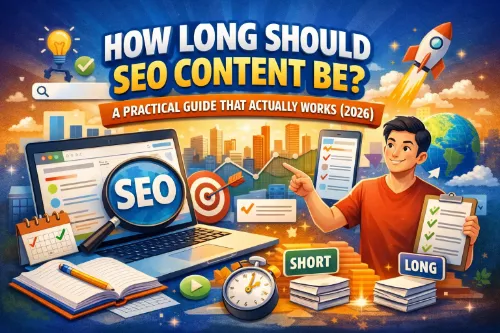
There’s no single ideal SEO content length. The right length depends on search intent, SERP expectations, topic complexity, and page type. Word count alone is not a direct ranking factor, as explained by Yoast, but your content must be long enough to fully satisfy user intent and compete with what’s already ranking.
If you want a practical rule that works in 2026:
- Match intent first
- Analyze the SERP second
- Write for coverage, then trim
That’s the real formula behind “how long should SEO content be.”
Why Word Count Alone Doesn’t Work
Many marketers still chase an “ideal word count for SEO.” But modern SEO isn’t about hitting 2,000 words.
Google emphasizes helpful, reliable, people-first content in its official documentation on creating helpful content. That means usefulness and relevance matter more than raw length.
Research from Ahrefs also shows that both short-form and long-form content can perform well — especially in AI-powered answer results — suggesting that clarity often beats bulk.
This is why the real debate is content coverage vs word count, not short vs long.
What Actually Determines SEO Content Length
1. Search Intent (Primary Factor)
Your SEO word count should follow search intent.
Semrush explains that matching intent is central to performance in their guide to content length for SEO.
Types of intent:
- Informational
- Commercial
- Transactional
- Navigational
If you fail to match intent to content, no amount of words will fix ranking mismatch.
2. SERP Analysis
SERP analysis helps you understand what Google expects for a query.
Look at:
- Structure of top-ranking pages
- Subtopics repeated across multiple results
- FAQs included
- Depth of explanations
Semrush recommends evaluating SERPs before deciding length in their breakdown of ideal SEO content length.
Do not copy competitors’ word count blindly. Use it as a reference for coverage.
3. Topic Complexity
Some topics require more content depth naturally.
Simple topic:
“What is a canonical tag?”
Complex topic:
“Complete technical SEO audit checklist”
Complexity increases required comprehensive content.
4. Page Type Matters
Different pages require different content length for SEO.
Blog Post Length
Yoast notes that blog post length should support clarity and usefulness rather than arbitrary targets in their article on SEO word count.
Typical ranges:
- Quick answers: 600–1,000 words
- Guides: 1,000–2,000 words
- Pillar pages: 2,000+ words (only if useful)
Service Page Word Count
Service pages need persuasion + proof.
Typical effective range:
- 800–1,800 words
But focus on:
- Clear value proposition
- Process explanation
- FAQs
- Case examples
Conversion clarity matters more than padding.
Product Page Content Length
Product page content length depends on competition.
Strong product pages often include:
- Features and benefits
- Specs
- FAQs
- Reviews
- Use cases
Short product descriptions can rank when intent is purely transactional.
Category Page Content Length
Category pages usually require:
- 100–300 word intro
- Buying tips
- Internal links
If SERPs show long guides ranking, adjust accordingly.
Landing Page Copy Length
Landing page copy length depends on conversion goals.
Campaign landing pages:
- Short, focused
Evergreen pages:
- Longer with testimonials and FAQs
Length must serve persuasion.
When Short Content Wins
Ahrefs found that many pages cited in AI Overviews are under 1,000 words, meaning clear answers / concise answers can outperform long essays in certain contexts.
Short-form vs long-form content is not about size — it’s about satisfying user intent.
Short content works best when:
- The query expects a direct answer
- SERP results are concise
- The topic is narrow
- You’re supporting a topic cluster
When Long Content Wins
Long-form content wins when:
- The SERP competitors are comprehensive
- The topic contains many sub-questions
- You are building a pillar page
- Trust and authority are important
But long must equal helpful content, not repetition.
GEO Considerations (Philippines Example)
If targeting PH audiences:
Mobile-first browsing dominates. That means:
- Short paragraphs
- Strong readability
- Clear scannability
- Structured headings
For example:
“SEO services in Cebu” should include:
- Services
- Local examples
- FAQs
- Clear CTA
It does not need 3,000 words. It needs relevance and trust.
The Coverage Framework That Works
Before publishing, ask:
- Did I satisfy user intent?
- Did I include required subtopics from SERP analysis?
- Did I improve on competitors?
- Is the content easy to scan?
- Did I remove fluff?
Google’s documentation on SEO fundamentals reinforces building pages that are clear, useful, and accessible — not artificially long.
Mini Comparison Table
| Page Type | Intent | Typical Range | Priority |
|---|---|---|---|
| Blog Guide | Informational | 1,000–2,000+ | Coverage |
| Quick Answer | Informational | 600–1,000 | Clarity |
| Service Page | Transactional | 800–1,800 | Conversion |
| Product Page | Transactional | Variable | Specs + Trust |
| Category Page | Commercial | 100–500 intro | Structure |
| Landing Page | Transactional | Variable | Persuasion |
FAQ
Is word count a ranking factor?
No. Word count alone does not determine rankings, as explained by Yoast and supported by Google’s helpful content guidance.
How do I know if my content is too short?
If it fails to satisfy user intent or misses expected subtopics found during SERP analysis.
Can content be too long?
Yes. If it reduces readability or feels repetitive, it harms engagement and clarity.
What is the ideal SEO content length?
The length required to fully satisfy user intent and competitive coverage.
Does SEO content length affect Google Discover visibility?
Not directly. Google Discover prioritizes relevance, freshness, and engagement signals rather than word count. Short, visually engaging articles can perform well if they match user interests and provide clear value.
How long should an SEO content brief be for writers?
An SEO content brief should be long enough to clarify intent, target keywords, structure, and expectations—typically 1–3 pages. It doesn’t need to be long; it needs to be clear and actionable.
What’s the best content length for ranking in “People Also Ask”?
There’s no fixed length. Pages that provide clear, structured answers (40–60 word concise responses under strong headings) often perform well. Clarity matters more than overall article length.
How long should the introduction be for SEO blog posts?
Keep introductions between 80–150 words. It should confirm search intent, briefly answer the question, and preview what readers will learn—without delaying the main answer.
Do images, tables, and videos reduce the needed word count?
Yes, in many cases. Visual elements can improve content depth without increasing word count. If a table or diagram explains something better than 300 words, use the visual instead.
Should I increase word count when updating old content?
Only if additional coverage improves value. Updating content should focus on filling content gaps, refreshing examples, improving structure, and aligning with current SERP intent—not adding words for the sake of length.
How does page speed influence long-form SEO content performance?
Long-form content that loads slowly can hurt user experience, especially on mobile. Optimize images, use clean formatting, and avoid heavy scripts so longer pages remain fast and accessible.
What’s the best content length for voice search answers?
Voice search favors short, direct answers. Aim for concise definitions (30–50 words) under clear headings to increase the chance of being selected as a spoken response.
How long should FAQs be per question for SEO and AEO?
Each FAQ answer should be clear and focused—typically 40–120 words. Long explanations can reduce scannability. Start with a concise answer, then expand only if needed.
Does content length matter differently for new domains vs established sites?
Yes, indirectly. New domains often benefit from slightly more comprehensive content to demonstrate expertise and content depth. Established sites may rank with shorter content due to authority and trust signals—but intent alignment still matters most.