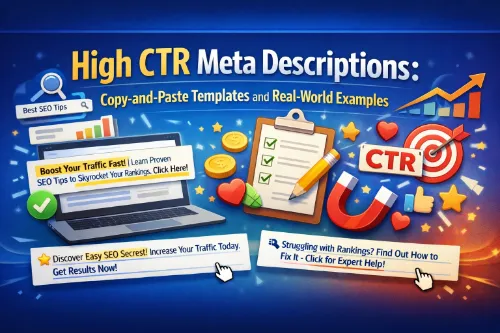
Why CTR-Focused Meta Descriptions Matter
Meta descriptions are the short snippets that appear under your page title in search results and help users decide whether to click. A well-written meta description can directly influence click-through rate (CTR), even though it is not itself a direct ranking factor.
You can see this emphasized in resources like the Moz meta description guide. When you write meta descriptions that increase CTR, you turn simple impressions into real traffic and potential customers. High CTR meta descriptions support your SEO because they send positive engagement signals to search engines and can improve your organic visibility over time.
When your search snippets are compelling, engaging, and aligned with search intent, your organic click-through rate improves even if your rankings stay roughly the same. For both local and global brands, this small piece of copy can be the difference between being ignored and being the obvious choice.
In modern search, meta descriptions also support answer-driven behavior and AEO (Answer Engine Optimization). Clear, natural language that directly responds to user needs makes your snippets more useful, even when search engines sometimes rewrite them, which is discussed in Google’s own guidance on snippets and meta descriptions.
If you consistently create meta descriptions that boost click-through rate using simple, natural language, you build a stronger presence across the entire SERP. This works whether you run a blog, an e‑commerce shop, a local business website, or a SaaS product.
What Makes a “High-CTR” Meta Description?
A high-CTR meta description is a short, clear line of copy that makes people want to click your result instead of your competitors. Meta descriptions that get more clicks usually match search intent, highlight a benefit, and make a simple promise the page actually delivers.
Instead of stuffing keywords, CTR-optimized meta descriptions use natural language that both humans and search engines understand. Resources like Neil Patel’s meta description guide and the Google Search Central article repeatedly stress clarity, relevance, and value over keyword lists.
This is where NLP (natural language processing) comes in: descriptions that read like a human wrote them align better with how users search and how algorithms interpret meaning.
High-converting meta descriptions also create curiosity without becoming misleading clickbait. Meta descriptions that stand out in SERPs often include power words, emotional triggers, or a small element of urgency.
For example, meta descriptions to boost click-through rate may use phrases like “step-by-step,” “proven,” “real examples,” or “no fluff” to reassure the reader. When you combine clarity, relevance, and a tiny hook, you get meta descriptions that drive organic traffic consistently.
Finally, meta descriptions for SEO should reinforce what the user already expects. If someone searches “how to write meta descriptions,” the snippet should clearly signal that the page offers guidance, examples, and meta description best practices.
When meta descriptions and page content stay tightly aligned, users feel satisfied after clicking, which helps reduce pogo-sticking and bounce rates. This “helpful and people-first” alignment is exactly what Google recommends in its helpful content guidelines.
Best Practices for Writing High-CTR Meta Descriptions
There are a few reliable best practices for writing meta descriptions that improve CTR across different page types.
Respect the practical character limits.
There is no hard HTML limit, but snippets get truncated to fit device width, so best practice is to keep meta descriptions concise yet informative. Guides such as Moz’s meta description article and case studies on snippet length show that around 120–160 characters is a common, safe range. Too short and you waste space; too long and your copy gets cut off before the key benefit or CTA appears.
Use your primary and secondary keywords naturally.
Include phrases like “meta descriptions that increase CTR” or “meta descriptions to boost click-through rate” only where they fit naturally. You want meta descriptions for SEO that read smoothly, not robotic lines created just for search engines. Both Moz and Google explicitly warn against keyword stuffing in meta descriptions.
Match search intent precisely.
SEO meta descriptions for blog posts should promise an explanation, guide, or clear takeaways that match informational queries. Meta descriptions for product pages should focus on features, benefits, and trust elements for users closer to a purchase. Comparison pages should signal that they help users evaluate options and make a decision. This intent alignment is also a core part of on-page best practices in the WordStream on-page SEO guide.
Add a clear benefit and a call to action.
You can improve organic click-through rate with meta descriptions by adding a call to action in meta descriptions such as “learn more,” “compare options,” “shop now,” or “book today.” Combining a benefit (“learn how to write high CTR meta descriptions”) with action verbs in meta descriptions gives users a clear next step. Neil Patel highlights the impact of active verbs and compelling CTAs on CTR.
Use emotional and clarity triggers, not hype.
Emotional triggers in meta descriptions like “stress-free,” “fast,” “step-by-step,” “beginner-friendly,” or “no jargon” make the result more attractive. Avoid vague hype such as “the best ever” without backing it up on the page, which Google warns against in its examples of poor meta descriptions.
Create unique meta descriptions for every page.
When you use unique meta descriptions for every page, you avoid internal competition and help search engines understand the specific purpose of each URL. This also supports GEO because you can include location modifiers, opening hours, or service areas for local SEO meta descriptions. Google explicitly recommends unique, descriptive snippets in its meta description best practices.
As you apply these best practices across your site, you’ll generate a consistent library of compelling search snippets that increase CTR and support both SEO and AEO.
Copy-and-Paste Meta Description Templates
This section gives you copy-and-paste meta description templates that increase clicks across different page types. Use them as a base, then tweak details to match your content, industry, and location.
Blog Post Meta Description Templates
SEO meta descriptions for blog posts should focus on clarity, value, and direct answers.
Use these for how-tos, guides, and list posts:
- “Learn how to write high CTR meta descriptions that improve your organic click-through rate with simple tips, real examples, and copy-and-paste templates.”
- “Discover examples of good meta descriptions and ready-made templates that increase clicks. Write compelling search snippets in minutes, even if you’re not a copywriter.”
- “Want meta descriptions that get more clicks? Use these high-CTR meta description frameworks to boost your organic click-through rate and drive more traffic from search.”
If you work with WordPress, tools like Yoast SEO’s snippet templates can help you scale these patterns automatically.
Service / Landing Page Meta Description Templates
For service pages and landing pages, meta descriptions that increase CTR should focus on outcomes and transformation.
- “Need help with SEO meta descriptions? Work with [Brand/Agency] to create high CTR meta descriptions that increase clicks, leads, and sales for your business.”
- “Boost your click-through rate with compelling meta descriptions and titles crafted by experts. Get CTR-optimized meta descriptions that match your audience, niche, and goals.”
- “Ready to increase SERP CTR and convert more visitors? Our team writes meta descriptions that stand out in search results and attract high-intent leads to your website.”
To further support GEO, you can localize them: “for businesses in [City/Region]” or “for companies across Southeast Asia,” turning them into strong local SEO meta descriptions.
E‑commerce / Product Page Meta Description Templates
Meta descriptions for product pages should balance features, benefits, and trust.
Use them to create click-worthy meta descriptions for Google Shopping and organic results:
- “Shop [Product] with fast shipping, easy returns, and secure checkout. Discover key features, benefits, and reviews in one place before you buy.”
- “Get [Product] at a great price with reliable delivery and friendly support. Read reviews, compare options, and enjoy risk-free shopping today.”
- “Find the best [Product Category] with detailed specs, real customer ratings, and honest pros and cons. Order now for quick delivery and hassle-free returns.”
These templates help create high-converting meta descriptions that answer common buyer questions directly in the snippet.
Local SEO Meta Description Templates
Local SEO meta descriptions should highlight location, availability, and trust signals.
- “Looking for [Service] in [City/Area]? Get fast, friendly, and professional support from a local team. View pricing, reviews, and contact details in one place.”
- “Find trusted [Service] near you in [City]. See opening hours, directions, and real customer reviews before you visit or call.”
- “Need [Service] today in [City/Neighborhood]? Book online in minutes and get reliable help from local experts you can trust.”
These local SEO meta descriptions are designed to stand out in SERPs for “near me” and city-based queries, supporting both GEO and higher CTR.
Comparison / Review Page Meta Description Templates
For “vs” pages, review pages, and best-of posts, meta descriptions for comparison and reviews should stress clarity and impartial help.
- “Compare [Brand A] vs [Brand B] with honest pros, cons, and pricing. See which option fits your needs with our detailed review and recommendation.”
- “Discover the best [Category] in 2026 with real-world tests, ratings, and comparisons. Find out which options offer the best value for your budget.”
- “Read our in-depth review of [Product/Service] with pros, cons, and top alternatives. Make a confident decision backed by clear, unbiased insights.”
These meta descriptions to boost click-through rate support research intent and reassure users that they’ll get helpful, balanced information.
Real-World High-CTR Meta Description Patterns
Even if you can’t see exact CTR numbers from other sites, you can spot patterns behind examples of good meta descriptions in your niche. The Moz guide and articles like Meta Description 101 from Neil Patel break down several strong samples. Strong meta descriptions that increase CTR usually:
- Lead with the main topic or outcome
- Mention who the content is for (beginners, small businesses, advanced users, etc.)
- Promise something concrete: a framework, checklist, templates, or examples
- Avoid fluff and vague claims like “top quality services”
For instance, a strong snippet for an SEO guide might say: “Learn how to write compelling page titles and high CTR meta descriptions that increase your organic click-through rate with simple frameworks and real examples.”
This line uses natural language, covers page titles, meta descriptions, and “increase CTR,” and clearly signals value. A high CTR meta description for an e‑commerce category might say: “Shop the best [Category] with detailed specs, real reviews, and fast shipping.
Compare top options and find the right fit today.” Again, it’s simple, concrete, and action-oriented.
Across blog posts, service pages, product pages, and local pages, you’ll see the same pattern: compelling search snippets, persuasive meta descriptions, and strong alignment with what the user wants to achieve.
Before-and-After Meta Description Makeovers
Before-and-after makeovers are one of the fastest ways to learn meta description best practices. Many expert checklists, like those from Moz and Google Search Central, rely on this “bad vs better” approach.
Weak example (blog post):
“Meta descriptions and SEO tips for websites.”
Improved high-CTR version:
“Learn how to write high CTR meta descriptions that increase your organic click-through rate with simple tips, real examples, and copy-and-paste templates you can use today.”
What changed?
- The improved version clearly states the outcome: “increase your organic click-through rate.”
- It uses natural phrases like “high CTR meta descriptions” and “copy-and-paste templates” without stuffing.
- It speaks directly to the user with “learn how,” which aligns with informational intent.
Weak example (service page):
“We provide many SEO services including meta descriptions, titles, and more for businesses.”
Improved high-converting version:
“Get high CTR meta descriptions and page titles that increase SERP CTR and bring qualified visitors to your site. Work with our SEO team to turn impressions into clicks and leads.”
Here, the improved version:
- Focuses on benefits (“increase SERP CTR,” “qualified visitors,” “leads”)
- Uses emotional and clarity triggers without hype
- Naturally includes “high CTR meta descriptions” and related phrases
By repeating this process across your pages, you transform generic snippets into CTR-optimized meta descriptions that better serve both users and search engines.
How to Test and Improve Meta Description CTR Over Time
Writing meta descriptions that increase CTR is only the first step. To make your work truly effective, you need a simple SOP for testing and improving meta description optimization for higher CTR.
A basic process you can follow, similar to what’s suggested in resources on measuring SEO content performance, such as this guide from Reform Digital and other content evaluation frameworks, looks like this:
Identify underperforming pages.
Use your search performance data (for example, Google Search Console) to find pages with relatively high impressions but low CTR compared to their average position. These are your best candidates for meta description makeovers.
Diagnose the issue.
Check whether the current snippet matches search intent, shows a clear benefit, and uses natural language. Compare it with examples from guides like Moz’s meta description page to spot obvious weaknesses.
Rewrite the meta description.
Create one improved version that focuses on clarity, benefit, and a stronger CTA. Consider adding emotional triggers in meta descriptions or sharper action verbs in meta descriptions if they fit.
Let it run and measure.
Give the new snippet time to collect data. Compare CTR over a consistent period before and after the change, making sure you account for seasonality and position shifts.
Iterate with variations.
Once you find what works, you can test small variations: switching the order of benefit and CTA, adjusting length, or refining how you mention “meta descriptions that increase CTR” and similar phrases.
This testing mindset is what turns a one-time optimization into a system that keeps lifting your organic click-through rate with meta descriptions over months and years.
Common Mistakes That Kill CTR
Many sites still use meta descriptions that hurt click-through rate without realizing it. Both Google’s snippet documentation and expert guides like Moz’s meta tag overview highlight the same recurring issues.
Avoid these common mistakes:
- Keyword stuffing
Filling your snippet with repetitive phrases like “meta descriptions for SEO, SEO meta descriptions, meta descriptions SEO” makes it unreadable and less trustworthy. - Vague copy
Lines like “We provide quality services at affordable prices” don’t say what you do, for whom, or why it matters. Google explicitly shows this as an example of a poor, non-descriptive meta description. - No clear benefit or CTA
If the meta description doesn’t answer “what’s in it for me?” and “what should I do next?”, users have no strong reason to click. - Duplication across pages
Using the same generic snippet on multiple URLs makes it harder for search engines and users to see each page’s unique value. Unique meta descriptions for every page are essential. - Ignoring local and intent-based search
If you serve specific locations but never mention them, you miss out on local SEO meta descriptions that could capture ready-to-buy customers nearby.
By avoiding these issues and focusing on meta descriptions that stand out in SERPs with clear value, you’ll naturally move toward higher CTR.
Copy-and-Paste Checklist for High-CTR Meta Descriptions
Use this simple checklist every time you write or optimize a meta description, in line with guidance from Moz and Google Search Central:
- Does it clearly describe the page and match search intent (informational, commercial, transactional, local)?
- Does it include your primary topic and, where relevant, semantic phrases like “meta descriptions that increase CTR” or “meta descriptions to boost click-through rate” in a natural way?
- Does it highlight a concrete benefit or outcome (save time, learn a skill, compare options, make a decision, buy confidently)?
- Does it use at least one call to action in meta descriptions (learn more, compare, shop now, book today, see how, read the guide)?
- Is it within a sensible meta description character range so it displays cleanly on desktop and mobile?
- Is it unique to this page and, if applicable, does it support GEO by mentioning the relevant location or audience?
- Would you personally choose this result over others if you saw it in the SERPs?
Frequently Asked Questions
Here are 10 fresh FAQs you can add that are not covered directly in the content:
Do meta descriptions directly affect my Google rankings?
No, meta descriptions are not a direct ranking factor, but they strongly influence CTR, which can indirectly impact your organic performance.
How often should I update my meta descriptions?
Review and refresh them at least every 6–12 months or whenever you significantly update content, see CTR drops, or change your offer.
Should I include my brand name in meta descriptions?
Yes, for branded, home, and key landing pages it can build trust; for long-tail blog posts you can skip it if space is tight.
Is it okay if Google rewrites my meta descriptions?
Yes, it happens often. Focus on writing strong, intent-matching meta descriptions; Google will still use them in many cases.
Can I use AI tools to generate meta descriptions?
You can, but always review and lightly edit them to ensure accuracy, brand voice, and a clear benefit plus CTA.
What is a good CTR for my meta descriptions?
“Good” CTR depends on position and niche, but you should aim to beat the average CTR for your current ranking positions.
Should meta descriptions be different for mobile users?
You don’t create separate mobile descriptions, but you should front-load key information so it works well on smaller screens.
Can I use emojis in my meta descriptions?
Yes, but sparingly. They can catch attention, yet overuse may look unprofessional or be rendered inconsistently.
Do I need meta descriptions on paginated or archive pages?
For most sites, focus on key pages (money pages, pillars, top posts). For archives, you can use simple, template-based descriptions or let Google generate them.
How do meta descriptions work with other meta tags like titles and schema?
Treat them as a team: the title grabs attention, the meta description sells the click, and schema enhances your snippet with rich elements.