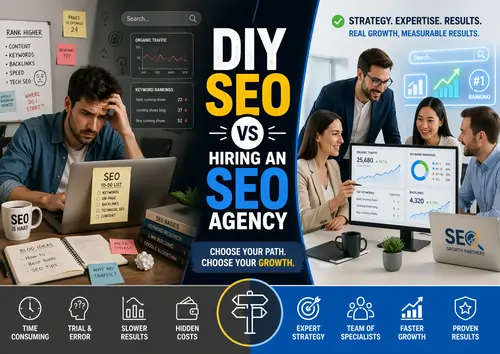
DIY SEO vs Hiring an SEO Agency: Which One Is Better for Your Business?
DIY SEO vs hiring an SEO agency is one of the most common questions small business owners ask when they want more traffic, leads, and sales from Google. Some business owners want to save money by doing SEO on their own. Others want faster results and consider working with professionals. The truth is, both options can work, but the better choice depends on your time, budget, goals, and competition.
For some brands, do it yourself SEO is a smart way to build basic visibility and learn the process. For others, hiring an agency brings better planning, faster execution, and fewer mistakes. The key is understanding what each path really involves before you invest time or money.
If you are exploring affordable SEO services or trying to decide whether you should handle optimization yourself, this guide will walk you through the pros, cons, costs, and best use cases of each option.
- DIY SEO is best for small businesses, startups, and site owners with time to learn.
- Hiring an SEO agency is better for competitive industries, larger websites, and businesses that want faster execution.
- DIY SEO costs less upfront, but it often takes more time and leads to slower growth.
- An agency costs more, but it can bring deeper expertise, better tools, and a clearer strategy.
- The best choice depends on your budget, available time, internal skills, and growth goals.
- A hybrid model can also work well: do basic SEO in-house and outsource advanced work.
What Is DIY SEO?
DIY SEO means handling search engine optimization on your own without paying an outside expert or agency. You manage your keyword research, optimize your pages, publish content, improve internal linking, and try to grow your rankings through self-managed effort.
For many small businesses, DIY SEO sounds practical because it offers a low-cost entry point into digital marketing. Instead of spending on an agency, you spend your own time learning how Google works, how search intent shapes content, and how pages rank over time.
Typical DIY SEO work includes:
- Writing blog posts
- Editing title tags and meta descriptions
- Updating product or service pages
- Finding target keywords
- Improving internal links
- Compressing images
- Fixing simple on-page SEO issues
- Tracking rankings and traffic
- Learning basic technical SEO
DIY SEO is often chosen by:
- Startups
- Freelancers
- Solo business owners
- Small local brands
- Bloggers
- New websites with limited budgets
If your business is still early-stage, DIY SEO may be enough to get started. In fact, many brands begin with DIY work while learning what small businesses should expect from SEO packages before investing in outside help.
What Does Hiring an SEO Agency Mean?
Hiring an SEO agency means bringing in a team of specialists to plan, execute, and improve your SEO strategy. Instead of doing everything yourself, you work with professionals who already understand keyword research, technical SEO, content structure, local SEO, analytics, and ranking factors.
An agency may help with:
- Full SEO audits
- Keyword mapping
- Competitor analysis
- Content strategy
- Blog content planning
- Service page optimization
- Local SEO setup
- Technical fixes
- Link building
- Reporting and performance reviews
This matters because SEO is no longer just about adding keywords to a page. Modern SEO requires content relevance, clear page structure, search intent alignment, entity signals, internal linking, topical authority, and strong user experience. A capable agency can manage those layers more efficiently than a beginner doing everything alone.
Businesses often hire an agency when:
- They do not have time to manage SEO
- Their website is not growing
- Their niche is competitive
- Their site has technical issues
- They need more leads from organic search
- They want a clearer roadmap for search growth
DIY SEO vs Hiring an SEO Agency: The Core Difference
The real difference between DIY SEO vs hiring an SEO agency is not just cost. It is the exchange between time, expertise, and execution.
With DIY SEO, you save money but spend far more time learning, testing, and correcting mistakes.
With an SEO agency, you spend more money but gain access to people who already understand what to prioritize, what to fix, and how to build momentum.
In simple terms:
- DIY SEO: lower upfront spending, more learning, slower execution
- SEO agency: higher upfront spending, less personal workload, faster planning
This does not mean one path is always better. It means the right option depends on your situation.
The Pros of DIY SEO
1. Lower upfront cost
The biggest advantage of DIY SEO is cost. If your budget is tight, doing your own SEO lets you start without paying an agency retainer. That makes it attractive for early-stage businesses and solo founders.
2. Full control over your strategy
You control the content, the timing, the message, and the direction. You do not need to explain your business voice to an outside team. For some owners, that control matters a lot.
3. Better understanding of your audience
When you do your own keyword research and content writing, you get close to what your customers are really searching for. That can improve both your SEO and your messaging.
4. Good for simple websites
If your site is small and your market is local or lightly competitive, DIY SEO can be enough to build traction. A simple service business website may not need a full agency right away.
5. Useful for building internal skill
Learning SEO helps you understand Google, content quality, search behavior, and user questions. Even if you hire an agency later, your DIY experience can help you make better decisions.
The Cons of DIY SEO
1. It takes a lot of time
This is where many people underestimate the challenge. SEO is not a one-time task. It requires planning, writing, editing, reviewing, tracking, and updating. That takes hours every week.
2. The learning curve is steep
Modern SEO includes:
- Keyword intent
- Content depth
- On-page SEO
- Technical SEO
- Internal linking
- Local SEO
- Content clusters
- Indexing
- Backlinks
- AI Overview readiness
If you are new, it is easy to get stuck on the wrong tasks or follow outdated advice.
3. Mistakes can slow rankings
DIY SEO often leads to common problems like:
- Targeting low-value keywords
- Writing pages without search intent
- Publishing thin content
- Ignoring technical issues
- Overusing keywords
- Weak page titles
- Poor internal links
- Duplicate topics
- Cannibalized pages
These mistakes do not always crash your website, but they can delay growth for months.
4. Results tend to be slower
Because you are learning while doing, progress is usually slower. Many businesses start strong with DIY SEO, then lose consistency because the workload becomes too much.
The Pros of Hiring an SEO Agency
1. Access to specialist knowledge
A good agency has already solved problems like yours before. It knows how to audit pages, identify keyword gaps, improve structure, and fix weak points faster than a beginner can.
2. Faster execution
An agency already has systems, workflows, and tools in place. That helps you move from confusion to action faster.
3. Better tools and deeper analysis
Many SEO tools are expensive. Agencies typically already use paid platforms for keyword tracking, site crawling, competitor analysis, reporting, and backlink review. That gives them a stronger view of what is happening on your site.
4. Better for scaling
If you have many service pages, multiple locations, a large blog, or a competitive content plan, an agency can help manage the structure and consistency required to scale.
5. Stronger content strategy
A skilled agency does not just publish random blogs. It helps build a topic map, align content with intent, and create search-driven pages that support the full funnel. That includes building commercial intent clusters that target people closer to buying, not just browsing.
The Cons of Hiring an SEO Agency
1. Higher cost
This is the biggest downside. Good agencies cost more than DIY tools and self-learning.
2. Quality varies
Not every agency is good. Some promise too much, focus on vanity metrics, or use weak strategies. Choosing the right SEO partner matters just as much as deciding whether to hire one.
3. Less direct control
You still guide the brand, but you will not control every small SEO action the way you would with DIY work.
4. SEO still takes time
Even with expert help, SEO is not instant. A good agency can reduce wasted effort, but it cannot make rankings appear overnight.
Cost Comparison: DIY SEO vs Hiring an SEO Agency
When people compare DIY SEO vs hiring an SEO agency, cost is usually the first thing they ask about. On the surface, DIY SEO looks much cheaper. But the full picture includes your time, the cost of errors, and the time it takes to get results.
DIY SEO costs may include:
- SEO tools
- Writing tools
- Training or courses
- Website updates
- Lost time from testing
- Opportunity cost from doing SEO instead of running your business
Agency costs may include:
- Monthly retainer
- Audit fee
- Content creation costs
- Technical cleanup
- Local SEO setup
- Ongoing strategic support
So what is the better deal?
DIY SEO is cheaper in cash, but more expensive in time.
Hiring an SEO agency costs more upfront, but often reduces wasted effort and missed growth.
That is why some businesses start with DIY SEO, then transition later after reading deeper comparisons like DIY SEO vs hiring an SEO agency to understand the long-term trade-offs.
Time Comparison: The Hidden Cost Most Businesses Ignore
Time is where the real difference becomes clear.
To do SEO properly, you need to:
- Research keywords
- Understand intent
- Review competitors
- Plan your page structure
- Write and update content
- Build internal links
- Check technical issues
- Track rankings
- Review analytics
- Refresh older pages
If you can only give one or two hours a week, DIY SEO may feel overwhelming. That does not mean it is impossible. It means progress will likely be slower, and consistency may be harder to maintain.
For business owners, time has a real cost. Every hour spent trying to fix SEO is an hour not spent on sales, customers, operations, or growth. That is one reason many businesses move toward agency support when they want to scale.
When DIY SEO Makes Sense
DIY SEO is often a smart choice when:
1. You are just starting out
A new site does not always need a full agency. Sometimes it makes sense to learn the basics first and build a foundation.
2. Your niche is low competition
If there are not many strong competitors in your market, basic optimization may be enough to gain early traction.
3. Your site is small
A five-page local site is much easier to manage than a large eCommerce or service-area website.
4. You enjoy learning
If you like digital marketing and are willing to study, DIY SEO can be a useful long-term skill.
5. You have more time than money
This is the classic DIY SEO situation.
When Hiring an SEO Agency Makes Sense
Hiring an SEO agency is usually better when:
1. Your market is competitive
If top competitors already have strong content, backlinks, and technical depth, DIY SEO may not be enough.
2. Your site has technical issues
Slow pages, crawl problems, thin content, weak internal linking, and poor structure can hurt rankings. Agencies are often better equipped to handle these issues.
3. You want faster and cleaner execution
A skilled team can remove guesswork and focus on the highest-impact tasks earlier.
4. You do not have time
This is one of the strongest reasons to outsource SEO.
5. You need a content strategy that goes beyond basic blogs
A strong SEO program includes informational, comparison, and buyer-intent content. Agencies often do a better job of mapping that properly.
The Hybrid Model: Often the Smartest Choice
For many businesses, the best answer is not full DIY or full agency. It is a mix of both.
A hybrid model may look like this:
- You write or approve content in-house
- The agency handles keyword research
- You manage your brand tone
- The agency handles technical SEO
- You publish simple updates
- The agency builds strategy and page mapping
This lets you keep control while getting expert help on the harder parts. For many small and mid-sized businesses, that is the most practical solution.
7 Questions to Help You Decide
If you are unsure which path is right, ask yourself:
- What is my real budget?
Can you invest in agency help, or do you need to start with DIY? - How much time do I actually have each week?
SEO needs consistency. - How competitive is my industry?
The harder the competition, the more valuable expert help becomes. - How big and complex is my website?
Larger sites often need better planning. - Do I need leads soon?
SEO still takes time, but expert help can remove delays caused by beginner mistakes. - Do I understand search intent and content structure?
If not, there will be a learning gap. - What is the cost of doing nothing well?
Poor SEO can mean losing traffic, leads, and market share.
Final Verdict: DIY SEO vs Hiring an SEO Agency
So, which is better: DIY SEO vs hiring an SEO agency?
The answer depends on your business stage.
Choose DIY SEO if:
- Your budget is limited
- Your site is small
- Your market is not highly competitive
- You have time to learn and stay consistent
Choose an SEO agency if:
- You want faster progress
- Your market is competitive
- Your site needs deeper strategy
- You do not have time to manage SEO yourself
- You want stronger execution and better reporting
Choose a hybrid model if:
- You want to stay involved
- You can handle some content internally
- You want expert help on technical or strategic work
There is no one-size-fits-all winner in the SEO agency vs DIY SEO debate. The best option is the one that matches your resources, goals, and growth timeline.
Quick List: Who Should Choose What?
DIY SEO is best for:
- Startups
- Solo founders
- Freelancers
- Local businesses
- Small websites
- Low-competition niches
Hiring an SEO agency is best for:
- Growth-focused companies
- Competitive industries
- Multi-page websites
- Businesses with little time
- Brands needing technical SEO
- Companies building long-term organic growth
Closing Summary
DIY SEO vs hiring an SEO agency is really a decision about resources. If you have time and want to learn, DIY SEO can be a smart first step. If you need faster growth, clearer direction, and stronger execution, hiring an agency is often the better move. For many brands, the smartest path is not choosing one side forever, but using the option that fits their stage right now.
Frequently Asked Questions
1. What are the signs that my business has outgrown DIY SEO?
Your business has likely outgrown DIY SEO when SEO tasks keep getting delayed, traffic growth stalls, or your website becomes too large or complex to manage alone. It is also a sign when you know SEO matters but no longer have the time to do it properly.
2. How do I know if an SEO agency is actually doing quality work?
A good SEO agency should show clear strategy, explain what they are doing, and connect their work to rankings, traffic, leads, or conversions. Quality work usually includes audits, page improvements, content planning, reporting, and realistic expectations rather than empty promises.
3. What questions should I ask before hiring an SEO agency?
Ask what their process looks like, what they prioritize first, how they measure success, what reports they provide, and how they handle content, technical SEO, and backlinks. You should also ask for examples of work, timelines, and how communication is handled.
4. Can an SEO agency help with local SEO and Google Business Profile optimization?
Yes, many SEO agencies help with local SEO, including Google Business Profile setup and optimization. They may also improve local landing pages, citations, reviews strategy, map visibility, and location-based keyword targeting.
5. Do I need SEO if I already run paid ads?
Yes, because SEO and paid ads serve different roles. Paid ads can bring quick traffic, while SEO helps build long-term visibility and can reduce dependence on ad spend over time.
6. What happens if I stop doing SEO for a few months?
Your rankings may not disappear overnight, but your site can slowly lose momentum. Competitors may publish fresher content, improve pages faster, and take over keywords you were ranking for.
7. Can DIY SEO hurt my website rankings if done incorrectly?
Yes, it can. Poor keyword targeting, weak content, bad internal linking, over-optimization, or technical mistakes can make it harder for your site to rank well.
8. How often should SEO content be updated?
It depends on the topic, but many pages benefit from review every few months. Content should be updated when it becomes outdated, loses rankings, misses new search intent, or needs stronger examples, links, or structure.
9. What SEO tasks should never be ignored on a business website?
You should never ignore keyword intent, title tags, meta descriptions, internal linking, mobile usability, page speed, crawlability, and content quality. These are core parts of a healthy SEO foundation.
10. Is SEO different for eCommerce websites and service-based businesses?
Yes, very much. eCommerce SEO often focuses on category pages, product pages, filters, and purchase intent, while service-based SEO focuses more on service pages, location pages, trust signals, and lead generation.
11. Should I hire a freelancer or an SEO agency?
A freelancer can work well for smaller projects or narrow tasks, while an agency is often better for bigger campaigns needing content, technical work, reporting, and multiple skill sets. The right choice depends on your budget, scope, and how much support you need.
12. What kind of reports should an SEO agency provide each month?
A useful SEO report should include keyword movement, organic traffic, landing page performance, completed work, technical findings, and next steps. The report should be easy to understand and tied to business goals, not just vanity numbers.
13. Can an SEO agency help recover from a Google ranking drop?
Yes, a strong agency can investigate the cause and recommend fixes. That may include checking technical errors, content quality, recent site changes, lost backlinks, indexing issues, or algorithm-related weaknesses.
14. Who owns the SEO content and data if I hire an agency?
That depends on the agreement, so it should be clarified before work begins. In most cases, businesses should keep ownership of their website content, analytics access, search console data, and published assets.
15. What is the difference between one-time SEO work and monthly SEO services?
One-time SEO work usually covers audits, fixes, or setup tasks, while monthly SEO services focus on continuous growth. Ongoing SEO is often better because rankings need regular updates, new content, monitoring, and improvement.
16. How important are backlinks in DIY SEO vs agency SEO?
Backlinks still matter because they can support authority and trust, especially in competitive niches. Agencies often handle backlink strategy more effectively, while DIY SEO usually works better when focused first on content quality, site structure, and on-page improvements.
17. Can I hire an SEO agency just for strategy and do the execution myself?
Yes, that is a practical option for many businesses. An agency can provide audits, keyword plans, content maps, and recommendations, while your internal team handles publishing and implementation.
18. What red flags should I watch for when choosing an SEO provider?
Be careful with anyone promising guaranteed rankings, instant results, or vague deliverables. Other warning signs include poor communication, lack of transparency, unclear reports, and no real explanation of how they plan to improve your site.
19. Does my website platform affect whether DIY SEO is realistic?
Yes. Some platforms are easier for beginners to manage, while others make technical changes harder. If your platform limits page control, speed improvements, structured setup, or content flexibility, DIY SEO may become more difficult.
20. How do I measure ROI from SEO efforts?
You measure SEO ROI by tracking whether organic traffic leads to valuable actions such as calls, form submissions, bookings, purchases, or qualified leads. Rankings matter, but the stronger measure is whether SEO helps your business make more money or win more customers.