What Small Businesses Should Expect From SEO Packages
Small businesses should expect SEO packages to include keyword research, on-page SEO, technical fixes, content support, local SEO, reporting, and a clear monthly plan. A good SEO package should help a business improve search visibility, attract qualified traffic, and turn more visitors into leads over time. It should not promise instant rankings or overnight success.
If you are still comparing offers, it also helps to review guides on affordable SEO services and what small businesses should expect before choosing a provider.
- SEO packages for small businesses usually include an SEO audit, keyword research, on-page SEO, technical SEO, local SEO, content work, link building, and monthly reporting.
- Small business SEO packages should focus on business goals, not just rankings.
- Most businesses should expect early setup and fixes in month one, small movement in 2 to 3 months, and stronger growth in 4 to 6 months.
- A reliable provider will explain what is included in SEO packages, what work is done each month, and how results are tracked.
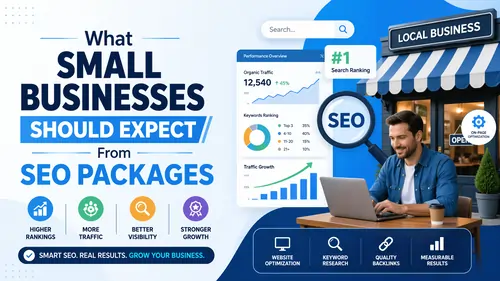
- Good SEO packages help with higher rankings, more traffic, better visibility, and stronger growth, but they do not guarantee a #1 ranking.
Why SEO Packages Matter for Small Businesses
Many small business owners know they need SEO, but they do not always know what they are paying for.
Some agencies sell cheap monthly SEO packages with vague promises. Others talk about traffic and rankings but never explain what work is being done. For a small business with a limited budget, that can lead to wasted time and wasted money.
That is why it helps to know what small businesses should expect from SEO packages before signing a contract.
A strong SEO package should not feel like a mystery. It should show what is being done, why it matters, and how it supports your business goals. Whether you run a local service business, an online store, a clinic, a law office, a salon, or a restaurant, the right SEO services for small business should help you get found by the right people at the right time.
For business owners trying to keep costs reasonable, reading about affordable SEO services can also help set better expectations on price versus value.
What Is an SEO Package?
An SEO package is a group of SEO services bundled into a monthly plan or campaign. Instead of buying one task at a time, such as only keyword research or only technical fixes, a business pays for a complete set of services that work together.
Most SEO packages for small businesses are built to help with:
- Search rankings
- Website traffic
- Local search visibility
- Leads and calls
- Content improvement
- Website health
This is why many small businesses choose monthly SEO packages. SEO is not a one-time task. Search results change. Competitors update their pages. Google updates how it ranks websites. Your site also needs new content, updates, and fixes over time.
A package gives small businesses a more practical way to keep moving forward month after month.
Why Small Businesses Buy SEO Packages
Small businesses usually invest in SEO for one reason: they want more qualified leads without depending only on paid ads.
Here are the main reasons businesses buy small business SEO packages:
1. To increase visibility in Google
When people search for services, products, or answers, they often start on Google. If your business is not showing up, you are missing traffic and sales.
2. To attract local customers
For service-based businesses, local SEO can be a major source of calls, bookings, and foot traffic. This is why local SEO packages are popular with dentists, law firms, contractors, salons, clinics, and restaurants.
3. To compete with larger brands
Small businesses may not have the ad budget of bigger companies, but SEO gives them a chance to win traffic through relevance, local intent, and useful content.
4. To get better long-term value
Paid ads stop when the budget stops. SEO takes longer, but it can keep bringing in traffic and leads over time.
5. To build trust
Strong rankings, well-written pages, accurate business details, and a polished website all help build trust with both search engines and customers.
What a Good SEO Package Should Include
When asking what is included in SEO packages, small businesses should look for clear deliverables. A good package usually covers the following areas.
1. SEO Audit
A proper SEO campaign often starts with an audit.
This may include:
- Website health review
- Page indexing check
- Broken links
- Duplicate content issues
- Title tag and meta description review
- Mobile usability check
- Site speed review
- Local SEO review
- Competitor gap review
The audit gives the provider a starting point. Without this, the campaign is often guesswork.
2. Keyword Research
Keyword research is one of the most important parts of any SEO plan.
The goal is not just to find high-volume keywords. The goal is to find keywords that match what your customers are actually searching for.
A solid keyword strategy should include:
- Primary keywords
- Secondary keywords
- Long-tail keywords
- Local keywords
- Buyer-intent keywords
- Service-based keywords
- Question-based keywords for FAQs
For this article topic, examples include:
- SEO packages for small businesses
- small business SEO packages
- SEO services for small business
- local SEO packages
- monthly SEO packages
- what is included in SEO packages
- how much do SEO packages cost
- best SEO package for local business
If your business wants faster wins from high-converting topics, it is also smart to understand commercial intent clusters, because those keywords often bring in visitors who are closer to taking action.
These keywords should be used naturally, not stuffed into every paragraph.
3. On-Page SEO
On-page SEO is the work done on your website pages to help them rank better and read better.
This often includes:
- Page title updates
- Meta description writing
- Heading structure
- Keyword placement
- Internal linking
- Image alt text
- URL cleanup
- Content editing
- Service page updates
For small businesses, on-page SEO helps connect each page to a clear search topic. A homepage, service page, location page, and blog post should all have a clear purpose.
4. Technical SEO
Technical SEO deals with how your site works behind the scenes.
This may include:
- Site speed fixes
- Mobile-friendly improvements
- Crawl issues
- Indexing issues
- Redirect cleanup
- XML sitemap review
- Schema setup
- HTTPS check
- Core web performance basics
Technical SEO matters because even good content can struggle if the site is slow, broken, or hard for search engines to crawl.
5. Content Support
Most SEO packages for small businesses should include some form of content work.
That can mean:
- New blog posts
- Service page rewrites
- Location pages
- FAQ content
- Content briefs
- Updating old articles
- Content expansion
Content is where SEO often becomes visible. It gives you pages to rank, questions to answer, and more chances to appear in search results.
6. Local SEO
For many small businesses, local SEO should not be optional.
A local SEO package may include:
- Google Business Profile setup or updates
- Business category review
- Service area updates
- NAP consistency
- Local citation work
- Review strategy guidance
- Location page optimization
- Map pack targeting
Local SEO is often one of the fastest ways for a small business to get relevant traffic, especially when customers search with local intent such as “near me” or by city name.
7. Link Building
Link building should be part of a smart SEO package, but it needs to be done carefully.
Good link work may include:
- Local citations
- Industry directory listings
- Relevant local mentions
- Resource links
- Guest content opportunities
- Digital PR outreach
Bad link building usually looks like bulk backlinks, random directory spam, or hundreds of links with no relevance. That can hurt more than help.
8. Reporting and Tracking
A business should never pay for SEO without knowing what is being tracked.
A monthly report should usually cover:
- Keyword movement
- Organic traffic
- Top pages
- Leads or conversions
- Calls or form fills
- Google Business Profile activity
- Work completed that month
- Next steps
This is one of the clearest signs of a serious provider. Reporting shows progress and keeps the campaign grounded in business results.
What Small Businesses Should Not Expect From SEO Packages
To understand what small businesses should expect from SEO packages, it also helps to know what they should not expect.
Do not expect instant rankings
SEO takes time. Even when a website has strong potential, Google still needs time to crawl updates, process signals, and compare your pages against competitors.
Do not expect guaranteed #1 rankings
No honest provider controls Google. A company can improve your chances, but it cannot promise exact ranking positions.
Do not expect huge results with no website work
A weak website cannot be saved by keywords alone. SEO often needs content updates, page changes, technical fixes, and stronger calls to action.
Do not expect thousands of backlinks overnight
That is often a red flag. Fast, low-quality links can damage trust.
Do not expect SEO to work without patience
SEO is a long-term channel. That is part of its value, but it also means results build over time.
What Small Businesses Can Realistically Expect Over Time
A good SEO package should come with realistic timing.
Month 1: Setup, research, and fixing the base
In the first month, most of the work happens behind the scenes.
You may see:
- Full SEO audit
- Keyword mapping
- Competitor review
- Google Business Profile review
- Technical issue list
- On-page updates
- Reporting setup
This stage may not look exciting, but it sets the base for future growth.
Months 2 to 3: Early movement
This is when businesses may start seeing early signs of progress.
Possible outcomes:
- Better page targeting
- Improved crawlability
- More impressions in search
- Small ranking gains
- More local visibility
- Better click-through rates
Traffic may still be modest, but the site is usually in a better position than before.
Months 4 to 6: Stronger visibility and better lead flow
This is often when the work starts showing more clearly.
You may see:
- Higher rankings for target terms
- More organic traffic
- Better Google Business Profile activity
- More page-one placements
- More calls, leads, or bookings
- Better local map visibility
Results vary by niche, location, site age, and competition, but this is a common range where momentum starts to build.
Long-term: Compounding value
Over time, SEO can keep improving brand visibility, website traffic, and lead quality.
That is why many businesses stick with monthly SEO packages. The work builds on itself.
Common Types of SEO Packages for Small Businesses
There is no single package that fits every business. Here are the most common types.
1. Local SEO Packages
Best for businesses that serve a city, region, or set of local areas.
Examples:
- Salons
- Dental clinics
- Restaurants
- Contractors
- Real estate offices
- Law firms
- Auto repair shops
2. Basic Monthly SEO Packages
Best for small businesses that want steady SEO work without a large budget.
These often include:
- Basic on-page SEO
- Keyword tracking
- Technical checks
- Content edits
- Monthly reports
3. Content-Focused SEO Packages
Best for businesses that want to grow through blog posts, service content, and topical authority.
4. E-commerce SEO Packages
Best for online stores that need category page SEO, product page work, and shopping-related search visibility.
5. Fully Managed SEO Packages
Best for businesses that want strategy, content, local SEO, technical work, and reporting handled together.
How Much Do SEO Packages Cost?
One of the most common questions is: how much do SEO packages cost?
The answer depends on the business type, market, competition, and scope of work.
In general:
- Lower-cost SEO packages often cover basic work for very small businesses or limited local campaigns.
- Mid-range packages usually include more monthly content, local SEO, and stronger technical work.
- Higher-end packages often include a larger strategy, more content, more technical depth, and wider campaign support.
Price should not be judged by cost alone. A cheap package with weak deliverables can cost more in the long run if it produces no real results.
The better question is this: What work is included every month, and how does that work support leads and sales?
If you are weighing cost against effort, it also helps to compare DIY SEO vs hiring an SEO agency, since many small business owners start there before deciding which path makes more sense.
Red Flags to Watch Out For
Not every SEO offer is worth buying. Watch for these warning signs.
1. No clear deliverables
If the package says “full SEO” but does not list what is included, be careful.
2. No reporting
A business should be able to see what changed, what improved, and what comes next.
3. Rankings-only talk
Rankings matter, but they are not the only goal. Leads, calls, and conversions matter more.
4. Cheap bulk backlinks
Low-quality backlinks can do harm.
5. No content plan
Without content, many sites have limited room to grow.
6. No local SEO for a local business
A local company that ignores Google Business Profile, citations, and location signals is missing a major part of search visibility.
7. Overpromising
“Page one in 30 days” sounds good, but it is usually sales talk, not a real strategy.
How to Choose the Right SEO Package for Your Business
When comparing SEO services for small business, ask practical questions.
Know your goal
Do you want:
- More local calls?
- More online sales?
- More service page traffic?
- More form fills?
- Better Google Business Profile visibility?
Your goal affects the type of package you need.
Ask what is included every month
A real provider should be able to tell you exactly what work is done monthly.
Ask how success is measured
Tracking should connect SEO work to real business outcomes.
Ask who creates the content
Some providers include content writing. Others leave it to the client. Know the difference.
Ask whether local SEO is included
For local businesses, this matters a lot.
Ask about communication
You should know how often updates are shared and who you can contact.
For a broader look at planning content around buyer-ready searches, learning about commercial intent clusters can help small businesses choose a package that targets revenue-focused keywords instead of traffic alone.
SEO Packages vs DIY SEO
Some small businesses wonder whether to buy an SEO package or do SEO themselves.
DIY SEO can work when:
- The business has time
- The competition is low
- The website is simple
- The owner is willing to learn
An SEO package is often better when:
- The business needs faster progress
- The market is competitive
- The owner has little time
- The site needs technical work
- Content and local SEO need regular attention
DIY is not wrong. It just has limits. For many owners, the bigger issue is time.
If you are still undecided, this guide on DIY SEO vs hiring an SEO agency is a useful next read because it helps small business owners compare cost, time, and expected results.
Final Thoughts
The best answer to what small businesses should expect from SEO packages is simple: clarity, useful work, realistic timing, and measurable progress.
A strong package should include keyword research, on-page SEO, technical SEO, content support, local SEO, reporting, and a clear monthly direction. It should help your business become easier to find, easier to trust, and easier to choose.
Small businesses should not buy SEO based on hype. They should buy SEO based on fit, strategy, and clear deliverables.
That is what turns an SEO package from a monthly bill into a growth channel.
For more context, you can also review what small businesses should expect and compare it with other guides on affordable SEO services.
FAQs
1. How do I know if an SEO package is too cheap?
If an SEO package is far below market price, it may exclude important work like content, technical fixes, or reporting. Very cheap SEO often relies on generic tactics, weak backlinks, or little real effort.
2. Can SEO packages help a brand-new website?
Yes. SEO packages can help a new website build a strong structure, target the right keywords, create useful content, and start gaining visibility early. New sites usually need patience because they do not yet have authority.
3. Do SEO packages include website redesign?
Usually not. Most SEO packages include optimization, not a full redesign. Some providers may recommend design changes if the site is hard to use or convert, but that is often billed separately.
4. Will SEO packages help me get more calls and leads?
They can, if the campaign focuses on qualified traffic and conversion-ready pages. SEO brings people to your website, but the site still needs clear messaging, trust signals, and strong calls to action.
5. Should I choose a local agency or a remote SEO provider?
Either can work. What matters more is whether the provider understands your industry, market, and goals. A remote SEO team can still deliver strong results if communication and strategy are solid.
6. Do SEO packages include blog writing?
Some do, some do not. Many SEO packages include content writing, while others only give content recommendations or briefs. Always ask whether blogs, service pages, or location pages are part of the package.
7. How often should SEO work be done?
SEO should be ongoing. Most businesses benefit from monthly work because rankings, competitors, and site needs change over time. Consistent updates usually perform better than one-time fixes alone.
8. Can I stop SEO once I rank well?
You can, but rankings may drop over time if competitors keep improving and your site stays unchanged. SEO is easier to maintain than to restart after losing momentum.
9. Do SEO packages work for service-area businesses without a storefront?
Yes. SEO packages can still help service-area businesses rank through local landing pages, Google Business Profile optimization, service area targeting, and content built around local intent.
10. What metrics matter most in an SEO report?
The most useful metrics are organic traffic, keyword growth, lead volume, form fills, phone calls, top landing pages, and conversion trends. Rankings matter, but business outcomes matter more.
11. Can SEO packages help seasonal businesses?
Yes. Seasonal businesses can use SEO to prepare ahead of peak months. This works best when pages and content are optimized before demand rises, not after the season has already started.
12. Is content quality more important than content quantity?
Yes. A few useful, well-optimized pages often perform better than many weak pages. SEO content should answer real questions, match search intent, and support the customer journey.
13. Do SEO packages include competitor analysis?
Many good SEO packages do. Competitor analysis helps show which keywords competitors rank for, what content they publish, where they get links, and where your site can improve.
14. What happens if my business has multiple locations?
Your SEO package may need location-specific pages, local keyword targeting, separate Google Business Profiles, and citation management for each branch. Multi-location SEO usually needs a more detailed strategy.
15. Can SEO help if my website already gets traffic but few conversions?
Yes. SEO can improve page targeting and user intent matching, but conversion issues may also come from weak copy, poor design, slow pages, or unclear offers. Traffic alone is not enough.
16. Should small businesses choose fixed packages or custom SEO plans?
That depends on the business. Fixed packages are easier to compare and budget for, while custom plans can better match a specific niche, goal, or market. The best choice is the one that fits your real needs.
17. Do SEO packages include schema markup?
Some do. Schema markup is often included in better SEO packages because it helps search engines understand page details more clearly and can support stronger search appearance.
18. Can SEO packages help recover from poor past SEO work?
Yes, but recovery may take time. A provider may need to clean up bad backlinks, fix thin content, repair technical issues, and rebuild trust signals before growth starts again.
19. How involved should I be in the SEO process?
You should stay informed, review reports, and give input on services, offers, and customer pain points. You do not need to do the SEO yourself, but your business knowledge helps shape a better strategy.
20. What is a good minimum commitment for SEO?
Many SEO campaigns need at least 3 to 6 months to show meaningful progress. A one-month test usually does not give enough time to judge the full value of the work.