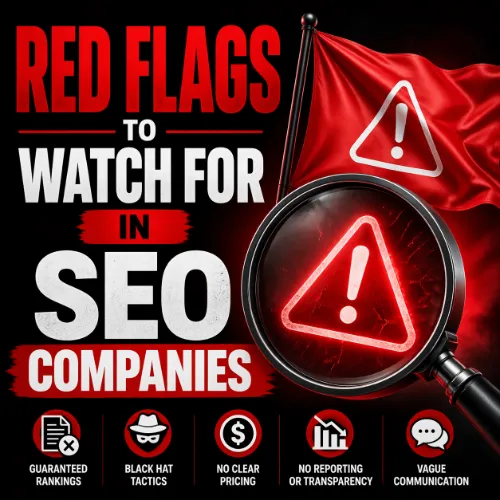
Red Flags to Watch for in SEO Companies: A 2026 Guide to Avoiding Google Penalties
Choosing the wrong SEO company can destroy your website traffic. In fact, hiring a bad agency is the fastest way to receive a manual action from Google. With the rise of AI Overviews and Generative Engine Optimization (GEO), the rules of the game have changed.
This guide lists the red flags to watch for in SEO companies. We will cover unrealistic promises, black hat tactics, contract traps, and how to use NLP (Natural Language Processing) to find a partner who follows white hat SEO.
Resource: For a step-by-step process on vetting partners, learn how to choose the right SEO agency (Note: This page is currently under maintenance, but the directory offers excellent expert listings).
Introduction: Why Vetting SEO Agencies Matters
Search Engine Optimization (SEO) is a long-term strategy. It takes 4 to 6 months to see real movement. However, many SEO companies prioritize shortcuts over safety.
If you ignore these warning signs, you risk losing your rankings forever. You might also waste your budget on vanity metrics like “total impressions” without getting actual sales.
Let’s dive into the specific tactics you must avoid. To see the positive opposite of these traits, check out this guide on the best SEO agency traits for long-term growth.
1. The “Too Good to Be True” Promises
The first red flag is usually verbal. If a salesperson sounds like a magician, hang up the phone. Here are the specific promises that indicate a scam.
They Guarantee #1 Rankings
No legitimate SEO expert can guarantee a #1 ranking on Google. The algorithm changes thousands of times per year. A company that offers a guaranteed #1 ranking is lying to you. They might rank you for a totally irrelevant long-tail keyword nobody searches for, just to check a box. In fact, legitimate experts will warn you about the dangers of guaranteed SEO services (Note: This specific page is currently being updated, but their expert directory emphasizes ethical practices).
They Guarantee Traffic
Guaranteed traffic is also a trap. What good are 10,000 visitors if they all hate your product? Real SEO focuses on conversion rates, not just raw numbers. If an agency guarantees traffic, they will likely use bots or buy cheap pop-under ads, not organic search.
They Promise Instant Results
SEO is a marathon, not a sprint. If a company says “instant results,” they are either using pay-per-click (PPC) and calling it SEO, or they are hacking the system. Real technical fixes take weeks; content takes months to age.
“We Have a Special Relationship with Google”
This is the ultimate scam signal. No one has a special relationship with Google. Not even John Mueller’s mother. If an agent tells you they have an inside track at Google, run away. This is often used to justify black hat tactics.
2. Black Hat Tactics That Trigger Penalties
Many SEO companies use black hat tactics because they are fast and cheap. However, these strategies violate Google’s SpamBrain rules. Here is what to watch for.
Link Schemes
Link schemes are unnatural patterns of backlinks. Some agencies use Private Blog Networks (PBNs) . These are expired domains repurposed to link to you. When Google detects a PBN, it devalues every link. If you are caught buying links, you will receive an immediate ranking drop.
Keyword Stuffing
Keyword stuffing is the practice of forcing a keyword into a page 50 times until the text reads like gibberish. For example: “We sell red shoes. Red shoes are great. Buy red shoes here.” Modern NLP algorithms detect this instantly. It looks spammy and destroys user experience.
Hidden Text or Links
Some old-school agencies try hidden text or links. They set the font color to match the background (white text on white background) or use CSS to push text off-screen. Google considers this a fraudulent attempt to manipulate rankings.
Doorway Pages
Doorway pages are low-quality pages created just to rank for a specific city or query. They redirect the user to the main site without providing value. These are illegal under Google’s webmaster guidelines.
Content Spinning
Content spinning uses software to replace words with synonyms. For example: “Buy fast cars” becomes “Purchase quick automobiles.” This generates gibberish articles that no human wants to read. Google’s AI detects spinning easily.
3. Lack of Ownership & Poor Communication
A trustworthy partner provides full transparency. If they hide things from it, it is a major warning sign.
You Don’t Own Your Assets
Never let an SEO company register your domain name. You must have ownership of your assets. This includes the domain, the hosting account, and the Google Search Console property. If you leave the agency, you should be able to take everything with you.
No Access to Google Tools
If they refuse to give you access to Google Search Console or Google Analytics, assume they are doing something wrong. Legitimate agencies welcome you to look under the hood. They want you to see the growth.
High-Pressure Sales Tactics
Beware of high-pressure sales tactics. If the call ends with “Sign in the next 24 hours or you’ll lose this deal,” it is a trap. Real professionals do not use urgency to close SEO contracts. SEO is a considered purchase.
No Regular Communication
No regular, clear communication is a death sentence. If you only hear from them when you send an email, or if they skip monthly reviews, you are paying for a ghost. You need scheduled calls and weekly updates. Before hiring, read this list of questions to ask before hiring SEO services to establish clear expectations.
4. The Red Flags in Reporting
Many agencies send beautiful PDFs that mean nothing. They use vanity metrics to hide failure.
Generic Monthly Reports
A generic monthly report might show “Impressions: +200%” but fail to show conversions. If the report does not connect SEO to business outcomes (like sales, leads, or phone calls), it is useless.
Hiding the Bad News
If your rankings drop for a major keyword, a bad agency will hide that data. They will cherry-pick the one keyword that went up (even if it has zero search volume). You need full disclosure: wins and losses.
Focus Only on “Rankings”
Rankings are nice, but they are not money. An agency obsessed with “we ranked for X” while your revenue drops is missing the point. Look for reports that highlight organic traffic and conversion rates.
5. Contract & Pricing Traps
Money is where the scam gets real. Many SEO companies hide behind legal jargon.
Long-Term Contracts Without Performance Clauses
Long-term contracts with no performance clause are predatory. If the agency is terrible, you should be able to leave after 90 days. If they force you into a 12-month lock-in without an exit option, walk away.
Extremely Low Pricing
Extremely low pricing ($99/month) is a mathematical impossibility. Good SEO requires writers, developers, and analysts. You cannot buy that for $99. These agencies use automated bots (spinning) or Fiverr links that will get you penalized.
Hidden Fees
Watch for hidden fees. They advertise $500/month but then charge extra for “SEO setup,” “content revisions,” or “analytics configuration.” Always ask for a clear scope of work in writing.
No Scope of Work
A no clear scope of work contract is dangerous. If the agreement just says “SEO Services” without specifying deliverables (like number of optimized pages or backlinks), they can do nothing and claim they fulfilled the contract.
6. Reputation & Credibility Gaps
Before signing, check their reputation.
No Verifiable Case Studies
No verifiable case studies is a huge red flag. If they show you a graph with no URL or date, it might be fake. Ask for a live example of a client they currently rank. If they cannot provide a reference, assume fraud.
Fake Reviews
Check Google Maps and Clutch. Look out for fake reviews. If all 50 reviews were posted on the same day or use the same language (“John is a genius!”), they are likely paid for.
Frequent Rebranding
Search the owner’s name. Frequent rebranding suggests they are running from bad reviews or a Google penalty. If the company changed names in the last two years, ask why.
No Clear Team or Location
A PO Box is fine, but no clear team or location is sketchy. If the sales rep uses a fake name or refuses to share their LinkedIn profile, do not trust them.
7. Lack of User Experience & E-E-A-T
Google’s algorithm now prioritizes E-E-A-T (Experience, Expertise, Authoritativeness, Trustworthiness). If an SEO company ignores this, they are stuck in 2015.
They Dismiss User Experience
If an agency only talks about keywords and links, but never mentions site speed, mobile-friendliness, or Core Web Vitals, they are outdated. Google ranks pages that humans like to use.
No Mention of E-E-A-T
A good SEO company will explain E-E-A-T. They will talk about author bios, customer reviews, and cited sources. If they don’t know what E-E-A-T stands for, they are not qualified.
Ignoring Structured Data
Structured data (schema markup) helps Google understand your page. It is essential for AI Overview triggers. If the agency ignores schema, you will lose the AI click war.
8. Agreements & Ownership Rights
Let’s get specific about the contract language.
Who owns the content?
If you pay for blog posts, you must own the copyright. Some agencies license the content to you. When you leave, they take the articles down, leaving your site empty. Ensure ownership of assets is written in the contract.
Access to the backlinks
If they build links, they should provide a spreadsheet of every URL. If they refuse to give you the list of links, they are likely using PBNs (which they don’t want you to see).
Exit strategy
Does the contract say what happens when you cancel? You need a clause that says: “Upon cancellation, client receives full access and data export within 48 hours.”
9. Green Flags: The Opposite of Red Flags
It helps to know what good looks like. While we focus on red flags to watch for in SEO companies, here are the green flags:
- Performance-based testing: They offer a 30-day trial with no long lock-in.
- Transparent tactics: They show you the exact sites they will get links from.
- Focus on business outcomes: They define success as leads or sales, not just traffic.
- They admit limits: A good agency says, “I don’t know” when asked a hard question.
For a full list of positive traits, review this resource on the best SEO agency traits for long-term growth.
10. How to Conduct Due Diligence
Here is your checklist before hiring any SEO company:
- Ask for three references. Call them. Ask if they suffered a Google penalty.
- Review the contract. Look for hidden fees and ownership clauses.
- Check Google’s guidelines. Go to Google Search Central. Read the quality guidelines. If the agency’s tactics violate one rule, reject them.
- Run a free site audit. Use tools like Ahrefs or Semrush. Look for toxic backlinks. If the agency’s “audit” is just a printout of this free tool, they add no value.
- Test communication. Send an email at 5 PM on a Friday. Do they reply by Monday? Good.
Pro Tip: Use curated directories to find safer partners. You can ask before hiring SEO services by checking if they are listed in verified communities like the SEO Mafia Club, which only features experts with proven, ethical results.
Conclusion: Protect Your Domain Authority
Red flags to watch for in SEO companies include guaranteed #1 ranking, black hat tactics, link schemes, and hidden text or links. If you see these, walk away.
Remember, an SEO penalty can cost you years of hard work. It is better to rank #5 safely than #1 for a week followed by a de-indexing.
Top 5 Red Flags
- Promises: “We guarantee #1 ranking” or “special relationship with Google.”
- Tactics: Keyword stuffing, doorway pages, or content spinning.
- Access: No access to Google Search Console or ownership of assets.
- Contracts: Long-term lock-in with no performance clause.
- Reporting: Only vanity metrics without conversion data.
Final Takeaway
Prioritize white hat SEO that follows E-E-A-T principles. Use Generative Engine Optimization (GEO) to prepare for AI Overviews. Ensure your agency knows how to optimize for semantic search and NLP. If they cannot explain the difference between AEO (Answer Engine Optimization) and traditional SEO, keep looking.
Take action now: Bookmark this guide on the red flags to watch for in SEO companies to share with your team. Your domain authority is your most valuable asset. Don’t hand it to a company that uses black hat tactics. Choose transparency, patience, and technical skill.
20 FAQs About Red Flags in SEO Companies
1. Can I sue an SEO company for damaging my website with a Google penalty?
Yes, potentially. If the SEO company used black hat tactics against your explicit written instructions or industry standards, you may have grounds for a lawsuit based on negligence or breach of contract. However, most contracts include clauses that protect the agency. Always have a lawyer review the “indemnification” section before signing.
2. What is a “white hat SEO” certification, and is it real?
There is no official Google certification for SEO. Any agency claiming a “Google Certified SEO Expert” badge is lying. Legitimate certifications come from platforms like HubSpot, Semrush, or Moz. If an agency leads with a fake Google cert, that is a major warning sign.
3. How do I spot an SEO company that uses AI-generated content unethically?
Ask them directly: “Do you use generative AI for client content, and how do you edit it?” A red flag is if they mass-produce unreviewed AI articles with no human fact-checking, no original data, and no E-E-A-T signals. This can trigger Google’s spam updates.
4. Is it a red flag if the SEO company doesn’t ask for access to my Google Business Profile?
Yes. For local businesses, Google Business Profile (GBP) optimization is critical. If an SEO company ignores GBP, claims it “doesn’t matter,” or refuses to help you verify ownership, they are likely not a local SEO specialist. This is a sign they use generic, one-size-fits-all tactics.
5. What should I do if the SEO company demands my Google Search Console password but won’t add me as an owner?
Never share your password. A legitimate agency will ask you to add them as a delegated user or property owner via your own Google account. Demanding your password violates Google’s Terms of Service and is a massive security risk.
6. Can an SEO company guarantee to remove bad reviews or negative content?
No. Reputation management is about generating positive content to push down negatives, but no one can guarantee removal from third-party sites (Yelp, Trustpilot, etc.) unless the review violates the platform’s policy. If an agency promises to “delete bad reviews,” they likely use fake DMCA notices or other black hat tactics that can backfire.
7. Is it normal for an SEO agency to charge a “setup fee” of over $2,000?
A high setup fee isn’t automatically a red flag, but lack of transparency about what that fee covers is. Ask for an itemized breakdown. If the setup fee includes “algorithm submission” or “search engine registration” (which is free and useless), that is a scam. Legitimate setup fees cover technical audits, competitor analysis, and keyword research.
8. How do I check if an SEO company has caused penalties for previous clients?
Ask for client references from at least 12 months ago. Then, use free tools like the Google Transparency Report or Ahrefs’ Site Explorer to check their domain history for traffic drops. A sudden 90% traffic drop often indicates a manual penalty. If the former client is unwilling to speak, that is a red flag.
9. What are “negative SEO attacks,” and do SEO companies use them against competitors?
Negative SEO involves building thousands of toxic spam links to a competitor’s site to trigger a penalty. While rare, some unethical “SEO companies” offer this as a hidden service. If an agency hints at “de-ranking competitors,” run away. This is unethical, potentially illegal, and often traceable.
10. Is it a red flag if the SEO company uses a generic Gmail address instead of a company domain?
Yes. A professional agency should have company email addresses (e.g., name@agency.com). Using @gmail.com or @yahoo.com suggests they are either brand new, hiding their identity, or operating at a very amateur level. However, very small freelancers may use Gmail legitimately, so check other signals.
11. What does “domain diversity” mean in link building, and why does it matter?
Domain diversity refers to getting backlinks from many different websites (e.g., 100 links from 100 sites) rather than 100 links from the same site. An SEO company that builds 500 links from just 5 domains (like low-quality PBNs) is a red flag. Ask for their referring domain count in monthly reports.
12. How can I tell if an SEO company is outsourcing work to unqualified freelancers?
Ask to meet the person doing your technical SEO or content writing. If the salesperson cannot introduce you to the actual delivery team, or if the writing has poor grammar and inconsistent tone, they are likely outsourcing to low-cost platforms. Ask for a sample of recent work from your assigned writer.
13. Is it a red flag if the SEO company refuses to sign a Non-Disclosure Agreement (NDA)?
Legitimate agencies sign NDAs to protect your business data (e.g., keyword strategies, profit margins). If they refuse, claiming “our methods are standard,” that is a red flag. They may be planning to use your successful strategy for a direct competitor, or they have something to hide.
14. What are “vanity keywords,” and why do bad agencies use them in reports?
Vanity keywords are search terms that look impressive but have zero commercial value. Example: “What is SEO” for a plumber. A bad agency will rank you for these easy, low-intent terms and celebrate “rankings,” while your phone never rings. Always ask: “Does this keyword lead to a sale or a signup?”
15. Can I verify if an SEO company’s case study is fake?
Yes. Use the Wayback Machine (archive.org) to check the client’s website history. If the case study claims they grew traffic from 1,000 to 50,000 visits, but the Wayback Machine shows the site was barely active, the case study is fake. Also, check if the “before” screenshot matches the actual historical data.
16. Is it normal for an SEO contract to have an automatic renewal clause?
Automatic renewal is common, but it becomes a red flag if the notice period is unreasonable (e.g., 90+ days) or if they require written cancellation via certified mail with no email option. Always negotiate a 30-day cancellation window with simple email notice.
17. What does “proprietary SEO software” usually mean from a scam agency?
It often means nothing. Many bad agencies claim to use a “secret, patented algorithm” to justify high fees. In reality, they are using the same free or low-cost tools you could access. Ask for a demo of the software. If they refuse or it looks like a simple dashboard with fake metrics, it’s a scam.
18. How do I spot an SEO company that buys fake social signals (likes, shares, followers)?
Watch for sudden spikes in social metrics that don’t align with content quality. You can use tools like SocialBlade to detect purchased followers (e.g., a jump of 10,000 followers overnight). Buying fake signals does not help SEO and can get your social accounts shadowbanned.
19. Is it a red flag if the SEO company charges extra for “mobile optimization” as an add-on?
In 2026, mobile optimization is a standard part of basic SEO, not a luxury add-on. If an agency tries to upsell you for “mobile-friendly design” or “accelerated mobile pages (AMP)” as a separate line item, they are nickel-and-diming you. It should be included in the core service.
20. What should I do if I suspect my current SEO company is using black hat tactics?
Immediately ask for a full backlink audit and access to all accounts. Then, run a free Google Search Console check for “manual actions.” If you see a penalty, stop all work, change all passwords, and consider filing a disavow file. You can also report the agency to Google’s spam report form (though responses are rare). Consult a forensic SEO to clean up the damage.