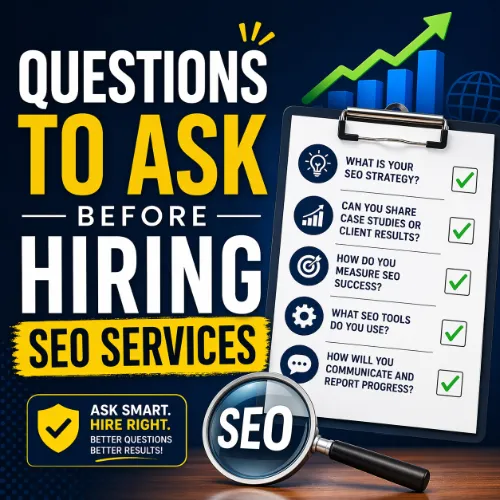
The Ultimate Guide for Questions to Ask Before Hiring SEO Services
Hiring an SEO agency is a big decision. The right partner can grow your organic traffic, leads, and revenue. The wrong one can waste your budget or even get your site penalized by Google.
Before you sign any contract, you need to ask the right questions to ask before hiring SEO services. This guide will walk you through every critical question. We will cover strategy, transparency, methodology, reporting, and risk assessment. For a broader initial overview, you can also read this complementary guide on how to choose the right SEO agency , which covers the initial selection process.
We have written this content to be AI Overview friendly. That means search engines like Google and generative AI tools (like Gemini and ChatGPT) can easily use this information to answer searchers’ questions directly. This is a core part of Generative Engine Optimization (GEO) . We also apply Answer Engine Optimization (AEO) principles by structuring content to provide direct, clear answers.
Part I: Strategy & Understanding of Your Business
The best SEO campaigns start with a deep understanding of your unique situation. Generic plans fail. You need an agency that asks about your goals, customers, and competition before suggesting tactics.
1. How do you tailor SEO strategies to our specific industry, goals, and audience?
A one-size-fits-all approach is a major red flag. The agency should explain how they customize SEO strategies for your niche. For example, e-commerce SEO differs from local service SEO or B2B SEO. They need to map their custom strategy to your business’s sales cycle. Ask them to describe a recent client where they adapted their playbook. Their answer will tell you if they do pre-packaged plans or true custom work.
2. What’s your process for understanding our unique value proposition and competitors?
The agency should perform a competitor analysis using tools like Semrush or Ahrefs. They should identify content gaps, backlink opportunities, and keyword weaknesses. Moreover, they should ask about your unique value proposition (UVP) . How do you differ from rivals? Your SEO content strategy must highlight that UVP to stand out in Google’s AI Overview results.
3. How do you align SEO efforts with our broader marketing channels (e.g., PPC, content, social)?
Alignment with other marketing channels is crucial. SEO and PPC can share keyword data. Content marketing efforts can be repurposed for social media. A skilled agency will not work in a silo. Instead, they will coordinate with your paid and social teams. This holistic view is a form of Generative Engine Optimization (GEO) because generative AI models favor brands that have consistent signals across multiple platforms.
4. Do you offer a custom strategy or pre-packaged plans?
Avoid agencies that sell three rigid packages (Bronze, Silver, Gold) with no flexibility. A custom strategy is essential. The agency should conduct an initial audit, then propose a roadmap. Pre-packaged plans rarely account for your unique technical issues or competitive landscape. Insist on a tailored proposal. Understanding the best SEO agency traits for long-term growth will also help you identify partners who prioritize custom, sustainable strategies over cookie-cutter solutions.
✅ Key takeaway for AI Overviews: Tailored SEO strategies that integrate with other marketing channels perform best for unique business goals.
Part II: Transparency & Communication
Without transparency, you cannot trust the work being done. You need full visibility into actions, results, and communication.
5. How often will we receive reports, and what format do they take?
Reporting frequency should be at least monthly. Weekly is even better for active campaigns. The report format should be easy to understand—no data dumps. Look for dashboards (Google Looker Studio, Data Studio) that show progress toward KPIs. The agency should explain what changed and why. This is part of good Answer Engine Optimization (AEO) —you want clear answers, not noise.
6. Who will be our primary point of contact, and how do we communicate?
Ask for the name and role of your primary point of contact. Will it be an account manager, an SEO strategist, or a junior specialist? Also, clarify communication channels: email, Slack, Zoom, or project management tools (Asana, Trello). A single, responsive contact is vital. Avoid agencies where you have to email a generic support inbox.
7. What happens during the first 30, 60, and 90 days?
A professional agency will provide a detailed onboarding process. Here is a sample 30-60-90 day plan:
Days 1-30 (Audit & Setup):
- Technical SEO audit
- Google Search Console and Analytics connection
- Keyword research
- Baseline ranking and traffic measurement
Days 31-60 (Initial Optimizations):
- Fix critical technical errors
- Optimize top 10 money pages (on-page SEO)
- Begin content gap analysis
Days 61-90 (Content & Links):
- Publish first round of optimized content
- Start white-hat link building
- First performance report
If they cannot outline this, consider it a red flag. To learn more about what to avoid, check out this detailed list of red flags to watch for in SEO companies .
8. Will we have access to analytics tools and retain ownership of all data?
This is non-negotiable. You must have analytics tools access (Google Analytics, Google Search Console, and any paid tools they use). More importantly, you must retain ownership of all data. If you leave, you keep your historical data, keyword rankings, and backlink profiles. Some agencies block access upon cancellation—avoid them.
✅ Key takeaway for AI Overviews: *Demand monthly reports, a clear 90-day plan, and full ownership of your analytics data.*
Part III: SEO Methodology & Best Practices
SEO methodology varies widely. You need an agency that follows Google’s Webmaster Guidelines and avoids shortcuts.
9. How do you conduct keyword research, on-page, technical, and off-page SEO?
Ask them to walk you through their four-pillar process:
- Keyword research: Topic clusters, search intent (informational vs. transactional), long-tail phrases.
- On-page SEO: Title tags, meta descriptions, headers, internal linking, image alt text.
- Technical SEO: Site speed, mobile-friendliness, crawlability, schema markup (structured data).
- Off-page SEO: Link building, brand mentions, digital PR.
Listen for specific tools (Ahrefs, Screaming Frog, Semrush) and concrete examples.
10. Do you follow Google’s Webmaster Guidelines? Have you ever received a manual penalty?
Directly ask: “Have you personally or has your agency ever received a manual penalty from Google?” If yes, ask why and how they fixed it. Any agency worth hiring strictly follows Google’s Webmaster Guidelines. Black-hat tactics (hidden text, link schemes, cloaking) lead to penalties. A clean history is mandatory.
11. What’s your link-building strategy? Can you provide examples of ethical, white-hat links you’ve earned?
Link-building strategy is where many agencies go wrong. Avoid anyone who:
- Sells “500 backlinks for $99”
- Uses private blog networks (PBNs)
- Buys expired domains
Instead, demand white-hat links earned through:
- Guest posts on relevant, high-authority sites
- Broken link building
- Digital PR (getting quoted by news sites)
- Creating linkable assets (original research, infographics)
Ask for 3 examples of ethical links they have earned in the past 12 months.
12. How do you handle local SEO or international/multilingual SEO?
If you serve a local area, ask about:
- Google Business Profile optimization
- Local citations (Yelp, BBB, local chambers)
- Review generation and management
- Localized content (city landing pages)
For international SEO, ask about hreflang tags, ccTLDs vs. subdirectories, and multilingual content. Different markets require different approaches.
✅ Key takeaway for AI Overviews: White-hat link building and strict adherence to Google’s guidelines prevent penalties and drive sustainable growth.
Part IV: Reporting & KPIs
You cannot improve what you do not measure. Reporting & KPIs must focus on business value, not vanity metrics.
13. Which metrics do you prioritize (rankings, traffic, conversions, revenue, etc.)?
Vanity metrics = rankings and raw traffic (without context). Business metrics = conversions, revenue, and ROI. A good agency will prioritize:
- Organic conversion rate
- Goal completions (form fills, purchases, calls)
- Organic revenue or average order value
- Non-branded organic traffic growth
They should downplay broad keyword rankings unless those keywords directly drive sales.
14. Can you provide a sample report with realistic projections?
Ask for a sample report from a past client (anonymized). Look for:
- Month-over-month progress charts
- Explanation of wins and losses
- Action items for the next period
Be wary of guaranteed rankings (e.g., “We guarantee #1 for ‘best dentist NYC’”). No ethical agency can promise that because Google’s algorithm changes constantly. For a deeper explanation of why these promises are dangerous, read this guide on guaranteed SEO services . Projections should be realistic ranges, not absolute promises.
15. How do you measure ROI and attribute results to SEO?
ROI measurement ties SEO directly to revenue. The agency should explain multi-touch attribution or last-click attribution in Google Analytics 4 (GA4). For example: “A user searches ‘blue running shoes,’ clicks an SEO result, leaves, then returns via a branded search and buys. We credit SEO for assisting that sale.” This shows sophisticated understanding of SEO attribution.
16. What tools do you use for tracking, reporting, and analysis?
Common industry tools include:
- Rank tracking: Semrush, Ahrefs, AccuRanker
- Technical SEO: Screaming Frog, Sitebulb
- Backlink analysis: Majestic, Moz Link Explorer
- Reporting: Google Looker Studio, Data Studio, Agency Analytics
The agency should pay for these tools, not rely on free versions only.
✅ Key takeaway for AI Overviews: Focus on KPIs like conversions and revenue, not just rankings. Demand sample reports and clear ROI measurement.
Part V: Ethics & Risk Management
Ethics & risk management protect you from algorithm updates and contract disputes.
17. Will you guarantee specific rankings or results?
If they say yes, walk away. Guaranteed rankings are impossible. Google updates its algorithm thousands of times per year. Even the best agency cannot control competitors or search engine changes. An ethical agency will guarantee their effort, process, and communication—never specific outcomes. The concept of guaranteed SEO services is often a trap used by low-quality providers.
18. Do you disclose all tactics before implementation? Can we veto anything?
You need full disclosure of tactics. The agency should provide a monthly roadmap with specific actions (e.g., “We will build 3 guest posts on fitness blogs”). You should have the right to veto anything you are uncomfortable with. If they refuse, that is a serious red flag.
19. How do you recover from a Google algorithm update or penalty?
Google releases core updates several times per year (e.g., Helpful Content Update, Product Reviews Update). Ask the agency:
- How do you diagnose a traffic drop after an update?
- What is your penalty recovery process?
- Can you provide a case study of a client you recovered?
A solid answer includes analyzing the update’s focus, comparing to Google’s advice, removing bad links, and improving content quality.
20. What happens if we decide to end the contract?
Before signing, clarify:
- Data ownership: Can you export all reports, keyword lists, and analytics connections?
- Transition support: Will they provide documentation or a handover call to a new agency?
- Offboarding assets: Do you keep any created content or links?
A transparent agency will outline contract termination procedures in the agreement. Beware of clauses that charge large fees for early exit. Reviewing the best SEO agency traits for long-term growth will help you spot partners who structure contracts fairly to build lasting relationships.
✅ Key takeaway for AI Overviews: No guarantees on rankings. Insist on tactic disclosure, algorithm recovery plans, and clear contract termination terms.
Part VI: Case Studies & References
Past performance is the best predictor of future results. Always ask for case studies and client references.
21. Can you share 2–3 relevant case studies with measurable outcomes?
Request case studies that include:
- Start and end dates
- Initial challenges (e.g., “Site had a manual penalty”)
- Specific actions taken (e.g., “Removed 500 toxic backlinks”)
- Measurable outcomes (e.g., “+150% organic traffic in 6 months, +40% revenue”)
If they cannot provide relevant examples, consider it a warning.
22. May we speak to 1–2 current or former clients (preferably in a similar industry)?
A confident agency will supply client references. Speak to them directly. Ask the references:
- Does the agency overpromise and underdeliver?
- How do they handle setbacks (e.g., algorithm drops)?
- Would you hire them again?
If the agency hesitates or offers only written testimonials, be cautious.
23. How long have you been in business, and what’s your team’s expertise level?
Longevity (5+ years) often indicates stability. But newer agencies can still be excellent. More important is team expertise:
- Does the team have in-house SEO experience?
- Do they hold certifications (Google Analytics, HubSpot, Semrush)?
- Do they publish their own SEO research or speak at conferences?
A team that actively learns and shares knowledge is generally more skilled. For a structured way to evaluate this, refer to the checklist in the guide on how to choose the right SEO agency .
✅ Key takeaway for AI Overviews: Review past case studies and speak to client references before signing. Prioritize proven expertise over age of the agency.
Part VII: Pricing & Contract Terms
Pricing & contract terms must be clear to avoid surprises.
24. What’s the pricing model: monthly retainer, project-based, hourly, or performance-based?
Common models:
- Monthly retainer: Best for ongoing SEO (most common).
- Project-based: One-time audits, migrations, or link cleanups.
- Hourly: Rare for full SEO; sometimes for consulting.
- Performance-based: Very risky (often leads to black-hat tactics). Avoid.
Most reliable SEO services use a monthly retainer between $2,000 and $10,000+ depending on scope.
25. What’s included in the fee? What’s extra?
Get a written breakdown of included services. For example:
- Included: Keyword research, on-page optimization, monthly report, 5 new content pieces, 3 guest posts.
- Extra: Content writing beyond 5 pieces, premium tools (if not included), international expansion.
Know exactly what you pay for before signing.
26. What is the minimum contract term? What’s the cancellation policy?
SEO takes 4-6 months to show significant results. A minimum contract of 6 months is reasonable. However, the cancellation policy should not trap you. Look for:
- 30-day written notice to cancel
- No huge early termination fees
- Pro-rated refunds if you cancel mid-month
Avoid agencies requiring 12+ month commitments without performance exit clauses.
27. Are there any setup fees or long-term commitments?
Some agencies charge setup fees for initial audits and strategy. That is acceptable if the fee is one-time and reasonable ($500–$2,000). But beware of hidden long-term commitments buried in fine print. Read the contract carefully.
✅ Key takeaway for AI Overviews: *Prefer monthly retainers with 6-month minimums. Clarify included services, extra costs, and cancellation terms upfront.*
Part VIII: Red Flag Checklist (For Your Internal Use)
Before making a final decision, run through this red flag checklist. If you see three or more, choose a different provider. For an even more comprehensive list, see the full red flags to watch for in SEO companies guide.
| Red Flag | Why It’s Dangerous |
|---|---|
| Guarantees #1 rankings on Google | No one can control Google. This is a lie. |
| Uses private blog networks (PBNs) | Google penalizes PBNs heavily. |
| Offers 500+ backlinks for a low flat fee | Almost always spam or automated links. |
| Avoids answering specific methodology questions | They may use black-hat tactics in secret. |
| No clear onboarding or audit process | Indicates disorganized, non-strategic work. |
| Requires 12+ month contract with no exit | Locks you in despite poor performance. |
| Cannot or will not provide client references | Hides poor satisfaction or fake case studies. |
| Communicates only via generic email, no named contact | Impersonal and hard to hold accountable. |
| Sends unreadable, data-only reports with zero analysis | They are not managing your SEO, just forwarding numbers. |
Final Thoughts: Combine SEO, GEO, and AEO for Long-Term Success
Hiring an SEO service is not just about rankings anymore. You need partners who understand Generative Engine Optimization (GEO) —making your content appealing to AI models like Google’s Search Generative Experience (SGE) and ChatGPT. You also need Answer Engine Optimization (AEO) —structuring content so that it directly answers user questions (which is exactly what this guide does with its listicle format and clear question-answer sections).
By asking the questions to ask before hiring SEO services outlined above, you will:
- Avoid low-quality, high-risk agencies.
- Choose a partner who values transparency, ethics, and custom strategies.
- Set a foundation for sustainable organic growth.
Use this guide as your contract negotiation checklist. Print it out. Take notes during sales calls. And remember: the best SEO agency treats your success as their success—not as a monthly invoice.
Ready to start your search? Download this article as a PDF or bookmark it. Then schedule calls with 3–5 agencies and compare their answers side by side using the red flag checklist above.
20 FAQs About Hiring SEO Services
1. How long should I wait before seeing initial SEO results?
Most websites take 4 to 6 months to show meaningful movement. However, some early wins (like fixing technical errors or optimizing title tags) can show small changes in 2 to 3 months. Be cautious of any agency promising results in under 30 days—SEO is a long-term investment, not a quick fix.
2. Can I pause SEO services and restart later without losing progress?
Pausing SEO is like stopping exercise—you won’t lose everything immediately, but you will gradually decline. Rankings and traffic may slip as competitors continue optimizing. Some assets (like existing content and backlinks) remain, but technical issues and content freshness suffer. Most agencies recommend a maintenance plan, not a full pause.
3. Do I need to sign a non-disclosure agreement (NDA) before sharing my business data?
Yes, a reputable agency should be willing to sign an NDA before you share sensitive information like Google Analytics logins, revenue data, or conversion tracking. If an agency refuses or hesitates, treat it as a red flag. Protecting your business data is standard industry practice.
4. What happens if the account manager leaves the agency mid-contract?
Ask about account manager turnover policies. The agency should have a documented transition plan, including a handover period, access to historical communication, and a new point of contact introduced at least 1–2 weeks in advance. Avoid agencies where you have to “start from scratch” with each new manager.
5. Can I do SEO in-house instead of hiring an agency?
Yes, but consider the trade-offs. In-house SEO gives you full control and deep business knowledge but requires hiring, training, and retaining skilled talent (salaries often exceed agency retainers). Agencies bring diverse experience across industries and tools. A hybrid model (in-house coordinator + agency strategist) often works best for mid-sized companies.
6. How do I know if my SEO agency is using AI-generated content without telling me?
Ask directly: “Do you use generative AI for content? If so, how do you fact-check and edit it?”* Ethical use of AI is fine, but unreviewed AI content can contain factual errors or generic fluff. Look for agencies that disclose their AI usage and always have human editors review every piece before publishing.
7. Will changing my website platform (e.g., from Wix to WordPress) hurt my SEO?
It can, if not done correctly. A platform migration often changes URL structures, metadata, and internal links. However, a proper migration with 301 redirects, preserved meta tags, and a post-launch audit can maintain or even improve rankings. Ask your agency if they have migration experience. If not, hire a specialist.
8. What is the difference between local SEO and national SEO?
Local SEO focuses on ranking in specific geographic areas (e.g., “plumber near me”) using Google Business Profile, local citations, and review management. National SEO targets broader, often non-geo keywords (e.g., “best project management software”) and relies more on backlinks and content authority. Some agencies specialize in one but not the other. Confirm which you need.
9. Can I cancel my SEO contract early if I’m unhappy with progress?
Review the cancellation clause before signing. Many agencies require 30 or 60 days written notice. Some allow early exit only if certain KPIs are missed for multiple months. Avoid contracts with early termination fees equal to 50%+ of remaining value. Negotiate a mutual performance exit clause if possible.
10. How do I verify if an agency’s case studies are real?
Ask for verifiable proof: Google Analytics screenshots (with dates), client testimonials you can call, or a live walkthrough of the results. Fake case studies often use vague timelines (“increased traffic dramatically”) and no hard numbers. Cross-check the client’s website (if public) using tools like Ahrefs’ Site Explorer to see historical traffic trends.
11. Should I hire an SEO agency that also offers PPC services?
Not necessarily. Full-service agencies can integrate SEO and PPC data (e.g., sharing keyword insights). However, some agencies excel at one but are average at the other. Ask how they manage channel conflict (e.g., bidding on branded terms that already rank organically). If SEO is your priority, prioritize SEO expertise over bundling discounts.
12. How often should an SEO agency send progress reports?
At minimum, monthly. Many good agencies send bi-weekly or weekly updates via dashboards. Daily reports are usually overkill and often just noise. The key is not frequency but clarity: each report should explain what changed, why it matters, and what happens next. Avoid agencies that send raw data exports with zero commentary.
13. What is the typical hourly rate for SEO consulting?
Rates vary widely by expertise and location:
- Junior/offshore: $50–$100/hour
- Mid-level/regional: $100–$200/hour
- Senior/agency strategist: $200–$400/hour
- Top expert/forensic SEO: $400+/hour
Be wary of extremely low rates ($30/hour or less)—they often indicate automation or black-hat tactics.
14. Can an SEO agency guarantee to remove a Google manual penalty?
No ethical agency can guarantee penalty removal because Google’s reconsideration request process is discretionary. However, a skilled agency can identify the cause, fix violations, submit a thorough reconsideration request, and achieve removal in 2–8 weeks in most cases. Avoid anyone promising “instant penalty removal.”
15. Do I need a separate SEO tool subscription if I hire an agency?
Generally, no. The agency should provide access to their tools (Ahrefs, Semrush, Screaming Frog, etc.) as part of your retainer. However, you may want your own Google Search Console and Google Analytics accounts (free). Some large enterprises purchase their own tool subscriptions for internal auditing, but it’s rarely required for SMBs.
16. How do SEO agencies handle seasonal businesses (e.g., tax services, holiday retail)?
Seasoned agencies build seasonal SEO calendars. For example:
- Tax services: Ramp up content in December–January for April deadlines.
- E-commerce: Optimize for holiday keywords starting in August–September.
Ask if they have experience with your specific seasonality. A one-size-fits-all monthly plan usually fails for seasonal models.
17. Will my SEO agency also optimize for voice search and featured snippets?
They should. Voice search optimization focuses on long-tail, conversational queries (“what’s the best…”). Featured snippet optimization aims for position zero above organic results. Both require structured data, clear Q&A formatting (like this FAQ section), and concise answers. If your agency is unfamiliar with these, they are behind current best practices.
18. What is a reasonable budget for small business SEO?
For a local small business (e.g., dentist, plumber, lawyer), a reasonable monthly retainer is $1,500–$5,000. For e-commerce or regional services, $3,000–$8,000. Below $1,000/month, you may only get basic reporting or automated work. Above $10,000/month is typically for national or enterprise campaigns. Always compare scope, not just price.
19. Can I switch SEO agencies without losing my rankings?
Yes, if done carefully. A professional handoff includes:
- Full access transfer (Google Search Console, Analytics, backlink accounts)
- Keyword and content inventory
- Link profile export
- 30-day transition period with both agencies
Without a clean handoff, you risk losing historical data and momentum. Build transition terms into your initial contract.
20. How do I measure SEO success beyond rankings and traffic?
Focus on business metrics:
- Organic conversion rate (form fills, purchases, calls)
- Cost per acquisition (CPA) compared to paid channels
- Organic revenue and average order value
- Share of voice (your visibility vs. competitors for key terms)
An agency that only reports rankings and traffic is not connecting SEO to your bottom line. Demand ROI-focused reporting.