SEO experiments Key Takeaways
Running controlled SEO experiments is the most reliable way to improve your search rankings without guesswork.
- SEO experiments reveal which on-page changes truly impact rankings.
- Simple A/B testing on title tags and meta descriptions can boost click-through rates by over 20%.
- Testing content depth and internal linking structures provides data-backed optimization strategies.
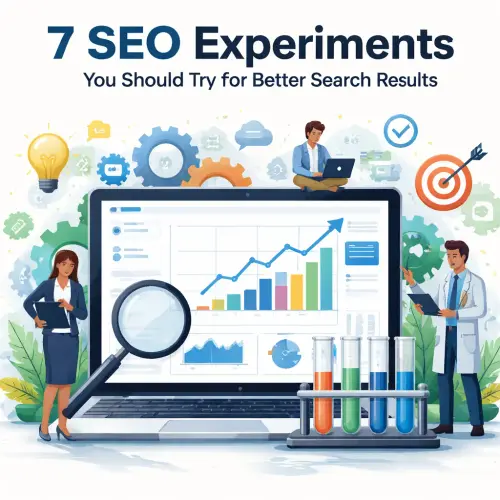
Why Running SEO Experiments Is Essential in 2025
Search engine algorithms update thousands of times per year. What worked six months ago may now hurt your rankings. Running deliberate SEO experiments allows you to adapt with confidence. Instead of following industry trends blindly, you gather your own data. For a related guide, see SEO Trial-and-Error: What Actually Works for New Sites in 2026.
Many marketers rely on intuition or outdated advice. But the most successful SEO professionals treat their websites as testing labs. They formulate hypotheses, implement changes, measure results, and iterate. This scientific approach separates guesswork from strategy.
Your goal is to achieve predictable, repeatable ranking improvements. The only way to do that is through careful search results experiments that account for external variables like seasonality and competitor activity.
The Seven Must-Try SEO Experiments for Higher Rankings
Below are seven proven SEO testing ideas you can implement this week. Each experiment includes step-by-step implementation guidance, expected outcomes, and a real-world example to illustrate the concept in action.
1. Title Tag Rewriting Experiment
The experiment: Systematically rewrite 10 to 20 title tags on underperforming pages. Keep the same core keyword but change the angle, format, or benefit promise.
How to implement: Choose pages that rank between positions 5 and 15. Change only the title tag. Leave all other elements unchanged. Wait four to six weeks before analyzing results.
Expected outcome: A 15 to 25 percent increase in organic click-through rate for pages with improved titles. Some pages may also see ranking improvements as search engines reassess relevance.
Real-world example: An e-commerce site selling running shoes changed titles from “Buy Running Shoes” to “Best Cushioned Running Shoes for Marathon Training 2025.” The click-through rate doubled within one month.
2. Meta Description A/B Test
The experiment: Test two different meta description variants for the same page. Publish one version for two weeks, then switch to the alternative. Track impressions and click-throughs in Google Search Console. For a related guide, see H1 Optimization Test: Keyword-Rich vs. Branded.
How to implement: Write descriptions with and without emotional triggers, urgency, or specific numbers. Use a spreadsheet to track performance before, during, and after the test.
Expected outcome: You may discover a 10 to 30 percent difference in click-through rates between variants. The winning formula can be applied across your entire site.
Real-world example: A SaaS blog tested “Learn SEO Basics” versus “Double Your Traffic in 30 Days with These SEO Basics.” The benefit-driven version won by a 22 percent higher CTR.
3. Content Depth Comparison
The experiment: Take a short (300 to 500 word) page that ranks modestly and expand it to at least 1,500 words. Add original insights, data tables, and expert quotes. Keep the URL and meta data identical.
How to implement: Identify a page ranking between positions 6 and 12. Expand it without removing the original content. Add new headings, examples, and visuals. Monitor ranking changes weekly.
Expected outcome: Deep content often jumps three to five positions in search results, especially for topics requiring expertise or thorough explanations.
Real-world example: A personal finance blog expanded their “How to Budget” article from 400 words to 1,800 words with step-by-step instructions and a downloadable template. The page moved from position 9 to position 3 in six weeks.
4. Internal Link Placement Shift
The experiment: Identify your top 5 most linked-to pages on your site. Remove or reduce internal links to those pages from low-value pages, and add links from high-authority pages instead.
How to implement: Use a tool like Ahrefs or Screaming Frog to map your internal link structure. Redirect link equity from pages with thin content to pages that rank well but need a small boost.
Expected outcome: Targeted pages often see a one to three position ranking increase within two to three months.
Real-world example: An online magazine shifted internal links from their “About Us” page to their best-performing guide. The guide jumped from position 7 to position 4 for its primary keyword.
5. Featured Snippet Targeting Test
The experiment: Rewrite content specifically to capture featured snippet positions. Use direct answers, bulleted lists, and concise definitions at the top of your content.
How to implement: Search for your target keyword. Identify what kind of snippet appears (paragraph, list, or table). Reformat your content to match that structure exactly.
Expected outcome: Pages that capture featured snippets see a 20 to 40 percent increase in click-through rates and often rank in the top three organic positions.
Real-world example: A travel site reformatted “Best Time to Visit Iceland” to include a clear table with months and weather conditions. They won the featured snippet within two weeks and saw a 300 percent increase in organic sessions.
6. Image Optimization with Alt Text A/B Test
The experiment: Rewrite image alt text for all images on a specific set of pages. Use descriptive, keyword-rich alt text instead of generic labels. Compare organic image search traffic before and after.
How to implement: Use Google Search Console’s image search report to identify underperforming images. Rewrite alt text for 20 images, including the focus keyword where natural. Wait one month.
Expected outcome: Image search traffic can increase by 30 to 50 percent, and the page may also see a mild boost in organic rankings due to improved accessibility signals.
Real-world example: A recipe blog changed alt text from “chocolate cake” to “moist chocolate cake with chocolate frosting and sprinkles.” Their image impressions in search grew by 45 percent in three weeks.
7. Schema Markup Implementation Test
The experiment: Add structured data (schema markup) to pages that currently lack it. Start with review schema, FAQ schema, or article schema depending on content type.
How to implement: Use Google’s Structured Data Markup Helper or a plugin to generate JSON-LD code. Validate the markup using Google’s Rich Results Test. Monitor changes in Google Search Console’s rich results report.
Expected outcome: Pages with schema markup often appear with rich snippets, increasing click-through rates by 20 to 30 percent compared to plain listings.
Real-world example: A product review site added review schema to their top 10 product pages. Their search snippets now show star ratings and price ranges, and they saw a 35 percent increase in organic traffic to those pages.
Recap Checklist: How to Run SEO Experiments Correctly
Before you start, keep these best practices in mind. Skipping any step can invalidate your results:
- Change only one variable per experiment.
- Allow at least four to six weeks for results to stabilize.
- Use a control page that remains unchanged for comparison.
- Track rankings and traffic using the same tools before and after.
- Document your hypothesis, method, and results for future reference.
Running SEO experiments this way ensures you build a repeatable optimization system rather than relying on luck.
| Experiment | Time to See Results | Difficulty | Potential Impact |
|---|---|---|---|
| Title Tag Rewriting | 4–6 weeks | Easy | High |
| Meta Description A/B Test | 2–4 weeks | Medium | Medium |
| Content Depth Comparison | 6–10 weeks | Medium | High |
| Internal Link Placement Shift | 8–12 weeks | Advanced | Medium |
| Featured Snippet Targeting | 2–4 weeks | Easy | High |
| Image Optimization with Alt Text | 4–6 weeks | Easy | Medium |
| Schema Markup Implementation | 2–4 weeks | Advanced | High |
Your Call to Action: Try One SEO Experiment This Week
You do not need to run all seven experiments at once. Pick the one that sounds most impactful for your current situation. Start small, measure carefully, and let the data guide your decisions. Consistency outperforms perfection every time.
Share your results with your team or in online SEO communities. Your findings might help others make better decisions too. The best time to start running search results experiments was six months ago. The second best time is today.
Useful Resources
For deeper reading on running SEO experiments properly, check out these authoritative sources:
- Google’s Search Quality Evaluator Guidelines — essential reading for understanding what search engines reward.
- Ahrefs’ Guide to SEO Experiments — a practical resource with more advanced testing frameworks.
Frequently Asked Questions About SEO experiments
What are SEO experiments ?
SEO experiments are controlled tests where you change one element of a webpage to measure its effect on search rankings or traffic. They help you make data-driven optimization decisions.
How long should an SEO experiment run?
Most SEO experiments need four to six weeks to produce reliable data. Longer tests (eight to twelve weeks) are better for changes that affect link equity or authority signals.
Can I run SEO experiments on a new website?
Yes, but results may be less reliable due to the Google sandbox effect. Wait at least three to six months of consistent publishing before drawing strong conclusions from experiments.
What tools do I need for SEO experiments ?
You need Google Search Console, a rank tracking tool (like Ahrefs or SEMrush), and a spreadsheet. A/B testing tools like Google Optimize can help with on-page content experiments.
Do I need technical skills to run SEO experiments ?
Basic skills are enough for most experiments. Implementing schema markup or internal link changes requires some technical knowledge, but many experiments are purely content-based.
How many variables should I test at once?
Always test one variable at a time. Testing multiple changes simultaneously makes it impossible to know which change caused the result. This is the golden rule of SEO experimentation.
What is the easiest SEO experiment for beginners?
Title tag rewriting or meta description A/B testing are both excellent starting points. They require no technical changes and produce measurable results quickly.
Can SEO experiments hurt my rankings?
Poorly designed experiments can temporarily affect rankings. Always keep a control page unchanged and revert changes if you see negative trends. The risk is minimal if you follow proper methodology.
Should I experiment with black hat techniques?
No. Black hat techniques like keyword stuffing or link buying violate search engine guidelines. They can lead to penalties that take months to recover from. Stick to white hat experiments.
How do I measure success in an SEO experiment?
Measure organic traffic, keyword ranking position, click-through rate, and engagement metrics like time on page. Use the same metrics before and after the experiment for comparison.
What is the difference between an experiment and an optimization?
An experiment is a test with a clear hypothesis and control. An optimization is a change based on prior experiments or best practices. Experiments inform optimizations.
How do I account for seasonality in SEO experiments ?
Run experiments during stable periods of the year, or use a control page that experiences similar seasonal trends. Compare year-over-year data when possible.
Can I experiment with voice search optimization?
Yes. Test adding question-and-answer sections, featured snippet formatting, and conversational language. Monitor Google Search Console for voice search impressions.
Do SEO experiments work for local businesses?
Absolutely. Local SEO experiments can test Google Business Profile updates, local keyword variations, and review schema. Local experiments often produce faster results due to lower competition.
How do I document an SEO experiment?
Create a document with five sections: hypothesis, method, timeline, results, and conclusion. Include screenshots and data exports for transparency and future reference.
What is the most common mistake in SEO experiments ?
The most common mistake is changing too many things at once. Always isolate one variable. The second most common mistake is ending the experiment too early.
Should I use AI tools for SEO experiments ?
AI tools can help generate content variations or analyze data, but the experiment design and interpretation should remain human-led. Use AI as an assistant, not a decision-maker.
How do I choose which experiment to run first?
Identify the page with the biggest gap between current ranking and desired ranking. Choose an experiment that targets the most likely cause of that gap. Start with low-effort experiments.
Can I replicate experiments from other websites?
Yes, but expect different results because of different site authority, competition, and audience behavior. Use others’ experiments as inspiration, not guarantees.
How often should I run SEO experiments ?
Run one experiment at a time consistently. Most experienced SEOs run two to four experiments per month. Quality matters more than quantity.