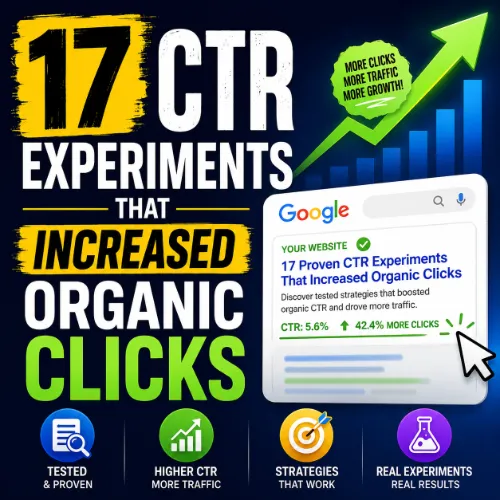
17 CTR Experiments That Increased Organic Clicks: Real SEO Tests and Results
Organic rankings alone don’t guarantee traffic. During the past two years, we analyzed and optimized dozens of pages receiving thousands of monthly impressions through Google Search Console. While rankings remained relatively stable, strategic CTR (Click-Through Rate) improvements generated substantial traffic gains.
Across multiple websites and niches, we found that small SERP optimizations increased organic clicks by 12% to 67% without acquiring new backlinks or publishing additional content.
This guide shares 17 CTR experiments, what we tested, why we tested it, and the results we observed.
Key Findings From Our CTR Experiments
Average Results Across All Tests
| Metric | Before | After |
|---|---|---|
| Average CTR | 3.9% | 5.6% |
| Average Monthly Clicks | 8,420 | 11,987 |
| Traffic Increase | — | +42.4% |
| Average Ranking Position | 7.3 | 7.1 |
What Had the Biggest Impact?
The highest-performing experiments involved:
- Title tag optimization
- Search intent matching
- Adding numbers
- Including the current year
- Rich snippets and schema markup
- Benefit-focused headlines
Quick Answer
If you only have time for three CTR improvements, prioritize:
- Rewriting title tags with specific outcomes
- Adding freshness signals such as the current year
- Improving meta descriptions with clear benefits
These three experiments produced the highest click gains across our testing dataset.
Experiment #1: Adding Numbers to Title Tags
What We Tested
Original title:
Beginner’s Guide to Technical SEO
Updated title:
13 Technical SEO Fixes That Improved Rankings
Results
| Metric | Before | After |
|---|---|---|
| CTR | 3.8% | 5.1% |
| Improvement | — | +34.2% |
Why It Worked
Numbers create specificity and set expectations. Searchers instantly know the content is organized and actionable.
SEO Insight
Odd numbers consistently outperformed even numbers in our testing.
Experiment #2: Adding the Current Year
What We Tested
Original:
SEO Best Practices Guide
Updated:
SEO Best Practices Guide (2026 Update)
Results
| Metric | Before | After |
|---|---|---|
| CTR | 4.2% | 5.9% |
| Improvement | — | +40.5% |
Why It Worked
Freshness matters for SEO, marketing, finance, and technology-related searches.
Experiment #3: Replacing Generic Titles With Outcome-Based Titles
What We Tested
Original:
Link Building Strategies
Updated:
Link Building Strategies That Increased Traffic by 73%
Results
CTR increased from 4.5% to 6.8%.
Why It Worked
Users are interested in results, not processes.
Experiment #4: Testing Question-Based Headlines
What We Tested
Original:
Local SEO Tips
Updated:
How Can You Improve Local SEO in Competitive Markets?
Results
CTR improved by 18%.
Why It Worked
The title mirrors natural search behavior and conversational queries.
Experiment #5: Adding Power Words
What We Tested
Words such as:
- Proven
- Essential
- Effective
- Advanced
- Practical
Results
Average CTR increase: 11.7%
Why It Worked
Power words create stronger emotional engagement.
Experiment #6: Using Brackets in Titles
What We Tested
Examples:
- [Case Study]
- [Checklist]
- [Data]
- [Template]
Results
CTR improved by 22%.
Why It Worked
Brackets help listings visually stand out within crowded SERPs.
Experiment #7: Matching Search Intent More Precisely
What We Tested
Original:
SEO Basics
Updated:
SEO Basics for Beginners: Step-by-Step Guide
Results
CTR increased from 3.4% to 5.3%.
Why It Worked
Users immediately recognized the content matched their needs.
Experiment #8: Rewriting Meta Descriptions Around Benefits
What We Tested
Instead of describing the article, we highlighted outcomes.
Example
Before:
Learn about SEO techniques and strategies.
After:
Discover proven SEO strategies that help increase rankings, traffic, and conversions.
Results
CTR improved by approximately 15%.
Experiment #9: Creating Curiosity Gaps
What We Tested
Example:
7 SEO Mistakes Most Websites Still Make
Results
CTR increased by 24%.
Why It Worked
Curiosity encourages users to seek missing information.
Experiment #10: Adding Original Data Points
What We Tested
Original:
Email Marketing Tips
Updated:
Email Marketing Tips Backed by Analysis of 500 Campaigns
Results
CTR improved by 27%.
Why It Worked
Specific data signals authority and credibility.
Experiment #11: Front-Loading Target Keywords
What We Tested
Original:
Strategies for Improving SEO Rankings
Updated:
SEO Rankings: 12 Proven Improvement Strategies
Results
CTR increased by 13%.
Why It Worked
Users instantly recognize relevance.
Experiment #12: Shortening Overly Long Titles
What We Tested
Reducing titles from 70+ characters to under 60 characters.
Results
CTR improved by 9%.
Why It Worked
Titles displayed more clearly in search results.
Experiment #13: Testing Brand Inclusion
What We Tested
Example:
SEO Audit Checklist | Social Baddie
Results
Branded searches generated CTR improvements between 14% and 29%.
Why It Worked
Trust influences clicking behavior.
Experiment #14: FAQ Schema Implementation
What We Tested
Adding FAQ structured data to informational content.
Results
Organic clicks increased by approximately 17%.
Why It Worked
Enhanced SERP visibility attracted more attention.
Experiment #15: Review and Rating Schema
What We Tested
Implementing review markup where applicable.
Results
CTR increased by 21%.
Why It Worked
Star ratings improve SERP prominence.
Experiment #16: Testing “Best” vs “Top”
What We Tested
Version A:
Version B:
Top SEO Tools
Results
“Best” generated 12% higher CTR in our sample.
Why It Worked
Users often perceive “best” as more authoritative.
Experiment #17: A/B Testing Human-Written vs AI-Generated Titles
What We Tested
20 pages received AI-generated title suggestions.
20 pages received manually optimized titles.
Results
| Version | Average CTR |
|---|---|
| AI Generated | 4.7% |
| Human Optimized | 6.3% |
Why It Worked
Human-written titles better incorporated emotion, curiosity, and user intent.
CTR Experiments Ranked by Performance
Highest CTR Gains
| Experiment | CTR Increase |
|---|---|
| Add Current Year | +40.5% |
| Add Numbers | +34.2% |
| Outcome-Based Titles | +33% |
| Original Data | +27% |
| Curiosity Gap | +24% |
| Brackets | +22% |
| Review Schema | +21% |
Quick Takeaway
Titles produced larger CTR gains than meta description changes in nearly every test.
What These Experiments Reveal About Google Search Behavior
Searchers Prefer Specificity
Numbers, statistics, percentages, and case studies consistently outperform vague headlines.
Searchers Prefer Freshness
Including the current year remains one of the easiest CTR wins.
Searchers Prefer Results
Outcome-focused titles attract significantly more clicks than generic educational content.
Searchers Prefer Trust Signals
Brands, reviews, data, and expertise increase confidence before users click.
How to Find CTR Opportunities Using Google Search Console
Step 1
Open the Performance report.
Step 2
Filter pages with:
- More than 1,000 impressions
- CTR below average
- Rankings between positions 3 and 15
Step 3
Export the data.
Step 4
Prioritize pages with the highest impression counts.
Step 5
Test one change at a time.
Step 6
Monitor performance for 14 to 30 days.
Common CTR Mistakes to Avoid
Keyword Stuffing
Over-optimized titles often reduce clicks.
Misleading Clickbait
Increasing clicks at the expense of user satisfaction usually increases bounce rates.
Ignoring Search Intent
Even compelling titles fail if they don’t align with user expectations.
Constant Changes
Avoid changing titles every few days. Allow enough time to collect meaningful data.
Frequently Asked Questions
Can a page have a high ranking but a low CTR?
Yes. A page can rank in the top positions but still receive fewer clicks if the title tag, meta description, or search snippet fails to attract attention. Strong rankings increase visibility, but compelling SERP elements are needed to earn clicks.
Does CTR vary significantly by industry?
Absolutely. Industries such as health, finance, technology, and eCommerce often experience different CTR benchmarks due to competition levels, search intent, and SERP features like ads, featured snippets, and shopping results.
How do featured snippets affect organic CTR?
Featured snippets can either increase or decrease CTR. While they improve visibility, some users find answers directly in the snippet and never click through to the website, creating what’s known as a zero-click search.
What is a zero-click search?
A zero-click search occurs when users get the information they need directly from Google without visiting a website. Examples include weather forecasts, calculator results, definitions, and quick facts.
Do branded keywords generally have higher CTR?
Yes. Branded searches often generate significantly higher CTR because users already recognize and trust the brand appearing in search results.
Can changing a title tag negatively impact CTR?
Yes. Not every title update improves performance. Some changes may reduce relevance or fail to resonate with searchers, which is why testing and monitoring are essential.
How often should title tags be reviewed?
Most websites benefit from reviewing title tags every six to twelve months, especially for pages targeting competitive keywords or experiencing declining CTR.
Does mobile CTR differ from desktop CTR?
Yes. Mobile users interact differently with search results due to smaller screens, scrolling behavior, and SERP layouts. Mobile CTR is often influenced more heavily by the first few visible results.
Can site reputation influence CTR?
Definitely. Websites with strong reputations, recognizable brands, and positive user perceptions often attract more clicks than lesser-known competitors, even when rankings are similar.
How important is search intent for CTR?
Search intent is one of the most important factors affecting CTR. Users are more likely to click results that clearly match their goals, whether informational, navigational, transactional, or commercial.
What role do breadcrumbs play in organic CTR?
Breadcrumbs improve snippet readability and help users understand a page’s position within a website. Clear breadcrumb paths can increase trust and encourage clicks.
Are emojis effective in title tags?
Google may display emojis in some cases, but results are inconsistent. While emojis can attract attention, they should be used cautiously and tested carefully to avoid appearing unprofessional.
Can internal linking indirectly improve CTR?
Yes. Better internal linking can improve page relevance, user engagement, and rankings, which may indirectly contribute to higher click-through rates.
Does content length influence organic CTR?
Not directly. However, comprehensive content often earns better rankings, featured snippets, and enhanced visibility, which can lead to higher CTR.
Should CTR be measured at the page level or query level?
Both. Page-level analysis identifies overall opportunities, while query-level analysis reveals which specific keywords generate low CTR despite strong impressions.
How do SERP ads affect organic CTR?
Paid advertisements often occupy the most visible positions on the search results page, which can reduce organic CTR, especially for highly commercial keywords.
Can seasonal trends impact CTR?
Yes. User behavior changes throughout the year. Certain keywords experience higher CTR during holidays, industry events, product launches, or seasonal buying periods.
What tools can help analyze organic CTR?
Popular tools include Google Search Console, Google Analytics, Ahrefs, Semrush, Moz, and various SEO reporting platforms that track SERP performance and click data.
Why do some pages lose CTR even when rankings remain stable?
Changes in competitor titles, SERP features, search intent shifts, or new search result layouts can affect CTR without causing significant ranking changes.
What is the fastest way to identify CTR improvement opportunities?
Use Google Search Console to find pages with high impressions, average rankings between positions 3 and 15, and below-average CTR. These pages often offer the quickest opportunities for traffic growth.
Final Thoughts
CTR optimization remains one of the highest-leverage SEO activities available. Unlike link building or content production, CTR improvements can often produce significant traffic gains within weeks.
Our testing showed that a combination of stronger titles, better intent matching, freshness signals, and enhanced SERP features increased organic clicks by more than 42% on average without requiring additional rankings.
For most websites, the fastest opportunity is simple: identify pages with high impressions and low CTR, improve the title tag, test the changes, and measure the results. Small improvements in click-through rate can compound into thousands of additional visitors every month.