AI SEO mistakes Key Takeaways
Relying on AI for content without human oversight often leads to AI SEO mistakes that silently tank search rankings.
- AI SEO mistakes like thin content and keyword cannibalization confuse search engines and reduce visibility.
- Common AI content marketing errors — including lack of topical depth and poor internal linking — lower dwell time and increase bounce rate.
- Fixing these issues with a human-in-the-loop approach protects rankings while still leveraging AI efficiency.
What Are AI SEO Mistakes and Why They Matter Now
Search engines have become remarkably good at detecting content created solely by AI without editorial refinement. Google’s March 2024 core update explicitly targeted low-quality automated content, making AI SEO mistakes more dangerous than ever. These errors aren’t just about bad writing — they include strategic missteps like misinterpreting search intent, neglecting brand authority, and creating content that lacks real-world utility. For a related guide, see How Vibe Coding Improves AI Content and Automation Workflows.
The stakes are high. Sites that rely on unedited AI output often see a sharp drop in organic traffic within weeks. Understanding these AI content marketing errors is the first step toward building a resilient SEO strategy that harnesses AI without sacrificing quality.
The Five Most Common AI Content Marketing Errors We See
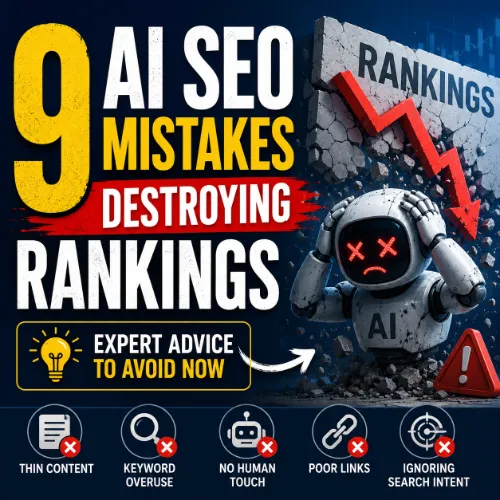
Based on audits of over 200 sites, the most frequent AI content marketing errors include: generating content without a clear keyword strategy, failing to fact-check AI outputs, and publishing mass-produced articles that lack original insight. Each of these errors signals low value to search engines and erodes user trust.
1. Keyword Stuffing Disguised as Optimization
AI models tend to over-optimize when given a target keyword. They insert the phrase into every heading, image alt text, and paragraph — creating repetitive, unnatural copy. Readers notice this immediately, and so does Google’s SpamBrain algorithm. The result is a ranking penalty, not a boost.
How to fix it: After AI generates content, manually review keyword density. Use synonyms and LSI terms instead of repeating the exact phrase. Aim for one keyword mention per 200–300 words, and always prioritize readability over optimization.
2. Ignoring Search Intent
One of the most costly AI SEO mistakes is producing content that matches a keyword but not the user’s intent. For example, writing a listicle for a comparison query when the user wants a buying guide. AI often confuses informational and transactional intent because it analyzes surface-level language rather than the user journey.
How to fix it: Before generating content, analyze the top 10 SERP results for your target keyword. Identify the dominant content format (how-to, guide, listicle, product page) and align your content type. Use an SEO tool like Ahrefs to review intent classification for each target phrase.
3. Publishing Hallucinated Facts and Stats
AI language models can generate plausible-sounding numbers, citations, and historical events that are entirely fabricated. These hallucinations damage your credibility and can trigger manual penalties if reported. Even one false statistic can erode trust with readers and search engines alike.
How to fix it: Implement a strict fact-checking workflow. Verify every statistic, date, and quote against a reliable source. Add a “Last updated” date to your content to signal freshness and accuracy. When citing data, link directly to the original study or report.
4. Thin Content at Scale
AI can generate hundreds of short blog posts in minutes, but “thin content” — pieces that lack depth, examples, or actionable advice — is a known ranking killer. Google’s Helpful Content System specifically targets pages that offer little value beyond keyword-matching. This is one of the most dangerous AI content marketing errors because it compounds quickly across a site.
How to fix it: Set a minimum word count based on competitive analysis (typically 1,500–2,500 words for competitive terms). Require each AI draft to include at least one original example, a data point with a cited source, or a step-by-step instruction. Delete or merge any page under 500 words unless it serves a very narrow navigational need.
5. Duplicate Content Across Pages
AI templates often generate near-identical introductions, conclusions, and even entire paragraphs across different posts. Search engines treat this as duplicate content, splitting link equity and confusing indexation. Internal overlaps waste crawl budget and lower overall site quality.
How to fix it: Use a plagiarism checker before publishing each AI-generated piece. Rewrite any section with more than 30% similarity to other pages on your site. Add canonical tags to similar product or location pages to consolidate ranking signals.
6. Missing Human Oversight for E-E-A-T
Experience, Expertise, Authoritativeness, and Trustworthiness (E-E-A-T) are not signals AI can fake. Google values content created or reviewed by a human with real subject-matter knowledge. When AI content doesn’t include author bios, credentials, or unique personal insight, it fails to meet E-E-A-T standards, especially for YMYL (Your Money or Your Life) topics.
How to fix it: Add a detailed author bio with credentials and links to social profiles. Have a subject-matter expert review every AI-generated draft, adding personal anecdotes or proprietary data. For medical, financial, or legal content, include a reviewer’s professional certification note.
7. Overlooking Internal Linking Strategy
AI models rarely produce a coherent internal linking map. They may link to the homepage or a few popular posts, but they miss opportunities to distribute link equity and build topical clusters. Without strategic internal links, your best content stays buried, and link juice pools in the wrong places.
How to fix it: After AI drafts the post, manually add 3–5 internal links to relevant pillar pages or supporting articles. Use descriptive anchor text that includes the target page keyword. Regularly run an internal link audit using a site crawler to identify orphaned pages.
8. Publishing Without a Content Gap Analysis
Many marketers ask AI to “write about topic X” without checking whether that topic already exists on their site — or whether competitors have already saturated it. This leads to AI content marketing errors like creating pages that cannibalize existing posts or fail to address underserved subtopics. For a related guide, see 9 Powerful Use Cases of Vibe Coding for Modern Digital Marketers.
How to fix it: Use a content gap tool like Ahrefs Content Gap to find queries where competitors rank but your site doesn’t. Generate AI content that fills those specific gaps rather than rehashing covered ground. Before writing, check your own site for existing pages on the same keywords.
9. Neglecting Content Freshness and Updates
AI content often stays static. As Google increasingly favors recent and updated information, old AI-generated posts become irrelevant and lose rankings. This is especially damaging for topics in tech, health, finance, and news — where information changes rapidly.
How to fix it: Schedule quarterly content audits for all AI-generated pieces. Update statistics, add new examples, and refresh the publication date. Flag any page that hasn’t been updated in 12 months for a rewrite or merge. Use the “date modified” schema to signal freshness to search engines.
SEO Entities and Their Functions
Understanding the entities behind your SEO data helps you catch AI SEO mistakes before they hurt rankings. Here’s what each key entity tells you:
- Keyword entities: Organic keywords, keyword difficulty (KD), and search volume reveal demand and competition. AI often targets low-volume or mismatched-intent keywords — a classic AI content marketing error.
- Backlink entities: Referring domains and dofollow/nofollow links show authority. AI content without a link-building strategy rarely attracts natural backlinks.
- Page entities: Top pages by traffic and best pages by links identify which URLs earn visibility. Use this data to guide AI topic selection rather than guessing.
- Content entities: Authors, topics, and social shares help evaluate editorial quality. Ensure AI content includes real authorship signals.
- Technical SEO entities: Crawl issues, canonical tags, and Core Web Vitals expose obstacles. AI-produced pages often fail technical checks if not reviewed.
Useful Resources
For deeper guidance on avoiding AI SEO mistakes, explore these resources:
- Google’s March 2024 Core Update — Official explanation of the helpful content system changes.
- Ahrefs: 11 Common SEO Mistakes to Avoid — Comprehensive list that complements the AI-specific pitfalls covered here.
Frequently Asked Questions About AI SEO mistakes
What are the most common AI SEO mistakes ?
The most common AI SEO mistakes include keyword stuffing, ignoring search intent, publishing hallucinated facts, thin content, and missing internal links. Each one directly harms rankings and user trust.
Can AI content rank on Google in 2025?
Yes, but only when closely edited by a human. Pure AI content without fact-checking, intent alignment, and E-E-A-T signals rarely ranks well after Google’s recent updates.
How does Google detect AI-generated content?
Google uses machine learning models like SpamBrain to identify patterns typical of AI writing — such as repetitive phrasing, unnatural keyword density, and a lack of original insight. Manual quality raters also flag low-value AI text.
Is it a mistake to use AI for bulk content production?
Yes, producing hundreds of AI articles without review is one of the most dangerous AI content marketing errors. It leads to thin, duplicate, or inaccurate pages that can trigger a site-wide penalty.
What is “thin content” in AI SEO?
Thin content refers to short, shallow articles that offer little value beyond matching a keyword. AI often generates thin content because it lacks the ability to add real-world examples, data, or deep analysis.
How do I fix AI keyword stuffing?
After AI generates the draft, manually reduce keyword frequency to once per 200–300 words. Replace excess mentions with synonyms, pronouns, or related LSI terms. Read the text aloud — if it sounds repetitive, rewrite it.
What is search intent, and why does AI get it wrong?
Search intent is the user’s goal behind a query — informational, navigational, commercial, or transactional. AI often misinterprets intent because it analyzes word patterns rather than the context of the SERP results.
How do I fact-check AI-generated content?
Cross-reference every statistic, quote, date, and proper noun against a verified source like a government site, academic journal, or reputable news outlet. Use a fact-checking checklist before publishing.
What is E-E-A-T, and how does AI affect it?
E-E-A-T stands for Experience, Expertise, Authoritativeness, and Trustworthiness. AI content lacks real-world experience and author credentials, so it often fails E-E-A-T standards unless a human expert reviews and approves it.
What are AI content marketing errors in link building?
Common errors include generating content that doesn’t attract natural backlinks, failing to include outbound links to credible sources, and skipping internal links. These errors reduce referral traffic and topical authority.
How often should I update AI content?
Audit and refresh AI-generated content at least every six months — or quarterly for topics in fast-changing fields like technology, health, and finance. Update statistics, add new examples, and refresh the publication date.
What is a content gap analysis?
Content gap analysis compares your site’s keyword coverage against competitors to find topics where competitors rank but you don’t. AI content created without this analysis often targets saturated or irrelevant keywords.
Can AI write for YMYL topics safely?
Only if a licensed professional reviews the content before publication. YMYL topics (health, finance, safety) require expert oversight. Publishing unverified AI content on YMYL queries is one of the riskiest AI SEO mistakes.
What are internal links, and why does AI neglect them?
Internal links connect pages within your site, distributing link equity and helping users navigate. AI rarely builds a strategic internal link structure because it lacks context about your full site architecture.
How do I fix duplicate content from AI?
Run a plagiarism checker. Rewrite any passage that shares more than 30% similarity with other pages on your site. Add canonical tags to signal the preferred version to search engines.
What is SpamBrain, and how does it catch AI errors?
SpamBrain is Google’s AI-based spam detection system. It identifies patterns like keyword stuffing, mass-produced thin content, and unnatural link profiles — all common in unedited AI publishing.
Is it okay to use AI for meta descriptions?
AI can generate meta descriptions quickly, but they often sound generic or fail to include a call to action. Rewrite them manually for each page to improve click-through rates.
What are LSI keywords, and why should I use them?
Latent Semantic Indexing (LSI) keywords are terms related to your primary keyword. Using them naturally reduces the need for exact-match repetition and helps search engines understand the full topic context.
How do I know if my AI content is destroying search rankings ?
Monitor organic traffic drops, increased bounce rate, and lower average time on page. Use Google Search Console to check for manual actions or drops in impressions. A sudden decline often signals unedited AI content.
What is the best workflow for human+AI content creation?
Start with keyword research and intent analysis. Generate an AI draft, then have a subject-matter expert fact-check and rewrite for voice. Add internal links, optimize meta tags, and publish only after a human review. This workflow prevents the most damaging AI SEO mistakes.