

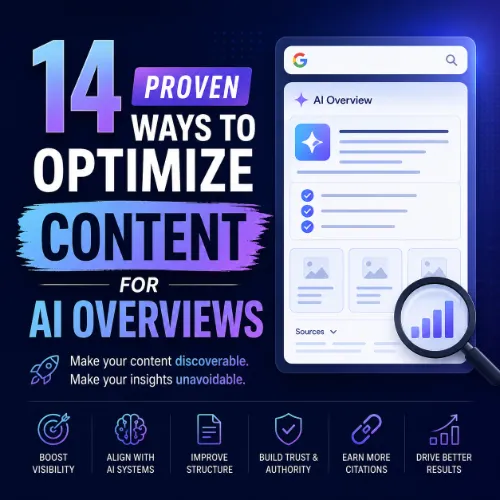
optimize content for AI overviews Key Takeaways
To optimize content for AI overviews , you must shift from traditional keyword-stuffing to structured, authoritative, user-focused writing.
- Use clear headings, lists, and tables so AI can easily parse your key points.
- Demonstrate topical authority by covering related subtopics and citing credible sources.
- Match search intent with direct answers at the top of your article.
Why You Need to Optimize Content for AI Overviews Now
AI Overviews are reshaping how users discover information. Instead of clicking through multiple links, searchers often get a synthesized answer directly in the results. If your content isn’t structured for this format, you risk losing visibility to competitors who have adapted. The good news: the same practices that improve user experience—clarity, depth, and trustworthiness—also align with what AI looks for. For a related guide, see GEO Content Frameworks That Actually Work.
1. Answer the Core Question in the First 100 Words
AI models scan the opening paragraph to determine relevance. Place your direct answer to the user’s query at the very beginning. For example, if you’re writing about “how to brew pour-over coffee,” start with a clear, concise explanation of the method before diving into background details.
2. Structure Content with Descriptive H2 and H3 Headings
Headings act as signposts for AI crawlers. Use H2 for main topics and H3 for subtopics. Avoid vague headings like “Introduction” or “Conclusion.” Instead, use question-based or keyword-rich phrases like “How Does Optimize Content for AI Overviews Work?” or “Key Benefits of Structured Data.”
3. Incorporate Lists and Tables for Quick Extraction
AI Overviews often pull bullet points and tables because they present information in a scannable format. Whenever you compare features, list steps, or rank options, use an unordered list or a simple table. For instance, a comparison of tools like Ahrefs and SEMrush can be displayed in a two-column table.
4. Build Topical Authority with Related Subtopics
Don’t just answer the primary question—cover adjacent topics naturally. If your article is about AI Overviews, also discuss user intent, featured snippets, and entity optimization. This signals to AI that your page is a comprehensive resource, increasing the chance of being selected for an overview.
5. Use Natural Language and Avoid Jargon Overload
AI models are trained on conversational text. Write in plain English, define technical terms when first used, and keep sentences under 25 words. This doesn’t mean dumbing down content—it means making it accessible to a broader audience. For a related guide, see 14 Proven Ways to Optimize Content for ChatGPT Search.
6. Cite Authoritative Sources to Boost Trust Signals
Back up claims with links to reputable domains like Google Search Central, academic papers, or well-known industry blogs. For example, when discussing AI Overview updates, reference Google’s official documentation. These citations help AI assess the credibility of your information.
7. Add a Clear, Scannable Summary Block
Place a “Key Takeaways” or “What You’ll Learn” box near the top of your article. This gives AI a condensed version of your main points that can be extracted directly. Use the same blockquote format shown at the start of this article.
8. Optimize for Voice Search and Question-Based Queries
Include one or two “People Also Ask” style questions in your article and answer them concisely. For instance, “How long does it take to optimize content for AI overviews?” followed by a 2-3 sentence answer. This mirrors the format AI uses when pulling information for voice responses.
9. Maintain Freshness with Regular Updates
AI Overviews favor content that reflects current best practices. Review your top-performing pages every six months, update statistics, add recent examples, and refresh any outdated links. Even small tweaks can signal to search engines that your content is still relevant.
Frequently Asked Questions About optimize content for AI overviews
What is an AI Overview in search results?
An AI Overview is a synthesized answer displayed at the top of search results, generated by AI from multiple sources to directly address the user’s query.
How do I start optimizing for AI Overviews?
Begin by identifying high-intent questions in your niche, then write clear, concise answers in the first paragraph of your article, using structured headings and lists.
Does schema markup guarantee an AI Overview placement?
No, but it helps AI understand your content’s format and context, increasing the likelihood of being selected for an Overview.
How long should my article be to appear in AI Overviews?
There is no fixed length, but articles that thoroughly cover a topic in 1,000–2,000 words with clear subsections tend to perform well.
Can I optimize existing content for AI Overviews?
Yes. Add a summary block, restructure headings, include lists, and update statistics to make older content more AI-friendly.
What is the difference between a featured snippet and an AI Overview?
A featured snippet is a direct quote from a single page, while an AI Overview synthesizes information from multiple sources into a new summary.
Do AI Overviews reduce click-through rates?
They can, but if your content appears in the Overview, you still gain brand exposure and authority, which often leads to clicks from users seeking deeper information.
How often should I update my content for AI Overviews?
Review high-priority pages every 3–6 months, especially for fast-changing topics like technology or SEO.
What types of content are most likely to earn an AI Overview?
How-to guides, definition articles, comparison posts, and listicles with clear, extractable answers perform best.
Should I use bullet points or numbered lists in my article?
Both are effective. Use bullet points for unordered features and numbered lists for step-by-step instructions.
Does AI Overview favor longer or shorter paragraphs?
Shorter paragraphs (2–4 sentences) are easier for AI to parse and extract key points from.
Can images or videos help my content appear in AI Overviews?
Not directly, but visually structured content with alt text and captions can improve user engagement, which indirectly signals quality.
Is there a penalty for using AI-generated content in AI Overviews?
Google’s guidelines focus on quality and usefulness, not the method of production. However, low-quality AI content that lacks depth may be ignored.
How do I find the right questions to target for AI Overviews?
Use tools like Ahrefs’ Content Explorer or Google’s “People Also Ask” feature to discover common queries in your niche.
Does social sharing affect AI Overview placement?
Indirectly. Social shares can amplify reach and earn backlinks, which boost authority and increase the chance of being cited.
Can I target multiple AI Overviews from one page?
Yes, if your page comprehensively covers several related subtopics, each with its own clear section and answer.
What role do backlinks play in AI Overviews?
Backlinks remain a strong trust signal. Pages with higher domain authority are more likely to be selected as sources.
How does search intent affect AI Overview selection?
AI Overviews prioritize informational intent. If your content matches what users are trying to learn, it has a better chance of being featured.
Should I include a table of contents for AI Overviews?
Yes, a linked table of contents helps AI understand your page structure and makes navigation easier for users.
What is the most important factor for AI Overview success?
Clarity. Content that directly answers the user’s question in a well-structured, authoritative manner has the highest chance of being selected.







