

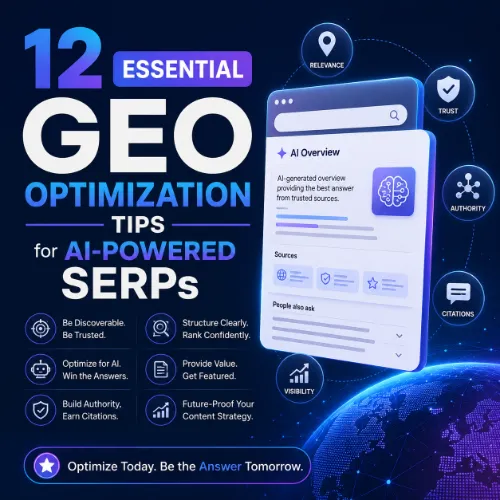
GEO optimization tips Key Takeaways
Generative Engine Optimization (GEO) is reshaping how content appears in AI-powered search results.
- Focus on conversational, authoritative content that answers user intent directly.
- Optimize for structured data and entity clarity to help AI models understand your content.
- Build topical authority clusters instead of thin, isolated pages.
What Are GEO Optimization Tips and Why They Matter Now
Search engines are no longer just link blueprints — they generate answers. AI-powered SERPs pull from trusted, clearly structured content to create summaries, comparisons, and step-by-step guides. GEO optimization tips are the strategic adjustments that make your content more eligible for these generative features. For a related guide, see On-Page SEO Content Optimization Made Easy (2026 Guide).
Unlike traditional SEO, which focuses on ranking a URL, GEO prioritizes content that AI models can parse, cite, and rephrase. This means clarity, authority, and intent alignment become even more critical.
How AI-Powered SERPs Differ From Classic Search Results
Classic SERPs show a list of blue links with snippets. AI-powered SERPs, such as Google’s AI Overviews or Bing Chat, combine information from multiple sources into a synthesized answer. Your content needs to be the source AI models trust most.
Key differences include:
- Answer format: AI models prefer direct, well-structured answers.
- Authority weighting: Citations from recognized domains get preference.
- Contextual relevance: Content that covers a topic comprehensively outperforms thin pages.
12 GEO Optimization Tips to Dominate AI-Powered SERPs
1. Structure Content for Direct Answers
AI models extract clear statements, not fluff. Write concise definitions, numbered steps, and bulleted reasons. Each paragraph should answer one question or explain one concept. This helps generative engines pull your exact wording into their summaries.
2. Build Topical Authority Clusters
Instead of a single page on “GEO optimization tips,” create a cluster of interlinked articles covering subtopics: structured data for GEO, AI-friendly tone, entity optimization, and more. This signals expertise to both search engines and AI models.
3. Optimize for Conversational Queries
People ask AI assistants full questions, not fragmented keywords. Include natural question-and-answer formats, such as “How do I implement GEO optimization tips for my blog?” This matches the language pattern of voice and chat queries.
4. Use Structured Data to Clarify Entities
Schema markup — especially FAQ, HowTo, Article, and Product — gives AI models explicit clues about your content’s structure and meaning. Implement JSON-LD structured data for every page you want to be cited in generative results.
5. Prioritize E-E-A-T Signals
AI models weigh author credibility, citation quality, and content freshness. Include author bios, link to reputable sources, and update your content regularly. Demonstrating Experience, Expertise, Authoritativeness, and Trustworthiness is non-negotiable.
6. Create Unique Definitions and Explanations
AI models pull from multiple sources and prefer unique phrasing. Avoid copying generic definitions. Craft your own clear, accurate explanations for key terms. This increases the likelihood that your content becomes the primary source.
7. Optimize for Featured Snippets (They Feed AI Overviews)
Google’s AI Overviews often originate from featured snippet content. Use bullet lists, tables, and clear headings. Answer “what is,” “how to,” and “why” questions directly to win these snippet spots.
8. Improve Page Experience and Core Web Vitals
AI models consider user engagement signals. Fast-loading, mobile-friendly pages with good Core Web Vitals are more likely to be cited. Slow or broken pages get ignored, even if the content is relevant.
9. Link to Authoritative External Sources
AI models favor content that cites trusted references. Include links to credible organizations, research, or industry standards. For example, linking to a Google developer guide or a peer-reviewed study boosts your content’s perceived reliability.
10. Use Internal Links to Build Context
Internal links help AI models understand the relationship between pages on your site. Link from your main GEO guide to related subtopics. This reinforces your site as a comprehensive resource within a specific niche.
11. Write for Humans First, AI Models Second
GEO isn’t about tricking an algorithm; it’s about being genuinely useful. If your content is clear, accurate, and easy to read, it will naturally perform well in generative results. Avoid keyword stuffing or unnatural phrasing.
12. Monitor AI Overview Citations with Analytics
Track when your content appears in AI Overviews using tools like Google Search Console and Ahrefs’ Site Explorer. Look for sudden traffic changes or impression spikes from featured snippet or AI-powered spots. Adjust your strategy based on what gets cited.
How to Implement These GEO Optimization Tips Today
Start with a content audit. Identify your top 10 performing pages and check if they answer common questions directly. Add structured data, rewrite thin sections, and link out to authoritative sources. Then monitor your generative search visibility over the next 30 days.
Remember, GEO optimization tips aren’t a one-time fix. As AI models evolve, so must your content strategy. Stay updated on changes to how generative engines crawl, parse, and cite web content.
SEO Entities and Their Functions
Understanding the entities involved in GEO and AI-driven search helps you make smarter optimization decisions. Here are the key entities and what they reveal:
- Keyword entities: Organic keywords, search volume, and keyword difficulty (KD) show which topics have demand and competition. Use them to prioritize which subtopics to cover in your content cluster.
- Page entities: Top pages by traffic, best by links, and broken pages reveal which URLs earn visibility or need repair. Optimize underperforming pages for GEO by adding structured data and clear answers.
- SERP entities: Featured snippets, People Also Ask, and AI Overviews show what format AI models prefer. Create content that matches these formats, such as Q and A sections or comparison tables.
- Backlink entities: Referring domains, dofollow/nofollow balance, and new/lost backlinks indicate your site’s authority trajectory. Build links from trusted, relevant sites to boost your content’s citation likelihood.
- Content entities: Authors, topics, published dates, and social shares help AI evaluate freshness and credibility. Maintain a consistent publishing schedule and feature author credentials.
Useful Resources
To deepen your understanding of GEO and generative search optimization, explore these resources:
- Google’s Guide to Creating Helpful Content — official best practices for content that serves humans and may be cited by AI models.
- Ahrefs’ Featured Snippet Guide — a practical resource on optimizing for snippets that often feed AI Overviews.
Frequently Asked Questions About GEO optimization tips
What are GEO optimization tips?
GEO optimization tips are strategies to make your content more likely to be cited and summarized by AI-powered search engines, such as Google’s AI Overviews, ChatGPT, and Bing Chat.
How is GEO different from traditional SEO?
Traditional SEO focuses on ranking a URL in blue links. GEO prioritizes content clarity, authority, and structure so that AI models extract and present your information in generative answers.
Do I need special tools for GEO optimization ?
Standard SEO tools like Ahrefs, Google Search Console, and structured data testing tools are sufficient. The key is adapting your content strategy, not buying new software.
How long does it take to see results from GEO?
Results vary, but you may see changes in featured snippet impressions or AI Overview citations within 4–8 weeks after implementing structured data and improving content clarity.
Does GEO work for local businesses?
Yes. Local businesses can optimize for GEO by creating clear HowTo and FAQ pages, using local structured data, and answering common local queries in a conversational tone.
What is a topical authority cluster?
It’s a group of interlinked articles that cover a broad topic and its subtopics. For GEO, this helps AI models see your site as a comprehensive, trusted source on that subject.
How important are backlinks for GEO?
Backlinks remain important because they signal authority to both traditional search engines and AI models. High-quality, relevant links increase the likelihood your content will be cited.
Should I write for AI or for humans?
Always write for humans. Content that is clear, accurate, and easy to read naturally performs better in generative search. AI optimization follows naturally from good writing.
What is structured data’s role in GEO?
Structured data (schema markup) explicitly tells AI models what each part of your page means, increasing the chance that your content is correctly interpreted and used in generative responses.
Does page speed affect GEO?
Yes. AI models consider user engagement signals. Fast-loading, responsive pages with good Core Web Vitals are more likely to be favored in generative search results.
Can I optimize old content for GEO?
Absolutely. Audit your existing high-traffic pages, add structured data, rewrite thin sections, and include direct answers to common questions. Old content with authority can rank well.
What is a featured snippet’s relationship to AI Overviews?
Google’s AI Overviews often pull from pages that already rank in featured snippets. Optimizing for snippets is a direct path to appearing in AI-generated answers.
Do I need to change my keyword research for GEO?
Yes. Include conversational, long-tail questions and natural language phrases. People ask AI assistants full questions, so your content should match that format.
How do I track GEO performance?
Use Google Search Console to monitor impressions from featured snippets and AI Overviews. Tools like Ahrefs can show traffic changes related to these features.
What is entity optimization for GEO?
Entity optimization means clearly defining the people, places, concepts, and things in your content using clear language and structured data so AI models understand their relationships.
Is GEO the same as Google’s Helpful Content Update?
They overlap, but GEO is a broader concept encompassing optimization for any AI-powered search engine, not just Google. The Helpful Content Update is Google’s specific algorithm for prioritizing useful content. For a related guide, see Rank Math Content AI: Mastering NLP and Generative Engine Optimization (GEO).
How often should I update content for GEO?
Aim to review your core content every 3–6 months. Update statistics, refresh examples, and improve clarity. AI models favor fresh, maintained content.
Do social signals affect GEO?
Indirectly. Content with strong social engagement may attract more backlinks and citations, which then signal authority to AI models. Social shares alone are not a direct ranking factor.
Can small websites compete with big brands in GEO?
Yes. Niche authority, clear writing, and strong topical clusters can outperform generic brand pages. Focus on depth and accuracy in your specific field.
Where can I learn more about GEO optimization tips?
Follow industry blogs like Ahrefs, Search Engine Journal, and Google’s official search documentation. The field evolves quickly, so regular reading is essential.







