AI has changed how SEO work gets done—but it has also created confusion at scale.
In 2026, the biggest threat to performance isn’t AI itself. It’s the persistence of AI SEO Myths that distort decision-making, waste resources, and push teams toward either reckless automation or unnecessary fear.
Some teams overuse AI because they believe the myths.
Others avoid AI entirely because they believe the myths.
Both lose.
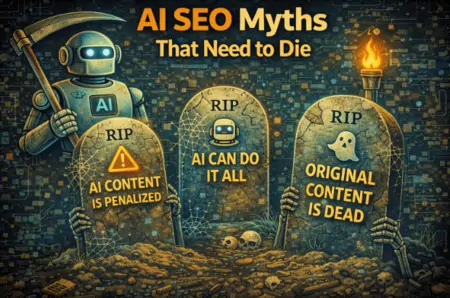
This article breaks down the most common AI SEO Myths still circulating in 2026, explains why they’re wrong, and clarifies what actually works in modern search.
Why AI SEO Myths Are So Persistent
AI tools evolve faster than SEO education.
That gap creates assumptions like:
- “If AI wrote it, Google must penalize it”
- “If AI can generate content, volume wins again”
- “If AI understands language, strategy is obsolete”
These AI SEO Myths feel logical on the surface—but they don’t reflect how Google evaluates quality, usefulness, or trust today.
Myth 1: “Google Penalizes AI Content”
This is the most damaging of all AI SEO Myths.
Google does not penalize content because it’s AI-assisted. It devalues content because it’s unhelpful, thin, misleading, or scaled without purpose.
Content fails when it:
- adds no new insight
- rewrites what already exists
- lacks accuracy or proof
- exists only to target keywords
AI can assist excellent content. It can also accelerate bad content. The filter is quality—not authorship.
Reality: AI is neutral. Value determines outcomes.
Myth 2: “More AI Content = More Traffic”
This myth survived from the early days of SEO and resurfaced with AI.
In 2026, this is one of the most expensive AI SEO Myths to believe.
Mass publishing leads to:
- index bloat
- diluted topical authority
- low engagement signals
- more pages ignored by Google
Modern growth comes from:
- refreshing pages that already rank
- consolidating overlapping content
- publishing only when new value exists
Reality: Fewer, stronger pages outperform volume.
Myth 3: “AI Can Replace SEO Strategy”
AI can generate options.
It cannot choose priorities.
Strategy requires:
- understanding business goals
- knowing which audiences matter
- deciding which SERPs to compete in
- choosing what not to publish
Believing otherwise is one of the most dangerous AI SEO Myths, because it turns SEO into output without direction.
Reality: AI executes strategy—it doesn’t create it.
Myth 4: “SEO Is Just Prompt Engineering Now”
Prompting is useful.
But SEO is not a text-generation contest.
SEO still depends on:
- technical foundations
- index hygiene
- internal linking systems
- intent satisfaction
- content maintenance
If your site has crawl traps, thin archives, or weak structure, no prompt will fix that.
Reality: Prompting is a skill. SEO is a system.
Myth 5: “AI Tools Know What Google Wants”
Many AI SEO tools still optimize for:
- keyword density
- generic scores
- outdated checklists
These approaches are often packaged as “AI intelligence,” but they lag behind how search actually works.
This is one of the subtler AI SEO Myths—because tools feel authoritative.
Reality: Tools assist analysis. They don’t understand your SERP, audience, or competitors.
Myth 6: “AI Makes Links Optional”
Authority still matters.
AI can help you:
- ideate link-worthy assets
- draft outreach messages
- improve content quality
But it cannot replace the role of reputation signals in search.
Believing this myth leads teams to publish endlessly without earning trust—one of the quieter AI SEO Myths that causes long-term stagnation.
Reality: AI helps you earn links. It doesn’t replace them.
Myth 7: “E-E-A-T Can Be Faked With AI”
You can generate author bios.
You can add credentials.
You can sound confident.
But trust isn’t cosmetic.
Google and users notice patterns:
- generic advice
- lack of firsthand experience
- no evidence or sources
- content that could belong to anyone
This AI SEO Myth collapses fastest over time, because credibility compounds—or erodes.
Reality: Trust comes from real expertise and proof, not templates.
Myth 8: “Fast Rankings Mean Success”
AI makes it easier to publish and rank quickly.
But fast rankings are often unstable.
Pages churn when they:
- lack depth
- fail to satisfy intent
- aren’t maintained
- don’t earn trust
Many teams celebrate early wins driven by AI—only to watch traffic disappear months later. This is one of the most misleading AI SEO Myths because it confuses speed with sustainability.
Reality: Stable traffic matters more than quick spikes.
Myth 9: “AI Overviews Kill SEO”
AI Overviews changed click behavior—but they didn’t end SEO.
They reward:
- citation-worthy content
- brand authority
- high-intent pages
- clear structure and proof
Sites that adapt continue to grow. Sites that panic stagnate.
This is one of the most emotionally driven AI SEO Myths, because it’s rooted in fear rather than data.
Reality: SEO evolves. It doesn’t disappear.
Myth 10: “If It Sounds Smart, It Must Be Right”
AI writes confidently—even when it’s wrong.
Publishing unverified AI output leads to:
- misinformation
- trust loss
- brand damage
- long-term ranking risk
This final AI SEO Myth is the most dangerous because it’s invisible until damage is done.
Reality: Accuracy requires human verification.
What Replaces These AI SEO Myths in 2026
Teams that succeed don’t argue about AI. They operationalize it.
They:
- use AI to speed up research and execution
- keep humans responsible for judgment
- enforce standards for originality and accuracy
- maintain content instead of flooding sites
- treat SEO as a system, not a prompt
When these principles replace AI SEO Myths, AI becomes a competitive advantage instead of a liability.
Final Thoughts
AI didn’t break SEO.
Bad assumptions did.
In 2026, the winning teams are the ones that:
- reject outdated AI SEO Myths
- use AI to remove friction, not responsibility
- focus on trust, intent, and systems
- build for stability instead of shortcuts
Kill the myths.
Keep the process.
Let AI support the work—not define it.