SEO platforms compared Key Takeaways
Each platform in this list was assessed across six practical criteria, using multiple user reviews from G2, Capterra, and TrustRadius, as well as our own hands-on tool testing.
- SEO platforms compared by real users reveal that Ahrefs and Semrush dominate for all-in-one power, while Screaming Frog remains the unbeatable specialist for technical crawls.
- Budget-conscious teams and freelancers consistently rank Ubersuggest and Mangools as top value picks, praising their clean interfaces and low entry price.
- Enterprise users highlight Conductor and BrightEdge for robust reporting and account support, though they note the premium pricing requires clear ROI justification.
Why Comparing SEO Platforms Compared by Real Users Matters
An SEO tool is only as good as the results it helps you achieve. Vendor demos often gloss over the glitches, learning curves, and missing features that can slow your team down. That is why SEO platforms compared by real users offers a more honest baseline for decision-making. Real users share actual workflow pain points — like slow data refreshes, confusing navigation, or limited integrations — that you won’t read in polished case studies. By focusing on authentic feedback, you can identify which platform aligns with your specific SEO maturity, content volume, and technical depth needs without wasting months testing the wrong fit. For a related guide, see 15 Best AI SEO Tools Compared by Real SEOs in 2026.
How to Evaluate SEO Platforms Compared in This Review
Each platform in this list was assessed across six practical criteria, using multiple user reviews from G2, Capterra, and TrustRadius, as well as our own hands-on tool testing. The criteria cover the core capabilities that matter most to day-to-day SEO work.
Criteria 1: Core Feature Set
Look beyond keyword research and backlink databases. The best SEO platforms compared here offer a complete toolkit: site audit, rank tracking, competitor analysis, content optimization, and reporting. If a tool lacks one critical piece, you will need to pair it with another solution, which increases cost and complexity. For a related guide, see 15 SEO Platforms Compared for Accurate Keyword Tracking.
Criteria 2: Usability and Learning Curve
A steep learning curve can stall team adoption. Real users consistently flag platforms that require weeks of training versus those that let you run a first report in minutes. We prioritized feedback on onboarding documentation, UI clarity, and customer support responsiveness.
Criteria 3: Pricing and Value
We compared entry-level plans, mid-tier options, and enterprise pricing relative to the feature depth delivered. Freemium trails or low-cost trials helped gauge whether a platform offers real value before you commit. User reviews about hidden costs, API limits, or add-on fees were noted.
Criteria 4: Data Freshness and Accuracy
Outdated backlink or keyword data can derail strategic decisions. Real users share frequent feedback on how often a platform updates its index and whether the data matches what you see in Google Search Console. Data lag was a common complaint in several tools.
Criteria 5: Integration and Workflow Fit
If your team uses Google Data Studio, WordPress, Slack, or a specific CMS, integration ease matters. Users reported frustration when platforms forced manual exports or offered limited API access — something that can slow down reporting and collaboration.
Criteria 6: Customer Support and Community
When something breaks or a feature is unclear, responsive support saves hours. We weighed reviews that mentioned live chat response times, knowledge bases, and user community forums. Tools with active communities often provide faster workarounds than official support channels.
11 SEO Platforms Compared — Detailed Reviews
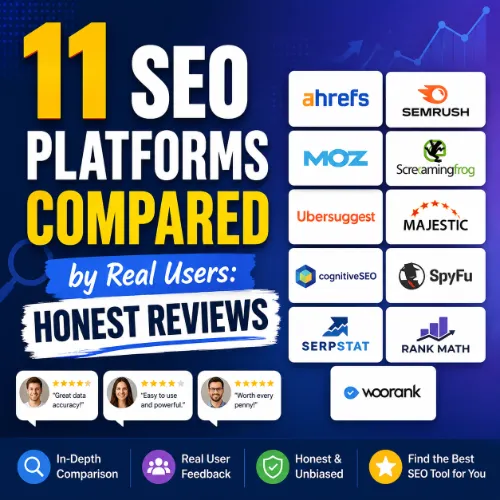
Below are the 11 platforms with key strengths, real user quotes, and honest limitations. Each entry includes a summary of typical user sentiment so you can quickly match a tool to your use case.
1. Ahrefs
Best for: All-in-one SEO with unmatched backlink analysis. Real users praise Ahrefs for its massive index, intuitive Site Explorer, and Content Gap tool. One reviewer notes: “Ahrefs’ backlink data updated faster than any other tool I tested — huge advantage for link building.” The main critique is pricing; the Lite plan starts at $129/month but limits keyword data. The UI has a moderate learning curve for new SEOs.
2. Semrush
Best for: Competitive research and PPC+SEO convergence. Real users highlight the Keyword Magic Tool and domain vs. domain comparisons. A digital marketing manager says, “Semrush gave me insights into competitor ad strategies I could not get anywhere else.” Some users report the site audit tool flags many false positives, and the interface can feel cluttered. Pricing begins at $129.95/month.
3. Moz Pro
Best for: SEO beginners and local SEO teams. Moz is known for its clear metrics (DA, PA, Spam Score) and beginner-friendly UI. A small business owner shares: “Moz Pro helped me understand rank tracking without feeling overwhelmed.” Advanced users sometimes find the backlink index smaller than Ahrefs or Semrush. Plans start at $99/month.
4. Screaming Frog SEO Spider
Best for: Technical SEO audits and crawl analysis. This is a desktop tool, not a SaaS platform, but it remains a must-have. A technical SEO specialist says, “Screaming Frog is irreplaceable for finding redirect chains, duplicate content, and broken links.” The free version crawls up to 500 URLs; the paid version is $259/year. The lack of built-in rank tracking means you will still need another platform for ongoing monitoring.
5. Google Search Console (Free)
Best for: Foundation SEO — no budget needed. Real users agree it is essential but limited: “GSC gave me accurate data on impressions and clicks, but it does not suggest what to do next.” It is excellent for technical health monitoring and understanding how Google treats your site. Pair it with any paid platform for keyword and backlink analysis.
6. Ubersuggest
Best for: Budget-friendly keyword research and content ideas. Created by Neil Patel, Ubersuggest offers a free tier and a very low-priced Pro plan ($29/month). A freelancer notes: “For the price, Ubersuggest helped me find long-tail keywords my competitors overlooked.” Some users report the backlink data is less reliable than premium tools, and the site audit feature is basic.
7. SE Ranking
Best for: Agencies that need white-label reporting and affordable rank tracking. Real users love the customizable dashboards and the fact that SEO audits include on-page optimization suggestions. A digital agency owner says: “SE Ranking let me create branded reports for clients in minutes.” Its backlink database is smaller than top-tier tools, but the value for the price is high. Plans start at $55/month.
8. Mangools (KWFinder, SERPWatcher, LinkMiner)
Best for: SEO beginners and small teams wanting a clean interface. Mangools combines several tools under one subscription ($49/month). Users consistently praise its ease of use: “KWFinder makes keyword research feel like a game — simple and fast.” The trade-off is limited depth: no advanced site audit, no API, and a smaller backlink index. It is great for basic SEO needs but not for enterprise-scale work.
9. Conductor
Best for: Enterprise SEO with content focus and multi-team collaboration. Real users mention excellent account management and deep integration with content management systems. A senior SEO manager at a large retailer says: “Conductor gave us a single source of truth for our content teams and SEO specialists.” The downside is high starting pricing (often $40,000+/year) and a steep learning curve for non-technical users.
10. BrightEdge
Best for: Large enterprises needing robust reporting and executive dashboards. BrightEdge is widely used by Fortune 500 companies. Users like the automated recommendations and the Data Cube feature for keyword discovery. One review mentions: “BrightEdge’s reporting impressed our C-suite, but the platform felt very rigid.” The price is premium; smaller businesses will find it overkill.
11. Rank Ranger
Best for: SEOs needing customizable rank tracking and SERP feature analysis. Rank Ranger stands out for tracking local pack results and Google updates. A user comments: “Rank Ranger showed me exactly how my local listings moved in the pack — that data helped me adjust my GMB strategy.” The interface is less polished than some competitors, and initial setup requires time. Plans start at $49/month.
Key Features and Pricing Comparison Table
The table below summarizes core capabilities and starting prices for each platform, helping you quickly see which tools fit your budget and technical depth.
| Platform | Starting Price (Monthly) | Backlink Index | Site Audit | Rank Tracking | Content Optimization | Free Trial |
|---|---|---|---|---|---|---|
| Ahrefs | $129 | Excellent | Good | Yes | Yes | 7 days ($7) |
| Semrush | $129.95 | Excellent | Good | Yes | Yes | 7 days |
| Moz Pro | $99 | Good | Good | Yes | Limited | 30 days |
| Screaming Frog | $21.58 (yearly) | N/A | Excellent | No | No | Free (500 URLs) |
| Google Search Console | $0 | Limited | Basic | Basic | No | Always free |
| Ubersuggest | $29 | Limited | Basic | Yes | No | Free tier |
| SE Ranking | $55 | Moderate | Good | Yes | Yes | 14 days |
| Mangools | $49 | Moderate | No | Yes | No | 10 days ($1) |
| Conductor | Custom (high) | Moderate | Good | Yes | Excellent | Demo only |
| BrightEdge | Custom (high) | Excellent | Good | Yes | Good | Demo only |
| Rank Ranger | $49 | Limited | No | Excellent | No | 14 days |
Risks and Safeguards When Choosing an SEO Platform
Even the best SEO platforms compared here carry potential risks. Lock-in is a common one: some tools make it hard to export your historical rank or backlink data if you want to switch. Safeguard: always check the export options (CSV, API) before subscribing. Another risk is over-reliance on a single tool’s keyword data. Different platforms use different indexes, and none perfectly match Google Search Console. Mitigate by cross-referencing your primary tool with at least one other data source. Finally, budget creep is real. Many platforms introduce add-ons for API access, extended history, or more users that can double your initial cost. Review the total cost of ownership for your intended team size and data needs before signing a yearly contract. For a related guide, see 25 Best SEO Tools Compared for 2026.
Summary Verdict: Which Platform is Best For You?
| Use Case | Recommended Platform | Why |
|---|---|---|
| All-in-one SEO (mid-to-enterprise) | Ahrefs or Semrush | Best feature depth and data freshness |
| Technical audits on a budget | Screaming Frog + GSC | Free or low-cost desktop crawler, accurate |
| Budget-conscious freelancers | Ubersuggest or Mangools | Low price, easy to learn, covers basics |
| Agencies needing white-label | SE Ranking | Excellent reporting and client management |
| Enterprise with content focus | Conductor or BrightEdge | Deep integrations, robust reporting, dedicated support |
| Local SEO with specific tracking | Rank Ranger | Best local SERP pack and update tracking |
Useful Resources
For further reading on how to evaluate SEO tools, check out G2’s SEO tools category for aggregated real user reviews and detailed feature comparisons. Also, Capterra’s SEO software list provides up-to-date pricing and verified user ratings across hundreds of tools.
Frequently Asked Questions About SEO Platforms Compared
Frequently Asked Questions About SEO platforms compared
Is there a free SEO platform that competes with paid tools?
Google Search Console is the only truly free platform that provides accurate, authoritative data from Google. It lacks keyword suggestions and backlink analysis, so it works best when paired with a low-cost tool like Ubersuggest or Mangools.
Which SEO platforms compared are best for beginners?
Moz Pro, Ubersuggest, and Mangools are consistently rated as the most beginner-friendly. They offer clean interfaces, guided tutorials, and clear scoring systems that help new SEOs understand data without being overwhelmed.
How often do backlink databases update across these tools?
Ahrefs and Semrush update their backlink indices daily or every few days. Moz and Mangools update weekly. Screaming Frog does not include a backlink database, and Google Search Console provides limited backlink data from Google’s own index.
Can I use two SEO platforms together effectively?
Yes. Many SAAS professionals combine a technical crawl tool (Screaming Frog) with an all-in-one platform (Ahrefs or Semrush) to cover both technical audits and ongoing keyword/backlink monitoring. This often provides the most comprehensive coverage.
What is the biggest complaint users have about Ahrefs?
The most common complaint from real users is that Ahrefs’ lower-tier plans limit keyword data to a fixed number of reports per month, and the pricing is among the highest in the market, which can be a barrier for small teams.
Which platform is best for local SEO tracking?
Rank Ranger and BrightEdge offer the most granular local pack tracking. Users appreciate that they can see movement in map pack results and local keyword positions over time. Semrush’s Local SEO toolkit is also strong but requires a separate add-on.
Do any platforms offer a lifetime deal?
No major SEO platform offers a lifetime deal today. Ubersuggest previously had lifetime pricing but has since moved to a subscription model. AppSumo occasionally features SEO tools, but they are typically niche rather than full platforms.
How does Semrush compare with Ahrefs for keyword research?
Both are excellent, but users find Semrush’s Keyword Magic Tool slightly better for PPC keyword grouping and filter options. Ahrefs’ Keyword Explorer is praised for its accurate keyword difficulty scores and click-stream data insights.
Is Screaming Frog worth the price if I already have an all-in-one platform?
Yes. Real users confirm that Screaming Frog’s crawl depth and custom extraction capacity far exceed the site audit modules inside all-in-one platforms. It is essential for technical audits, especially for large sites or complex architectures.
Which platform has the most accurate rank tracking?
Rank Ranger and SE Ranking are frequently praised by users for accurate daily rank tracking, especially for local and Google update tracking. Ahrefs and Semrush provide reliable rank tracking but update less frequently (every few days).
Do any of these platforms integrate directly with WordPress?
Yes. Semrush, Ahrefs, Moz, SE Ranking, and Rank Ranger all offer WordPress plugins or API integrations. The level of integration ranges from content scoring to automatic SEO report data feeds into your dashboard.
What is the cheapest way to get decent SEO data?
Combine Google Search Console (free) with Ubersuggest’s free tier or Mangools’ $49/month plan. This gives you keyword suggestions, basic backlink data, rank tracking, and technical health signals for under $50 per month.
How do enterprise platforms differ from tools like Moz or Semrush?
Enterprise platforms like Conductor and BrightEdge prioritize multi-user collaboration, executive reporting, and deep CMS integrations. They also offer dedicated account management and custom API limits, which justifies the higher price for large organizations.
Which platform is most commonly criticized for false positives in site audits?
Semrush and Moz Pro receive the most user feedback about false positives in their site audit tools, such as incorrectly flagging non-issues as critical errors. Users recommend combining these audits with manual checking or Screaming Frog for verification.
Is there a platform that does both SEO and social media management?
Semrush includes social media posting and monitoring tools in its higher-tier plans. No other platform in this list offers social media management natively; you would need to pair it with a separate tool like Hootsuite or Buffer.
How much does Conductor cost per year?
Conductor does not publish public pricing, but real user reports and review sites indicate that starting annual cost is around $40,000, with additional fees for add-ons and extra users. It is exclusively for enterprise-level teams.
Which platform offers the best integration with Google Data Studio?
SE Ranking and Semrush provide native connectors for Google Data Studio that real users find easy to configure. Ahrefs and Moz require third-party connectors or custom API scripts for Data Studio integration.
What do users say about customer support for these platforms?
Ahrefs and SE Ranking receive the highest marks for fast, knowledgeable support via live chat and email. Moz and Mangools also score well for helpful documentation. Semrush and BrightEdge receive mixed feedback, with some users citing slow response times during peak periods.
How do I export data from a platform if I decide to switch?
Most platforms allow CSV or Excel exports for keyword lists, backlink data, and rank history. Users report that Ahrefs, Semrush, and SE Ranking offer the most comprehensive export options. Always test export features during your free trial.
Which platform is best for content optimization and topic clustering?
Semrush (SEO Content Template) and Ahrefs (Content Gap) lead for content optimization. Conductor is best for enterprise-scale topic clustering and content governance. Mangools and Ubersuggest lack in-depth content optimization features.