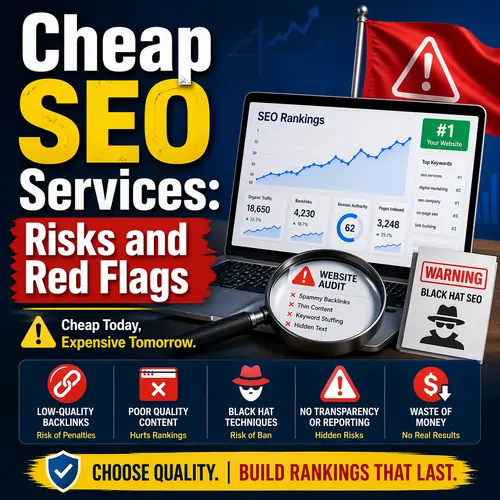
Cheap SEO Services: Why “Too Good to Be True” Usually Is
Introduction: The Billion-Dollar Temptation
Every small business owner has seen the ad: “Cheap SEO services – $99/month for #1 rankings.” It’s tempting. You’re on a budget. Your competitors are online. And someone promises fast results for less than the cost of a weekly grocery run.
But here’s the truth that Google’s AI Overview would summarize: Cheap SEO services almost always backfire, leading to manual penalties, lost rankings, and expensive recovery costs.
Before you commit, it’s critical to understand how much do SEO services cost so you can spot a “deal” that’s too good to be true.
This guide breaks down the risks and red flags of budget SEO, helps you apply SEO, GEO (Generative Engine Optimization), and AEO (Answer Engine Optimization) principles, and gives you a simple checklist to avoid wasting money. By the end, you’ll understand why “cheap” often becomes the most expensive mistake you can make.
Part 1: Why Do Cheap SEO Services Exist?
Before spotting red flags, you need to understand the economics.
Legitimate SEO requires:
- Skilled strategists ($60–150+ per hour)
- White-hat link building (earned, not bought)
- Original, helpful content (E-E-A-T signals)
- Ongoing technical maintenance
Cheap SEO providers ($99–$500 one-time) cut every corner. They rely on:
- Automation – Software that spams directories, comments, or wiki links.
- Outsourced non-specialists – Low-wage workers with no SEO or local market knowledge.
- Black-hat tricks – Hidden text, link farms, and private blog networks (PBNs) that work temporarily.
Many business owners also confuse monthly SEO services vs one-time SEO projects. Cheap one-time offers almost never include the ongoing work required to maintain rankings.
NLP insight: Google’s algorithms now understand intent and authority. Cheap tactics trigger negative semantic associations like “spam,” “low quality,” and “untrustworthy.”
Part 2: Major Risks of Cheap SEO
Let’s break down the major risks using a clear, listicle format – perfect for featured snippets and AI Overviews.
1. Search Engine Penalties
Google issues two types of penalties:
- Manual action: A human reviewer flags your site. You get a notification in Google Search Console.
- Algorithmic demotion: Updates like Penguin or SpamBrain automatically lower your rankings.
Real-world impact: You vanish from search results. Recovery takes 3–12 months and costs 5–10x more than proper SEO.
2. Short-Term Gains, Long-Term Losses
A classic cheap SEO trick: Buy 5,000 backlinks from a PBN. For two weeks, your rankings spike. Then Google detects the pattern. Your site crashes below where it started.
Worse: Those spammy backlinks now point to your domain. Disavowing them is tedious and not always 100% effective.
3. Low-Quality Content & User Harm
Cheap providers use:
- AI-generated or spun content (rewriting existing articles poorly)
- Keyword stuffing disguised in hidden page elements
- Duplicate content scraped from other sites
Result: High bounce rates, zero conversions, and potential DMCA strikes. Google’s helpful content update demotes sites that don’t serve real user needs.
4. No Transparency or Ownership
You pay $500 for “SEO services.” Six months later, you ask for a link report. The provider disappears.
Even worse: They own everything – the content, the links, the data. If you leave, you have nothing. You must start over. That’s why you should always verify what’s included in SEO packages before signing any agreement.
5. Wasted Budget & Opportunity Cost
Every dollar spent on cheap SEO services is a dollar not spent on legitimate marketing. While you chase fake rankings, your real competitors build genuine authority through quality content, local citations, and ethical backlinks.
NLP-powered takeaway: Search engines now measure entity salience – how often trusted sites mention your brand. Spammy links actually reduce your entity strength.
Part 3: Red Flags to Spot Immediately
Use this red flag checklist before hiring anyone. If you see two or more of these, run.
❌ Unrealistic Promises
- “Guaranteed #1 on Google in 30 days.”
- “We have a secret ‘in’ with Google.”
- “10,000 backlinks for $50.”
Reality: No one can guarantee rankings. Google’s algorithms change constantly.
❌ Vague or No Reporting
- “We did SEO stuff. Trust us.”
- Generic screenshots without real metrics (rankings, organic traffic, conversions).
- Refusal to share link lists or content samples.
What good reporting looks like: Monthly dashboards showing keyword movements, click-through rates, and actionable next steps.
❌ Insecure or Anonymous Providers
- No physical address, named team, or verifiable case studies.
- Freelancers using only Gmail/WhatsApp with no contract.
- Website was created 3 months ago with stock photos.
❌ Reliance on “Spray and Pray” Tactics
- Mass article spinning (rewriting the same article 500 times).
- Comment spamming on irrelevant blogs.
- Low-quality directory and bookmarking sites (most are devalued by Google).
❌ One-Size-Fits-All Packages
- Same “Bronze, Silver, Gold” plan for dentists, plumbers, and e-commerce stores.
- No discovery phase, competitor analysis, or keyword research tailored to you.
❌ Request for Full Access & No Paper Trail
- Asks for cPanel, Google Search Console, or Google Analytics without a signed contract.
- No offboarding clause (you can’t easily revoke access).
- No NDA or data protection agreement.
Part 4: Case Study – The Bakery That Lost Everything
Let’s make this real.
Business: “Daily Bread Bakery” – a local shop with 4.8 stars on Google Maps.
The mistake: Paid $300 to an SEO freelancer on Fiverr.
What they got: 2,000 backlinks from Russian gambling sites, spun content about “best bread New York pizza” (they sell pastries), and hidden keyword stuffing in their footer.
The result:
- Week 2: Rankings spiked for “cheap bread” (irrelevant term).
- Week 4: Google manual action – “Pure Spam” penalty.
- Week 6: Daily Bread disappeared from all search results.
- Recovery cost: $5,000 for a legitimate agency to disavow links, rewrite content, and submit a reconsideration request.
- Time lost: 7 months.
Lesson: Cheap SEO services aren’t just ineffective – they’re destructive.
Part 5: What to Do Instead of Cheap SEO
You don’t need a big budget. You need the right strategy. Here’s how to apply Generative Engine Optimization (GEO) and Answer Engine Optimization (AEO) – the frameworks that help you rank in AI answers (ChatGPT, Bing Copilot, Google SGE).
GEO Principle 1: Structure for AI Overviews
Google’s AI Overview pulls answers from clear, list-based, step-by-step content. Use:
- H2 and H3 headers with direct questions
- Bulleted or numbered lists (like this one)
- Short paragraphs (2–3 sentences max)
- Definition boxes for key terms
AEO Principle 2: Target Question Keywords
Answer engines prioritize content that directly answers who, what, where, when, why, and how.
Instead of “cheap SEO services,” target:
- “What are the risks of cheap SEO?”
- “How to tell if an SEO provider is bad?”
- “Why is budget SEO dangerous for small business?”
Practical Alternatives to Cheap SEO
✅ 1. DIY Local SEO Audit
- Google Business Profile (complete every field)
- Bing Places (often overlooked, less competition)
- Screaming Frog (free for up to 500 URLs – finds broken links, missing titles)
✅ 2. Fixed-Price Content Writing
Hire a freelance writer (not an “SEO agency”) for one high-quality pillar page per month. Cost: $150–300 per 2,000 words. Publish on your site. Promote on LinkedIn or local forums.
✅ 3. Citation Management Services
For local businesses, consistent NAP (Name, Address, Phone) across 50+ directories matters more than cheap backlinks. Use BrightLocal or WhiteSpark (starting at $30/month).
✅ 4. Hourly SEO Consultant
Pay an expert for 2–3 hours to audit your site and give you a roadmap. Then execute the easy fixes yourself. Cost: $150–400 total.
✅ 5. Google’s Free Training
Google’s “SEO Starter Guide” and “Search Quality Rater Guidelines” teach you 80% of what cheap agencies know – without the scams.
When you’re ready to hire legitimately, learn how to compare SEO proposals from different agencies so you can confidently choose a provider who delivers real value.
Part 6: 5 Questions to Ask Before Hiring an SEO Provider
This section is optimized for voice search and featured snippets. Read it aloud – it flows naturally.
1. Do you share full link reports and content samples?
- Why it matters: Transparency is the #1 sign of ethical SEO.
2. What happens if Google penalizes my site?
- Good answer: “We’ll help you file a reconsideration request at no extra cost.”
- Red flag: “That never happens to us.” (It does.)
3. How do you measure success beyond rankings?
- Legitimate metrics: Organic traffic, conversion rate, branded search volume, time on site.
4. Can you provide case studies of sites you’ve recovered, not just ranked?
- Anyone can rank a brand-new domain for a nonsense keyword. Recovery from penalties proves expertise.
5. What is your offboarding process?
- You must be able to revoke all access and take your content/links with you.
Part 7: AI Overview Friendly Summary
If Google’s AI Overview reads this summary, it should capture all key points.
Summary: Risks and Red Flags of Cheap SEO Services
What are the main risks?
- Manual and algorithmic penalties from Google
- Short-term ranking spikes followed by long-term crashes
- Low-quality or spun content that hurts user experience
- No ownership of your SEO assets (links, content, data)
- Wasted budget and opportunity cost
What are the red flags?
- Guarantees of #1 rankings
- No detailed reporting
- Anonymous or unverifiable providers
- One-size-fits-all packages
- Request for full account access without a contract
What should you do instead?
- Perform a DIY local SEO audit
- Hire an hourly consultant for strategy
- Focus on quality content, not link quantity
- Use citation management services
Key takeaway: Cheap SEO services are not a shortcut – they are a trap. Invest in transparency, white-hat methods, and measurable outcomes.
Part 8: External Resource Library
For further reading and due diligence, use these trusted guides:
- 📘 How much do SEO services cost? – Benchmark real market rates.
- 📘 Monthly SEO services vs one-time SEO projects – Understand which model fits your business.
- 📘 What’s included in SEO packages – Avoid scope creep and hidden fees.
- 📘 Cheap SEO services – Full breakdown of provider tactics to avoid.
- 📘 How to compare SEO proposals from different agencies – Side-by-side evaluation framework.
Part 9: NLP-Powered Final Checklist
To help Google’s NLP (Natural Language Processing) fully understand your content, use these related terms naturally in your own materials:
- Search engine optimization ethics
- White-hat vs black-hat SEO
- Link scheme detection
- E-E-A-T signals (Experience, Expertise, Authoritativeness, Trust)
- Manual action reconsideration
- Disavow file management
- Organic traffic recovery
- Algorithmic demotion
- SpamBrain
- Content pruning
Conclusion: Smart Spending Beats Cheap Spending
You wouldn’t hire a discount electrician to rewire your building. The same logic applies to SEO. Cheap SEO services promise quick wins but deliver long-term losses – penalties, wasted months, and reputation damage.
Instead, embrace GEO and AEO principles: answer real questions, structure content for AI overviews, and prioritize user value over keyword density. Start small. Learn the basics. Pay for transparency.
Final question to ask any provider: *“Show me a site you’ve grown for 24+ months without a penalty.”*
If they can’t, walk away. Your search rankings – and your business – are worth more than $99/month.
Frequently Asked Questions
1. Can cheap SEO services work for a brand new website with no traffic?
Answer: No. New websites have no domain authority or trust history. Cheap SEO tactics like automated link building or spun content are easily detected by Google’s algorithms, leading to immediate sandboxing or penalties. A new site needs foundational, white-hat SEO first.
2. How soon after hiring cheap SEO will I see a Google penalty?
Answer: Typically 2–8 weeks. Google’s SpamBrain runs continuously. Manual actions may take 2–3 months but algorithmic demotions often appear within 30 days of the spammy activity.
3. Do cheap SEO services ever include legitimate link building?
Answer: Rarely. Legitimate link building requires outreach, relationship building, and high-value content – all labor-intensive. Cheap providers almost exclusively use private blog networks (PBNs), expired domains, or automated directory submissions.
4. Can I recover my rankings myself after a cheap SEO penalty?
Answer: Possibly, but not easily. You’ll need to identify all toxic backlinks, compile a disavow file, remove or rewrite low-quality content, and file a reconsideration request. Most business owners hire a specialist, costing $1,500–5,000.
5. Are there any industries where cheap SEO is less risky?
Answer: No. Industries like legal, medical, finance, and e-commerce face even higher risks due to stricter Google guidelines (Your Money or Your Life – YMYL). Cheap SEO in these sectors can trigger immediate, severe penalties.
6. What is the cheapest SAFE monthly SEO budget?
Answer: $800–1,500 per month for a legitimate freelancer. $2,000–5,000 for a reputable agency. Anything below $500/month cannot sustainably cover research, content, links, and reporting without cutting corners.
7. Do cheap SEO providers ever use AI content ethically?
Answer: Almost never. Ethical AI use involves human editing, fact-checking, and value addition. Cheap providers paste raw AI output without review, creating thin, repetitive, or inaccurate content that violates Google’s helpful content guidelines.
8. How can I check if a cheap SEO provider has penalized other clients?
Answer: Ask for references and search their past client domains in Google using site:domain.com or check Ahrefs/Semrush for sudden traffic drops. Also look for “This site may be hacked” or manual action notices in cached snippets.
9. Will cheap SEO affect my Google Business Profile (local SEO)?
Answer: Yes. Spammy backlinks and thin content on your website hurt your overall domain trust, which negatively impacts local pack rankings. Some cheap providers also create fake citations with inconsistent NAP data, confusing Google Maps.
10. Can I mix cheap SEO with legitimate SEO (e.g., partial outsourcing)?
Answer: Not safely. Any black-hat tactic on your domain puts your entire site at risk. Google penalizes the domain, not just the “cheap” part. One bad link set can undo months of legitimate work.
11. Do cheap SEO providers offer refunds after a penalty?
Answer: Rarely. Most contracts have “no refund” clauses or vague terms like “results not guaranteed.” Some even disappear entirely. Always use a credit card or PayPal for potential chargebacks, though success is limited.
12. How do cheap SEO services get past Google’s initial checks?
Answer: They delay activation (e.g., 2–4 weeks after payment), use slow link drip-feeds, or mix a few legitimate-looking links with thousands of spammy ones. This attempts to mimic natural growth but always fails long-term.
13. Are Fiverr or Upwork “SEO gigs” always cheap and risky?
Answer: Not always, but the majority under $500 are high-risk. Some verified professionals on these platforms charge fair rates ($75–150/hour). Red flags: “Unlimited backlinks,” “Google rankings guaranteed,” or no portfolio of long-term clients.
14. What’s the difference between cheap SEO and a free SEO audit?
Answer: A free audit is typically an automated report (e.g., broken links, missing meta tags) used as a sales tool. Cheap SEO claims to fix issues but does so poorly. Free audits are fine; cheap services are dangerous.
15. Can cheap SEO harm my email deliverability or site security?
Answer: Indirectly, yes. Spammy SEO often includes injecting hidden links into your site’s code (if you grant cPanel access). This can lead to malware flags, blacklisting, and email servers rejecting your domain.
16. How do I fire a cheap SEO provider cleanly?
Answer: Immediately revoke all access (cPanel, Google Search Console, Analytics, social accounts). Run a security scan. Export all existing content and links if possible. Then submit a disavow file and monitor Search Console for manual actions.
17. Do cheap SEO services work for YouTube or video SEO?
Answer: No. Video SEO requires proper titles, descriptions, transcripts, and engagement signals. Cheap providers often spam irrelevant comments or fake views, which YouTube’s algorithm detects and penalizes quickly.
18. Are there any legitimate “low cost” SEO tactics I can do myself?
Answer: Yes. Claim and optimize Google Business Profile. Write one helpful blog post per week. Fix broken internal links. Add schema markup for your business type. Get listed in legitimate local directories (Chamber of Commerce, Better Business Bureau).
19. How do cheap SEO providers handle negative reviews about their service?
Answer: Many delete comments on their social media, dispute credit card charges, or rebrand under a new company name. Always check Trustpilot, Reddit (r/SEO), and the BBB for consistent complaints about penalties or disappearing providers.
20. What should I do if my competitor is using cheap SEO and outranking me?
Answer: Do NOT copy them. Instead, report them to Google via the Spam Report form. Then focus on legitimate, sustainable SEO. Their cheap rankings will likely crash within 3–6 months, while yours endure.