

Search engine optimization (SEO) has three main pillars: on-page SEO, off-page SEO, and technical SEO, and understanding how they work together is essential if you want stable rankings and long‑term organic traffic. This complete guide explains the difference between on-page vs off-page vs technical SEO in simple language, with practical checklists you can use for your own site.
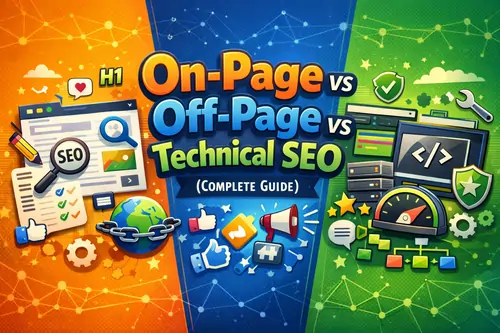
You will learn what on-page SEO is, what off-page SEO is, and what technical SEO is, plus how to create a strategy that combines all three types of SEO on one website. We will also cover on-page SEO vs off-page SEO, on-page SEO vs technical SEO, and off-page SEO vs technical SEO so you can see exactly where to focus first.
1. What Is On-Page SEO?
On-page SEO is everything you do directly on your website pages to improve rankings, relevance, and user experience. It covers your content, title tags, meta descriptions, header tags, keyword usage, internal linking, and URL structure.
In simple terms, on-page SEO tells search engines and users what each page is about and why it deserves to rank. When you optimize on-page elements, you align your content with search intent and make it easier for search engines to understand and index your pages.
Core On-Page SEO Elements
Key on-page SEO elements include:
- Title tags and meta descriptions
- Header tags (H1, H2, H3)
- URL structure and keyword placement
- Internal linking
- Image alt text and file names
Your title tag should clearly reflect the main topic, such as “On-Page vs Off-Page vs Technical SEO (Complete Guide),” and include the focus keyword “on-page vs off-page vs technical SEO” naturally. Meta descriptions should summarize the page in a human‑friendly way while including related phrases like “types of SEO (on-page, off-page, technical)” and “difference between on-page and off-page SEO.”
Header tags (H1–H3) help structure your content so both search engines and users can scan it easily. For example, you might have H2 sections for “What Is On-Page SEO?”, “What Is Off-Page SEO?”, and “What Is Technical SEO?” and then use H3s for specific topics like “content optimization,” “backlinks and authority,” and “crawlability and indexability.”
Content Optimization and NLP
Content optimization means matching search intent, using keywords naturally, and covering the topic in enough depth. For NLP‑friendly content, use simple sentences, clear headings, and semantically related phrases such as:
- on-page SEO techniques
- SEO best practices for on-page optimization
- website content optimization
- internal linking strategy
- user experience and SEO
These phrases help search engines understand context and relationships between concepts, which supports modern NLP and entity‑based ranking systems.
Write for people first by explaining concepts like “difference between on-page and technical SEO” or “difference between off-page and technical SEO” in plain language. Then layer in related terms, such as “meta tags and title tags optimization,” “readability,” “topical depth,” and “search intent,” to strengthen topical relevance.
On-Page UX Signals
On-page SEO also includes user experience signals such as:
- Mobile-friendly website design
- Time on page and bounce rate
- Clean layout, readable fonts, and short paragraphs
- Relevant images and media
A mobile-friendly website helps both SEO and GEO, because mobile users often search with local intent and expect fast, responsive pages. Site speed optimization and a good internal linking strategy keep users moving through your site, which supports engagement and conversions.
2. What Is Off-Page SEO?
Off-page SEO includes everything that happens away from your website but still influences your rankings and authority. The core idea is that when other websites and platforms talk about you or link to you, search engines see your site as more trustworthy and relevant.
Off-page SEO vs on-page SEO is mainly about control: on-page SEO focuses on elements you directly edit on your site, while off-page SEO focuses on how the rest of the web reacts to your content.
Backlinks and Authority
Backlinks are links from other websites to yours, and they are still one of the strongest off-page SEO signals. High-quality backlinks from relevant, authoritative sites can increase your domain authority and page authority, which helps individual pages rank better.
When thinking about backlinks and link building, focus on:
- Relevance of the linking site
- Authority and trust of the domain
- Natural anchor text
- Diversity of referring domains
Avoid toxic links or spammy link schemes, because they can hurt your rankings and reputation. Tools like Ahrefs, Semrush, and Moz can help you analyze your backlink profile and discover new link-building opportunities.
Key Off-Page SEO Techniques
Common off-page SEO techniques include:
- Guest posting on relevant blogs
- Digital PR and news mentions
- Brand mentions and citations
- Social media marketing and community engagement
Guest posting and digital PR help you earn contextual backlinks and brand mentions from trusted publications. Local citations and business directory listings support GEO and local SEO by reinforcing your business name, address, and phone number across the web.
Social signals (e.g., shares, likes, comments) are not direct ranking factors, but they can increase visibility, send referral traffic, and indirectly support link building. Participating in relevant communities, forums, and groups builds trust and can lead to organic backlinks over time.
Measuring Off-Page SEO
To measure off-page SEO success, track:
- Domain authority / domain rating
- Number and quality of referring domains
- Growth in organic traffic from pages that received links
- Brand searches and mentions
Using tools like Ahrefs, Semrush, and Moz, you can monitor new and lost backlinks, identify toxic links, and see how your off-page SEO efforts translate into better rankings. This helps you refine your link-building strategy over time and avoid risky tactics.
3. What Is Technical SEO?
Technical SEO focuses on the backend structure and performance of your website to help search engines crawl, index, and understand your pages efficiently. While on-page SEO is about content and keywords, and off-page SEO is about reputation and backlinks, technical SEO is about the foundation that keeps everything running smoothly.
Technical SEO vs on-page SEO vs off-page SEO is not about which type is “better,” but about how each plays a different role in your overall strategy.
Crawlability and Indexability
Crawlability and indexability determine whether search engines can discover and store your pages in their index. Important elements include:
- XML sitemap
- robots.txt file
- Canonical tags
- Proper use of noindex and nofollow
An XML sitemap lists your important URLs so search engines can find them more easily. A well‑configured robots.txt file prevents crawlers from wasting time on duplicate or irrelevant sections of your site and supports better crawl budget usage.
Canonical tags tell search engines which version of similar pages is the preferred one, which helps manage duplicate content. Correct use of noindex and nofollow ensures that private or low-value pages do not clutter the index.
Site Speed, Core Web Vitals, and Security
Technical SEO also covers site speed optimization, Core Web Vitals, and website security with HTTPS. Fast-loading pages improve user experience and can positively impact rankings, especially on mobile devices.
- Loading performance
- Interactivity
- Visual stability
Compressing images, minifying CSS/JS, using browser caching, and choosing reliable hosting are all technical SEO tasks that support these metrics. Using HTTPS and a valid SSL certificate shows that your website is secure, which is both a trust factor and a ranking signal.
Site Structure and Mobile-First Indexing
A clean site structure and internal linking at scale help search engines understand how your pages relate to each other. Group content into logical categories, use descriptive URLs, and avoid deep, complicated click paths.
Mobile-first indexing means search engines primarily use the mobile version of your site for ranking and indexing. A responsive design, mobile-friendly navigation, and readable text sizes are now critical technical SEO and UX requirements.
4. On-Page vs Off-Page vs Technical SEO: Key Differences
Here is a simple way to think about on-page vs off-page vs technical SEO:
- On-page SEO: content, keywords, and user experience on your pages
- Off-page SEO: reputation, backlinks, and external signals
- Technical SEO: site health, crawlability, speed, and structure
On-page SEO vs off-page SEO is often about relevance vs authority: on-page SEO ensures your page is relevant for a query, while off-page SEO shows that other sites trust your content. On-page SEO vs technical SEO is about what users see (content and layout) versus what happens in the background (code, infrastructure, indexing).
Off-page SEO vs technical SEO highlights the difference between external promotion and internal infrastructure. Off-page SEO builds your domain authority, while technical SEO ensures your site is fast, secure, and easy to crawl.
5. How All Three Types Work Together
The three types of SEO (on-page, off-page, technical) are most powerful when they work together in one strategy. A typical workflow might look like this:
- Start with on-page SEO: research keywords such as “on-page vs off-page vs technical SEO,” “types of SEO (on-page, off-page, technical),” and “difference between on-page and off-page SEO,” then create high‑quality content around them.
- Fix technical SEO: ensure your XML sitemap, robots.txt, HTTPS, site speed, and mobile responsiveness are in good shape so search engines can crawl and index your new content.
- Build off-page SEO: promote your content via guest posts, digital PR, and outreach to earn backlinks and brand mentions that increase authority.
You can think of on-page SEO as the content of the house, off-page SEO as its reputation in the neighborhood, and technical SEO as the solid foundation it is built on. If one of these pillars is weak, your overall SEO performance will suffer, even if the other two are strong.
6. Practical Checklists (Simple and AEO-Friendly)
Structured checklists are good for AEO (answer engine optimization) because they create clear, scannable answers that voice assistants and featured snippets can use.
On-Page SEO Checklist
Before publishing a page, check:
- Focus keyword in title tag, H1, URL, and early in the content
- Related phrases like “on-page SEO techniques” and “website content optimization” used naturally
- Clear meta description that includes “on-page SEO vs off-page SEO” or similar intent phrases
- Logical header structure (H2s and H3s) matching user questions
- Internal linking strategy: links to related pages and cornerstone content
- Optimized images with descriptive alt text
- Short paragraphs and bullet lists for readability
Off-Page SEO Checklist
Ongoing off-page SEO tasks:
- Identify relevant websites for guest posting
- Pitch expert content that earns editorial backlinks
- Monitor domain authority and referring domains
- Claim and optimize local citations if you target local GEO searches
- Engage on social media and communities to build brand mentions
Technical SEO Checklist
- Validate XML sitemap and submit it in Google Search Console
- Review robots.txt for accidental blocking
- Fix crawl errors and 404s
- Improve site speed and Core Web Vitals
- Maintain HTTPS and renew SSL certificates
- Test mobile usability and responsive layout







