

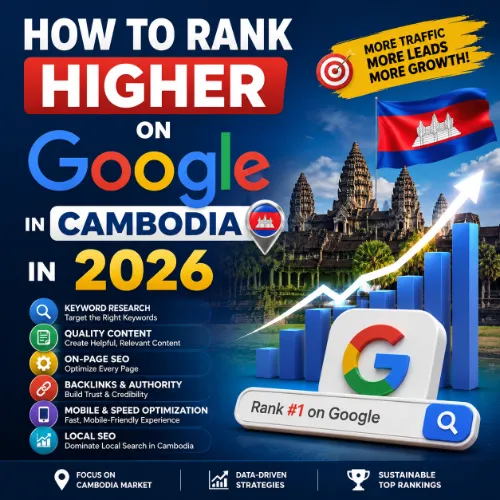
Introduction: Why Rank Higher on Google in Cambodia Matters for 2026
In 2026, ranking well on Google is essential for business visibility, local discovery, and digital credibility in Cambodia. Search behavior today is:
📍 Mobile — Most people search from phones.
📍 Local — Queries often include city names like Phnom Penh, Siem Reap, and Kampot.
📍 Intent‑driven — Users want precise answers, not long lists of vague links.
Modern Google ranking combines multiple factors — from content quality and technical experience to contextual relevance and AI‑friendly formatting. Unlike old SEO (which was mainly about keywords), today’s ranking engines emphasize helpful content that satisfies user intent and local signals that tie search results to Cambodian markets.
I. Core Ranking Factors in 2026 (Google Search Ecosystem)
Before we dive into regional strategy, let’s understand what Google says matters most in 2026.
1. Content Quality & Relevance
Google’s algorithm now focuses heavily on content that truly satisfies user intent — useful, accurate, and clearly organized. According to a comprehensive analysis of modern ranking signals, quality content is consistently the top driver of search success.
📌 Top Resource: Learn more about how Google evaluates content in the Google Ranking Factors Complete Guide (external).
2. User Experience & Technical Signals
Technical SEO ensures that Google can crawl, interpret, and serve your site to users. This includes:
✔ Mobile responsiveness
✔ Fast page speed
✔ Stable layout and accessibility
Google has increasingly tied ranking to Core Web Vitals — load speed and interactivity metrics that measure real user experience.
3. Backlinks & Authority
Backlinks still serve as signals of trustworthiness and expertise, but they’re no longer the only or dominant factor. Today, Google views contextual quality and user signals as equally critical.
4. Structured Data & AI Compatibility
As search becomes more generative and AI‑driven, formatting your content for AI interpretation — with lists, concise answers, and metadata — becomes a ranking asset.
II. Keyword Strategy for Cambodia (SEO + GEO + NLP)
Smart keyword research ties together SEO, geography (GEO), and search intent (AEO — Answer Engine Optimization).
A. Target Local & Bilingual Keywords
Cambodian searchers use both English and Khmer, often in the same query.
✔ High‑value phrases might include:
- best restaurants Phnom Penh
- cheap hotels Siem Reap
- SEO Cambodia 2026
- SEO tips Khmer
- ការរីកលូតលាស់អាជីវកម្មអនឡាញ (online business growth in Khmer)
B. Use Tools to Discover Search Demand
To find relevant keywords, use:
🔗 Google Keyword Planner – for localized search demand data
🔗 Google Trends – to track Khmer vs English search patterns
🔗 AnswerThePublic – to see question‑based search phrases
Always optimize content around contextual intent, not just exact keywords. This aligns with Google’s shift toward NLP‑centric ranking.
III. On‑Page SEO That Google Loves
Every page you publish should be optimized for humans first, then search engines.
1. Craft Powerful Title Tags
Title tags tell Google what your page is about and influence click‑through rate.
📌 Example:
How to Rank Higher on Google in Cambodia 2026 | SEO Guide Phnom Penh & Khmer SEO Tips
Make sure your primary keyword appears early in the title.
2. Use Clear Meta Descriptions
Your meta description should describe what the user will learn — not just list keywords.
📌 Strong example:
“Step‑by‑step SEO guide to rank higher on Google in Cambodia in 2026 — includes AI search best practices, local SEO tips, bilingual keyword strategies, and technical ranking essentials.”
3. Headers That Reflect Content Structure
Use semantic headers so search engines understand what your section is about:
H2: On‑Page Optimization Tips
H3: Title Tags
H3: Meta Descriptions
H3: Header Tags
This helps Google’s NLP systems contextualize your content.
4. Include Helpful External Resources
High‑quality external links improve trust signals and give users deeper learning paths.
For example:
✔ Google Search Console Help — official guide to monitoring and improving your site’s search performance.
✔ Google Search Console Complete Guide for SEO — comprehensive instructions to boost search visibility.
These links naturally reinforce your SEO credibility.
IV. Technical SEO: The Foundation of High Rankings
Technical SEO ensures that search engines index and interpret your website correctly.
A. Optimize Website Speed
Page loading time affects both SEO and user behavior.
✔ Compress images
✔ Use browser caching
✔ Minimize JavaScript and CSS
Fast sites not only rank higher — they reduce bounce rate and increase engagement.
B. Mobile‑First Indexing
Google primarily uses the mobile version of a site for indexing and ranking. Ensure your site works flawlessly on smartphones.
Mobile responsiveness is a confirmed Google ranking signal.
C. Submit Sitemaps & Use Robots.txt
Submit your sitemap through Google Search Console and properly configure robots.txt to help search engines crawl your pages efficiently.
📌 Learn how to set up and use Search Console here:
🔗 “Getting started with Search Console” — official Google help resource.
V. Local SEO for Cambodia (GEO‑Focused Strategy)
Local SEO is essential for Cambodia businesses that serve nearby customers.
A. Google Business Profile
Create or claim your business in Google Business Profile and make sure it includes:
✔ Full business name
✔ Accurate Khmer + English address
✔ Phone number
✔ Operational hours
✔ High‑quality photos
✔ Detailed description with local keywords
Local citations and GPS‑linked signals help Google match searchers to businesses near them.
B. Local Directory Listings
Directory mentions on websites like Yellow Pages Cambodia or local tourism sites add geographical context that helps SEO.
C. Encourage Local Reviews
Customer reviews strengthen trust and user signals — two factors Google uses to interpret relevance and credibility.
VI. Content Strategy for 2026: AI, Intent, & NLP
Creating content that matches user intentions is the centerpiece of modern SEO.
A. Answer Real Search Questions (AEO Friendly)
To be visible in both search engine results and AI‑driven generative responses, your content should:
✔ Directly answer common questions
✔ Offer concise answers with detailed context
✔ Use natural language (similar to voice search queries)
This aligns with principles of Answer Engine Optimization (AEO), where Google uses your content to answer queries inside AI summaries.
B. Use Lists & Structured Formats for Clarity
Listicles help both readers and search engines parse information clearly.
📌 Example list:
Top SEO Strategies for Cambodia in 2026
- Mobile‑First Responsive Content
- Local Keyword Targeting in Khmer + English
- Content Depth Matching Search Intent
- High‑Value Backlinks From Trusted Sites
- Technical Optimization (Speed & UX)
C. Include FAQ Sections
FAQs can trigger rich results and featured snippets in Google Search, improving visibility and click‑through rates.
VII. Off‑Page SEO: Building Authority Outside Your Site
Off‑page signals tell Google you’re trusted across the web.
A. Quality Backlinks Still Matter
Although SEO has evolved, authoritative backlinks remain a strong signal of trust. Focus on:
✔ Relevant industry blogs
✔ Local news sites
✔ Influential Cambodian websites
B. Brand Signals & Mentions
Brand mentions — even without a link — can count as credibility signals in modern algorithms.
VIII. Voice Search & AI Assistants
Voice search queries are conversational and often localized.
For example:
“Hey Google, find the best Khmer restaurant near me in Phnom Penh.”
To optimize for voice SEO, include conversational phrases and question‑style queries in your content.
IX. Tracking & Analytics
Measuring results is critical. Use:
🔗 Google Search Console — to monitor rankings, impressions, and click‑through rates.
🔗 Google Analytics — to track user behavior and conversions.
Regularly review performance to refine and update your SEO strategy.
X. Quick SEO Checklist for Cambodia
✔ Target local Malayalam and English keywords
✔ Use relevant external authoritative links
✔ Optimize technical SEO (speed, mobile, Core Web Vitals)
✔ Create high‑value, intent‑satisfying content
✔ Implement structured data and schema
✔ Build quality backlinks from trusted sources
✔ Ensure strong local SEO signals (GMB, citations, reviews)
Conclusion: Winning SEO in Cambodia in 2026
Ranking higher on Google in Cambodia in 2026 is not a trick — it’s a strategy. Rather than focusing on short‑term shortcuts, invest in:
🔹 Content built for humans and AI collaboration
🔹 Technical efficiency and mobile experience
🔹 Local relevance and intent alignment
🔹 Authority signals through strong external references and backlinks
By weaving together SEO, GEO, AEO, NLP optimization, and user‑centric content, you’ll create web pages that consistently rank higher in Cambodian search results — and deliver real value to your audience.
Frequently Asked Questions
Q: How long does it take to rank on Google in Cambodia?
A: Ranking depends on competition, content quality, and website authority. For new sites, it can take 3–6 months to see consistent rankings, while established sites may see results faster.
Q: Should I focus on Khmer or English keywords?
A: Use both. Khmer keywords help local users, while English keywords attract tourists and expats. Prioritize based on your audience.
Q: Can social media posts improve my Google ranking in Cambodia?
A: Indirectly. High engagement drives traffic and brand awareness, which can signal authority to Google.
Q: Is it important to have a .kh domain?
A: Yes, a .kh domain helps Google recognize your website as locally relevant, boosting local SEO.
Q: How many words should my articles have to rank well?
A: Aim for 1,500–2,500+ words for in-depth guides, but always prioritize quality over quantity.
Q: Does Google prefer mobile-first sites in Cambodia?
A: Absolutely. Google’s index primarily evaluates mobile versions, so responsive design is crucial.
Q: How do I target nearby cities in Cambodia?
A: Use local keywords and create content specific to each city or district (e.g., Phnom Penh, Siem Reap, Kampot).
Q: Can I rank without backlinks?
A: You can, especially for local or niche topics, but backlinks from trusted local sites significantly improve authority.
Q: How often should I update my content?
A: At least every 3–6 months, or whenever new information is available. Google favors fresh and relevant content.
Q: What type of images help with SEO in Cambodia?
A: Use compressed, relevant images with descriptive alt text in Khmer or English. Infographics perform well for engagement.
Q: Are videos important for Google ranking?
A: Yes, videos increase engagement and can appear in Google Video or YouTube snippets, improving overall SEO signals.
Q: Should I include local addresses and phone numbers on my website?
A: Yes, consistent NAP (Name, Address, Phone) information is essential for local SEO and Google Maps rankings.
Q: Do reviews in Khmer affect my ranking?
A: Yes. Reviews in the local language improve relevance for Khmer-speaking users and signal trustworthiness.
Q: Can AI-generated content rank in Cambodia?
A: AI content can rank if it is high-quality, accurate, and user-focused. Always review and edit for local context.
Q: How does Google understand Khmer language content?
A: Google uses Natural Language Processing (NLP) to analyze grammar, semantics, and context, making structured and clear content more effective.
Q: Are long-tail keywords effective in Cambodia?
A: Very effective. Long-tail keywords like “best vegan restaurant Phnom Penh 2026” have less competition and attract higher-intent traffic.
Q: Should I optimize for voice search?
A: Yes. Many Cambodians use mobile voice search in Khmer and English. Use conversational phrases and questions naturally.
Q: What role does HTTPS play in ranking?
A: HTTPS ensures secure browsing, which is a confirmed ranking signal. It also builds trust with your visitors.
Q: How do I measure SEO success in Cambodia?
A: Track metrics such as organic traffic, keyword rankings, click-through rates, bounce rates, and conversions using Google Analytics and Search Console.
Q: Are structured FAQs helpful for ranking?
A: Yes. FAQ sections can trigger rich snippets in search results, improve visibility, and answer user queries directly.







