

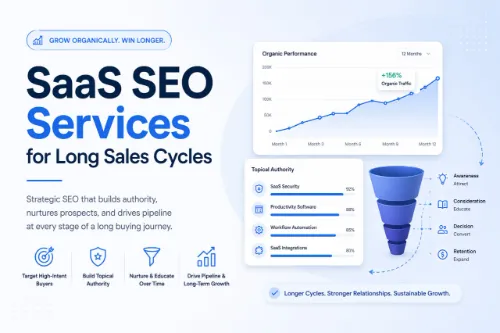
The Definitive Guide to SaaS SEO Services for Long Sales Cycles: From Anonymous Click to Closed Won
For B2B SaaS companies with high-ACV products and long sales cycles, standard SEO fails. Effective SaaS SEO services for long sales cycles must map content to three distinct buying stages: Top-of-Funnel (problem identification), Middle-of-Funnel (vendor comparison), and Bottom-of-Funnel (procurement). Key strategies include buyer journey mapping, stakeholder persona SEO, account-based SEO (ABM), and multi-touch attribution tracking organic pipeline velocity rather than just rankings.
Introduction: Why Standard SEO Breaks in Enterprise SaaS
If you sell a $50,000/year SaaS platform, a blog visitor reading “how to reduce churn” is not a lead. They are a researcher. In long sales cycles—often lasting 6 to 18 months—the buyer journey involves multiple stakeholders: the Champion, Economic Buyer, Technical Evaluator, and Legal/Compliance. Each searches differently.
Generic SaaS SEO services that focus only on traffic volume will fill your CRM with unqualified free-trial seekers. What you need is a funnel-stage keyword clustering strategy that nurtures across time. This guide delivers a repeatable framework. For a deeper dive into structuring offers around product-led growth, explore these product-led SEO strategies for SaaS brands.
Strategic Foundation – Mapping the Invisible Committee
Buyer Journey Mapping for SaaS
Before writing one word, map your ideal customer profile (ICP) across four phases:
- Problem-Aware (Top-funnel): “We have slow reporting.”
- Solution-Aware (Mid-funnel): “Cloud vs on-premise BI tools.”
- Vendor-Aware (Bottom-funnel): “Tableau vs PowerBI vs Looker.”
- Decision (Procurement): “SOC2 compliance checklist for vendors.”
Understanding the difference between awareness and decision content is critical. Learn more about BOFU vs TOFU content in SaaS SEO to avoid miscategorizing your assets.
Stakeholder Persona SEO
You aren’t optimizing for one user. You’re optimizing for a committee:
- The Champion (Head of Ops) searches: “how to automate manual reporting”
- The Economic Buyer (CFO) searches: “ROI of workflow automation”
- The Technical Evaluator (CTO) searches: “API latency comparison”
- Legal/Compliance searches: “GDPR compliant analytics vendors”
Stakeholder persona SEO means creating separate content clusters for each role. The Champion’s blog post links internally to the Economic Buyer’s ROI calculator.
Funnel-Stage Keyword Clustering & Competitive Gap Analysis
Group keywords by intent, not just volume:
- Top-funnel keywords (informational): “why SaaS churn happens”
- Mid-funnel keywords (comparison): “alternatives to X”, “X vs Y”
- Bottom-funnel keywords (commercial): “enterprise pricing for Z”, “demo request”
Perform a competitive gap analysis by identifying keywords your top three rivals rank for that you don’t. Then, create content that answers the missing questions—especially those related to security, scalability, and legal concerns.
Top-of-Funnel (Awareness) – Solve Unframed Problems
Goal: Get found when the buyer doesn’t yet know your category exists.
Problem-First Content Clusters
Do not lead with your product. Lead with pain. Create problem-first content clusters around universal frustrations. For example:
- Core topic: “How to reduce churn in enterprise SaaS”
- Subtopics: “7 reasons enterprise customers downgrade”, “churn prediction models using AI”, “customer success team structure for retention”
These cluster pages interlink naturally, passing authority from high-level pain to specific solutions.
“Alternatives to X” & “X vs Y” Pages
Long-cycle buyers are skeptical. They search “alternatives to Salesforce” or “HubSpot vs Marketo vs Pardot” six months before talking to sales. Write unbiased, data-rich comparisons. Include:
- Feature tables
- Pricing estimates (even if yours isn’t listed)
- G2/Capterra review summaries
- A clear “when to choose each” verdict
These pages rank for mid-funnel comparison keywords and capture researchers who will return later.
Industry Trend & ROI Frameworks
Economic buyers love frameworks. Publish “Total cost of manual reporting in 2025” or “The hidden cost of legacy CRM maintenance”. Use real numbers: “Companies with 50 sales reps waste 120 hours/month on manual data entry.”
Video & Podcast SEO
Decision-makers listen to podcasts during commutes. Transcribe every episode and publish as a blog post with video & podcast SEO tactics: optimized titles, show notes, and timestamped summaries. Embed YouTube videos with schema markup for VideoObject.
Middle-of-Funnel (Consideration) – Build Authority & Trust
Goal: Become the vendor they compare every other vendor against.
“Buying Guide for [Category]” with Evaluation Criteria
Create the definitive “Buying guide for enterprise marketing automation” or “How to evaluate data warehouses in 2025”. Include evaluation criteria that your product naturally wins on: security, scalability, compliance, and integration depth. This content is evergreen and earns backlinks.
ROI Calculators & TCO Templates
Nothing converts a skeptic like a self-serve calculator. Build an ROI calculator (gated or ungated depending on lead scoring) that asks 3–5 inputs and outputs savings. Example: “Based on 200 users, you save $47,000/year.” Pair it with a TCO template spreadsheet download.
Feature Deep-Dives & Architecture Comparisons
Technical evaluators want to see under the hood. Write “How our event-driven architecture compares to legacy batch processing”. Be specific: latency numbers, API response times, uptime SLAs.
Case Study Schema & Success Stories
Publish case studies organized by industry/use case. Apply case study schema & success stories markup (Article, Product, Review). Each case study must answer:
- Problem before
- Solution implemented (your product)
- Quantitative results (e.g., “43% faster reporting”)
- Unexpected benefits
Trust Signals as Content
Create standalone pages for trust signals:
- SOC2 Type II report summary (not the full report)
- GDPR compliance checklist for vendors
- Uptime history (99.99% SLA)
- Integrations directory with live API status
These pages rank for legal/procurement queries like “SOC2 compliant file sharing”.
Bottom-of-Funnel (Decision & Sales-Ready)
Goal: Capture the hand-raiser who is ready to buy now.
Pricing & Packaging Comparison Pages
Create a page titled “Our pricing vs Competitor X vs On-premise Y”. Be transparent about:
- Per-seat vs usage-based vs flat fee
- Implementation costs
- Overages
- What’s included in each tier
This pricing & packaging comparison page will be the last stop before “Request Demo”.
Implementation & Migration SEO
Procurement and IT need to know the pain of switching. Write “How to migrate from X to Y without downtime”. Include:
- Data export instructions from competitor
- Field mapping templates
- Rollback plan
- Estimated hours for IT team
This implementation & migration SEO content reduces perceived switching risk.
Sales Enablement Content (Battle Cards Repurposed)
Take your internal battle cards (e.g., “Why we win vs Oracle”) and rewrite them as public comparison posts. These sales enablement content pieces rank for exact competitor names and drive high-intent traffic.
“Request a Demo” Intent Keywords
Optimize your demo page for long-tail bottom-funnel phrases like:
- “enterprise demo request for [category]”
- “schedule sales call with [competitor alternative]”
- “pricing quote for [feature] SaaS”
Use CRM-integrated lead capture on these pages: pre-fill forms with UTM parameters and send real-time Slack alerts to sales.
Legal & Procurement SEO
Legal teams search for “MSA template for SaaS vendors”, “data processing agreement example”, “vendor risk assessment questionnaire”. Publish these documents (redacted) as gated content. Legal & procurement SEO is the most overlooked but highest-converting bottom-funnel tactic.
Technical SEO for Long Cycles
Account-Based SEO (ABM + SEO)
Combine account-based SEO (ABM + SEO) by creating pages for specific target accounts. Example: “How [Target Company Name] can reduce CRM data duplication”. Do not mention the company publicly? Use job titles: “A guide for VPs of Revenue Operations at Series B SaaS”.
Internal Linking Funnel
Guide the reader from awareness to decision using a deliberate internal linking funnel:
- Blog post → “Related: Feature deep-dive on [topic]”
- Feature page → “See how [Customer Name] achieved X with case study”
- Case study → “Compare pricing plans”
- Pricing page → “Request demo”
Every click should move them one step closer to a sales conversation.
Retargeting via Search
Use retargeting via search by showing different SERP snippets to returning visitors. With a CMP (consent management platform), you can customize:
- First-time visitor sees: “What is [problem]?”
- Returning visitor sees: “Compare [Your Product] vs [Competitor]”
Schema Markup for SaaS
Implement these schema types on relevant pages:
HowTofor “How to migrate from X to Y”FAQfor procurement questions (e.g., “Do you have SOC2?”)Productwith aggregate ratings (G2 stars)SoftwareApplicationwithoffers(pricing)VideoObjectfor demo recordings
This schema markup helps Google surface rich results and improves CTR.
Site Speed & Mobile
Enterprise buyers often start research on mobile (evening at home) before moving to desktop (at work). Ensure site speed & mobile scores >90 on Lighthouse. Compress images, use lazy loading, and avoid heavy JavaScript on content pages.
Content Nurture via Search & Email
Sequence-Triggered Content
Build an email nurture that responds to search behavior:
- Downloaded white paper → 24h later: ROI sheet
- Viewed pricing page → 48h later: case study in their industry
- Compared two features → 72h later: request demo invite
This sequence-triggered content keeps your brand top-of-mind across the 6-month cycle.
“Unfinished” Content
Create “unfinished” content where part 1 is public (e.g., “5 signs you need new CRM”) and part 2 is gated (“Step-by-step CRM migration checklist”). The gate captures a lead while the public content ranks.
Personalized SERP Experiences
Use a tool like Mutiny or Intellimize to create personalized SERP experiences based on:
- Geo (local compliance requirements)
- Industry (manufacturing vs healthcare vs fintech)
- Previous visit data (show “pricing” to returning visitors)
Sales Alerts
Set up sales alerts when a high-fit account visits bottom-funnel pages. Integrate Google Analytics or HubSpot with Slack so your SDR gets: “🔔 [Account Name] viewed pricing page for 4 minutes → demo intent”.
Measurement & KPIs (Not Just Rankings)
Stop measuring only keyword positions. Track what matters for long sales cycles:
| Metric | Why It Matters |
|---|---|
| Organic pipeline velocity | Days from first click to SQL (sales-qualified lead) |
| Assisted conversions | Multi-touch attribution – which content helped but didn’t get last click |
| Stakeholder keyword penetration | % of buyer committee roles searching your terms |
| SERP feature ownership | “People also ask” for procurement queries |
| Returning organic traffic | Indicator of nurturing progress over months |
| Bottom-funnel CTR | Click-through rate from SERP to pricing/demo page |
| Feature page → demo conversion rate | Bottom-of-funnel effectiveness |
Report monthly on organic pipeline velocity – the single metric that ties SEO to revenue.
Ongoing Optimization
Win/Loss Analysis to SEO
Interview lost deals. Ask: “What information couldn’t you find on vendor websites?” Then create that content. This win/loss analysis to SEO closes gaps competitors leave open.
Quarterly Buyer Persona Refresh
Job titles change. New concerns emerge (e.g., generative AI governance). Run a quarterly buyer persona refresh with sales and customer success.
Decay Auditing
Content decays. Perform decay auditing every 90 days: identify posts with dropping traffic, update pricing/features/screenshots, add new internal links, and republish with “updated [date]”.
Sales Feedback Loop
Establish a sales feedback loop: top sales questions from discovery calls become new blog posts. Within one week, the SDR can send that link to a prospect saying, “Here’s an article we wrote just to answer your question.”
Conclusion: The Long Game Wins
SaaS SEO services for long sales cycles is not about hacking rankings. It’s about being present across the entire 18-month journey, answering each stakeholder’s question at the exact moment they ask it. Execute the framework above – buyer journey mapping, stakeholder persona SEO, funnel-stage keyword clustering, account-based SEO (ABM + SEO), and multi-touch measurement – and your organic channel will become a predictable, high-ROI pipeline engine.
For a practical example of how to structure your content by funnel stage, read this guide on BOFU vs TOFU content in SaaS SEO. And if your SaaS product lends itself to in-product discovery, don’t miss these product-led SEO strategies for SaaS brands.
Frequently Asked Questions
1. How does SaaS SEO differ from ecommerce SEO for long sales cycles?
SaaS SEO focuses on nurturing multiple stakeholders over months using comparison content, ROI calculators, and procurement resources. Ecommerce SEO targets one user with transactional intent (e.g., “buy now”) and short conversion windows (hours or days).
2. What is the ideal content-to-lead ratio for enterprise SaaS blogs?
For long sales cycles, aim for 80% top/mid-funnel (educational, comparison, trust-building) and 20% bottom-funnel (demo, pricing, contact). This ratio nurtures without being pushy.
3. How do you measure SEO success when sales cycles last 12+ months?
Track leading indicators: organic pipeline velocity (first click to SQL), returning visitor rate, stakeholder keyword penetration, and assisted conversions. Do not rely on last-click attribution.
4. Can programmatic SEO work for high-ACV SaaS with long cycles?
Yes, but only for top-funnel problem pages (e.g., “how to fix [specific pain point] in [city/industry]”). Avoid programmatic pages for bottom-funnel intent, as they lack the depth needed for enterprise trust.
5. How often should you update content for long-cycle SaaS?
Every 90 days for statistical/financial content (ROI, pricing). Every 6 months for case studies and feature comparisons. Evergreen guides (e.g., “how to evaluate vendors”) need annual refreshes.
6. What role does first-party data play in SaaS SEO for long cycles?
Critical. Use search data to map which content led to SQLs, then double down on those topics. Also use site search queries to discover missing procurement or compliance content.
7. Should you gate middle-of-funnel content for long sales cycles?
Gate only high-value assets (ROI calculators, TCO templates, security white papers). Leave comparison guides and buying checklists ungated so they rank and nurture anonymously.
8. How do you optimize for “zero-click” searches in enterprise SaaS?
Target “People also ask” boxes with clear, concise answers (40–60 words) followed by “Learn more: [link to deep dive]”. Also optimize for AI Overviews by defining terms upfront and using lists.
9. What is the impact of G2/Capterra reviews on SaaS SEO?
Indirect but powerful. Review schema boosts CTR. More importantly, positive reviews on third-party sites appear in SERPs for “[competitor] alternatives” and “[category] reviews” – key mid-funnel queries.
10. How do you handle SEO for freemium vs free trial models in long cycles?
Freemium: optimize top-funnel for “how to [use feature]” to drive product-led growth. Free trial: optimize mid-funnel for “X vs Y” and “implementation guides” to reduce time-to-value friction.
11. Can LinkedIn content influence SaaS SEO rankings?
Directly? No. But LinkedIn engagement signals brand authority, which can increase branded search volume and click-through rates from SERPs – both indirect ranking factors.
12. What is the ideal blog post length for enterprise SaaS buyers?
Top-funnel: 1,500–2,000 words (comprehensive but scannable). Mid-funnel: 2,500–3,500 words (deep comparisons, evaluation criteria). Bottom-funnel: 1,000–1,500 words (pricing, migration steps).
13. How do you optimize for voice search in B2B SaaS long cycles?
Target question-based long-tail phrases like “how do I choose a [category] vendor for [industry]?” Write conversational answers (9th grade reading level). Voice searches often happen during late-night research before involving a team.
14. What is the role of internal linking in reducing sales cycle length?
Strategic internal links move buyers from awareness → consideration → decision in fewer clicks. Each click should answer one objection. A well-linked funnel can shorten cycles by 20–30%.
15. Should you create content for lost deals?
Absolutely. Publish “What to do after losing to [competitor]” or “Why [competitor] might be better for [specific use case].” This builds trust and captures the buyer when the competitor fails.
16. How do you align SEO with ABM (account-based marketing) for long cycles?
Create account-specific landing pages (password-protected or noindex) for target accounts. Then use organic retargeting ads to serve those pages only to IPs from those companies.
17. What is the best way to repurpose webinar content for SaaS SEO?
Transcribe → extract 5–7 blog posts (one per key question) → embed video clips → add schema markup for VideoObject → interlink to related case studies. One webinar can fuel months of SEO.
18. How does churn rate affect your SEO strategy for long cycles?
High churn means you need more bottom-funnel content to replace lost revenue. Low churn allows focus on top-funnel content to expand market share. Use churn data to prioritize SEO investments.
19. What are the most overlooked keywords in enterprise SaaS SEO?
Procurement phrases: “vendor risk assessment template”, “data processing agreement example”, “MSA negotiation checklist”, “SOC2 Type 2 report summary”. These have low volume but >40% conversion rates.
20. How do you use ChatGPT or generative AI safely in SaaS SEO?
For outlines, FAQs, and schema generation – but not for final fact-based content (pricing, compliance, case studies). Always human-verify numbers, claims, and legal language. Google rewards EEAT (Experience, Expertise, Authoritativeness, Trust).







