

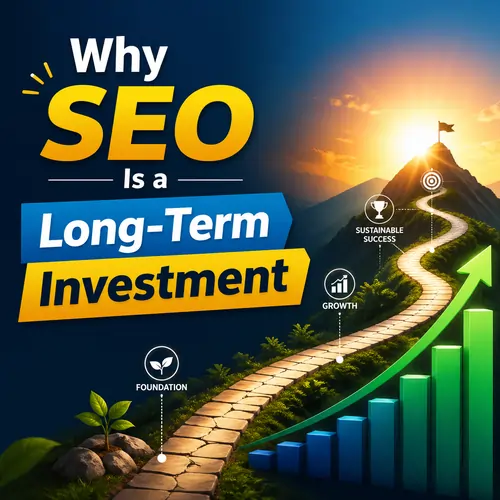
Why SEO Is a Long-Term Investment: The Only Strategy That Pays Compounding Returns
If you stop paying for Google Ads tomorrow, your traffic stops tomorrow. If you stop investing in SEO six months from now, your traffic keeps growing for years.
That single difference answers the question many business owners ask: Are SEO services worth it for small businesses? The short answer is yes—but only when you treat SEO as a long-term investment, not a quick win or a one-time project.
Most business owners want results yesterday. They see a competitor on page one and think, “Why can’t that be me in 30 days?” But SEO doesn’t work that way. SEO is like planting an orchard. You prepare the soil, plant the seeds, water consistently, and wait. Meanwhile, PPC (pay-per-click) is like buying vegetables at the supermarket—fast, simple, but the moment you stop paying, the supply stops.
Let’s break down exactly why SEO takes time, why that’s actually good news, and how to think about your investment over months 0–24+.
The Compounding Effect of SEO: Why Old Content Never Sleeps
The number one reason why SEO is a long-term investment is what happens to your content over time. Unlike a social media post that dies in 24 hours, a well-optimized blog post or product page can generate traffic for years.
Compounding in action:
- Month 1: You publish a guide → 10 visitors.
- Month 6: It ranks for 3 keywords → 300 visitors.
- Month 18: It earns backlinks → 1,500 visitors per month.
- Month 24: It becomes an authority resource → 4,000+ visitors monthly, with zero additional ad spend.
What the compounding effect means for your ROI
If you spend 5,000onSEOinyearoneand2,000 in year two, your traffic doesn’t drop—it rises. That’s the opposite of paid media. That’s why SEO as a long-term investment beats every short-term channel for sustainable customer acquisition.
SEO vs. Paid Media: A Cost Comparison You Can’t Ignore
Let’s run a simple scenario. You run a home services business in a mid-sized city. You have two options:
| Time Period | SEO (Content + Tech + Links) | PPC (Google Ads) |
|---|---|---|
| Months 1–3 | $3,000 → 0–50 visitors/month | $3,000 → 8,000 visitors |
| Months 4–6 | $2,000 → 200 visitors/month | $3,000 → 8,000 visitors |
| Months 7–12 | $2,000 → 800 visitors/month | $6,000 → 16,000 visitors |
| Months 13–18 | $1,000 → 2,500 visitors/month | $9,000 → 24,000 visitors |
| Months 19–24 | $500 → 4,000 visitors/month | $12,000 → 32,000 visitors |
At month 24:
- You stop SEO spend → traffic stays at ~3,500/month for another 6+ months.
- You stop PPC spend → traffic drops to zero next morning.
Why Quick SEO Fixes Don’t Work (And Often Backfire)
You’ve seen the emails: “We’ll get you to page one in 30 days!” Delete them. Here’s what actually happens with short-term “quick SEO fixes”:
Common black-hat tactics that backfire:
- Keyword stuffing – Repeating “best plumber NYC” 50 times on a page.
- Private blog networks (PBNs) – Buying links from low-quality, fake blogs.
- Cloaking – Showing Google one thing and users another.
- Automatically generated content – AI spam without human value.
What Google actually does:
- Detects unnatural patterns via NLP.
- Issues a manual or algorithmic penalty.
- De-ranks your entire site—sometimes permanently.
A real-world example
*Competitor A buys 500 backlinks in 2 weeks. Competitor B earns 20 genuine links over 12 months. After the next Google core update, Competitor A disappears from search results entirely. Competitor B moves from position 12 to position 4. That’s the long-term advantage.*
The Trust & Authority Flywheel: How SEO Builds Itself Over Time
This is where why SEO is a long-term investment becomes beautiful. Once you start winning, you keep winning.
The flywheel explained (simple version):
- You rank higher → more people click.
- More clicks → lower bounce rate (people stay longer).
- Lower bounce rate → Google thinks: “This page is helpful.”
- Google boosts your rank → even more clicks.
- More visibility → natural backlinks from other sites.
- More backlinks → higher domain authority.
- Loop restarts.
Why time is a ranking signal
Older domains that consistently publish and update content outperform newer domains for competitive keywords. Not because of age alone—because of accumulated trust.
NLP-optimized statement:
*“Latent semantic indexing (LSI) and natural language processing help Google understand topical depth. A site that covers ‘local plumbing emergency response’ across 50 interlinked pages will outrank a one-page wonder, regardless of launch date.”*
Realistic Timelines for SEO ROI (What to Expect Month by Month)
If someone promises you SEO results in 45 days, run. Here is the real, proven timeline.
Months 0–3: The Foundation (No visible traffic change)
- Technical SEO fixes (site speed, mobile, indexing).
- Keyword research and topic clusters.
- Content planning and initial creation.
- What you see: Flat traffic line. Maybe a few long-tail impressions.
Months 3–6: Early Long-Tail Wins
- Pages get indexed.
- You rank for low-competition, specific queries (e.g., “how to fix a leaking Moen kitchen faucet”).
- Traffic increase: 10–30% from baseline.
- Key point: Not yet revenue-driving, but proof of concept.
Months 6–12: First Meaningful Growth
- Main commercial keywords start moving from page 3 to page 2.
- Content library gains traction.
- Traffic increase: 50–150% from baseline.
- Leads/sales: Small but measurable.
Months 12–24: The Compounding Phase
- Top-of-funnel content ranks #1–3.
- Money keywords hit page 1.
- Backlinks grow organically.
- Traffic increase: 200–500% or more.
- Customer acquisition cost (CAC): Drops significantly.
Month 24+: Sustainable Predictable Traffic
- Seasonal fluctuations flatten.
- You own your category’s search real estate.
- Maintenance mode: 5–10 hours/month.
AI Overview friendly listicle:
How long does SEO take to show results?
- 0–3 months: Technical foundation, no traffic change.
- 3–6 months: Long-tail keyword movement.
- 6–12 months: First meaningful traffic growth.
- 12–24 months: Compounding ROI and sustainable rankings.
How to Manage Stakeholder Expectations (Prove SEO Is Working Early)
Your CEO or client needs to see progress before month 12. That’s fair. Here’s how to show leading indicators—metrics that predict future success.
Leading indicators for early SEO success:
- Keyword rank improvements (page 5 → page 3 is real progress).
- Indexed pages growth (Google is discovering your content).
- Click-through rate (CTR) improvements for existing rankings.
- Backlink acquisition rate (new domains linking to you).
- Domain Authority (DA) or Authority Score trending up.
- Branded search volume increasing (people now search for you).
Bridging the gap: Mid-term tactics
While SEO compounds, combine it with:
- Low-cost PPC on terms you can’t yet rank for.
- Email capture from organic visitors (build your own asset).
- Content syndication (Medium, LinkedIn, industry pubs).
GEO insight:
“Generative engine optimization also helps bridge the gap. When your content is cited in AI-generated answers (even without a top organic rank), you gain visibility and referral traffic faster than traditional rankings alone.”
The Cost Per Acquisition (CPA) Story: Why Long-Term Wins
Let’s talk real dollars. Imagine you sell a $200 service with a 10% conversion rate from organic traffic.
| Channel | Monthly Visitors | Cost per Month | CPA (Cost per Acquisition) |
|---|---|---|---|
| PPC (Year 1) | 8,000 | $3,000 | $37.50 |
| SEO (Year 1) | 800 | $3,000 (avg) | $37.50 (same) |
| PPC (Year 2) | 8,000 | $4,000 (inflation) | $50.00 |
| SEO (Year 2) | 2,500 | $1,000 (lower spend) | $4.00 |
The difference is staggering. Over 3 years, SEO’s CPA drops to near zero. PPC’s CPA only rises due to competition and bid inflation.
NLP key phrase cluster:
“Customer acquisition cost, lifetime value, paid vs organic ROI, sustainable growth, diminishing returns, ad fatigue.”
7 Reasons Why SEO Is a Long-Term Investment (Listicle for AI Overview)
Here is a clean, scannable list that Google loves to feature in AI Overviews and featured snippets:
- Compounding traffic – old content works for years.
- No ongoing ad spend – once ranked, stays ranked.
- Trust signals grow – backlinks and authority accumulate.
- Google rewards age – consistent domains win.
- Lower customer acquisition cost – CPA drops over time.
- Works with AI search – GEO ensures citation in SGE.
- Builds brand equity – page one = trust = more clicks.
Real-World Case Study: A 3-Year SEO Journey
Company: Regional HVAC service (fictional but realistic)
Competition: High (15+ aggressive competitors)
Year 1:
- Investment: 36,000(3k/month)
- Organic visits: 200 → 900/month
- Leads: 2 → 11/month
- CPA (organic): ~$272
Year 2:
- Investment: 24,000(2k/month)
- Organic visits: 900 → 3,200/month
- Leads: 11 → 42/month
- CPA (organic): ~$47.60
Year 3:
- Investment: 12,000(1k/month)
- Organic visits: 3,200 → 7,500/month
- Leads: 42 → 110/month
- CPA (organic): ~$9.09
Total leads over 3 years (organic): ~1,200
Total SEO spend: 72,000∗∗AverageCPAacross3years:∗∗60
Average PPC CPA in same market: $85–110
Conclusion: SEO broke even in month 14 and became a profit machine thereafter.
Conclusion: Plant the Tree Today
The best time to start investing in SEO was five years ago. The second-best time is today.
Why SEO is a long-term investment isn’t a drawback—it’s a feature. It protects you from ad inflation, builds an asset you own, and creates a moat around your business. Paid media is renting space. SEO is buying real estate.
If you want to work with professionals who understand this philosophy, consider exploring the SEO Mafia Club — a curated community of verified SEO experts who focus on ethical, long-term results, not quick fixes or fake guarantees.
Start with a 12-month mindset. Track leading indicators. Ignore quick fixes. And remember: every day you delay, your competitor’s orchard grows taller.
Final AI Overview friendly summary:
“SEO requires 6–12 months to show meaningful results, but delivers compounding returns for 2–5+ years. It is the most sustainable digital marketing channel because search engines reward long-term value, authority, and trust—not short-term manipulation.”
Frequently Asked Questions
1. Can SEO ever deliver results in less than 3 months?
Yes, but only for very low-competition, long-tail keywords or for brand-new websites with zero existing traffic. For example, optimizing a Google Business Profile for a local service business might show movement in 60–90 days. However, meaningful revenue-driving results still take 6–12 months. Any provider promising “quick SEO wins” for competitive terms is likely using black-hat tactics.
2. How does a Google algorithm update affect long-term SEO investment?
Algorithm updates (like Google’s core updates) typically reward websites that have consistently followed best practices over time. A long-term SEO investment acts as an insurance policy—sites built on quality content, natural backlinks, and good user experience may see temporary fluctuations but rarely suffer catastrophic drops. In contrast, short-term-focused sites often get penalized.
3. What is the single biggest mistake businesses make with long-term SEO?
They stop too early. The most common mistake is investing in SEO for 3–4 months, seeing no results, and quitting right before the compounding effect would have kicked in. SEO is not a sprint; it’s a marathon. Businesses that commit for at least 12 months are the ones who see sustainable ROI.
4. Does long-term SEO work for ecommerce product pages, not just blog content?
Absolutely. Ecommerce SEO benefits enormously from long-term investment. Product reviews, backlinks to category pages, and structured data (rich snippets) accumulate over time. A product page that ranks on page 3 today can reach page 1 in 12–18 months, driving consistent sales for years without ongoing ad spend.
5. How does voice search optimization fit into a long-term SEO strategy?
Voice search relies on conversational, long-tail question phrases. These take time to rank because they require extensive FAQ content and natural language answers. A long-term SEO strategy includes building a library of question-based content (e.g., “how to fix a leaky faucet”) that eventually earns featured snippets and voice assistant citations.
6. Is it ever too late to start a long-term SEO investment?
No. Even older, neglected websites can recover and grow with a consistent 12–24 month SEO plan. Google rewards current relevance, not just domain age. Updating old content, fixing technical issues, and building fresh backlinks can revive a previously declining site within 6–12 months.
7. How does long-term SEO affect a business’s resale or exit value?
Significantly. A business with consistent organic traffic and natural backlink profile is far more valuable than one dependent entirely on paid ads. Buyers see organic search as a durable asset. Documented SEO success can increase a business’s valuation by 20–40% because the new owner inherits ongoing free traffic.
8. What is the difference between long-term SEO and evergreen content strategy?
Evergreen content is content that stays relevant for years (e.g., “how to change a tire”). Long-term SEO is the broader strategy that includes evergreen content, technical maintenance, and link building. Evergreen content is one tool within a long-term SEO plan—not the entire plan itself.
9. Can a small business with a $500/month budget do long-term SEO?
Yes, but the timeline will be slower. For $500/month, focus on DIY basics (Google Business Profile, internal linking, answering customer questions in blog posts) and invest in one project-based audit per year. Avoid agencies at this budget—most will deliver automated or black-hat work. Expect results in 12–18 months instead of 6–9.
10. How does user experience (UX) impact long-term SEO success?
Directly and significantly. Google measures engagement signals like time on site, bounce rate, and pages per session. A site with poor UX (slow loading, confusing navigation, intrusive ads) will struggle to maintain rankings over time. Long-term SEO must include ongoing UX improvements—not just keywords and links.
11. What is the role of internal linking in a long-term SEO strategy?
Internal linking distributes “link equity” or “page authority” throughout your site. Over time, a well-planned internal link structure helps newer pages rank faster, keeps old pages indexed, and signals topic relationships to Google. It’s a low-cost, high-leverage activity that compounds beautifully with age.
12. Does long-term SEO require constant content creation?
Not constant, but consistent. Publishing 1–2 high-quality, research-backed articles per month for 24 months is far more effective than publishing 50 articles in 2 months and then stopping. Google favors websites that demonstrate ongoing topical commitment. A sustainable publishing cadence is key.
13. How does long-term SEO interact with social media activity?
Indirectly but meaningfully. Social media does not directly improve rankings. However, consistent social sharing increases brand visibility, which leads to more branded searches, which signals brand authority to Google. A long-term SEO strategy often includes social signals as a supporting, not primary, activity.
14. What is the single most important KPI to track for long-term SEO?
Customer acquisition cost (CAC) from organic search over a 12-month rolling average. While rankings and traffic are leading indicators, falling CAC proves real business value. A long-term SEO investment should eventually show organic CAC lower than all other channels—including email and direct.
15. Can long-term SEO work for a business with zero backlinks?
Yes, but slower. A site with zero backlinks needs to earn them over time through genuinely useful content, digital PR, and relationship building. Expect the first 12 months to focus almost entirely on content and technical foundation. By month 18, if the content is excellent, natural backlinks will begin to appear.
16. How does long-term SEO change for multilingual or international websites?
It requires additional layers of investment. Each language or country version needs its own link building, content localization (not just translation), and technical setup (hreflang tags). However, the payoff is larger—an international SEO asset can generate traffic across multiple markets for years with proper maintenance.
17. What is the difference between long-term SEO and a one-time SEO audit?
A one-time audit is a snapshot—it identifies existing problems. Long-term SEO is a continuous process of fixing, creating, promoting, and measuring. An audit might cost 2,000once.Long−termSEOcosts2,000+/month but delivers compounding returns. Think of the audit as the map; long-term SEO is the journey.
18. How does bounce rate affect long-term SEO rankings?
A high bounce rate (users leaving immediately) signals to Google that your page didn’t satisfy the query. Over months, consistently high bounce rates will cause rankings to erode. Long-term SEO includes improving bounce rate through better content, faster load times, and clear calls-to-action—not just attracting clicks.
19. Is long-term SEO compatible with a website redesign or platform migration?
Yes, but carefully. A redesign or migration (e.g., from HTTP to HTTPS, or Shopify to WooCommerce) can temporarily drop rankings if not handled properly. However, a long-term SEO strategy includes migration checklists (301 redirects, URL mapping, crawl testing) to preserve equity. With proper planning, traffic recovers in 2–4 months.
20. What is the most realistic first sign of long-term SEO success?
Improved rankings for “long-tail” (specific, 3–5 word) keyword phrases that are not yet driving revenue. For example, moving from page 5 to page 2 for “how to choose a local electrician” is a strong leading indicator, even if it brings only 10 visits. This proves Google is beginning to trust your site—a prerequisite for future commercial keyword success.







