TLDs Explained: How domain extensions affect SEO Rankings in 2026?
Choosing the right domain extension isn’t just a branding decision—it’s an SEO consideration that influences user trust, click-through rates, and search visibility.
After 18 years of optimizing websites across every TLD imaginable, I’ve witnessed how domain extensions shape organic performance in ways most marketers completely miss.
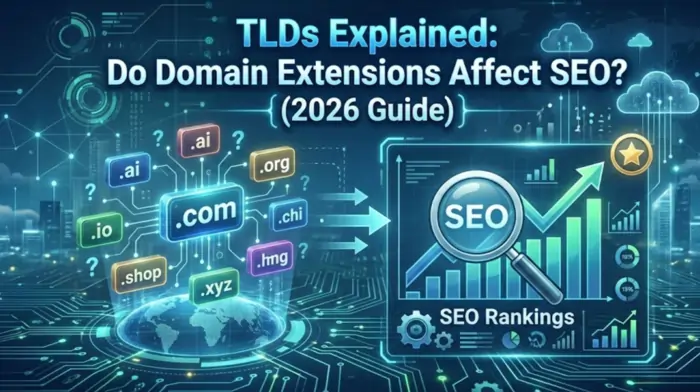
The short answer:
TLDs don’t directly affect rankings, but they profoundly impact the indirect factors that determine your search visibility.
Google has repeatedly confirmed that domain extensions aren’t a direct ranking signal, yet websites with strategic TLD choices consistently outperform those that ignore this critical component.
This comprehensive guide dissects exactly how domain extensions influence SEO performance, backed by official Google statements, industry research, and real-world data from 2026.
Table of Contents
What Are TLDs and Why They Matter for SEO
A Top-Level Domain (TLD) is the final segment of a domain name—the letters following the last dot in a web address. When you visit google.com, the .com portion represents the TLD.
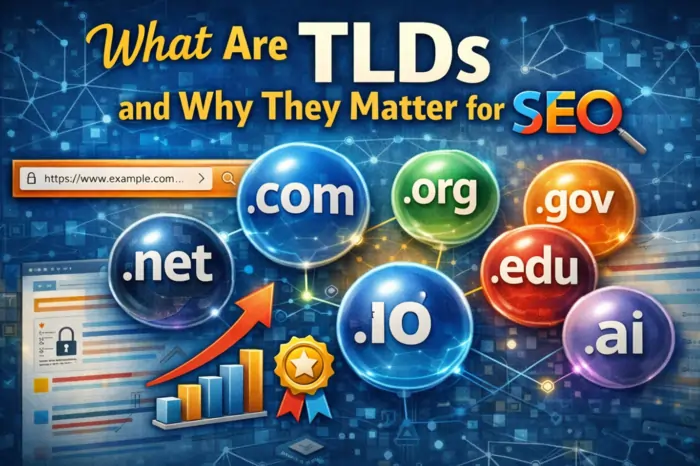
TLDs serve as the internet’s organizational structure, categorizing websites by purpose, geography, or industry. Think of them as digital area codes that help browsers route users to the correct destination while simultaneously communicating information about a website’s nature, location, and intended audience.
The Three Main Categories of TLDs
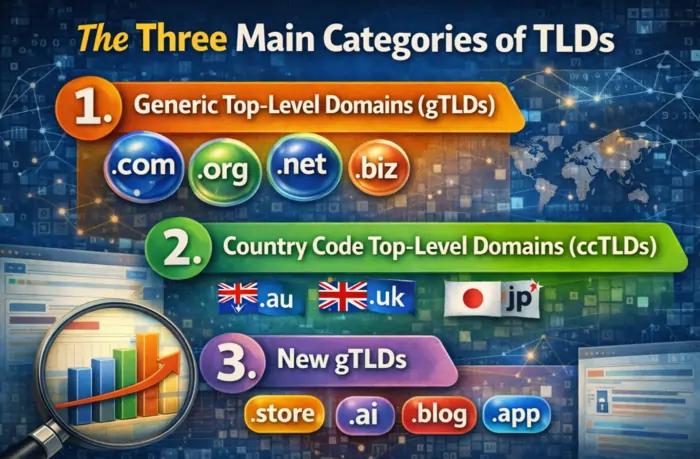
- Generic Top-Level Domains (gTLDs) represent the broadest category, including legacy extensions like .com, .org, and .net alongside newer options such as .tech, .ai, and .marketing. These domains aren’t restricted by geography or industry requirements, making them accessible to any registrant.
- Country Code Top-Level Domains (ccTLDs) designate specific geographic regions using two-letter codes like .uk (United Kingdom), .de (Germany), or .ca (Canada). Originally designed to signal geographic targeting, many ccTLDs now serve creative branding purposes beyond their intended countries.
- New gTLDs emerged from ICANN’s expansion programs in 2000 and 2012, introducing over 1,500 domain extensions by 2025. These include industry-specific options (.law, .finance, .studio), geographic identifiers (.nyc, .london), and creative branded domains (.guru, .club, .solutions).
Google’s Official Position on TLDs as Ranking Factors
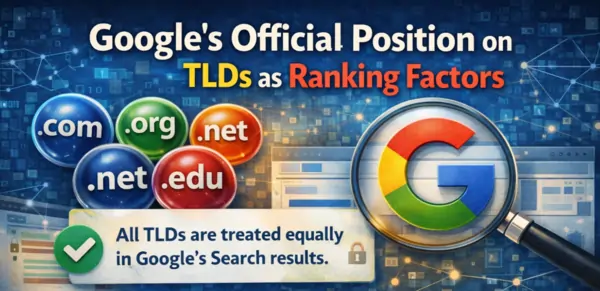
Google’s John Mueller has stated unequivocally that TLDs are not a direct ranking factor. The algorithm treats .com, .org, .tech, .expert and other gTLDs identically when calculating search positions.
This includes keyword-rich TLDs like .marketing or .finance having a keyword in your domain extension provides zero ranking boost. Mueller specifically addressed this misconception, clarifying that keyword-based generic TLDs offer no SEO advantage whatsoever.
However, Google’s ranking factors documentation reveals a crucial nuance: while TLDs don’t directly influence rankings, they impact multiple indirect factors that determine search visibility. Domain extensions affect user trust, click-through rates, backlink acquisition, and perceived authority—all of which influence rankings.
The one notable exception involves ccTLDs, which historically signaled geographic targeting to search engines. Google has used country-specific extensions to determine which regional search results should display a particular website. However, this advantage is diminishing as Google’s algorithm becomes more sophisticated at interpreting geographic intent through content, language tags, and other contextual signals.
The Indirect SEO Impact: How TLDs Actually Affect Rankings
Domain extensions shape search performance through four critical pathways that directly influence ranking factors.
User Trust and Click-Through Rates
Users make split-second judgments about website credibility based on domain extensions. Research from Name.com shows that .com domains have a 44% memorability score, higher than any other extension, and familiar TLDs generate significantly higher click-through rates in search results.
When users see unfamiliar or unconventional extensions, they experience cognitive friction that reduces trust and lowers the likelihood they’ll click. Since CTR is a confirmed ranking signal, domain extensions that damage click-through rates indirectly harm SEO performance.
Conversely, industry-specific TLDs can enhance trust when they clearly align with your niche. A .law extension reinforces credibility for legal firms, while .ai signals tech expertise for artificial intelligence companies. The key distinction: the extension must feel natural and relevant, not forced or gimmicky.
Backlink Acquisition Challenges
Websites with unconventional or unfamiliar domain extensions face greater skepticism when conducting outreach for backlinks, partnerships, and press coverage. Publishers naturally gravitate toward familiar, trustworthy domains when deciding which sites to link to.
Since backlinks remain one of Google’s most important ranking factors, any barrier to link acquisition directly impacts SEO performance. A .xyz, or .club extension may require additional trust-building compared to a .com or industry-standard alternative.
Spam Association and Trust Signals
Certain TLDs carry negative associations due to historical abuse by spammers. Extensions that became popular with low-quality sites or black-hat SEO tactics face an uphill battle establishing credibility.
While Google doesn’t penalize specific TLDs, users and webmasters do judge sites based on these associations. A domain extension with a poor reputation may:
- Reduce organic CTR due to user skepticism
- Limit backlink opportunities from quality publishers
- Trigger spam filters or security warnings
- Decrease social sharing due to perceived untrustworthiness
Brand Recognition and Search Behavior
Domain extensions influence how users remember and search for your brand. A memorable, relevant TLD makes it easier for users to recall your domain, driving direct traffic and branded searches—both of which Google uses as quality signals.
Branded search volume serves as a trust indicator in Google’s algorithm. Sites with strong branded search patterns receive preferential treatment because they demonstrate genuine audience relationships rather than purely algorithmic optimization.
gTLDs: The Standard Choice for Global Reach
Generic Top-Level Domains represent the default option for most websites, offering universal recognition and consistent global brand presence. The .com extension alone accounts for the vast majority of registered domains, making it the most familiar and trusted option.
Advantages of gTLDs for SEO
Universal recognition means users worldwide instantly recognize and trust gTLDs, particularly .com, .org and .net This familiarity translates to higher click-through rates and reduced bounce rates from searchers who feel confident clicking on known extensions.
Global reach allows gTLDs to rank competitively in any geographic market without geo-targeting limitations. Unlike ccTLDs that signal specific countries, gTLDs enable businesses to target multiple regions from a single domain.
Centralized SEO strategy simplifies optimization efforts by consolidating authority signals on one domain rather than managing multiple country-specific sites. This approach accumulates backlinks, domain authority, and ranking history in a single location.
Easier backlink acquisition results from the inherent trust and familiarity of established gTLDs. Publishers and journalists more readily link to .com domains than unconventional extensions.
Disadvantages and Limitations
Reduced local relevance in specific markets where users prefer country-specific domains. A .commay struggle to outrank local ccTLDs in countries with strong preferences for national extensions.
Competition for availability means premium .com domains are often unavailable or prohibitively expensive. This forces businesses into compromises like longer, less memorable domain names or alternative extensions.
Generic perception can make differentiation challenging in crowded niches where every competitor uses .com Industry-specific TLDs offer opportunities for relevant differentiation.
ccTLDs: Geographic Targeting with Local SEO Benefits
Country Code Top-Level Domains signal geographic relevance to both search engines and users. Historically, ccTLDs provided significant advantages for local SEO by clearly indicating a website’s target country.
How ccTLDs Impact Local SEO
Geographic signal strength has traditionally made ccTLDs the most powerful indicator of country targeting. Search engines interpreted a .uk domain as explicitly serving United Kingdom users, boosting rankings in UK search results.
Local user preference in many markets strongly favors country-specific extensions. Users in Germany, France, and Japan often prefer clicking on .de, .fr, and .jp domains over international .com alternatives.
Higher local click-through rates result from the trust and relevance signals that ccTLDs communicate to regional audiences. This CTR advantage translates to improved rankings through user engagement metrics.
Trust establishment happens faster with ccTLDs in markets where local domains signal legitimacy and commitment to the region. A ccTLD demonstrates investment in serving a specific market rather than treating it as an afterthought.
The Declining Advantage of ccTLDs
Google’s algorithm evolution has significantly reduced the SEO value of ccTLDs for geographic targeting. Several factors contribute to this shift:
Creative usage has blurred the connection between ccTLDs and their intended countries. Tech companies worldwide use .ai (Anguilla) and .io (British Indian Ocean Territory) for branding purposes unrelated to those locations.
Improved contextual analysis enables Google to determine geographic relevance through content, language tags, server location, and backlink patterns rather than relying primarily on domain extensions.
Geotargeting settings in Google Search Console now provide more precise control over geographic targeting than ccTLDs alone. Webmasters can specify target countries for gTLDs through console settings.
Hreflang implementation offers superior international SEO control compared to managing multiple ccTLD domains. This structured data explicitly declares language and regional targeting.
Google announced in 2025 that it’s gradually phasing out preferential treatment for ccTLDs in favor of these more nuanced signals. While ccTLDs still carry some local relevance, their advantage has diminished substantially.
When ccTLDs Still Make Sense
Single-country businesses with no international expansion plans benefit from the local trust and relevance ccTLDs provide. A German business exclusively serving German customers gains credibility with a .de domain.
Markets with strong local preferences where users demonstrably favor country-specific extensions justify ccTLD investment. Consumer behavior research should guide this decision.
Competitor landscape matters—if all major competitors in your niche use ccTLDs, a gTLD may appear less credible to local users.
Brand protection strategies often include registering ccTLDs in key markets even if the primary site uses a gTLD. This prevents competitors from capturing branded search traffic.
New gTLDs: Opportunities and Risks for Modern SEO
The explosion of new domain extensions since 2012 created over 1,500 TLD options, offering unprecedented creativity and niche relevance. These extensions range from industry-specific (.tech, .finance, .law) to creative branded options (.guru, .rocks, .solutions).
The SEO Performance of New TLDs
Google treats new gTLDs identically to legacy extensions in ranking calculations. A .techdomain has the same algorithmic standing as .com. However, real-world performance revealssignificant differences driven by user perception.
Industry-specific TLDs can reinforce relevance and expertise when they align naturally with your niche. A .studio extension for a design agency communicates specialization immediately. This clarity can improve CTR and reduce bounce rates as users understand your site’s focus before clicking.
Tech-focused extensions like .ai, .io, and .dev have gained credibility in startup and technology communities. These TLDs signal innovation and technical expertise, making them effective for SaaS companies, AI ventures, and developer tools.
Creative TLDs for branding purposes work when they create memorable, meaningful combinations. A budgeting app using budget.finance leverages the extension for clarity. However, forced or awkward combinations like buildyourcareer.careers create confusion rather than memorability.
Risks and Disadvantages of New TLDs
User unfamiliarity remains the primary challenge. Many internet users default to .com out of habit and may distrust or overlook unconventional extensions in search results.
Memorability issues arise when users struggle to recall non-standard extensions. Even if they visit your site, they may forget the exact TLD when trying to return directly.
Spam associations plague certain new TLDs that attracted low-quality sites and spammers early in their lifecycle. Extensions with poor reputations face trust barriers with both users and potential link partners.
Professional perception varies by industry. Conservative sectors like finance, law, and healthcare may view non-traditional TLDs as less credible compared to established .com or .org options.
Higher costs apply to some premium new TLDs, which command significantly higher registration and renewal fees than traditional extensions.
Strategic Guidelines for New TLD Selection
Research reputation before committing to any new TLD. Search for “{TLD} spam reputation” and examine what types of sites currently use the extension.
Test memorability by sharing your domain verbally and seeing if people correctly recall it later. If users default to adding .com, your TLD choice creates friction.
Assess industry fit by examining whether major players or respected brands in your niche use similar extensions. Industry adoption signals credibility.
Consider your audience demographics and technical sophistication. Tech-savvy audiences readily accept newer TLDs, while traditional consumers prefer familiar options.
Evaluate alternatives including availability and pricing for .com and other established extensions before selecting a new TLD purely based on availability.
TLD Selection Strategy: Choosing the Right Extension in 2026
Selecting the optimal domain extension requires balancing SEO considerations, branding goals, budget constraints, and user expectations. The decision framework from Search Engine Landdepends on your specific situation.
For Global Businesses and Startups
Prioritize .com first if available at a reasonable price. The universal recognition and trust make .com the default choice for businesses targeting international audiences.
Consider .org for nonprofits or mission-driven organizations where the extension reinforces your organizational structure. The .org TLD carries credibility for charitable, educational, and community-focused entities.
Evaluate .net as a secondary option if .com is unavailable and the domain name itself is highly memorable. While less common, .net maintains reasonable recognition and trust.
Explore relevant new gTLDs if they genuinely enhance your brand identity and target audience familiarity. A .tech or .ai extension works for technology companies where the audience expects innovation.
For Local and Regional Businesses
Use ccTLDs when exclusively serving a single country with strong local domain preferences. The local trust and relevance justify the geographic limitation.
Combine gTLD with geo-targeting for businesses planning international expansion. Start with a .com domain and implement proper hreflang, language tags, and geotargeting settings.
Consider subfolder structure (example.com/uk, example.com/de) rather than multiple ccTLDs for international sites. This approach from SearchVIU consolidates domain authority while maintaining geographic targeting.
Register defensive ccTLDs in key markets even if you use a primary gTLD. This prevents competitors from capturing branded traffic in important regions.
For Niche and Industry-Specific Sites
Match the TLD to your niche when industry-specific extensions carry credibility in your sector. A .law domain signals expertise for legal services.
Verify audience familiarity before committing to niche TLDs. If your target market doesn’t recognize or trust the extension, it becomes a liability.
Test user response through surveys or focus groups to gauge whether a specialized TLD enhances or diminishes credibility with your specific audience.
The TLD Decision Matrix
| Business Type | Recommended TLD | Avoid |
|---|---|---|
| Global E-commerce | .com, .shop, .store | Obscure new TLDs with spam history |
| Local Service Business | ccTLD (.uk, .de, etc.) or .com with geo-targeting | Unrelated ccTLDs |
| Tech Startup | .com, .ai, .io, .tech, .dev | Generic new TLDs lacking tech association |
| Nonprofit | .org, .com | Commercial-focused TLDs |
| Professional Services | .com, industry-specific (.law, .finance), .net | Casual TLDs (.fun, .rocks) |
| Creative Agency | .com, .studio, .design, .agency | Overly technical TLDs |
Technical SEO Considerations for TLD Management
Beyond selection, proper technical implementation ensures your TLD choice doesn’t create SEO complications.
International Targeting Setup
Hreflang tags must be implemented perfectly across all regional versions of your site. This structured data tells Google which language and region each page targets.
Geotargeting settings in Google Search Console specify your intended geographic audience for gTLDs. This compensates for the lack of geographic signals from non-ccTLD extensions.
Language declarations using the lang attribute on your HTML tag help search engines understand content language independent of domain extension.
Canonical tags prevent duplicate content issues when managing multiple regional versions. Proper canonicalization ensures you don’t cannibalize your own rankings.
Migration and TLD Changes
301 redirects are essential when changing domain extensions. Every old URL must permanently redirect to the corresponding new URL to preserve link equity.
Backlink updates should be pursued where possible, asking major referring domains to update links to your new TLD. While 301s pass most link value, direct links perform better.
Search Console verification for the new domain enables monitoring crawl status, indexation, and ranking performance during the transition.
Timing considerations matter—avoid TLD changes during peak seasons or alongside other major site updates. Migrations require several months for search engines to fully process.
Conservative approach generally recommends avoiding TLD changes unless absolutely necessary. The SEO risks and effort rarely justify switching extensions on established sites.
E-E-A-T Signals and Domain Extensions
Google’s Experience, Expertise, Authoritativeness, and Trust (E-E-A-T) framework influences how domain extensions affect search performance.
Domain Extensions as Trust Signals
Verified TLDs like .gov and .edu carry inherent trust because they require verification of government or educational status. Google recognizes these restrictions when evaluating content credibility.
Industry-specific restrictions on certain TLDs create similar trust advantages. Extensions requiring professional verification (like .lawyer or .doctor) signal authentic expertise.
Generic TLDs must establish trust through content quality, backlinks, author credentials, and off-site validation. The domain extension provides no inherent E-E-A-T advantage.
Spam-associated TLDs face trust deficits that require exceptional content and off-site authority to overcome. Sites on these extensions must work harder to establish credibility.
Building E-E-A-T with Any TLD
Author credentials matter more than domain extensions for establishing expertise. Detailed author bios from Backlinko, verified credentials, and demonstrated experience signal E-E-A-T regardless of TLD.
Third-party mentions and brand citations across authoritative sites build trust independent of your domain extension. Social proof from external sources validates expertise.
Original research and data demonstrate genuine expertise that transcends domain extension concerns. First-hand experience evidenced through unique insights matters most.
High-quality backlinks from respected domains in your niche signal authority more powerfully than your TLD choice. The sites linking to you matter more than your extension.
Common TLD Myths and Misconceptions Debunked
After 18 years in SEO, I’ve encountered persistent myths about domain extensions that refuse to die despite clear evidence to the contrary.
Myth: Keywords in TLDs Boost Rankings
Reality: Google explicitly confirmed that keyword-rich TLDs like .marketing or .finance provide zero ranking advantage. The keyword appears in the domain name itself potentially acts as a minor relevancy signal, but the TLD extension carries no algorithmic weight.
Myth: New TLDs Are Penalized
Reality: Google treats all gTLDs equally in ranking calculations. New extensions face user trust and CTR challenges, not algorithmic penalties. Sites on new TLDs rank perfectly well when they earn proper signals.
Myth: .com Always Outranks Other TLDs
Reality: Domain extension is not a ranking factor. A high-quality site on any TLD can outrank a weaker .com site. However, .com domains often perform better due to higher user trust and CTR.
Myth: ccTLDs Can’t Rank Internationally
Reality: ccTLDs can rank in any country with proper optimization. Geotargeting settings, content, and backlinks override the geographic signal from domain extensions. However, ccTLDs may face disadvantages compared to gTLDs for global targeting.
Myth: Changing TLDs Improves Rankings
Reality: Switching domain extensions rarely improves SEO performance and often causes temporary ranking drops during migration. Change TLDs only when absolutely necessary for branding or business reasons, not for SEO benefits.
Myth: More Expensive TLDs Rank Better
Reality: Registration cost has zero correlation with ranking potential. While expensive TLDs may discourage spammers (creating better neighborhood effects), the price itself doesn’t influence Google’s algorithm.
The Future of TLDs in Search Engine Optimization
The evolution of search algorithms continues shifting emphasis away from technical signals toward user experience and genuine value.
Declining Importance of Domain Extensions
Contextual analysis increasingly dominates Google’s approach to understanding websites. Content, backlinks, user behavior, and structured data provide more reliable signals than domain extensions.
ccTLD deprecation represents a clear trend as Google phases out preferential treatment for country-code domains. Geographic targeting through content and technical signals replaces blunt ccTLD interpretation.
User intent focus means Google prioritizes matching search queries with valuable results regardless of TLD. The extension matters only insofar as it influences user decisions and behavior.
Persistent User Perception Effects
Human psychology doesn’t change as quickly as algorithms. User trust, CTR, and brand perception based on domain extensions will continue influencing SEO performance through behavioral signals.
Generational shifts may gradually normalize newer TLDs as younger internet users encounter diverse extensions throughout their digital lives. However, this evolution happens slowly.
Industry-specific adoption patterns will likely cement certain TLDs as credible within particular niches while others remain marginal. Early adoption by respected brands determines which extensions gain legitimacy.
Actionable TLD Strategy Checklist
Based on 18 years of SEO experience and the latest 2026 data, follow this decision framework:
- Start with
.comavailability and pricing. This remains the default best choice for most situations. - Research your specific audience. Understand whether your target market trusts alternative TLDs or strongly prefers traditional extensions.
- Examine competitor domains. Note what extensions successful sites in your niche use.
- Verify TLD reputation. Search for spam associations and example sites using the extension before committing.
- Test memorability. Share your proposed domain verbally and see if people correctly recall the full address including TLD.
- Consider long-term scalability. Choose extensions that support your growth plans geographically and by market.
- Budget for defensive registrations. Secure variations and common TLD alternatives to protect your brand.
- Implement proper technical SEO. Ensure geotargeting, hreflang, and canonicalization are configured correctly through Google Search Console.
- Build E-E-A-T signals. Focus on content quality, author credentials, and third-party validation regardless of TLD.
- Monitor user behavior metrics. Track CTR, bounce rate, and engagement using Google Analytics to identify whether your TLD choice affects performance.
The domain extension you choose creates ripple effects across your entire SEO strategy. While TLDs aren’t direct ranking factors, they influence every aspect of user perception and behavior that determines search visibility. Here is the Domain Selection Strategy Guide for Your first Domain.
Choose wisely, optimize thoroughly, and remember that content quality and genuine expertise ultimately matter far more than the letters after your domain’s dot.
More SEO Insights from Jin Grey
- How to Choose the Perfect Domain Name for Your Brand in 2026
- The Calm SEO Framework: Building a Long-Term SEO Strategy Without Panic
- What Google Actually Rewards (And What It Ignores) in 2026
- Why Chasing SEO Trends Is Killing Your Rankings
- The Difference Between SEO Noise and Real Ranking Signals
- Why SEO Still Works in 2026 (If You Ignore the Noise)
- SEO Was Never the Problem. The Noise Was.
- My SEO Story: 18 Years of Survival, Strategy, and Success
- GEO vs. SEO: How to Rank in the Era of Answer Engines
- How to Rank When AI Answers Steal Your Clicks (2026 SEO Guide)
- SEO Without Traffic: How People Make Money in 2026