

If you want your blog posts to rank and stay readable, you need more than a good idea—you need an SEO friendly content outline that guides both readers and search engines through your article. A strong outline helps you cover the right subtopics in the right order, match search intent, avoid blank‑page syndrome, and build a structure that’s easy to scan for humans and easy to interpret for Google.
In this beginner’s guide, you’ll learn exactly how to build a simple SEO focused outline, where to place keywords naturally, how to support local SEO (GEO) and Answer Engine Optimization (AEO), and how to use a quick checklist before you hit publish.
What Is an SEO Friendly Content Outline?
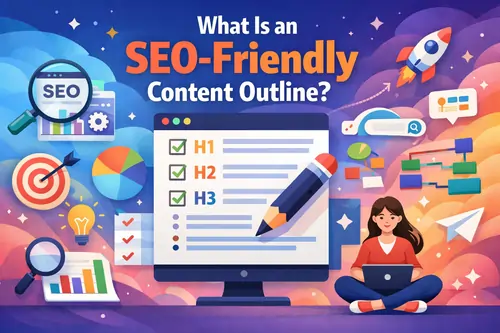
An SEO friendly content outline is a simple plan that lists your main headings, subheadings, and key points before you start writing. The difference between a “normal” outline and an SEO focused outline is that you also plan your primary keyword, supporting/semantic keywords, internal and external links, and user questions (FAQ‑style headings).
Instead of improvising as you write, you build a clear content structure that makes it easier for readers to scan and easier for search engines to understand what your page is about. Think of your outline as a roadmap: H2s and H3s are signposts that guide both humans and algorithms through your topic. When that roadmap is designed well, you cover your subject in a logical flow, support topical authority, and satisfy search intent far better than writing without a plan.
Quick takeaway: If you plan the structure first, writing becomes faster—and optimization becomes natural.
Why Your Outline Matters for SEO, GEO, AEO, and NLP
A good outline supports multiple layers of optimization at once:
- SEO (on‑page): Helps your page appear for your target keywords by placing them in titles, headings, and key parts of the content.
- GEO (local SEO signals): Helps you show up in location‑based searches by including natural local context, like city or country‑specific examples.
- AEO (Answer Engine Optimization): Helps your content perform in voice search and AI/summary‑style results by answering questions clearly and directly.
- NLP (Natural Language Processing): Helps search engines understand context, relationships, entities, and topic depth across your article.
By thinking about these early—during outlining—you can decide where to place your primary keyword, how to phrase headings as natural questions, and where to add local context without stuffing location terms. For example, if you write for businesses in the Philippines (or a specific city like Davao), you can plan localized examples inside the outline rather than awkwardly forcing “Philippines” or “Davao” into every heading.
Quick takeaway: Outlining is where you “program” clarity—before you write a single paragraph.
Step‑by‑Step: How to Create an SEO Focused Outline
Step 1: Define Your Topic, Goal, and Reader
Start by writing a 1–2 sentence “content brief” for yourself:
- Topic: What is the article about?
- Goal: What should the reader achieve after reading?
- Reader: Who is this for?
Example for this guide:
- Topic: SEO friendly content outlines / SEO content outline
- Goal: Teach beginners how to build a simple outline that supports rankings and readability
- Reader: Bloggers, freelancers, small business owners, and new SEO practitioners
This keeps your outline focused and prevents you from adding sections that don’t serve the main purpose.
Quick takeaway: A clear target reader makes every heading easier to choose.
Step 2: Choose Your Primary Keyword and Supporting Terms
Pick one primary keyword and a set of supporting semantic terms that can appear naturally.
For this topic, your primary keyword could be:
- SEO content outline
Supporting terms (use as needed, not all at once):
- SEO friendly outline
- blog structure for SEO
- content planning framework
- SEO content brief
- SEO content template
- search intent outline
- SEO content structure
- semantic SEO terms
- internal linking plan
- outline checklist
Where to place the primary keyword (naturally):
- Title tag / page title
- H1
- First 1–2 paragraphs
- At least one relevant H2
- A few times in the body where it fits
Avoid repeating the exact phrase in every section. Search engines recognize related terms, so rotate naturally and let semantic SEO terms fill in the topic context.
Quick takeaway: Choose one main keyword, then support it with related phrases—not repetition.
Step 3: Build Your Main Sections (H2 Headings)
Now turn your topic into a simple set of H2 sections. A beginner‑friendly structure usually looks like:
- What Is an SEO Friendly Content Outline?
- Why Outlines Matter for Modern SEO (SEO + AEO + GEO)
- Step‑by‑Step: How to Build an SEO Focused Outline
- Example Outline You Can Copy
- Pre‑Publish Checklist
- Common Mistakes and Final Tips
Each H2 should answer a real reader question. If a section doesn’t help the reader complete the goal, remove it.
Quick takeaway: Every H2 should earn its place by solving a specific reader need.
Step 4: Add Subsections (H3s), Questions, and AEO‑Friendly Headings
Under each H2, add H3 subsections that break down the details.
AEO tip: Turn some H3s into natural questions, such as:
- What’s the difference between a normal outline and an SEO focused outline?
- Where should the primary keyword go?
- How many headings should a blog post have?
- What should an SEO outline checklist include?
Question‑style headings encourage direct answers, which helps featured snippets, voice search, and AI summary systems.
Quick takeaway: If your headings sound like real questions, your content is easier to match to real searches.
Step 5: Plan On‑Page SEO Elements Inside the Outline
A strong SEO focused outline isn’t just headings and bullets. Add quick notes for on‑page elements:
- Title tag + meta description: Put your primary keyword near the start and clearly state the benefit of the article.
- URL slug: Keep it short and descriptive (for example,
/seo-content-outline-guide/). - Internal links: Plan links to related articles (keyword research, on‑page SEO, content updating).
- External links: Reference trusted resources like Google’s official SEO Starter Guide, a beginner’s SEO guide from Moz, or an on‑page SEO checklist from a reputable SEO tool—only when they genuinely add value.
- Images + alt text: Plan screenshots or diagrams and write descriptive alt text that reflects the content (not just keywords).
Planning these early prevents problems like weak internal linking, missed optimization opportunities, and “afterthought SEO.”
Quick takeaway: If you plan optimization in the outline, you won’t forget it in the draft.
Step 6: Use NLP and Semantic Keywords Naturally
Modern search relies heavily on meaning, not just exact phrases. Instead of repeating the same keyword, include related concepts where they make sense.
For example:
- When describing process: “content planning framework,” “SEO content structure”
- When describing templates: “SEO content brief,” “SEO content template”
- When describing intent: “search intent outline,” “question‑based sections”
This semantic variety strengthens topic coverage and helps your content feel complete without keyword stuffing.
Quick takeaway: Semantic variety improves both readability and topical coverage.
Step 7: Add GEO Elements for Local SEO (Optional, but Powerful)
If your content is meant for a local audience—like Philippine businesses—plan one natural local example.
Example H3 to add:
- Example: SEO outline for a local business in the Philippines
Instead of repeating the city name everywhere, use local customer habits, service areas, Philippine‑specific context (delivery, payment options, local terms), and natural location references. This feels helpful, not spammy, and strengthens local relevance.
Quick takeaway: Local SEO works best when it’s contextual—not repetitive.
Step 8: Micro‑Examples of Weak vs Strong Structure
Small changes make a big difference.
Weak heading:
- “More SEO Tips”
Better heading (clear + intent‑focused):
- “How to Turn Keyword Research Into an SEO‑Focused Blog Structure”
Weak instruction (vague):
- “Use keywords in headings.”
Better instruction (specific + natural):
- “Use your primary keyword once in the H1 and in one relevant H2, then support it with related terms in subheadings and examples—without forcing exact matches everywhere.”
Quick takeaway: Clarity beats cleverness. Always.
Step 9: Example Outline You Can Copy
Here’s a copy‑ready example you can adapt:
- H1: A Beginner’s Guide to Creating SEO Friendly Content Outlines
- H2: What Is an SEO Friendly Content Outline?
- H3: How an SEO focused outline differs from a normal outline
- H3: Why content structure matters for readers and rankings
- H2: Why Outlines Matter for Modern Search (SEO + AEO + GEO)
- H3: How outlines support search intent
- H3: How question headings help answer engines
- H3: When to add local context for PH/local searches
- H2: Step‑by‑Step: How to Build an SEO Focused Outline
- H3: Define topic, goal, and reader
- H3: Choose a primary keyword + supporting terms
- H3: Draft H2s and H3s in a logical flow
- H3: Plan internal links, external references, and images
- H2: Example: Local SEO Outline (Philippines)
- H3: Outline for a Davao‑based café (sample headings + local intent)
- H3: How to add location naturally without keyword stuffing
- H2: Pre‑Publish Outline Checklist
- H3: Quick checks before drafting the full article
- H2: Common Mistakes to Avoid
- H3: Over‑optimizing headings
- H3: Ignoring intent and readability
- H3: Skipping internal link planning
You can reuse this structure for almost any topic by swapping the keywords and examples while keeping the same logic.
Step 10: Pre‑Publish Content Outline Checklist
Before you draft, confirm these:
- You have one primary keyword and a small set of supporting terms.
- Every H2/H3 supports the reader’s goal and search intent.
- Your title and H1 are clear, benefit‑driven, and aligned with intent.
- You planned at least 1–3 internal links to related content.
- You noted where external references fit (only if useful).
- You planned images or diagrams that improve understanding.
- If targeting local readers, you included a natural PH/local example.
- Your headings are scannable and not overly repetitive.
If you can honestly say “yes” to most of these, your outline is ready to become a strong draft.
Final Tips and Next Steps
Creating SEO‑friendly outlines is a skill that gets easier with repetition. Start simple: define your reader and goal, pick one primary keyword, build a logical H2/H3 flow, plan on‑page elements early, then write with clarity—not keyword pressure.
Your next step: open a blank document, copy the example outline above, and customize it for your next topic. Over time, these outlines become a reusable framework—making your writing faster, your structure clearer, and your content more competitive in search results.







