

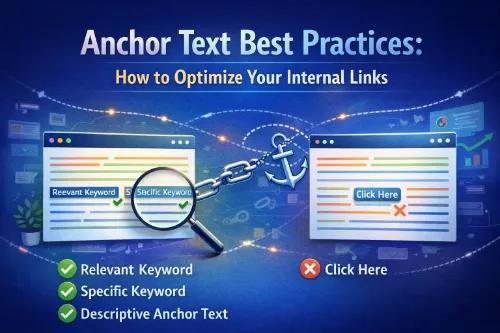
Anchor text and internal links work together to tell both users and search engines what your pages are about. When you apply anchor text best practices, you strengthen SEO, improve Answer Engine Optimization (AEO), and create a better experience for your visitors.
This guide explains what anchor text is, how it influences SEO, and exactly how to optimize anchor text for internal links without over-optimizing or looking spammy.
1. What Is Anchor Text and Why It Matters
Anchor text is the clickable text inside a hyperlink. It is usually styled differently (often blue and underlined) so users know they can click it. When someone clicks that text, they are taken to another page.
Internal links are links from one page on your website to another page on the same domain, helping users discover more content and helping search engines crawl and understand your site.
Search engines use anchor text as a signal to understand the topic and intent of the page you’re linking to, which is why using clear, descriptive anchor text is part of standard SEO best practice in guides from Moz and Semrush.
2. How Anchor Text Influences SEO
Anchor text plays a direct role in how search engines interpret and rank your content, especially when used in internal links.
- It helps define what the target page is about.
- It clarifies how pages relate to each other.
- It helps distribute internal link equity toward important URLs.
When you use SEO-friendly anchor text, you guide search engines to your most valuable content and support topical authority, which multiple anchor text and internal linking guides highlight as a key benefit.
At the same time, repeating the exact same keyword-rich anchor too often can look manipulative, so experts recommend a balanced mix of exact match, partial match, branded, and natural language anchors.
For AEO, clear and descriptive anchors such as “how to optimize anchor text for internal links” help answer engines identify which pages contain specific answers to common queries.
3. Types of Anchor Text (With Simple Examples)
Understanding the main anchor text types makes it easier to vary your anchors and keep your profile natural, a point emphasized in anchor text overviews by Moz and seoClarity.
Exact-Match Anchor Text
Exact-match anchor text uses the exact keyword you want to rank for.
- Example: “anchor text best practices” linking to your comprehensive anchor text guide.
Use exact-match anchors, but not every time you link to that page, which aligns with recommendations to avoid over-optimization.
Partial-Match and Phrase-Match Anchor Text
Partial-match and phrase-match anchors include your keyword along with other words.
- Partial match: “anchor text best practices for internal links.”
- Phrase match: “how to use anchor text in internal linking for SEO.”
These variations reflect how people search in long-tail queries and are considered safer and more natural in modern SEO.
Branded, Naked URL, and Generic Anchor Text
Branded anchor text uses your brand name (for example, “AIOSEO internal linking guide”), supporting brand-building while keeping anchors non-spammy.
Naked URL anchor text uses the URL itself, such as “https://example.com/internal-linking-guide,” which is crawlable but not very descriptive.
Generic anchor text uses non-descriptive phrases like “click here” or “read more,” which several best-practice guides advise limiting because they add little context.
Whenever possible, convert generic anchors into descriptive internal links, as suggested in quick guides on anchor text best practices.
Image Anchor Text and Alt Text
When an image is linked, search engines treat its alt text as the anchor text, a behavior documented in multiple SEO resources.
If you use banners or image-based buttons as internal links, give them descriptive alt text such as “internal linking strategy for beginners” to support accessibility and SEO simultaneously.
4. Anchor Text Best Practices for Internal Links
The following practices align closely with what major SEO resources recommend for crafting strong anchor text.
Make Anchor Text Concise and Descriptive
Anchor text should be short, clear, and specific so users know what to expect after clicking.
- Strong: “anchor text optimization guide.”
- Strong: “internal linking strategy for travel blogs.”
- Weak: “click here” or “this post.”
Guides from Moz and Semrush stress that effective anchor text is succinct yet descriptive so both users and search engines can predict the destination.
Prioritize Relevance at Every Level
Relevance matters for the anchor text, the surrounding sentence, and the target page, and maintaining this alignment is one of the core principles highlighted by seoClarity and Taboola.
If an anchor says “anchor text SEO tips,” the destination should genuinely cover anchor text SEO; linking off-topic phrases to unrelated pages can confuse both users and crawlers.
Write for Users First
User-first writing means your anchors fit naturally into sentences and don’t feel like keyword stuffing, which is consistent with Semrush’s and Taboola’s guidance on natural, readable anchors.
Natural anchors also support NLP and voice search because they resemble real questions and speech patterns, improving how algorithms interpret your content.
Use Varied Anchor Text Types
Instead of only using one exact phrase, mix anchor types, a practice multiple experts recommend to avoid over-optimization and create a richer anchor text profile.
For example, to point to the same page, you might rotate between:
- “anchor text best practices.”
- “anchor text for SEO.”
- “how to optimize anchor text for internal links.”
- “internal links anchor text best practices.”
This mirrors the advice in in-depth anchor text optimization guides to diversify anchor types while staying relevant.
5. Common Anchor Text Mistakes (And How to Fix Them)
Avoiding a few well-documented mistakes will instantly upgrade your internal linking.
Overusing Exact-Match Anchors
Many case studies and best-practice articles warn that repeating the same exact-match anchor text too often can look manipulative, even for internal links.
The fix is to rotate multiple descriptive variations while keeping them relevant, which maintains strong signals without forming a suspicious pattern.
Using Vague Generic Anchors
Guides from Yoast and smaller SEO agencies consistently advise against overusing generic anchor text like “click here” or “read more” because it doesn’t describe the target page.
By rewriting these as descriptive internal links, you both improve UX and send clearer topical signals, which is also recommended in internal linking best-practice resources.
Stuffing Too Many Links in One Paragraph
Resources on internal linking best practices stress balancing link quantity with user experience so paragraphs don’t become cluttered with links.
Limiting links in short sections and focusing on those that genuinely help users is a consistent theme across internal linking strategy guides.
Linking from Off-Topic Phrases
Several anchor text explainers, including those from Taboola and NeuralEdge, highlight the importance of placing links on the most relevant phrase rather than forcing a keyword into an awkward spot.
Choosing the phrase that truly describes the destination page keeps your internal links coherent and user-friendly.
6. Building an Internal Linking Strategy Around Anchor Text
Top internal linking guides emphasize that anchor text should support a structured internal linking strategy, not just standalone links.
Identify Your Priority Pages
Experts advise identifying pillar content, category pages, and key conversion pages first so you know where to direct internal link equity.
These priority pages will receive more contextual internal links with strong anchor text from related articles and cluster content.
Map Supporting Content to Pillar Pages
The pillar-and-cluster model described by AIOSEO and other tools shows how supporting content should link back to main hubs using relevant, descriptive anchor text.
Mapping each blog post to one or more pillars makes your internal linking consistent and reinforces topical clusters.
Improve Crawl Depth and Discoverability
Google’s link best practices documentation explains that crawlable links must use proper anchor tags with href attributes so crawlers can follow them, which is essential when you’re relying on internal links to surface important content.
Combining clean, crawlable HTML links with descriptive anchors and smart placement in navigation, footers, and content helps search engines discover and understand your key pages faster.
7. Auditing and Optimizing Existing Anchor Text
Performing an anchor text audit is a common recommendation in resources on internal linking and anchor optimization because it can deliver quick wins without new content.
Review Your Current Internal Links
SEO guides suggest examining which anchors point to each important page, how varied they are, and whether generic or over-optimized patterns dominate your profile.
This kind of review lets you identify pages that need more descriptive anchors or more diverse anchor text types.
Upgrade Weak Anchors
Replacing weak anchors like “click here” with descriptive alternatives matches recommendations from quick anchor text best-practice guides and deep-dive resources alike.
You can also add new contextual internal links where they naturally fit, which is a key tactic mentioned in internal linking strategy articles.
Create Simple Internal Guidelines
Many agencies and tools suggest setting internal guidelines to keep anchor text consistent, such as “anchors must be descriptive” and “avoid repeating the same exact phrase too often”.
This makes your anchor text SEO scalable as your site grows and more writers contribute content.
8. Advanced: NLP, AEO, and GEO-Friendly Anchors
Modern anchor text advice increasingly mentions natural language, answer engines, and geo-relevance as important considerations alongside classic SEO.
Shape Anchors Like Real Queries
Search Engine Land and other expert resources recommend using some anchors that resemble real questions or conversational phrases to align with how answer engines parse content.
Examples like “how to optimize anchor text for internal links” or “what is descriptive anchor text in SEO” help search systems recognize your page as a match for those intents.
Add GEO Signals When Relevant
Local SEO and internal linking guides note that including location terms in anchor text can support GEO targeting when the destination content is genuinely location-specific.
Anchors such as “internal linking guide for Philippine travel blogs” or “SEO-friendly anchor text for local restaurants in Davao” help clarify regional relevance without resorting to keyword stuffing.
Support Accessibility and Mobile UX
Accessibility guidance and UX-minded SEO resources stress that anchor text should make sense when read in isolation, which is important for screen readers and mobile users.
Writing anchors that are self-explanatory improves usability and tends to align with best practices for descriptive, user-focused link text.
9. FAQ: Anchor Text and Internal Links
What Is the Best Length for Anchor Text?
Moz and other industry sources note there is no strict character limit for anchor text but recommend succinct, helpful wording, often just a short phrase.
The key is clarity rather than hitting a specific length, so 2–6 words is common but not mandatory.
How Many Internal Links Should a Page Have?
Internal linking guides recommend focusing on user value instead of a fixed number, allowing longer pages to include more links and shorter pages fewer.
The main rule is that every internal link should genuinely help the user reach related, relevant content.
Should I Always Use Keywords in Anchor Text?
Anchor text resources emphasize that you don’t need to include an exact keyword in every anchor and should instead follow a natural mix of keyword-based, branded, and related phrases.
This diversity helps avoid over-optimization while still sending clear topical signals.
10. Quick Anchor Text Checklist (Before You Hit Publish)
Best-practice guides often recommend using a simple checklist to keep anchor text consistent and effective across your site.
Before publishing or updating a page, ask:
- Does each anchor clearly describe the target page?
- Is the anchor text relevant to the surrounding content and the destination?
- Does it read naturally and help the user decide whether to click?
- Have you avoided repeating the same exact-match anchor for one URL?
- Do you have a healthy mix of exact match, partial match, phrase match, branded, and related anchors?
- Are internal links placed where they genuinely add value, not just to force a keyword?
- Would your anchors still make sense if read out loud on their own?
If you can answer “yes” to these questions, you’re applying anchor text best practices in a way that supports SEO, GEO when needed, AEO, and NLP—all while keeping the experience simple and intuitive for users.







