Introduction
Local search has changed forever. Gone are the days when stuffing “best pizza NYC” into a footer twenty times guaranteed a top spot. Today, we are witnessing a fundamental shift from traditional Search Engine Optimization (SEO) to what experts now call Answer Engine Optimization (AEO) and Generative Engine Optimization (GEO) .
Why? Because Google’s AI—RankBrain, BERT, MUM, and now the Search Generative Experience (SGE) —no longer just matches keywords. It understands entities, intent, and context better than most humans. According to Neil Patel, a leading authority on digital marketing, large language models (LLMs) like ChatGPT and Google’s AI Overviews are fundamentally changing how people find local businesses .
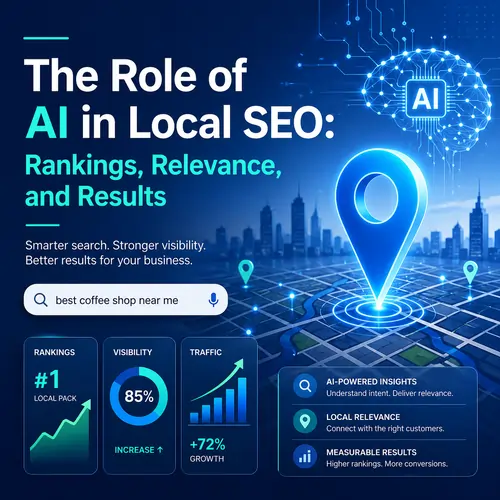
For local business owners, this is both a challenge and an opportunity. The role of AI in Local SEO is no longer about tricking the algorithm. It is about proving relevance to the AI so it shows your business when someone nearby needs you.
In this guide, we will explore exactly how AI impacts local rankings, why relevance is the new king, and how to measure results that actually matter for your bottom line.
I. How AI Redefines Local Rankings (Beyond Traditional Signals)
1. From Keywords to Entities & Intent
Traditional local SEO focused on exact-match keywords. AI has dismantled that approach.
Using Natural Language Processing (NLP) , Google now identifies entities (people, places, businesses, landmarks) and connects them. For example, if you search “emergency plumber near me,” AI understands the user intent is urgency. If you search “leaky pipe repair,” the intent is identical, but the phrasing differs.
AI Overview Friendly Keyword: Understanding user intent
According to research from Writesonic, SGE emphasizes user intent over keyword matching, meaning your goal is to be cited in AI responses, not just rank for specific terms .
Actionable Tip: Optimize for AEO by answering specific questions (Who, What, When, Where, Why) directly on your service pages.
2. AI’s Role in the Local Pack
The Local Pack (those top 3 map listings) is now selected by AI analyzing thousands of signals simultaneously:
- Review sentiment analysis (not just star rating)
- Open hours consistency across the web
- Proximity + prominence adjusted by real-time behavior
Ranking Factor Amplified by AI: Sentiment score. Google’s AI reads reviews using NLP to detect phrases like “fast service” or “rude staff.” Positive sentiment directly boosts local rankings.
For multi-location brands, this becomes even more complex. As noted by Single Grain, AI systems aggregate signals from each site, and inconsistencies can severely damage visibility across your entire network .
3. Personalization Means No Universal #1
Here is a hard truth: Ranking #1 is no longer universal. AI personalizes local rankings based on:
- Past search behavior
- Device type (mobile vs. desktop)
- Time of day (breakfast spots rank higher at 8 AM)
- Location history (even within a neighborhood)
Result for Your Business: Stop obsessing over a single rank position. Instead, track visibility across different user personas.
II. AI for Relevance: Optimizing Content, Entities, and User Intent
4. Semantic Search & Local Content Clusters
Relevance is the currency of AI-driven search. To build relevance, you must move from single keywords to topic clusters.
If you own a roofing company in Austin, don’t just write “roof repair Austin.” Create a content cluster:
- Pillar page: Roofing services Austin
- Cluster content: “Best shingles for Texas hail storms,” “How to find roof leak after rain,” “Insurance claims for roof damage Austin”
AI uses NLP to see that these topics are semantically related. It then ranks your entire site as an authority on local roofing.
GEO Strategy: Write for Generative Engine Optimization by including statistics, local data, and clear summaries. Generative engines (like Google SGE) pull these into AI Overviews.
5. AI-Generated vs. AI-Optimized Local Content
Tools like ChatGPT and Jasper are powerful, but they come with risks.
Pros of AI writing tools:
- Fast drafts for Google Business Profile posts
- Service page outlines
- FAQ generation
Cons:
- Generic, shallow content that lacks local authenticity
- Google’s March 2024 core update penalizes “mass-produced AI content”
The Winning Formula (Human + AI):
- Use AI to generate a draft.
- Edit manually: Add real local references (neighborhood names, landmarks, local events).
- Insert original photos of your team or work.
AI Overview Friendly Keyword: Authentic local content
For developers and technical SEOs, there are now 54 public repositories on GitHub dedicated to AI SEO tools, including Python scripts for technical SEO audits, content optimization, and AI visibility monitoring .
6. Entity SEO for Places and Practitioners
Entity SEO is the practice of helping AI understand exactly who you are, where you are, and what you do.
Implement schema markup (structured data) for:
LocalBusinessGeoCoordinates(latitude/longitude)OpeningHoursReview(aggregate rating)
According to Rank Math’s support documentation, the Service schema type is most appropriate for dedicated landing pages, with highly recommended fields including name, description, provider, and offers .
Go further by building associations with nearby entities: local landmarks, community centers, event venues. If your coffee shop is “next to the Central Library,” mention that naturally. AI reads those connections.
NLP Tip: Use consistent business names, addresses, and phone numbers (NAP) across every platform—AI uses entity resolution to decide if two listings refer to the same real-world business.
III. AI-Powered Results: Measuring & Improving Local Performance
7. AI in Local Analytics & Tools
You cannot improve what you do not measure. AI-powered analytics tools now predict trends before they happen.
Top tools with AI features:
- Google Business Profile (GBP) insights: Shows how customers find you (direct vs. discovery searches).
- BrightLocal: AI-driven local ranking factors and audit suggestions.
- Semrush + Sensor: Predictive SERP volatility alerts.
- Serpstat: Offers Local SEO tools for managing business presence across Yelp and numerous other local directories from a single dashboard .
Predictive Analytics Example: AI can forecast a dip in foot traffic due to bad weather or a local festival. Prepare by adjusting Google Ads or posting a GBP update offering delivery.
8. Review Analysis & Sentiment Scoring
AI does not just count your stars—it reads every word.
How review sentiment works:
- Positive sentiment words: “clean,” “fast,” “friendly,” “professional”
- Negative sentiment words: “rude,” “late,” “broken,” “ignored”
- Neutral sentiment (e.g., “okay service”) does not help rankings.
According to Ranktracker, AI assistants rely heavily on review data to determine credibility and sentiment. They recommend using AggregateRating schema to display ratingValue and reviewCount directly on your website .
Action Steps for AEO:
- Use an AI review analysis tool (ReviewTrackers, Grade.us).
- Identify recurring complaints (e.g., “wait time too long”).
- Fix the root issue, then respond to old reviews showing the fix.
Warning: Automated AI review responses can sound robotic. Never fully automate—always add a personal touch.
9. Voice & Visual Search as AI-Driven Channels
Over 40% of mobile users use voice search daily. AI powers that.
Optimizing for voice search (AEO focus):
- Use conversational, long-tail phrases: “Hey Google, find a sushi restaurant open right now near me.”
- Add FAQ pages with direct question → answer format.
- Target “near me” and “open now” queries explicitly.
Visual search (Google Lens): AI matches images to local inventory. A user snaps a photo of a sneaker, and Lens shows “available at City Sports 2 miles away.”
Optimization: High-quality, geo-tagged images with descriptive alt text (e.g., “outdoor seating at Main Street Cafe Austin”).
IV. Case Studies & Practical Applications
Case Study 1: Multi-Location Brand Uses AI for GBP Posts
Challenge: 50 locations, each needing weekly Google Business Profile posts.
Solution: AI-generated draft posts + local manager review (adding weekend hours or event mentions).
Result: 34% increase in Local Pack presence within 3 months.
Takeaway: Scale with AI, but localize with humans.
Case Study 2: Instrument Calibration Solutions (AEO Success)
Challenge: ICS did not appear in Google search results for critical service terms like “pressure calibration services” and faced strong competition from OEMs .
Solution: The team shifted from traditional SEO to AEO/GEO, targeting long-tail keywords and optimizing their Google My Business listing .
Result: ICS went from not ranking at all to appearing in AI answers, organic top results, and local search listings. The GEO/AEO approach delivered faster visibility than traditional SEO efforts .
Takeaway: Answer Engine Optimization can produce results when traditional SEO hits a ceiling.
Case Study 3: Generic AI Content Backfires
Challenge: A law firm used pure ChatGPT content for 20 city pages.
Result: Google’s March 2024 update removed all pages from index (soft penalty).
Recovery: Rewrote with local case studies, real office photos, and partner names.
Takeaway: Generative Engine Optimization (GEO) requires uniqueness, not duplication.
V. Risks & Ethical Considerations
10. Over-Optimization Penalties
Google’s AI is designed to detect and discount:
- AI-generated fluff with no value
- Fake reviews (even AI-written positive ones)
- Keyword stuffing (now hurts more than helps)
Rule of thumb: If a human would find it boring, so will AI.
11. Reduced Click-Through Rates with SGE
Research from Writesonic indicates that SGE will likely lower website click-through rates as AI-generated answers occupy prime SERP real estate, pushing organic listings further down the page .
Solution: Focus on being cited within the AI overview itself, not just ranking #1 organically.
12. Loss of Human Touch
A fully automated local SEO strategy feels cold. Consumers trust businesses that sound like actual locals.
Balance: Automate data analysis and drafts. Manually handle final content, review responses, and customer interactions.
13. Data Privacy Concerns
Personalized local rankings rely on location tracking. Consumers are increasingly privacy-aware. Be transparent about how you use their data.
VI. Future Outlook: Next Wave of AI in Local SEO
14. Search Generative Experience (SGE) Changes Everything
Google’s SGE provides AI-generated summaries at the top of search results. For local queries like “best brunch in Denver,” SGE may list 3-4 spots without requiring a click.
According to Serpstat’s analysis, SGE was officially rolled out in most languages and regions in May 2024. Nearly half of SGE results include a Places module, especially for local restaurant and travel queries .
How to appear in SGE:
- Use GEO tactics: clear lists, tables, and structured data.
- Earn citations from authoritative local sources.
- Optimize for AEO by being the direct answer.
15. Real-Time AI
Soon, local rankings will update in real-time based on:
- Live inventory (only show stores with item in stock)
- Wait times (show restaurant with shortest line)
- Foot traffic patterns
16. AI-Driven Local Ad Placement
Predictive bidding algorithms will automatically adjust Google Local Services Ads based on weather, events, and competitor activity.
For legal professionals, InterCore Technologies notes that platforms like ChatGPT, Gemini, Claude, and Perplexity now represent channels where newer firms can leapfrog established competitors—something previously impossible with traditional SEO alone .
VII. AI Overview Friendly Action Checklist (Listicle)
To ensure your content is AI Overview friendly and ranks well on Google SERP, implement this checklist:
1. Audit Existing Content for NLP Readiness
- Use clear headings (H1, H2, H3).
- Keep paragraphs short (2-3 sentences max).
2. Implement Entity SEO
- Add LocalBusiness schema markup.
- List nearby landmarks and neighborhoods naturally.
3. Optimize for Answer Engine Optimization (AEO)
- Create FAQ pages with direct question → answer structure.
- Target “near me” and “open now” queries.
4. Leverage AI Writing Tools Safely
- Generate drafts only; always localize and fact-check.
- Add real photos, local references, and unique data.
5. Monitor Review Sentiment
- Use an AI sentiment analysis tool monthly.
- Respond to negative reviews within 24 hours.
6. Prepare for SGE (Generative Engine Optimization)
- Write clear lists and tables.
- Include authoritative local statistics.
7. Track Voice Search Queries
- Use Google Search Console to see question-based queries.
- Optimize conversational pages for voice.
8. Use AI Analytics Tools
- BrightLocal, Semrush, Serpstat, or GBP Insights weekly.
- Adjust strategy based on predictive trends.
9. Avoid Pure Automation
- Never fully auto-post or auto-respond.
- Maintain a human, local voice.
10. Test Visual Search
- Geo-tag images and write descriptive alt text.
- Post interior/exterior photos to GBP regularly.
VIII. Conclusion
The role of AI in Local SEO is not a passing trend. It is the new foundation.
To win in local rankings, stop fighting the algorithm and start working with it. Build relevance through authentic, locally grounded content. Measure results with AI-powered analytics, but make decisions with human judgment.
Remember:
- SEO (traditional optimization) still matters, but only as a base.
- AEO (Answer Engine Optimization) is how you get featured in voice and direct answers.
- GEO (Generative Engine Optimization) is how you appear in Google’s SGE overviews.
The businesses that thrive will be those that blend AI efficiency with genuine community presence. Let the machines handle the data. You handle the heart.
For continuous learning, explore the growing ecosystem of AI SEO tools and repositories on GitHub, many of which offer production-ready SEO skills for technical SEO, content optimization, and keyword research .
Frequently Asked Questions
1. Does Google penalize websites for using AI-generated content in local SEO?
Yes, but only if the content is low-quality, spammy, or lacks original value. Google’s March 2024 core update targets “mass-produced AI content” that doesn’t help users. However, AI-generated content that is fact-checked, localized, and genuinely useful is not penalized. Focus on E-E-A-T (Experience, Expertise, Authoritativeness, Trustworthiness) .
2. How does Google’s RankBrain affect local search rankings differently from traditional SEO?
RankBrain uses machine learning to interpret ambiguous queries and match them with relevant local results. Unlike traditional SEO (which relied on exact keyword matching), RankBrain understands synonyms, context, and user intent. For local searches, this means “dentist open Sunday” might rank the same as “tooth doctor available weekend.”
3. Can AI help me find local keyword opportunities that competitors are missing?
Absolutely. AI-powered tools like Semrush’s Keyword Magic, Ahrefs, and BrightLocal analyze search patterns, question-based queries, and semantic clusters. They can identify long-tail phrases such as “emergency vet open late near me” that competitors overlook. AI also suggests near me variants and voice-friendly conversational keywords.
4. What is the difference between GEO, AEO, and traditional SEO for local businesses?
- Traditional SEO: Optimizing for search engines (crawlers, keywords, backlinks).
- AEO (Answer Engine Optimization): Optimizing to be the direct answer in voice search, featured snippets, and AI responses.
- GEO (Generative Engine Optimization): Optimizing for generative AI models like Google SGE and ChatGPT to cite your business in AI-generated summaries.
Local businesses now need all three.
5. How does AI process unstructured data like photos and videos for local rankings?
Google’s AI uses computer vision to analyze images for landmarks, storefronts, menus, and logos. Geotagged photos help AI confirm location accuracy. Videos with transcribed audio also provide NLP-friendly text. Best practice: Upload original, high-resolution images to your Google Business Profile with descriptive filenames and alt text.
6. Will voice search replace typed local queries in the next 5 years?
Not entirely, but voice search is growing rapidly. Over 40% of mobile users already use voice for “near me” queries. AI-powered assistants (Siri, Google Assistant, Alexa) prioritize conversational, long-tail questions. Local businesses should optimize for both typed and spoken queries by creating FAQ pages with natural language.
7. How does Google’s BERT algorithm understand local prepositions like “near,” “around,” or “outside”?
BERT (Bidirectional Encoder Representations from Transformers) analyzes the full context of a sentence, including prepositions. For example, “cafes near the museum” and “cafes outside the museum” have different meanings. BERT understands that “near” implies walking distance, while “outside” suggests proximity but not necessarily adjacency. This makes content clarity essential.
8. What role does click-through rate (CTR) play in AI-driven local rankings?
CTR remains a strong user interaction signal. AI monitors whether searchers click your listing in the Local Pack or organic results. A low CTR tells Google your title or meta description is irrelevant—even if you rank well. Use AI tools like Predictive CTR models in Semrush or BrightLocal to test and optimize your snippets.
9. Can small local businesses compete with big chains in AI-driven local SEO?
Yes, because AI prioritizes relevance and proximity over brand size. A small, highly-rated coffee shop two blocks away can outrank Starbucks if it has better reviews, accurate NAP data, and locally optimized content. AI also values authentic user-generated content (real photos, detailed reviews), which small businesses often excel at.
10. How does AI detect and filter fake reviews for local businesses?
Google’s AI uses spam detection algorithms that analyze review patterns: sudden 5-star spikes, identical wording, new accounts reviewing the same business, and IP address clustering. Fake reviews (positive or negative) are removed, and businesses caught soliciting them face ranking penalties or GBP suspension.
11. Does AI treat “open now” queries differently from general “near me” searches?
Yes. “Open now” queries trigger real-time AI processing. Google’s AI checks your GBP hours against the current time (including holidays and special hours). If you are closed, you will not appear—even if you rank #1 otherwise. Keep your hours updated, especially during holidays, weather events, or staffing changes.
12. What is the impact of AI-generated summaries (SGE) on local business website traffic?
SGE reduces click-through rates because users get answers directly on the SERP. For local queries like “best HVAC repair near me,” SGE may list 3-4 businesses without requiring a click. To counter this, optimize for branded searches (e.g., “John’s Plumbing Austin reviews”) and use GEO tactics like tables and lists that AI citations pull from.
13. How do I optimize Google Business Profile categories using AI insights?
AI tools like GBP Category Finder (available in BrightLocal and Semrush) analyze competitor categories and suggest missing ones. For example, a “pizza restaurant” might also qualify for “late-night food delivery” or “family restaurant.” Use primary + secondary categories to help AI understand your full service range.
14. Can AI predict seasonal trends in local search behavior?
Yes. Predictive AI models analyze historical search data, weather patterns, and local events. For example, AI might predict a surge in “air conditioner repair” searches three days before a heatwave. Use tools like Google Trends AI forecasts or Semrush Sensor to anticipate demand and schedule GBP posts or ads in advance.
15. Does Google use AI to personalize local results for repeat customers?
Yes. If a user frequently clicks on your business, Google’s AI may rank you higher for that specific user in future searches (personalized ranking). Conversely, if a user ignores your listing, AI may demote you for that individual. This creates a feedback loop where consistent quality and relevance matter more than ever.
16. How does AI handle local queries with misspellings or slang (e.g., “best grub near me”)?
NLP models like BERT and MUM understand semantic equivalents. “Grub,” “food,” “eats,” and “chow” are recognized as the same entity. Similarly, misspellings like “resturant” are automatically corrected. You do not need to optimize for every typo. Just use natural, conversational language on your site.
17. What free AI tools can local businesses use to improve local SEO?
Several free or freemium AI tools include:
- Google Business Profile Insights (AI-driven search query data)
- Google Search Console (AI-powered performance reports)
- AnswerThePublic (AI-generated question clusters)
- PeopleAlsoAsk.com (extracts real FAQ data from Google)
- Localo free tier (GBP optimization suggestions)
18. How does AI evaluate the authority of local citations and backlinks?
AI uses entity recognition to assess whether a citation or backlink comes from a relevant local source. A link from your city’s chamber of commerce or local news site carries more weight than a generic directory. Google’s SpiderFoot and other AI crawlers analyze domain authority, topical relevance, and geographic alignment.
19. Can AI automatically generate schema markup for local businesses?
Yes. Tools like Merchant Center’s auto-schema, Rank Math AI, and Schema App can generate LocalBusiness, GeoCoordinates, OpeningHours, and Review schema automatically based on your website content. However, always manually verify accuracy—incorrect schema (e.g., wrong hours or address) can confuse AI and harm rankings.
20. What is the single most important AI-related local ranking factor for 2026?
Review sentiment + recency combination. AI now analyzes not just star ratings, but the sentiment of recent reviews (last 30-60 days) and whether you respond to them. A business with 4.2 stars but 20 positive reviews this month will outrank a business with 4.5 stars but no recent activity. Responding to all reviews (positive and negative) signals active management to AI.